Kanji 忠 vs 義: Loyalty and Honor Kanji That Shaped the Warrior Code
忠 means loyalty rooted in the heart. 義 means righteousness and moral duty. Both shaped the samurai code, but they carry different weight and tell different stories. This guide compares them axis by axis, from stroke count and tattoo legibility to emotional temperature and everyday Japanese usage, then maps specific use cases so you can choose the honor kanji that actually matches your life rather than one picked for its shape.
If you want a character about devotion from the heart, about staying faithful to a person, a cause, or a version of yourself you refuse to abandon, choose 忠. If you want an honor kanji about moral duty, about doing the right thing even when nobody is watching and nobody rewards you, choose 義. Both belong to the same warrior vocabulary, and they are not interchangeable.
The difference matters most to people planning tattoos, calligraphy pieces, or personal symbols. One is an inward feeling directed outward at someone. The other is an external standard you hold yourself to. Get them mixed up and the character still looks beautiful, but it tells a story that isn't yours.
The Basics: 忠 and 義 Side by Side
Start with the raw facts before the philosophy. Both characters are common in Japanese, both appear in names, and both are considered highly suitable for calligraphy and tattoo work.
忠
義
Core meaning
Loyalty, devotion, faithfulness
Righteousness, duty, honor, justice
Common reading
chuu
gi
Stroke count
8
13
Visual weight
Compact, balanced, open
Dense, layered, architectural
Direction of the virtue
Inward feeling, outward devotion
External moral standard
Tattoo suitability
Excellent
Excellent
忠 is built from 中 (middle) sitting above 心 (heart), a combination WaniKani describes as what sits in the center of your heart. The classical Chinese dictionary Shuowen Jiezi glosses 忠 as 敬 (reverence), composed from the heart radical with 中 as the phonetic element, according to the Wiktionary entry. That etymology is worth sitting with. Loyalty, in this reading, isn't obedience. It's reverence held at the center.
義 carries a different architecture. It reads as righteousness, moral duty, justice, and honor, and inkanji lists it first among the justice characters. Where 忠 points at a heart, 義 points at a scale.
References: WaniKani 忠, Wiktionary 忠, inkanji: Justice in Kanji
Get the real meaning, not random characters
Discover Your Soul Kanji
Experience the depth of Japanese characters: each kanji carries timeless meaning, guiding your life's path.
Comparison at a Glance: Which Honor Kanji Wins Each Category
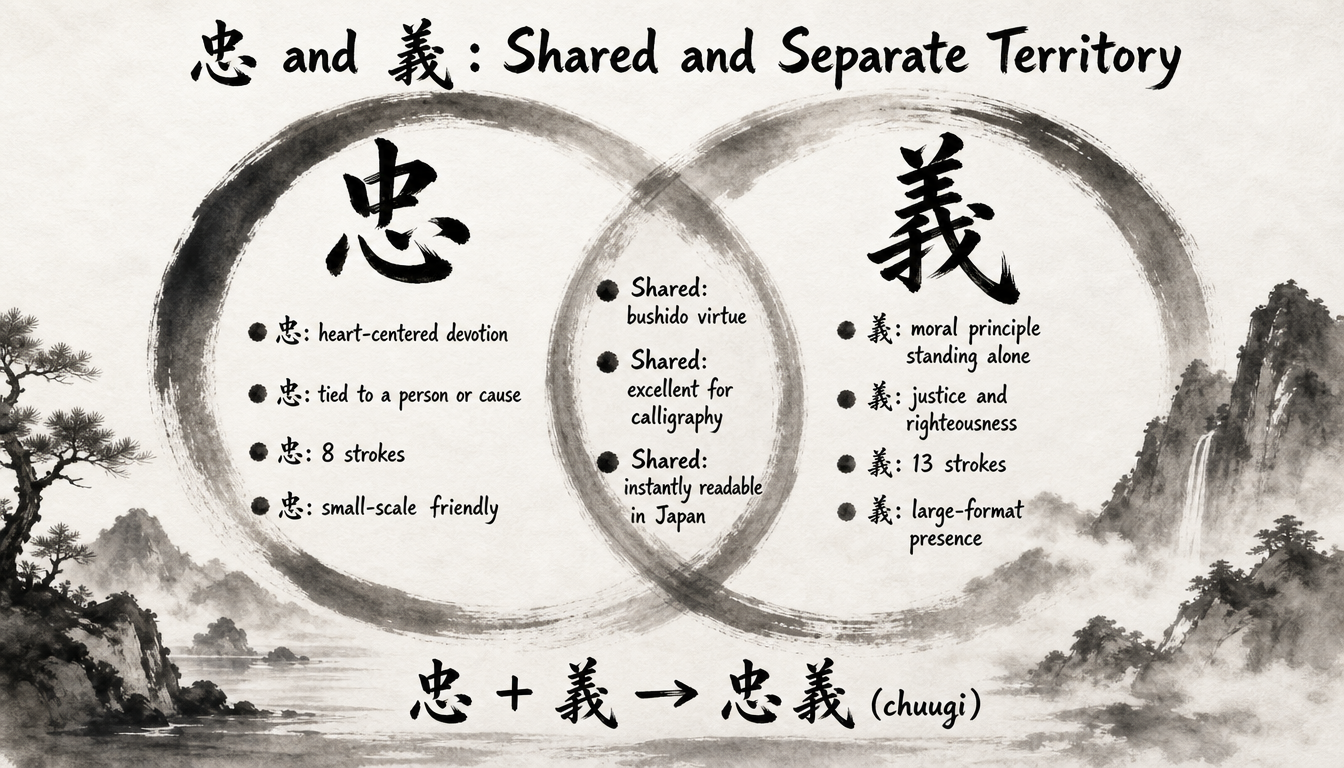
Six axes matter when you're choosing between these two. The diagram below maps how the two characters split across emotional and moral territory.
Axis
忠 (chuu)
義 (gi)
Edge
Emotional warmth
High, heart-centered
Cooler, principled
忠
Moral independence
Tied to a person or cause
Stands alone as a principle
義
Visual simplicity
8 strokes, clean
13 strokes, dense
忠
Breadth of meaning
Focused on loyalty
Justice, duty, honor, righteousness
義
Small-scale legibility
Holds up at small sizes
Can blur when tiny
忠
Recognition in Japan
Strong, formal register
Strong, everyday compounds too
Tie
Axis by Axis: Where the Two Characters Diverge
Emotional Temperature
忠 runs warm. The heart radical isn't decorative; it sets the emotional register of the whole character. Someone who chooses 忠 is usually saying something about the people they will not walk away from. 義 runs cooler and steadier. It describes what is right regardless of who benefits. A person acting from 義 might act against a friend if the principle demands it, and that tension is exactly what makes the character interesting.
Who or What You're Loyal To
忠 always implies an object. Loyal to whom? A lord, a family, a partner, a craft. The character has a direction built into it. 義 needs no object. It sits on its own as a standard. This is the single most useful distinction for anyone choosing between them: if your meaning collapses without naming a recipient, you want 忠. If your meaning is about your own conduct, 義.
Visual Design and Stroke Economy
Eight strokes against thirteen changes everything about placement. 忠 has breathing room. The 中 sits cleanly above the 心, and the whole shape reads as a stable square with a small vertical anchor. It survives being inked small, on a wrist or behind an ear. 義 is layered and busy in the best sense, with a strong horizontal rhythm across the upper half. It rewards scale. On a forearm or back, 義 has presence that 忠 can't match; shrunk down, its middle strokes start to merge.
Range of Meaning
義 covers more ground. Righteousness, moral duty, justice, and honor all live inside it, which is why it appears in the honor kanji lineup alongside 誉, 名, and 栄 as inkanji documents. That breadth cuts both ways. A wider meaning gives you interpretive room, but it also means a Japanese reader may land on a different shade than you intended. 忠 is narrower and therefore harder to misread.
Compounds and Everyday Life
Both characters live in modern Japanese, not just in historical drama. 義理 (giri), listed by Jisho as duty, sense of duty, honor, and debt of gratitude, is a concept people navigate daily in Japan, from gift-giving to workplace obligation. 忠 appears in 忠実 and in personal names; Kanshudo records it as a grade 6 character used in over a thousand names. A character that shows up in names carries a different social warmth than one that only appears in abstractions.
The Combined Form: 忠義
You don't always have to pick. 忠義 (chuugi) fuses both into loyalty and righteousness as one idea, and inkanji rates it as a solid tattoo choice at 21 combined strokes. The compound appears in classical Japanese narrative. In Yamamoto Shūgorō's story Tosa no Kunibashira, a retainer named Ohyōe delays his own ritual suicide for three years in order to draw out and destroy the clans rebelling against his house, and his lord's verdict on hearing the truth is simply that the man was a pillar of the province. That is 忠 and 義 operating as a single act: personal devotion executed through a hard moral calculation.
References: inkanji: Honor in Kanji, Jisho: honor, Kanshudo 忠, inkanji: Loyalty in Kanji, Aozora Bunko
What 忠 and 義 Share
Both characters sit inside bushido, the warrior code whose name breaks into 武士 (bushi, warrior) and 道 (dō, the way), as the Samurai Katana Shop explains. That code emphasized courage, loyalty, honesty, self-discipline, and respect, virtues that both characters serve.
Nitobe Inazō's Bushido, the Soul of Japan captures the ethical texture these characters describe. He quotes Nietzsche, "You are to be proud of your enemy; then, the success of your enemy is your success also," and adds that valor and honor alike required the samurai to own as enemies in war only those worthy of being friends in peace. Neither 忠 nor 義 is about domination. Both describe a self held to a standard.
Practically, both characters share real advantages. Native Japanese readers recognize each instantly with no ambiguity. Neither has an unfortunate secondary meaning waiting to embarrass you. Both carry weight in calligraphy, where their internal balance gives a brush artist something to work with. And both avoid the trap that catches so many kanji tattoos, where a character chosen for its shape turns out to mean something flat or accidentally comic.
The heart radical makes the emotional direction explicit
Small tattoo, wrist or behind the ear
忠
Eight strokes stay legible at small scale
A personal ethical code you live by
義
Stands alone without needing an object
Large-format back or forearm piece
義
Thirteen strokes create visual density and presence
Military, first responder, or service background
忠義
Combines devotion to a unit with the duty behind it
Calligraphy practice or wall art
義
Layered structure rewards brushwork
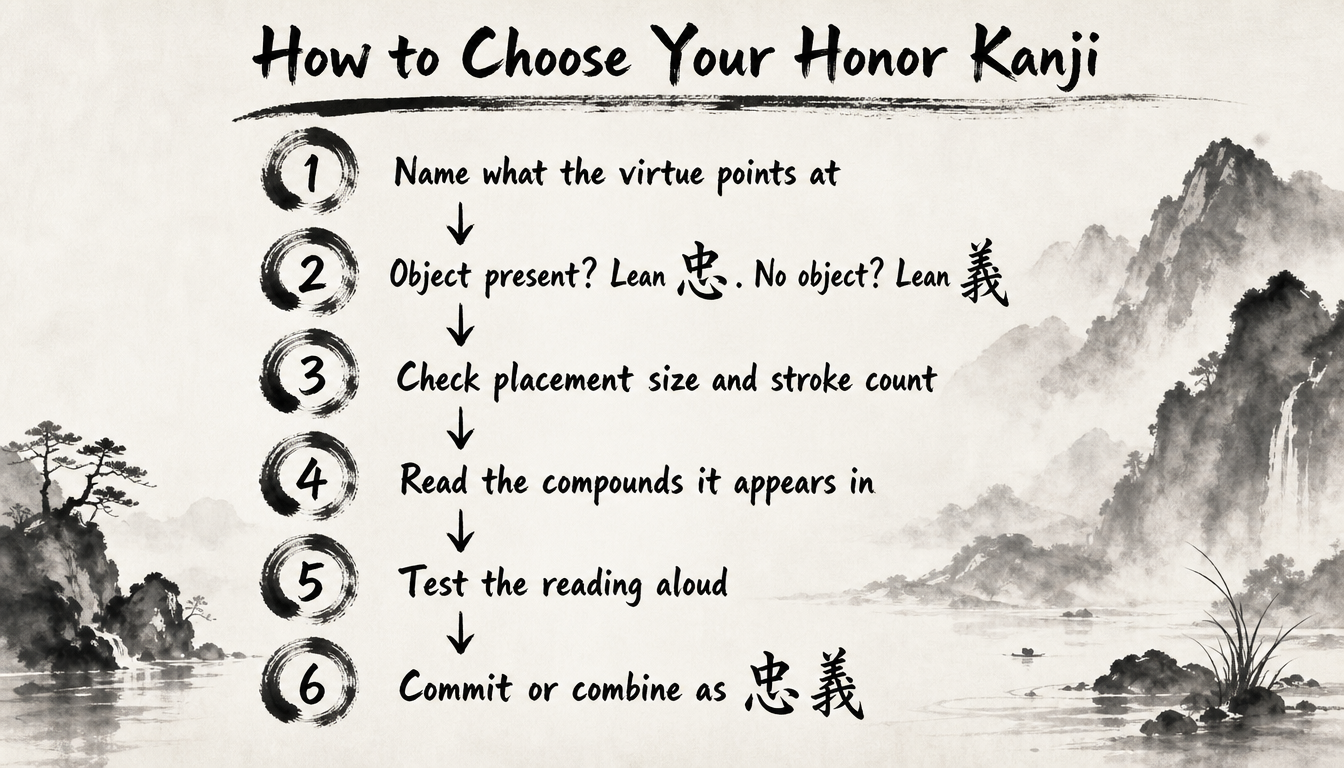
Before committing to either, test the fit against your own story rather than a list. The process below is one way to work through it.
If you're still torn, the useful move is to stop comparing dictionary glosses and start from yourself. This is where a tool like Oracle Kanji Writer earns its place. Instead of browsing a wall of characters and picking by silhouette, you enter your name, birthdate, and blood type, and the service returns a Soul Kanji matched to your qualities and path, with pronunciation, layered meanings, a personal message, and compound words that show how the character behaves in real Japanese. Curated by Japanese creators, it steers you away from the clichés and mistranslations that make some kanji tattoos read awkwardly to native speakers. You can download the result as art for a wallpaper, a keepsake, or a tattoo reference.
Final Verdict
Choose 忠 when your meaning has a face attached to it. It is the heart-centered honor kanji, quieter in form, warmer in feeling, and the better pick for small or delicate placements. Choose 義 when your meaning is a principle you carry regardless of circumstance. It is broader, heavier, and more architecturally impressive at scale.
If you cannot separate the two because your devotion and your ethics are the same thing, 忠義 exists for precisely that. It is the harder piece to execute and the more specific statement to make, which is usually a sign it's the honest one.
Whatever you land on, spend time with the character before you commit it to skin. Learn its readings, look at how it behaves inside compounds, and watch a brush stroke it in order. An honor kanji chosen this way stops being decoration and starts being a small, permanent argument about who you intend to be.
Get the real meaning, not random characters
Discover Your Soul Kanji
Experience the depth of Japanese characters: each kanji carries timeless meaning, guiding your life's path.