Kanji of the Day Vol.49 | "Kanji 勇 (Yu): The Courage Kanji Awakening Your Soul's Brave Heart"

Meet 勇 (Yū), the courage kanji that names real bravery, the willingness to act despite fear. Explore its readings, its warrior spirit within Bushidō, the meaning of 勇気 (yūki) as a courageous heart, and how to choose it as an authentic personal symbol or tattoo without the mistranslations that plague generic converters.
Kanji of the Day Vol.49 | Kanji 勇 (Yu): The Courage Kanji Awakening Your Soul's Brave Heart
The courage kanji 勇 (Yū) means bravery, valor, and the fearless spirit that carries a person forward against fear. It is the character Japanese people reach for when they want to name real courage, the kind that acts even when the heart is trembling. For anyone drawn to Japanese aesthetics, martial philosophy, or a meaningful personal symbol, 勇 offers one of the most resonant single characters in the language.
This is Vol.49 of our Kanji of the Day series, and today we sit with one of the most beloved virtue characters in the entire writing system.
Discover Your Soul Kanji
Experience the depth of Japanese characters: each kanji carries timeless meaning, guiding your life's path.
No credit card required • 2-minute process
What the Courage Kanji 勇 Really Means
At its surface, 勇 points to bravery, boldness, and heroism. In the dictionary it stands alone as a noun meaning bravery, courage, heroism, according to Jisho. But the feeling it carries runs deeper than a synonym list. True courage in the Japanese sense is not the absence of fear. It is the choice to move forward while fear is present, the willingness to act despite trembling.
Below is a quick reference for the essentials of this character.
| Item | Detail |
|---|---|
| Kanji | 勇 |
| Readings (On / Kun) | On: ユウ (yū) / Kun: いさ-む (isamu) |
| Primary meaning | Courage, bravery, valor, heroism |
| Category | Virtue kanji / character concept |
| Related concept | 勇気 (yūki), 武 (bu, martial) |
| Contrast concept | 臆病 (okubyō, cowardice) |
The verb form 勇む (isamu) means to be in high spirits, to be roused or emboldened, per Jisho. That reading reveals something important about 勇. It is not cold or grim. It carries the sense of a spirit lifting, of vigor rising in the chest before you step forward.
The courage kanji describes an inner state, not a reckless outward act. Courage backed by conviction is 勇; courage without it can collapse into mere rashness.
References: Jisho — 勇, Jisho — 勇む
Yuuki (勇気): The Courageous Heart and Spirit
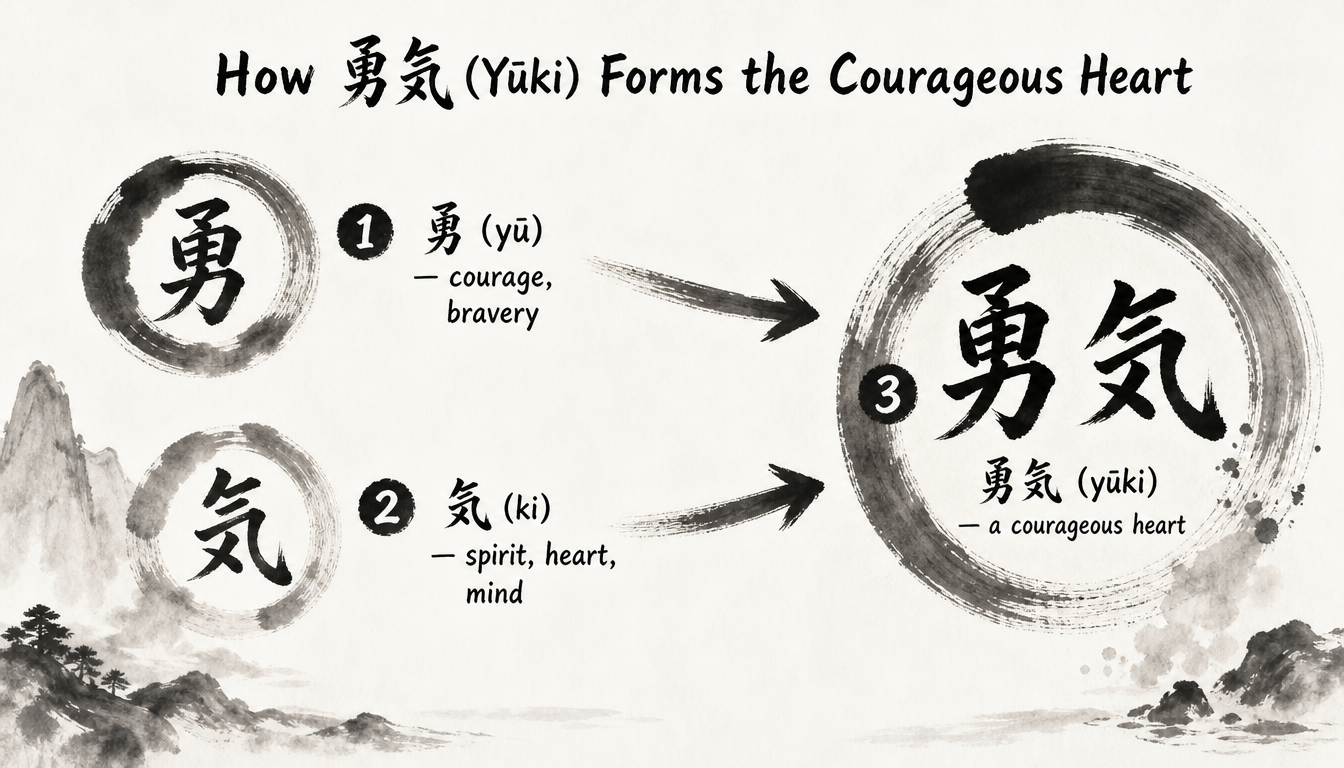
The most common word built from this character is 勇気 (yūki), usually translated as courage or bravery. It joins the courage kanji with 気 (ki), meaning spirit, mind, or heart. Read the two pieces together and you get something more textured than a single English word. As one karate school describes it, the two parts are yū (courage) and ki (spirit, heart), so yūki is literally a courageous heart or a courageous spirit, according to Goju Karate.
That same source makes a point worth holding onto. We tend to imagine courage as something reserved for large moments, war, disaster, dramatic peril. Yūki lives in the everyday. It is the quiet resolve to keep training when tired, to speak an honest word, to face a small fear that would rather be avoided. Courage is a daily practice, not a rare event.
The pronunciation is straightforward. Yūki sounds close to "you-key," as Goju Karate renders it. The diagram below shows how the two characters combine to form the fuller idea of courage.
The Japanese writer Okamoto Kanoko drew a sharp line between real courage and its counterfeit. In her Bukkyō Jinsei Dokuhon (A Buddhist Reader on Life), she argued that courage without a firm conviction behind it cannot be sustained or kept upright. Without some unchanging belief, she wrote, even a hard-won effort at bravery fails to become true courage and can degrade into wild rashness or violence, according to the text held at Aozora Bunko.
References: Goju Karate — Yuuki 勇気, Aozora Bunko — 仏教人生読本
From Ancient Form to Modern Kanji
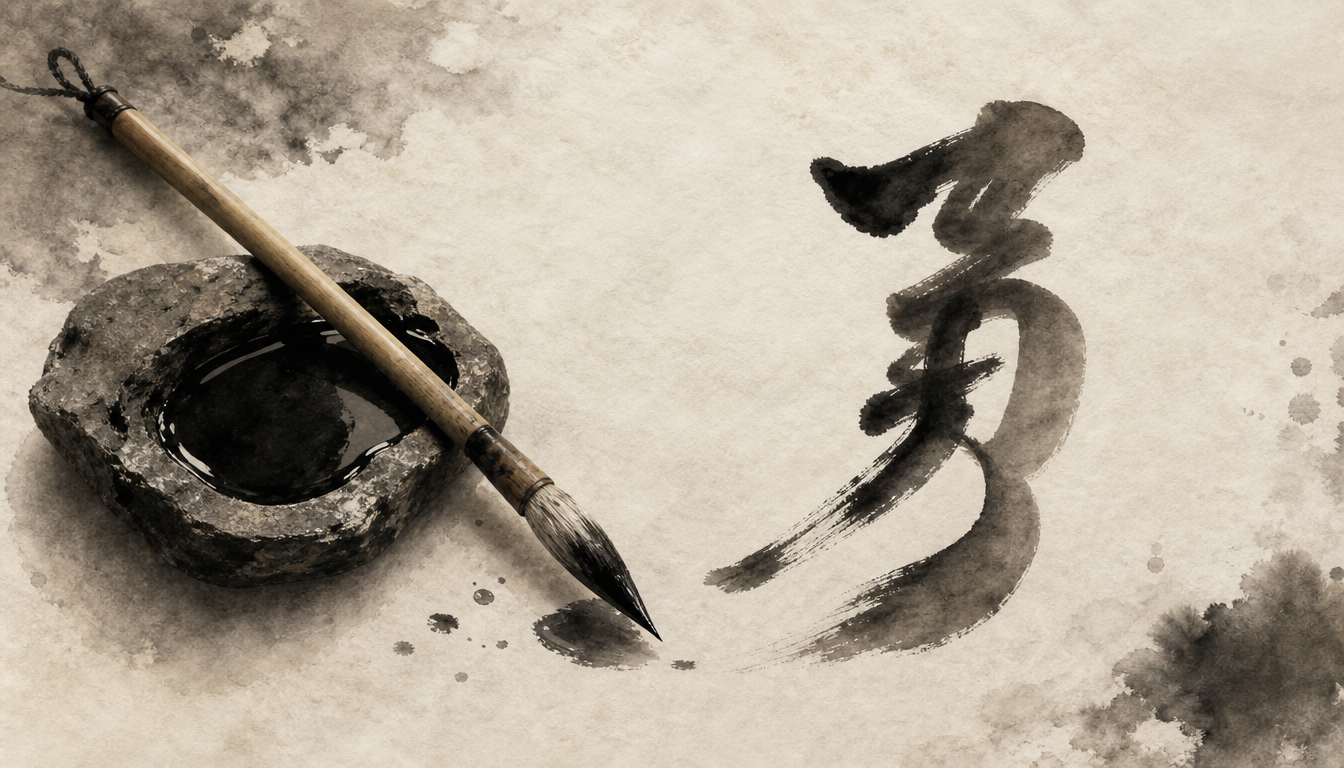
The character 勇 pairs a phonetic-semantic element with 力 (chikara), the radical for strength or power, sitting at the base. That grounding element matters. Courage in this character is not abstract sentiment floating in the mind. It rests on 力, on force and physical resolve. The upper portion carries the sound and lends the sense of a spirit welling up, springing forth. Put together, the graph suggests strength rising into motion, energy that gathers and then acts.
This mainstream reading of the components lines up neatly with how Japanese uses the character today. 勇む (isamu) captures the welling-up. 勇気 (yūki) captures the strength turned into a heart that acts. The verb, the noun, and the compound all circle the same core image of vigor mobilized toward a difficult thing.
Because 力 (power) anchors the character, 勇 reads as embodied courage, the kind expressed through action, rather than courage as a purely mental idea.
The name reading 勇 as Isamu remains a beloved Japanese given name. It carries the wish that a child grows into someone brave, high-spirited, and heroic, a quiet blessing folded into a single stroke pattern.
Cultural Significance in Samurai and Martial Arts
No account of the courage kanji is complete without Bushidō, the way of the warrior. Courage stands among the core virtues of the samurai ethical code, where bravery meant far more than fearlessness in battle. As Kyoshi A. Tanzadeh explains, yūki, or heroic courage, is one of the seven virtues of Bushidō, the samurai code of ethics, per this martial arts source. A warrior was expected to carry this courage into honor, integrity, and the conduct of daily life, not only onto the battlefield.
Okamoto's essay offers a vivid illustration through the samurai Kusunoki Masashige. At the Battle of Minatogawa, Masashige rode into a fight he knew was already lost, standing his ground with brimming courage because a single point of loyalty burned in his heart. Facing his own death, he is said to have vowed to be reborn seven times to repay his lord's grace. Okamoto cites the proverb that conviction turns a person to iron, and points to Masashige as its finest proof, according to Aozora Bunko.
Martial arts preserve this teaching in a gentler, everyday form. In karate-dō, courage is trained on the dojo floor and then carried out into ordinary life. The old warrior ideal survives not as nostalgia for combat but as a discipline of character. There is even a classical saying, gi wo mite sezaru wa yū naki nari, meaning to see what is right and fail to do it is a want of courage, listed among traditional Japanese proverbs at Land of Nu.
The table below compares the everyday and the heroic dimensions of the courage kanji as it lives in Japanese culture.
| Aspect | Everyday Courage | Heroic Courage (Bushidō) |
|---|---|---|
| Setting | Daily life, training, honest speech | Battlefield, moments of grave peril |
| Word | 勇気 (yūki), a courageous heart | 武勇 (buyū), martial valor |
| Test | Persisting when it would be easier to quit | Standing firm even in a losing fight |
| Foundation | Small daily resolve | Conviction and loyalty |
References: Tanzadeh — Yuuki (勇気): Heroic Courage, Aozora Bunko — 仏教人生読本, Land of Nu — Kotowaza Index
Readings, Compounds, and Choosing 勇 as a Personal Symbol
Knowing when each reading applies helps you use the character with confidence. The on'yomi ユウ (yū) appears in almost every compound word. The kun'yomi いさむ (isamu) surfaces in the standalone verb 勇む and in personal names. If you want to speak the character aloud in most contexts, yū is your reading.
A few real compounds show the range of the courage kanji in use:
- 勇気 (yūki) — courage, bravery. A courageous heart, the everyday and the heroic alike.
- 勇む (isamu) — to be roused, to be in high spirits. The verb of a spirit lifting before action.
- 武勇 (buyū) — martial valor, prowess. It joins 勇 with 武 (military, martial), the warrior side of bravery.
- 勇者 (yūsha) — a brave one, a hero. Familiar to anyone who has met the "hero" of a Japanese story.
For a tattoo or personal keepsake, 勇 balances well as a single square character with a strong base, thanks to 力 anchoring its foot. It reads cleanly on a forearm, along the spine, or as small standalone art. Confirm the stroke order with a reliable source before committing ink, and never mirror or rotate the character, since a flipped kanji reads as a mistake to anyone literate in Japanese.
Cheap tattoo converters often pick the wrong reading or an awkward nuance. If courage is the meaning you want, verify that the character carries the exact feeling you intend before it becomes permanent.
This is where getting the meaning right matters most. The Oracle Kanji Writer – Personalized Soul Kanji Diagnosis Tool was built by Japanese creators to help you discover a character aligned with your inner qualities, complete with pronunciation, primary and nuanced meanings, a personal message, and carefully chosen compound words. It exists to keep you from the mistranslations and clichés that plague generic converters, so a symbol like 勇 lands as beautiful and correct in Japan itself.
FAQ
Does Yuki mean courage?
Yes. 勇気, read yūki (sometimes romanized yuuki), means courage, bravery, valor, and boldness. It combines the courage kanji 勇 (yū) with 気 (ki, spirit or heart), so it reads as a courageous heart or courageous spirit. It does not mean love, a common mix-up online.
What is the symbol of courage in Japan?
The single kanji 勇 (Yū) is the classic symbol of courage in Japan, and the compound 勇気 (yūki) is its everyday word. In samurai culture, courage was one of the core virtues of Bushidō, the warrior code, uniting bravery in battle with honor and integrity in daily life.
What does 気 mean in the word yūki?
気 (ki) means spirit, mind, air, atmosphere, or mood. Paired with 勇 in 勇気, it turns raw bravery into a heart or spirit that acts, which is why yūki is best understood as a courageous heart rather than mere fearlessness.
Bringing the Courage Kanji Into Your Own Story
The courage kanji 勇 gathers a thousand years of meaning into a single graceful form. A few points to carry with you:
- 勇 (yū) means courage, bravery, and heroism, resting on 力 (power) for embodied, active strength.
- 勇気 (yūki) reads as a courageous heart or spirit, the everyday courage trained on the dojo floor and in honest daily choices.
- Courage in Japan needs conviction behind it, or it decays into rashness, as Okamoto Kanoko warned.
- In Bushidō, yūki stands among the warrior virtues, exemplified by figures like Kusunoki Masashige.
If 勇 speaks to the brave heart you are still growing into, let it be more than decoration. Confirm its meaning, honor its history, and consider whether the courage kanji truly reflects your path. To find the character that mirrors your own spirit, explore the Oracle Kanji Writer and let a personalized Soul Kanji show you the way.
Discover Your Soul Kanji
Experience the depth of Japanese characters: each kanji carries timeless meaning, guiding your life's path.
No credit card required • 2-minute process