Kanji of the Day Vol.57 | "Kanji 時 (Toki): The Time Kanji Guiding Your Soul's Eternal Moment"

時 (toki / ji) is the Japanese kanji for time, holding both clock hours and irreplaceable moments in a single form. Explore its meaning, its sun-and-temple structure, its readings, and why it resonates so deeply as a personal symbol or culturally accurate tattoo in Vol.57 of our Kanji of the Day series.
Kanji 時 (Toki): The Kanji for Time Guiding Your Soul's Eternal Moment
The kanji for time, 時 (toki / ji), names one of the most quietly profound ideas in Japanese thought: the flow of moments that carries a life from beginning to end. People who feel drawn to this character tend to sense that a single well-chosen instant can shape a whole path. They want a symbol for presence, timing, and the sacred weight of now. That is what 時 offers, and why it has become a favorite among those seeking a meaningful personal kanji.
This installment of our Kanji of the Day series looks closely at what 時 means, how it was built, how it sounds, and why it resonates so strongly as a personal symbol.
Discover Your Soul Kanji
Experience the depth of Japanese characters: each kanji carries timeless meaning, guiding your life's path.
No credit card required • 2-minute process
The Kanji for Time at a Glance
Before we go deeper, here is the essential profile of 時 in one place.
| Item | Detail |
|---|---|
| Kanji | 時 |
| On'yomi (Chinese reading) | ジ (ji) |
| Kun'yomi (Japanese reading) | とき (toki) |
| Core meaning | time, hour, moment, occasion |
| Category | Jōyō kanji (regular-use) |
| Related concepts | timing, eternity, impermanence, opportunity |
The two readings, ジ (ji) and とき (toki), come straight from the official Jōyō kanji table (List of jōyō kanji). Together they cover almost everything a Japanese speaker needs to say about time, from clock hours to fleeting emotional moments.
時 covers two ideas English usually splits apart: measured clock time (hours, o'clock) and lived experience (a moment, an occasion, the right time). Both live inside the same character.
What 時 Really Means: Time, Moment, and Occasion
On the surface, 時 means time. Dig a little and it splits into several layers that English handles with separate words. Jisho.org lists 時 (toki) as time, hour, and moment, then as occasion or case, and also as chance, opportunity, or season. The character can even carry the sense of "the times" or "the age."
That range matters. When a Japanese speaker says toki, they might mean the ticking of a clock or the quiet recognition that this particular moment will never come again. The word holds both the mechanical and the emotional face of time. A dictionary note on 時 points out that it is the everyday, concrete word for time, in contrast with more specialized characters that mark a specific hour or a decisive season.
There is a subtle Japanese sensibility hiding here. Writers and grammarians observe that toki is written with the kanji 時 when it points to a real, concrete time, while the hiragana とき tends to appear for abstract or conditional "when" (Atelier Bow-Wow study). Choosing the kanji itself is a choice to make time feel solid and present.
The Feeling 時 Carries
Beyond definitions, 時 carries a mood. It is the kanji of ma, the pregnant pause between events, and of ichigo ichie, the tea-ceremony idea that every meeting happens once and never repeats. To choose 時 is to honor the moment you are in rather than the past you left or the future you chase. That is why mindfulness seekers and people marking a turning point in life feel a pull toward it.
From Sun and Temple: The Structure of 時

Look at 時 and you can read its architecture. On the left sits 日 (nichi/hi), the sun, the same element that appears in words for day and light. On the right sits 寺 (ji/tera), which today means temple but historically also functioned as a phonetic and semantic component tied to holding, tending, and orderly measure.
The mainstream scholarly reading treats 日 as the meaning element: time is bound to the sun, to the rhythm of day and night that first let humans measure it. The right side 寺 lends the sound (it also supplies the ji reading you hear in 時 itself) and the idea of a place where things are kept in proper order. Put together, 時 evokes the sun observed and marked, time recognized rather than merely passing. The diagram below breaks the character into its two halves so you can see how the meaning assembles.
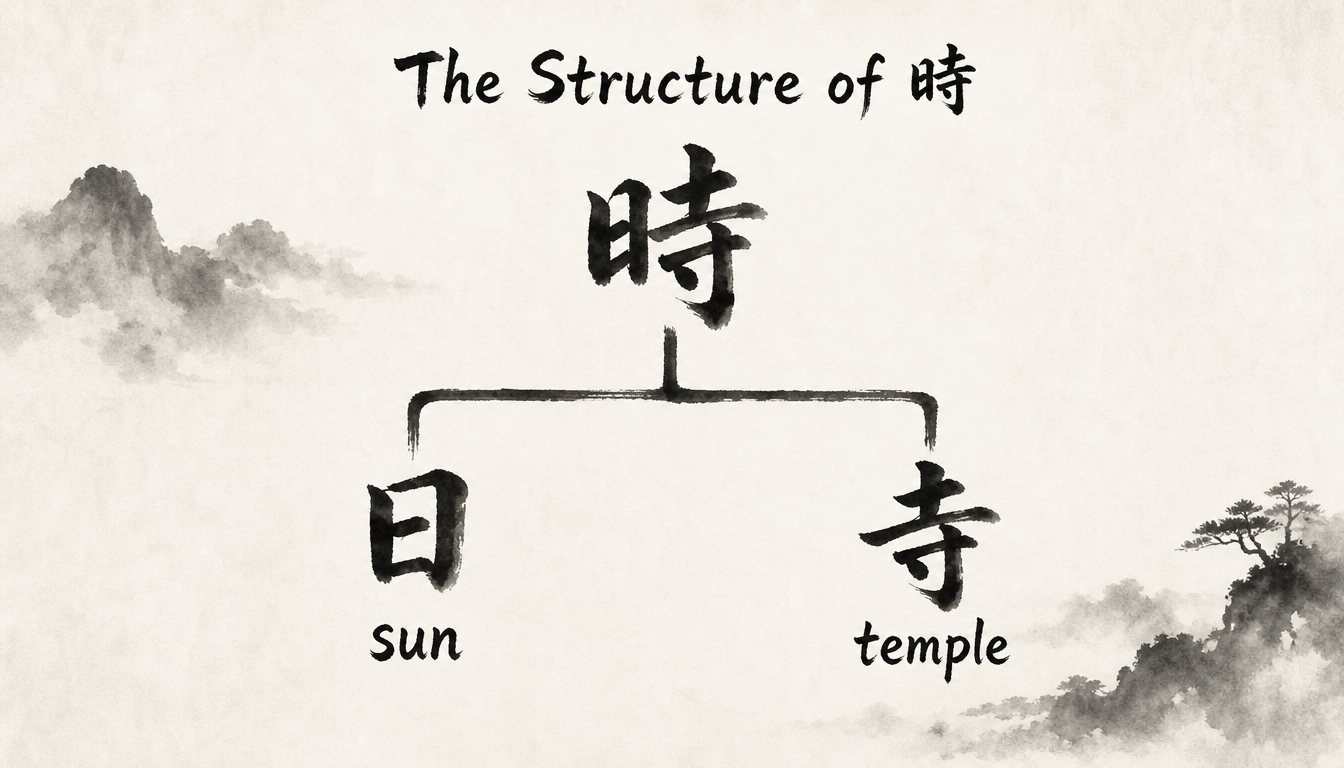
This origin ties the abstract to the physical in a way that feels honest. Before clocks, before calendars, time was the sun moving across the sky. 時 preserves that ancient observation inside its ten strokes, which is part of why it reads as both grounded and timeless.
Readings and Pronunciation of 時 (Toki and Ji)
Like most kanji, 時 carries two families of pronunciation, and knowing when each appears helps you use it correctly.
- On'yomi ジ (ji): the reading derived from Chinese, used mostly in compound words. You hear it in clock time, as in ku-ji for nine o'clock.
- Kun'yomi とき (toki): the native Japanese reading, used when 時 stands alone as the noun for time or moment.
Both readings, ジ and とき, are confirmed in the official Jōyō kanji table (List of jōyō kanji). As a rule of thumb across Japanese, the on'yomi tends to surface in multi-kanji compounds while the kun'yomi appears for the word on its own. So a standalone 時 reads toki, but glued into a compound like 時間 it reads ji.
| Reading | Type | Typical use | Example |
|---|---|---|---|
| とき (toki) | Kun'yomi | Standalone noun: a moment, time | 時を待つ (toki o matsu, to wait for the right moment) |
| ジ (ji) | On'yomi | Inside compounds, clock hours | 三時 (san-ji, three o'clock) |
Jōyō Classification and JLPT Level of 時
時 sits among the 2,136 characters of the Jōyō kanji, the regular-use list issued by Japan's Ministry of Education as the literacy baseline for anyone finishing compulsory education (Jōyō kanji, Wikipedia). In other words, this is a character every literate person in Japan knows and writes constantly, not an obscure ornamental pick.
It also ranks as one of the first kanji learners meet. Kanshudo lists 時 as a grade 2, ten-stroke character with very high frequency of use. The JLPT level varies by reading: the ji reading appears in N5 compounds such as clock hours, while Jisho.org places the standalone word とき at JLPT N3 as a common word. Whichever benchmark you use, the takeaway is the same: 時 is fundamental, high-frequency, and instantly readable to any Japanese person. For a tattoo or personal emblem, that recognizability is a real advantage.
Because 時 is such a common, correctly formed character, it avoids the awkward or nonsensical results that plague machine-converted "tattoo kanji." It looks right to native eyes.
Common Compounds Built from 時
Seeing 時 inside real words reveals how flexibly it works. Here are common, natural compounds every Japanese speaker uses.
- 時間 (jikan): time, an hour. The general word for time as a span or duration.
- 時代 (jidai): era, age, period. The time of a generation or historical epoch.
- 時々 / 時どき (tokidoki): sometimes, occasionally, from time to time.
- 時計 (tokei): clock, watch. Note the irregular reading, a device that keeps time.
Is jikan "time" or "hour"? Both. 時間 covers duration in general ("do you have time?") and also counts hours as a unit. Context decides. This kind of double duty is exactly why understanding the parent kanji 時 helps you read a whole family of words.
Choosing 時 as a Soul Kanji or Tattoo
People who resonate with 時 often share a certain relationship with time. Some are marking a rebirth, a new chapter that they want to remember always began now. Others are drawn to Zen and the discipline of presence. Still others simply find beauty in the idea that a life is a chain of irreplaceable moments.
As a visual character, 時 has pleasing balance. The compact sun radical on the left and the taller temple element on the right give it asymmetry that stays legible even at small sizes. It works well as a single-character piece on the forearm, wrist, or shoulder, and it pairs naturally with kanji from the same emotional family.
- 永 (eternity) for time that never ends
- 刹 (moment) for the fleeting instant
- 夢 (dream) for the future you move toward
- 心 (heart) for presence and feeling
One caution for anyone planning ink: confirm the stroke order and never let a shop mirror or stylize the character into something unreadable. A beautiful meaning ruined by a distorted form is the most common regret with kanji tattoos.
This is where getting the meaning right becomes the whole point. Oracle Kanji Writer – Personalized Soul Kanji Diagnosis Tool exists so that people outside Japan can find a character that truly fits them, complete with accurate pronunciation, layered meanings, and hand-picked compounds. Curated by Japanese creators who care about how a kanji actually lands in Japan, it helps you avoid the cliché picks and mistranslations that cheap converters produce. If 時 speaks to you, the tool can confirm the fit or surface an even closer match for your inner nature.
FAQ
What is the kanji word for time?
The kanji for time is 時, read toki on its own or ji inside compounds. The most common everyday word for time as duration is 時間 (jikan), built from this same character. Both readings, ジ and とき, appear in the official Jōyō kanji list.
What is the Japanese symbol for time?
時 is the core Japanese symbol for time. It combines 日 (the sun) on the left with 寺 on the right, tying the abstract idea of time to the observable movement of the sun. It appears in words ranging from clock hours to poetic "moments."
Is jikan time or hour?
時間 (jikan) means both. It refers to time or duration in a general sense, as in asking whether someone has time, and it also serves as the unit for counting hours. The right meaning depends on context, which is normal for this flexible word.
What does 時 mean in Japanese?
時 means time, hour, moment, and occasion. Dictionaries also give it senses of chance, opportunity, and "the age" or "the times." It is the everyday, concrete kanji for time and one of the first characters Japanese learners meet, classed as a beginner-level Jōyō kanji.
Conclusion
時 rewards the people who choose it with a symbol that is at once ordinary and profound, a character every Japanese person reads yet one that still whispers about impermanence, presence, and the single moment you are living.
- 時 (toki / ji) means time, moment, hour, and occasion, holding both clock time and lived experience in one form.
- Its structure pairs 日 (sun) with 寺, rooting time in the ancient act of watching the sun move.
- The readings ジ (ji) and とき (toki) come from the official Jōyō kanji table, and 時 ranks as a fundamental, high-frequency character.
- Its balanced shape and universal recognition make it a strong, safe choice for a tattoo or personal emblem.
If the kanji for time resonates with something in you, let it be a starting point rather than the final word. Explore related characters, learn their true readings, and let a trusted, culturally grounded guide like Oracle Kanji Writer help you find the kanji that mirrors your own moment in time.
Discover Your Soul Kanji
Experience the depth of Japanese characters: each kanji carries timeless meaning, guiding your life's path.
No credit card required • 2-minute process