Kanji of the Day Vol.52 | "Kanji Tattoo Meaning Gone Wrong: Avoid These Cringe-Worthy Ink Mistakes"

From Ariana Grande's accidental charcoal grill to mirrored stencils and font glitches, kanji tattoos go wrong more often than you'd think. Learn the most common mistranslations, why they happen, and a five-step verification process that keeps your ink beautiful and meaningful in Japan, not the punchline of a fail gallery.
Kanji Tattoo Meaning Gone Wrong: Avoid These Cringe-Worthy Ink Mistakes
A kanji tattoo can carry your deepest values on your skin, or it can quietly announce to every Japanese speaker who passes that you have a small charcoal grill etched on your ribs. The gap between those two outcomes is smaller than most people think. When a kanji tattoo meaning gone wrong happens, it usually comes down to one missing stroke, one mirrored character, or one blind trust in a font chart. This guide walks you through the classic failures, then shows you a verification process that actually protects your ink.
Goal: By the end, you will be able to spot a flawed kanji design before it becomes permanent and confidently commission one that reads as beautiful and meaningful in Japan.
Estimated reading time: about 10 minutes. Difficulty: beginner friendly, no Japanese required.
Discover Your Soul Kanji
Experience the depth of Japanese characters: each kanji carries timeless meaning, guiding your life's path.
No credit card required • 2-minute process
Why So Many Kanji Tattoos Go Wrong
Kanji originally came to Japan from China, and the term literally means "Han characters" (University of Passau kanji primer). A single character can hold several readings and layered meanings depending on context, which is precisely why it looks elegant and why it trips up outsiders. One symbol is rarely one word.
The failures cluster into a few predictable causes. The diagram below maps the main ones so you can see where a design typically breaks down.
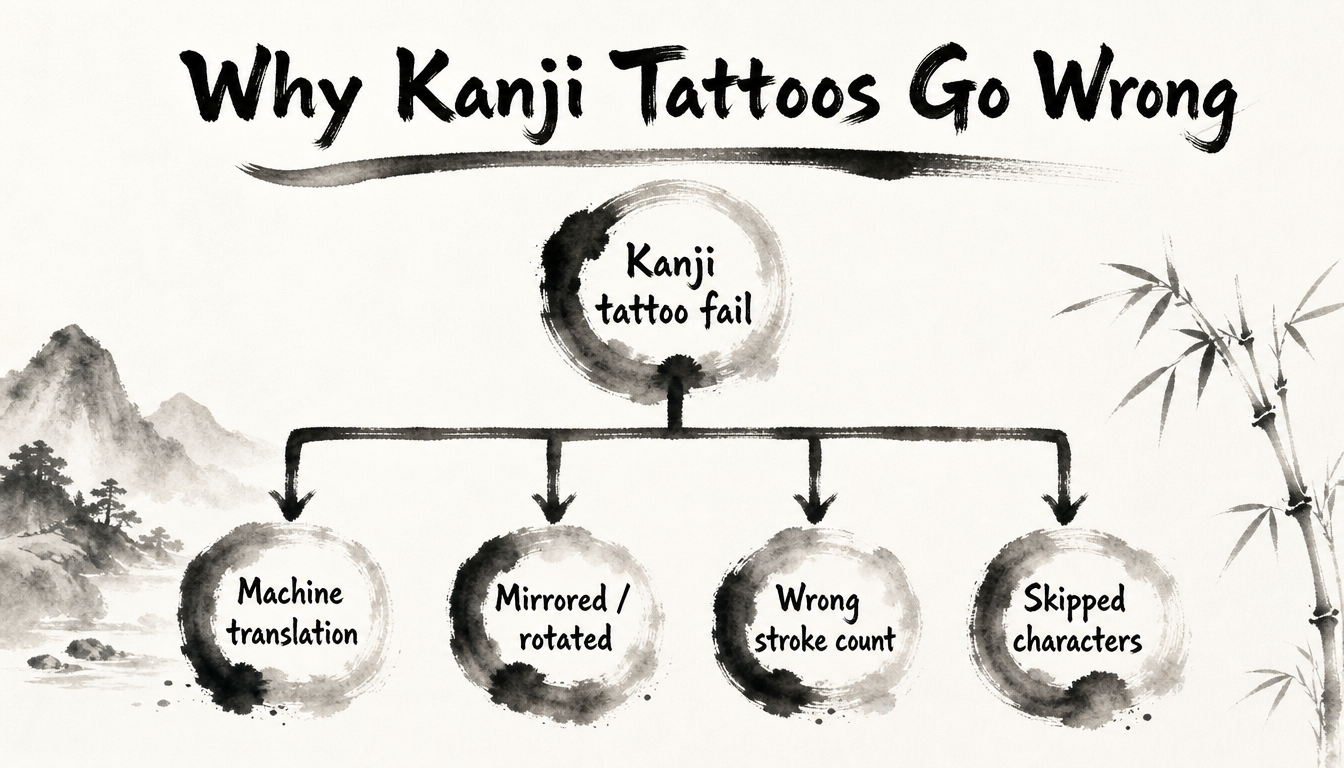
- Machine translation. Google Translate and cheap parlor charts pick the first dictionary hit, ignoring nuance and grammar.
- Mirrored or rotated characters. An artist unfamiliar with the script flips a stencil, and the result reads backwards to anyone literate.
- Wrong stroke order or missing strokes. Kanji are built stroke by stroke; drop one and the meaning shifts or dissolves into nonsense.
- Skipped characters. Leaving out a linking character collapses a whole phrase, which is exactly what happened in the most famous celebrity example.
None of these require bad intentions. They come from treating kanji as decorative shapes rather than a living writing system that millions of people read every day.
Common Kanji Tattoo Mistranslations and Failed Examples
The internet is full of galleries where fluent readers translate strangers' ink back into plain English, and the results range from charming to mortifying. Communities like Bored Panda and language blogs such as TutorABC have documented dozens of these fails, and the patterns repeat.
The Ariana Grande "7 Rings" Mishap
The best-known case belongs to a pop star. To celebrate her single, Ariana Grande wanted 七つの指輪 ("seven rings") inked on her palm. She left out the middle characters つの指 and ended up with 七輪, which reads shichirin, a small charcoal grill used for grilling food, according to Allure. The single itself debuted at the top of the Billboard Hot 100, as noted by Wikipedia, which only amplified the correction from Japanese fans.
In multi-character phrases, every character is load-bearing. Skip one and you can turn jewelry into a barbecue.
Other Recurring Failures
Beyond celebrities, three failure types show up again and again in fluent-reader roundups:
| Failure type | What the wearer wanted | What it actually said |
|---|---|---|
| Literal word-by-word translation | A poetic phrase like "free spirit" | Disconnected nouns with no grammar |
| Mirrored stencil | A clean single character | The same character reversed, unreadable |
| Wrong character choice | "Strength" or "fate" | An unrelated homophone or the joke translation "hot soup" |
| Font glitch | Crisp calligraphy | A broken, half-rendered shape |
As tattoo artist Micah Riot notes, kanji tattoos carry a running joke among speakers that a character meant to say "strength" probably says "hot soup" instead. The humor stings because it is often true.
How to Avoid a Kanji Tattoo Meaning Gone Wrong: A Verification Process
You can sidestep nearly every disaster with a short, disciplined process. The steps below move from meaning to final skin, and each one has a checkpoint so you never advance on a guess.
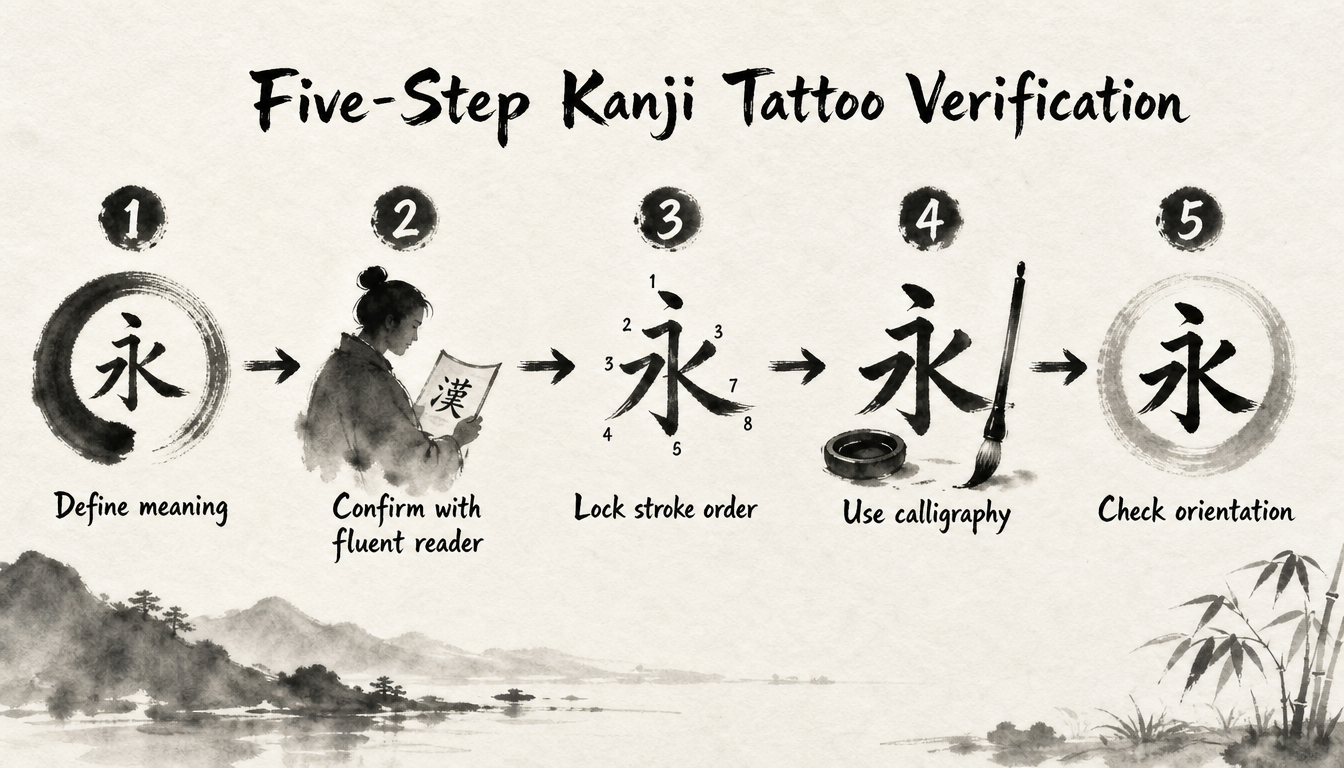
Step 1: Define the meaning before the character
Start in English. Write the exact feeling or value you want, then decide whether it belongs to one character or a short phrase. Single characters are safer because they avoid grammar traps. → If you can state your meaning in one clear sentence, you are ready to proceed.
Step 2: Confirm the correct kanji with a fluent reader
Never rely on a tattoo-shop wall chart or an auto-translator. Have a native or fluent reader confirm the character, its reading, and its nuance. Ask specifically: "What would a Japanese person read this as, with no context?" → If two independent fluent readers give the same reading, the character is verified.
Step 3: Lock the stroke count and stroke order
Every kanji has a fixed number of strokes drawn in a set order. Verify both, because a missing or extra stroke can create a different character. → If the stroke count matches a reliable dictionary entry, the shape is sound.
Step 4: Choose calligraphy over a computer font
Studios such as KANJI TOKYO stress that hand-brushed calligraphy carries spirit and balance that a system font cannot, and they deliver tattoo-ready vector artwork. A font can also glitch or clip strokes. → If your artwork is hand-brushed or professionally rendered vector, you have avoided the font-glitch trap.
Step 5: Guard against mirroring at the studio
Bring a clearly labeled "this side up" reference and confirm orientation before the needle touches skin. Ask the artist to hold the stencil against your body and photograph it, then check the photo against your reference. → If the stencil photo matches your reference exactly, you are clear to ink.
A trustworthy kanji tattoo has: a confirmed meaning, a double-checked reading, correct stroke count and order, hand-brushed or vector artwork, and confirmed orientation. Miss none of these.
Font Chart vs. Native Verification vs. Personalized Diagnosis
How you source your character decides how much risk you carry. The three common routes differ sharply in accuracy.
| Approach | Meaning accuracy | Cultural nuance | Risk of a fail |
|---|---|---|---|
| Parlor font chart / auto-translate | Low | None | High |
| Native speaker double-check | High | Good | Low |
| Personalized soul-kanji diagnosis | High | High, with context | Low |
This is where a curated tool earns its place. Oracle Kanji Writer – Personalized Soul Kanji Diagnosis Tool works from your name, birthdate, and blood type in a quick two-minute process, then recommends a character aligned with your inner qualities. Each result arrives with pronunciation, primary and nuanced meanings, and carefully chosen compound words, so you understand exactly how the character reads to a Japanese eye before it ever reaches skin. Because Japanese creators curate the picks, you skip the cliché characters and the mistranslations that fuel those fail galleries.
Think of it as the opposite of a wall chart. Instead of grabbing the first symbol that looks cool, you receive a character that resonates in Japan as beautiful, powerful, and meaningful along with the cultural explanation to back it up.
Common Errors and How to Fix Them
Even careful people hit snags. Use this quick troubleshooting table before your appointment.
| Symptom | Cause | Fix |
|---|---|---|
| Fluent friends read it differently than intended | Wrong character or missing nuance | Reconfirm with two readers and pick the character with the intended primary reading |
| The character looks "off" or backwards | Mirrored or rotated stencil | Compare against a labeled reference and re-lay the stencil |
| The phrase reads as choppy nouns | Word-by-word translation without grammar | Switch to a single character or a verified idiom |
| The brushwork looks broken | Font glitch or clipped strokes | Replace with hand-brushed calligraphy or clean vector art |
FAQ
Why do tattoos have a negative connotation in Japan?
In Japan tattoos have long carried associations with the yakuza and with outsider status, so many public baths, gyms, and pools still restrict visibly tattooed guests. Attitudes are softening among younger generations, but the cultural caution remains, which is one more reason to choose a character that reads as thoughtful rather than careless.
What does Ariana Grande's kanji tattoo mean?
She intended 七つの指輪, "seven rings," but omitted the characters つの指 and ended up with 七輪 (shichirin), which means a small charcoal grill, according to Allure. It is the textbook example of how dropping a single character in a phrase produces a kanji tattoo meaning gone wrong.
How can I be sure my kanji tattoo is accurate before getting inked?
Verify the meaning, reading, and stroke order with at least two fluent readers, use hand-brushed or professional vector artwork instead of a font, and confirm orientation with a labeled reference at the studio. A curated diagnosis tool that supplies pronunciation and nuanced meanings adds another layer of confidence.
Conclusion
A kanji tattoo rewards patience. Define your meaning first, confirm the character and its reading with fluent readers, lock the stroke order, insist on real calligraphy, and check for mirroring before the needle starts. Follow that sequence and you close the door on almost every kanji tattoo meaning gone wrong story. When you want a character chosen for who you are rather than what looked good on a chart, let a curated tool like Oracle Kanji Writer surface your soul kanji with the meaning already made clear.
Discover Your Soul Kanji
Experience the depth of Japanese characters: each kanji carries timeless meaning, guiding your life's path.
No credit card required • 2-minute process