Is a Kanji Tattoo Cultural Appropriation? An Honest Japanese Answer
Is a kanji tattoo cultural appropriation? An honest answer from Japanese creators on respect, mistranslation, and choosing a meaningful kanji you'll never regret.
If you've ever paused before booking a kanji tattoo appointment and wondered, "Wait — is this disrespectful?", you're not alone. The question of kanji tattoo cultural appropriation has become one of the most searched ethical concerns among Western tattoo enthusiasts. As the creators behind the Oracle Kanji Writer project — a commercial kanji tool — we want to give you a direct, honest answer, though we acknowledge we have a commercial interest in this topic. The short version: most Japanese people don't consider a kanji tattoo cultural appropriation, but they do notice when it's done badly. The line isn't about who wears the ink. It's about whether you treated the character with understanding.
The Honest Japanese Answer: It's About Respect, Not Race
Let's get the big question out of the way. In Japan, kanji tattoos are rarely viewed through the lens of cultural appropriation the way they are in Western academic discourse. As one Quora respondent fluent in Japanese culture put it bluntly, Japanese people are "among the least politically correct" about outsiders adopting their script. The more common reaction is curiosity, amusement, or — when the kanji is wrong — secondhand embarrassment on your behalf.
This matters because the standard definition of cultural appropriation, per Britannica and academic sources, hinges on a dominant culture borrowing from a marginalized or oppressed one in ways that strip meaning or reinforce power imbalances. Japan is not in that position relative to the West. Japanese culture is widely exported, celebrated, and economically powerful. Kanji itself was historically borrowed from China — Japan is a culture that has openly shared and adapted scripts for over a millennium.
That said, "not appropriation" doesn't mean "anything goes." The real concern Japanese people raise about Western kanji tattoos is almost always one thing: they're often wrong, awkward, or meaningless. And that's where respect comes in.
Discover Your Soul Kanji
Experience the depth of Japanese characters: each kanji carries timeless meaning, guiding your life's path.
No credit card required • 2-minute process
Where Kanji Tattoos Actually Go Wrong
If kanji tattoo cultural appropriation is rarely the real issue, what is? In our experience working with Japanese calligraphy and helping global users find meaningful characters, the genuine problems fall into four buckets.
1. Mistranslation and Gibberish
Bored Panda has published multiple viral threads where Japanese and Chinese speakers identify tattoos that read as "demon bird mothballs," "chicken noodle soup," or — famously, in Britney Spears' case — "strange" instead of "mysterious." Some blog writers note that grammatically correct hanzi tattoos in the wild are "almost non-existent." The same problem plagues kanji.
2. Ateji — Phonetic Substitution Without Meaning
Many free "your name in Japanese" generators pick kanji based on sound, not meaning. The result is called ateji: characters that approximate your name phonetically but spell something semantically random. Your tattoo might phonetically say "Jessica" while literally meaning something like "helpful-tree-add-flat." Technically not wrong. Definitely not meaningful.
3. Wrong Stroke Order or Font
A computer font printed and stenciled onto skin looks lifeless to Japanese eyes. Authentic kanji carries the energy of the brush — what calligraphy artists call tamashii (soul). Studios like KANJI TOKYO emphasize that hand-brushed calligraphy delivered in vector format gives the character a spirit a font cannot replicate.
4. No Personal Connection to the Meaning
Getting 侍 (samurai) tattooed because it looks cool, with no understanding of bushido, history, or why this character represents you, is what most Japanese observers would politely call "cosplay." It's not offensive — it's just shallow. And shallow ink is forever.
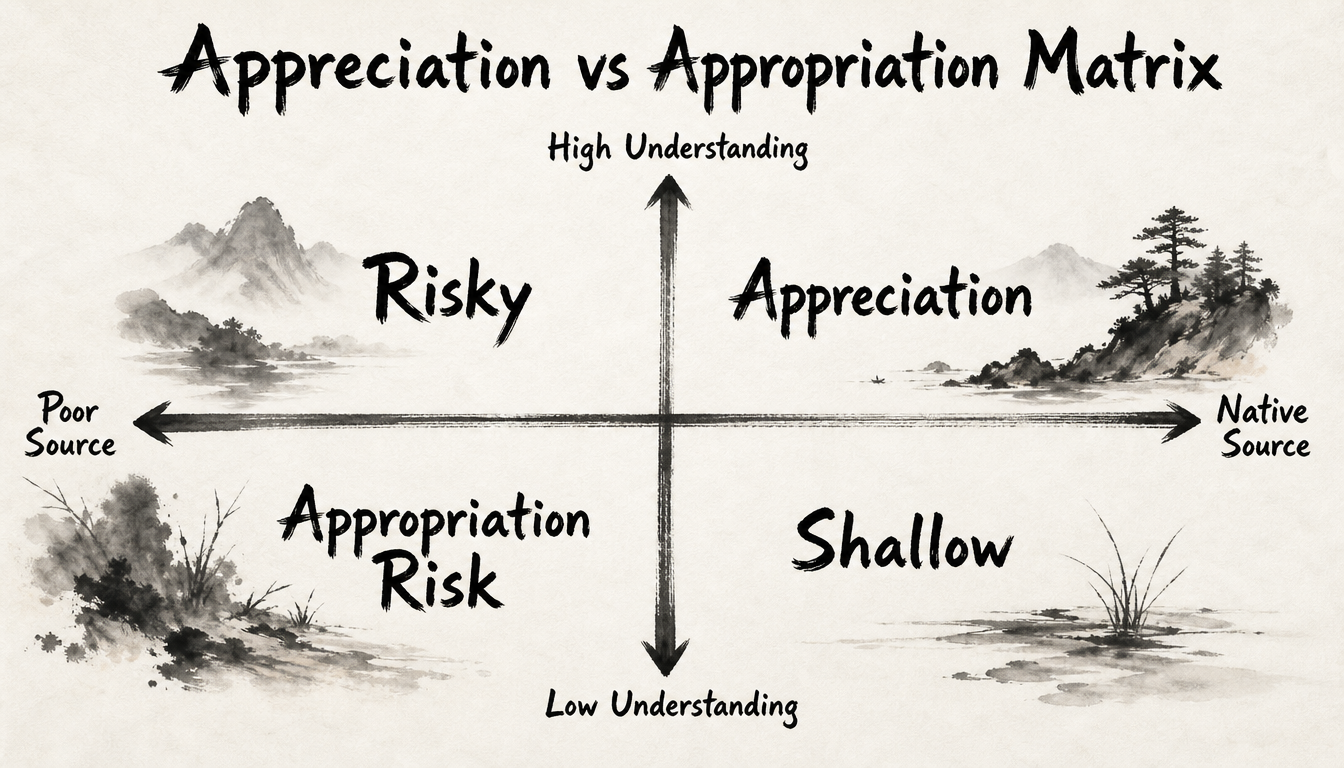
Appropriation vs. Appreciation: A Clear Framework
Here's a practical framework to evaluate whether your kanji tattoo crosses any line — cultural, aesthetic, or personal.
FactorCultural Appreciation ✅Problematic Choice ⚠️Source of designNative speaker, calligrapher, or vetted toolRandom Google image or generatorUnderstandingYou know the meaning, readings, and nuanceYou picked it because it "looks cool"Translation methodConcept-based (meaning first)Phonetic-only (ateji)Calligraphy styleHand-brushed or master-designedDefault computer fontPersonal relevanceTied to your values, story, or identityTrend-driven or impulse choiceSacred symbolsAvoids religious/clan-specific marksUses family crests or sacred terms casually
If your choices fall mostly on the left column, you're firmly in appreciation territory. The Japanese craftspeople we know would be more likely to compliment your taste than question your ethics.
What "Doing It Right" Looks Like in 2026
The 2026 kanji tattoo trend is moving toward single-character minimalist designs with deep, personal meaning. Popular picks include classics like 愛 (love), 夢 (dream), 力 (strength), and 希望 (hope), but more sophisticated choices are rising fast: 無限 (infinity), 刹那 (a fleeting moment), and 不屈 (indomitable spirit). The shift isn't just aesthetic — it reflects a broader cultural literacy among tattoo seekers who want substance over surface.
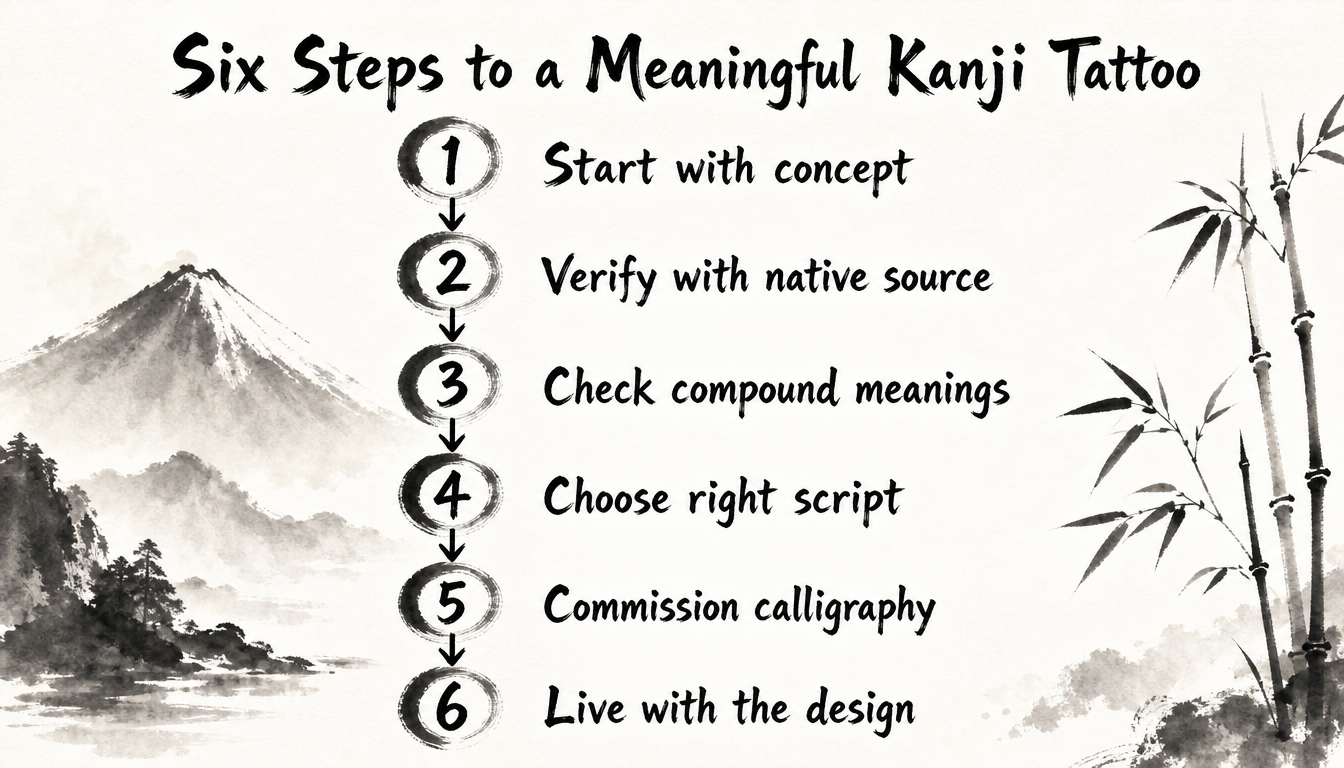
So how do you make sure your kanji tattoo is meaningful rather than cringeworthy? Follow these steps.
- Start with a concept, not a word. Don't translate "strength" — ask yourself what kind of strength. Quiet endurance (忍)? Raw power (力)? Unshakeable will (不屈)? Each carries different weight.
- Verify with a native source. Use a Japanese-curated tool, consult a calligrapher, or ask a fluent speaker. Avoid bulk "name converter" sites that prioritize phonetics.
- Check compound meanings. A character that means one thing alone can shift in combination. A trustworthy source will explain layered meanings and common compounds.
- Choose the right script. Kanji conveys concepts. Hiragana feels soft and personal. Katakana suits foreign names and modernity. Mixing them carelessly looks amateur.
- Commission real calligraphy. A hand-brushed character in kaisho (standard), gyosho (semi-cursive), or sosho (cursive) style has visual depth a font never will.
- Sit with it. Live with the design as a printout, phone wallpaper, or temporary tattoo for at least a month before committing.
How a Soul Kanji Approach Sidesteps the Whole Debate
One reason the kanji tattoo cultural appropriation question feels sticky is that most Western kanji selection happens at a surface level — you pick a word from a list, paste it into a font, and call it done. There's no relationship between you and the character. That's the gap our team built Oracle Kanji Writer to close.
Instead of translating your name phonetically (the ateji problem), Oracle Kanji Writer uses your name, birthdate, and blood type to generate a Soul Kanji — a single character chosen by a proprietary algorithm built by Japanese creators to reflect your spiritual essence. You receive:
- A hand-style calligraphy rendering of your kanji
- Pronunciation in both on'yomi and kun'yomi readings
- Layered cultural meanings, not just a single English gloss
- Common compound words showing how the kanji lives in real Japanese
- A personal fortune message tied to the character's symbolism
The benefit for anyone considering a tattoo: you're not picking a kanji because it trended on Pinterest. You're choosing one that has a documented, native-verified relationship to who you are. When someone asks, "Why that character?", you have a real answer — not just "I thought it looked cool."
This is the difference between wearing a culture as costume and wearing a symbol as identity. The first invites criticism. The second invites conversation.
Final Thoughts: Permission, Permanence, and Personal Meaning
Let's bring it home. Is a kanji tattoo cultural appropriation? Based on the actual attitudes of Japanese people and the academic definition of the term, the answer is almost always no — provided you approach the character with genuine understanding, accurate translation, and personal meaning. Japan is not a marginalized culture being stripped of its heritage when you ink 静 (stillness) on your forearm. What concerns Japanese observers is rarely the act of wearing kanji — it's the carelessness, the gibberish, the dead computer fonts, and the absence of any real connection between the wearer and the meaning.
So if you're going to do this, do it well. Choose a character that means something to your life. Verify it with native sources. Commission real calligraphy. And consider going beyond a dictionary lookup — let a tool like Oracle Kanji Writer reveal a Soul Kanji that's already tied to your identity. The kanji tattoo cultural appropriation debate dissolves the moment your ink stops being a borrowed aesthetic and becomes a personal symbol you can defend, explain, and live up to. That's not appropriation. That's appreciation made permanent.
Discover Your Soul Kanji
Experience the depth of Japanese characters: each kanji carries timeless meaning, guiding your life's path.
No credit card required • 2-minute process