Kanji of the Day Vol.45 | "Kanji 龍 vs 竜 (Ryu): The Dragon Kanji Variants & Their Soul Power"

龍 and 竜 both mean dragon and both read ryū, yet they look worlds apart. This guide breaks down the traditional and simplified ryu dragon kanji variants, their stroke counts, the postwar reform that split them, and how to choose the culturally accurate form for a tattoo or personal emblem.
Kanji 龍 vs 竜 (Ryu): The Dragon Kanji Variants & Their Soul Power
The dragon kanji comes in two faces. 龍 is the ornate traditional form, dense with strokes and heavy with history. 竜 is its streamlined modern cousin, cleaner and easier to write. Both read りゅう (ryū) and both mean dragon. If you are weighing the ryu dragon kanji variants for a tattoo, a piece of art, or a personal emblem, the choice between these two shapes is more than cosmetic. It touches on how Japan reformed its writing, what each form signals, and which one carries the feeling you want.
龍 (ryū) means dragon, a sacred creature of East Asian mythology tied to imperial power, rain, wisdom, and fortune. 竜 is the officially simplified form of the same character, identical in meaning and reading.
| Item | Detail |
|---|---|
| Character | 龍 (traditional) / 竜 (simplified) |
| Reading (on'yomi) | りゅう / りょう (ryū / ryō) |
| Reading (kun'yomi) | たつ (tatsu) |
| Meaning | dragon |
| Related concepts | imperial power, water, wisdom, ascent |
| Usage frequency | Common in names; 竜 in everyday text, 龍 for weight and tradition |
Discover Your Soul Kanji
Experience the depth of Japanese characters: each kanji carries timeless meaning, guiding your life's path.
No credit card required • 2-minute process
Understanding the Ryu Dragon Kanji Variants
The word ryū (dragon) can be written two ways, and the difference is entirely visual. 龍 is the kyūjitai, the old-form character used before Japan's postwar writing reforms. 竜 is the shinjitai, the new form adopted to make daily writing faster and more consistent. When you see 竜 in a newspaper and 龍 in a shrine inscription, you are looking at the same word in two registers, much like a formal serif logo versus a stripped-back sans-serif one in English.
The dragon itself sits at the center of East Asian symbolism. Unlike the fire-breathing menace of Western legend, the Japanese and Chinese dragon is a benevolent force. It governs rain and rivers, guards emperors, and embodies transformation and rising fortune. Choosing either of the ryu dragon kanji variants means aligning yourself with strength, ambition, and the power to ascend.
The diagram below compares the two forms side by side so you can see the trade-off at a glance.
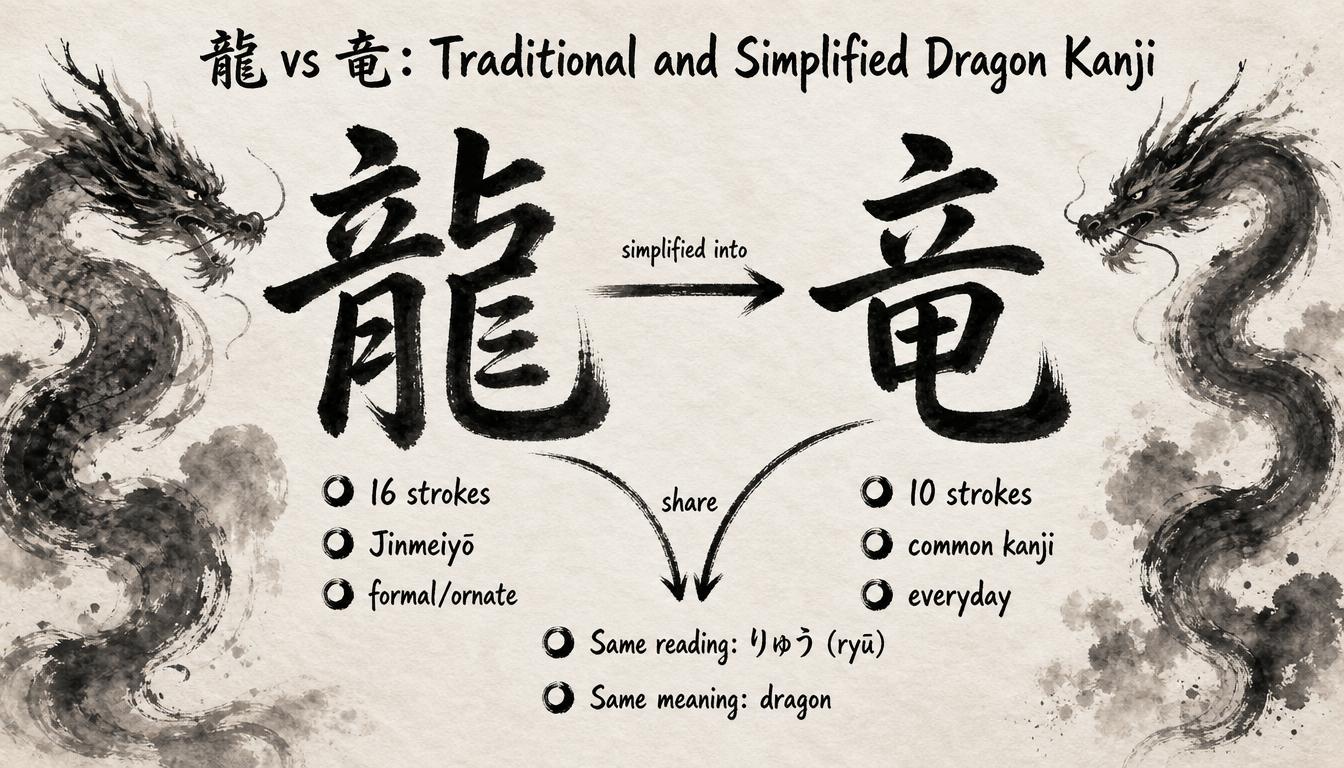
Both 龍 and 竜 mean exactly the same thing and read the same way. The only real differences are stroke count, visual density, and the cultural mood each form projects.
Traditional 龍 vs. Simplified 竜: Stroke Count and History
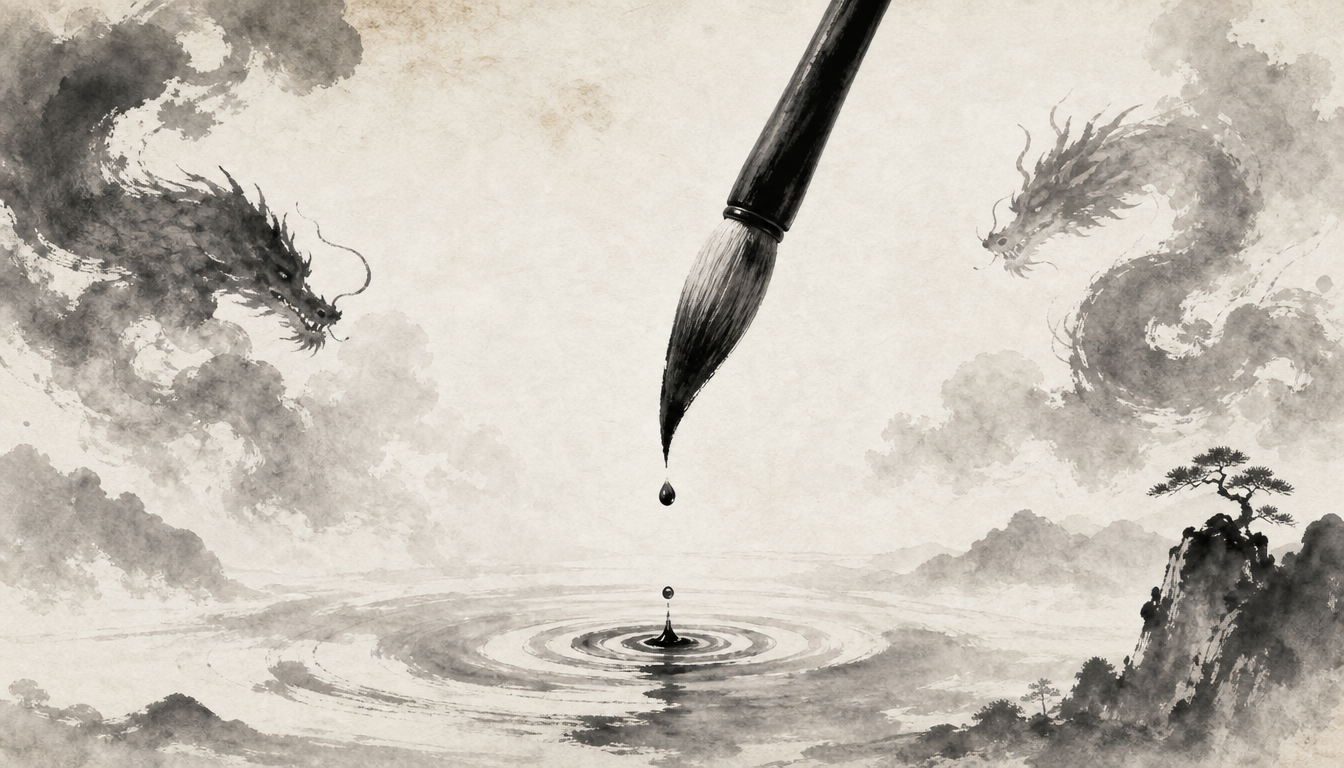
The most concrete difference between the two forms is how many strokes each takes to write. The traditional 龍 has 16 strokes and is classified as a Jinmeiyō (name-use) kanji at Grade 10 (Kanshudo). The simplified 竜 has 10 strokes and sits at Kanji Kentei Level Pre-2 as a common kanji (Jitenon). That six-stroke gap is why 竜 became the everyday standard while 龍 kept its place for formal and decorative use.
This split traces back to Japan's postwar language reforms. In the mid-twentieth century, the government simplified hundreds of complex characters to ease literacy and printing, replacing many kyūjitai with lighter shinjitai. The dragon was among them: 龍 gave way to 竜 as the recommended form in general writing. The older form never vanished, though. It survives in personal names, temple and shrine signage, martial arts schools, and any context where visual gravitas matters.
| Feature | 龍 (traditional) | 竜 (simplified) |
|---|---|---|
| Stroke count | 16 strokes | 10 strokes |
| Classification | Jinmeiyō, Grade 10 | Common kanji, Kanji Kentei Pre-2 |
| Typical use | Names, shrines, formal or ornamental text | Everyday writing, print, general text |
| Visual feel | Dense, ancient, powerful | Clean, balanced, modern |
| Meaning | Dragon | Dragon |
You can see the reform in action in one famous name. The author Akutagawa Ryūnosuke wrote his name with the traditional 龍, yet catalogs that standardize on new-form characters render him with 竜 (龍之介 becomes 竜之介), as the Aozora Bunko library notes in its indexing rules. Same person, same reading, two written faces.
References: Kanshudo, Jitenon, Aozora Bunko
Readings and Pronunciation: Why Both Say Ryū
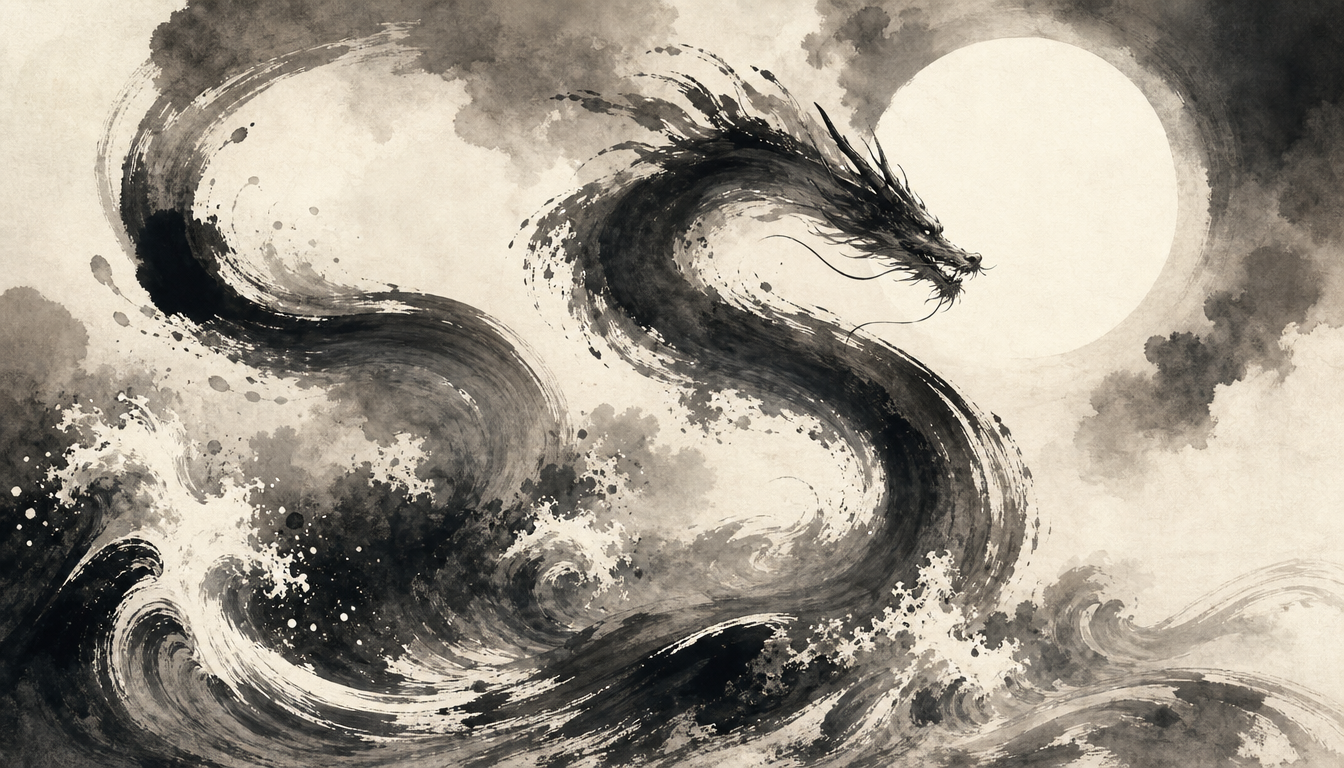
Here is what surprises many people new to kanji: 龍 and 竜 look nothing alike, yet they share identical readings. Both take the on'yomi りゅう (ryū), along with the less common りょう (ryō), and the kun'yomi たつ (tatsu). A dictionary entry for one simply cross-references the other (Jisho).
The reason is simple once you understand how simplification worked. A reading attaches to a character's identity, not to its visual shape. When reformers created 竜 as the new-form of 龍, they were not inventing a new word. They kept the same sound, the same meaning, and the same role, and only redrew the strokes. So りゅう rode along unchanged. The two are officially registered as variant forms of a single character, which is why every reading transfers cleanly from one to the other.
- りゅう (ryū) is the default on'yomi you will meet in compounds like 龍神 / 竜神 (ryūjin, dragon god).
- りょう (ryō) appears in a narrower set of literary and older readings.
- たつ (tatsu) is the native Japanese kun'yomi, used for the standalone word and in some names.
For anyone planning a design, this is reassuring news. Whichever of the ryu dragon kanji variants you pick, the pronunciation is the same. You are choosing a look, not a different word.
References: Jisho, ManyThings Kanji
Meaning, Compounds, and Cultural Weight
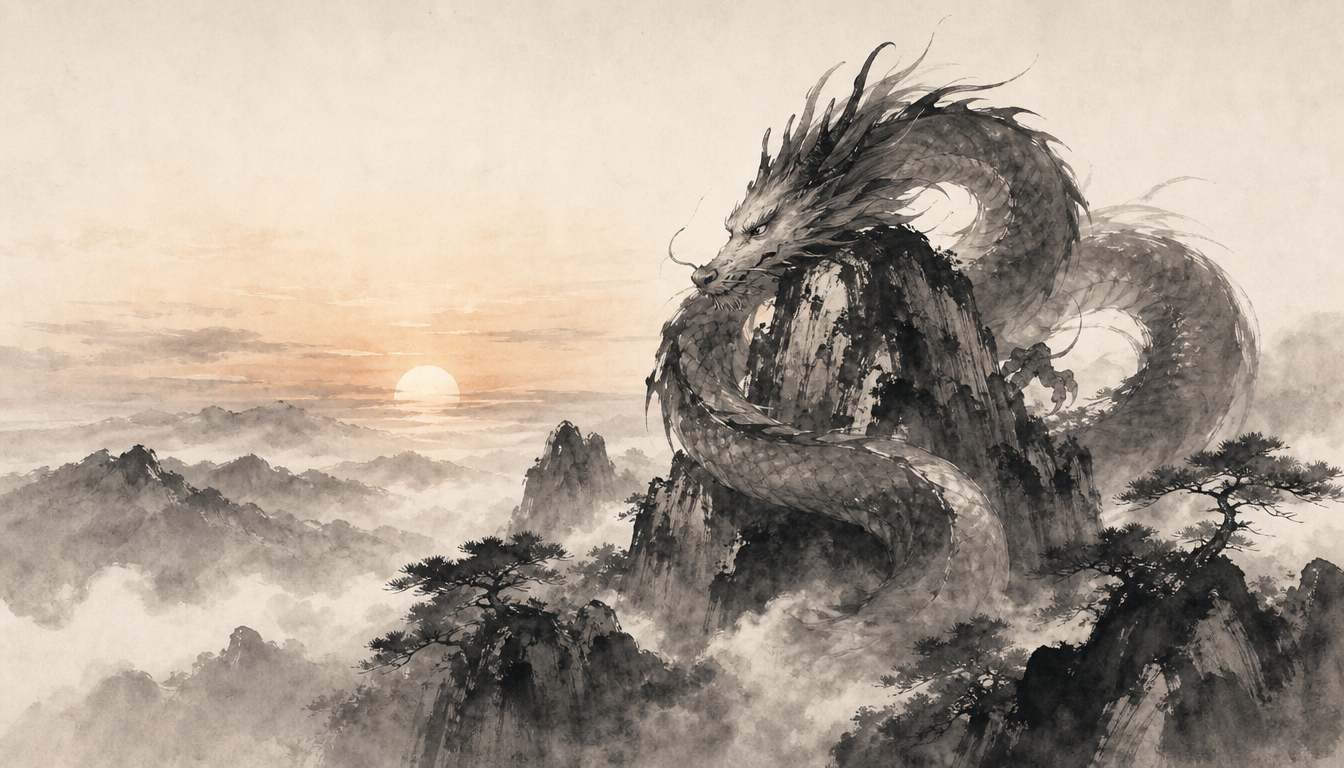
The dragon's meaning runs deep across both forms. In Japanese thought the ryū is a water deity, a bringer of rain and a guardian of rivers and seas. It also stands for upward movement, the surge of a person rising to meet their potential. That is why the character shows up so often in the names of ambitious, powerful figures. The novelist Murakami Ryū and the judoka Ryū Shichinohe both carry it, according to name records (Japanese Names).
Real compounds show the character's range:
- 龍神 / 竜神 (ryūjin) — dragon god or dragon king, a revered water deity.
- 龍虎 / 竜虎 (ryūko) — dragon and tiger, a pairing that means two mighty, evenly matched rivals.
- 烏龍茶 (ūroncha) — Oolong tea, where the traditional 龍 stays fixed by convention.
Notice that some words lock in one form. Oolong tea keeps 龍 because the term arrived as a fixed unit. Modern given names lean either way depending on the feeling parents want. The name Ryūki, for instance, appears as both 竜輝 and 龍輝, pairing dragon with 輝 (radiance) for a bold, luminous effect, as name guides describe (Japanese Names).
Which Form Should You Choose?
For a tattoo or a personal emblem, the decision comes down to intent and aesthetics. 龍 rewards you with intricate, layered strokes that fill space dramatically and read as ancient and imposing. It demands a skilled hand, since a misplaced stroke in sixteen is easier to spot. 竜 gives you clean geometry, better legibility at small sizes, and a modern balance that ages well.
| If you want... | Choose |
|---|---|
| Maximum tradition and ornate detail | 龍 |
| A clean, modern, highly legible look | 竜 |
| A small or fine-line placement | 竜 |
| A large statement piece with density | 龍 |
| Alignment with a name written in kyūjitai | 龍 |
Whichever form you choose, confirm the exact stroke order with a reliable dictionary before committing to ink, and never mirror or rotate the character. A flipped or stretched dragon reads as a mistake to any Japanese eye.
This is where getting the meaning and form right matters most. Oracle Kanji Writer exists to prevent the cliché picks and mistranslations that plague cheap converters. Rather than defaulting to whatever a font renders, it helps you understand what each character carries so your dragon resonates as beautiful and authentic in Japan, not just abroad.
References: Japanese Names, ManyThings Kanji
Finding Your Own Dragon
Choosing a kanji is a small act of self-definition. The dragon appeals to people who see themselves as ambitious, protective, or in the middle of a personal transformation. It suits those drawn to strength that serves rather than dominates, since the East Asian dragon protects and nourishes as much as it conquers.
If the dragon speaks to you but you are unsure it fits your character exactly, a guided approach helps. Oracle Kanji Writer takes your name, birthdate, and blood type and recommends a Soul Kanji aligned with your inner qualities, complete with pronunciation, nuanced meanings, a personal message, and hand-picked compound words for context. Everything is curated by Japanese creators who care about authenticity, so the character you receive is one that Japanese people would recognize as meaningful and beautiful.
FAQ
What is the kanji for dragon ryu?
The kanji for the dragon ryū is written two ways: 龍 in the traditional form and 竜 in the simplified form. Both read りゅう (ryū) and both mean dragon. The 16-stroke 龍 carries an ancient, ornate feel, while the 10-stroke 竜 is the modern standard used in everyday Japanese writing.
Are 龍 and 竜 the same word?
Yes. They are two written forms of a single character with identical meaning and identical readings. 龍 is the pre-reform kyūjitai and 竜 is the postwar shinjitai. Dictionaries list them as variants of each other, so the only differences are stroke count and visual style, not meaning or pronunciation.
Which dragon kanji is better for a tattoo?
Neither is objectively better; it depends on the look you want. Choose 龍 for a large, detailed, traditional statement piece, and 竜 for a clean, modern design or a smaller placement where legibility matters. Always verify stroke order before inking and avoid mirroring the character.
Key Takeaways
- 龍 and 竜 are the traditional and simplified ryu dragon kanji variants, both meaning dragon and both read りゅう (ryū).
- 龍 has 16 strokes (Jinmeiyō, Grade 10); 竜 has 10 strokes (common kanji, Kanji Kentei Pre-2).
- The split comes from Japan's postwar writing reforms; 竜 became standard while 龍 kept its formal, ornamental role.
- Readings transferred unchanged because the two are registered as variants of one character, not separate words.
- For personal use, pick 龍 for tradition and density, 竜 for modern clarity, and confirm the details with a trusted source like Oracle Kanji Writer.
Discover Your Soul Kanji
Experience the depth of Japanese characters: each kanji carries timeless meaning, guiding your life's path.
No credit card required • 2-minute process