Kanji of the Day Vol.51 | "Kanji 龍 (Ryu) Stroke Order: How to Write the Dragon Kanji Correctly"

The dragon kanji 龍 is one of the most beautiful and most complex characters you can learn to write. This step-by-step guide walks you through its 16 strokes in the correct order, explains the stroke-order rules behind them, compares the traditional 龍 with the modern 竜, and flags the mistakes that give beginners away, so your dragon reads as powerful and correct in Japan.
Kanji 龍 (Ryu) Stroke Order: How to Write the Dragon Kanji Correctly
By the end of this guide, you will be able to write the dragon kanji 龍 confidently, in the correct stroke order, without the tell-tale mistakes that mark a foreigner's hand. We use the dragon as our worked example because it is one of the most beloved and one of the most complex characters a learner can attempt. Learn how to write dragon kanji properly here, and you will hold the rules you need for almost any character.
Goal: Write 龍 correctly from memory. | Estimated time: about 15 minutes. | Difficulty: intermediate (beginner-friendly with patience).
Discover Your Soul Kanji
Experience the depth of Japanese characters: each kanji carries timeless meaning, guiding your life's path.
No credit card required • 2-minute process
What You Need Before You Start
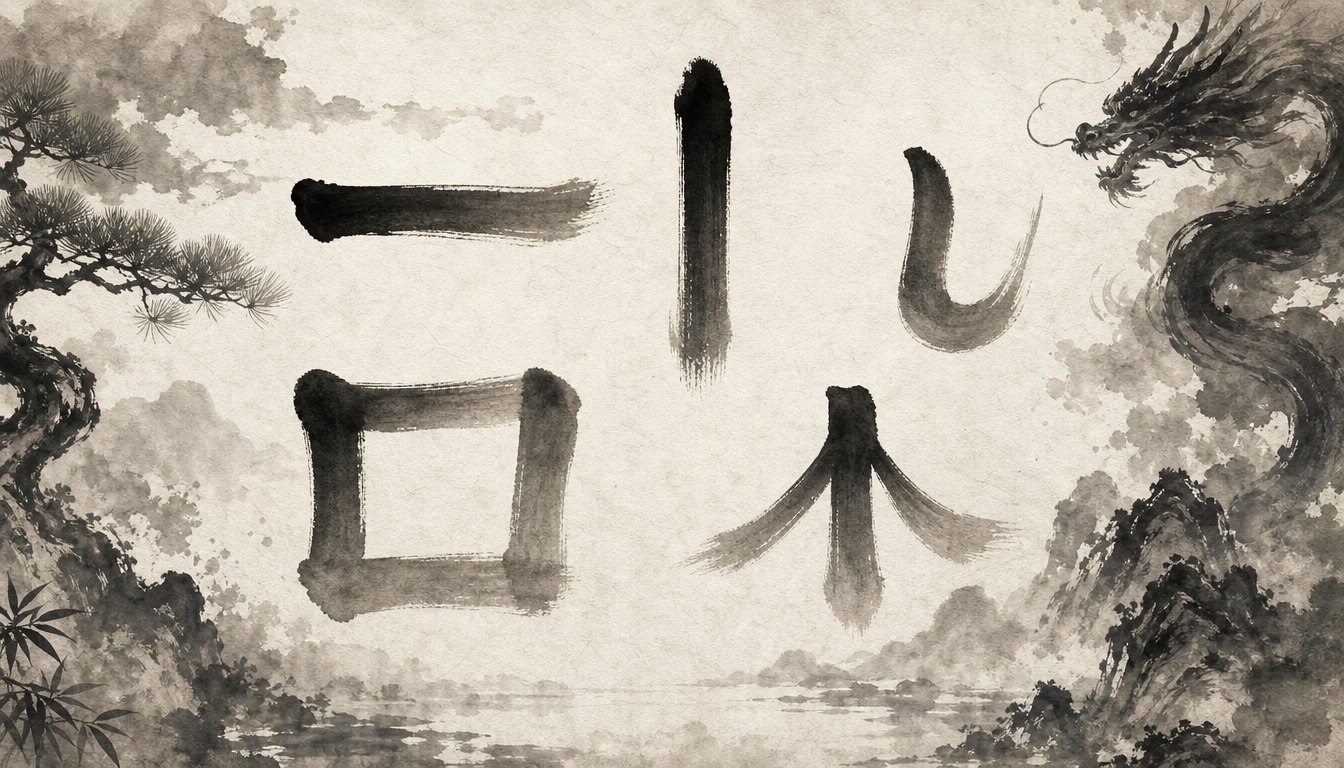
The dragon is a water god across much of East Asia, a bringer of rain and a symbol of ascendant power. Writing its character is a small act of respect toward that symbolism, so it deserves a little preparation before your brush touches the paper.
What you need:
- A pen with a consistent tip, or a brush and ink if you want the traditional feel
- Grid paper (genkō yōshi or simple square grid) to keep proportions even
- A stroke-order reference such as an animated dictionary entry from Takoboto or Jisho
- 10 to 15 minutes of unhurried attention
Prerequisites:
- You can recognize a horizontal stroke, a vertical stroke, and a simple hook
- You are comfortable writing a few basic kanji such as 十 or 木
The traditional dragon character 龍 has 16 strokes, according to Wiktionary. Its Japanese reading is りゅう (ryu-u). That stroke count is exactly why it makes such a good teacher: get 龍 right and lighter characters feel easy.
Stroke Order Rules and Why They Matter
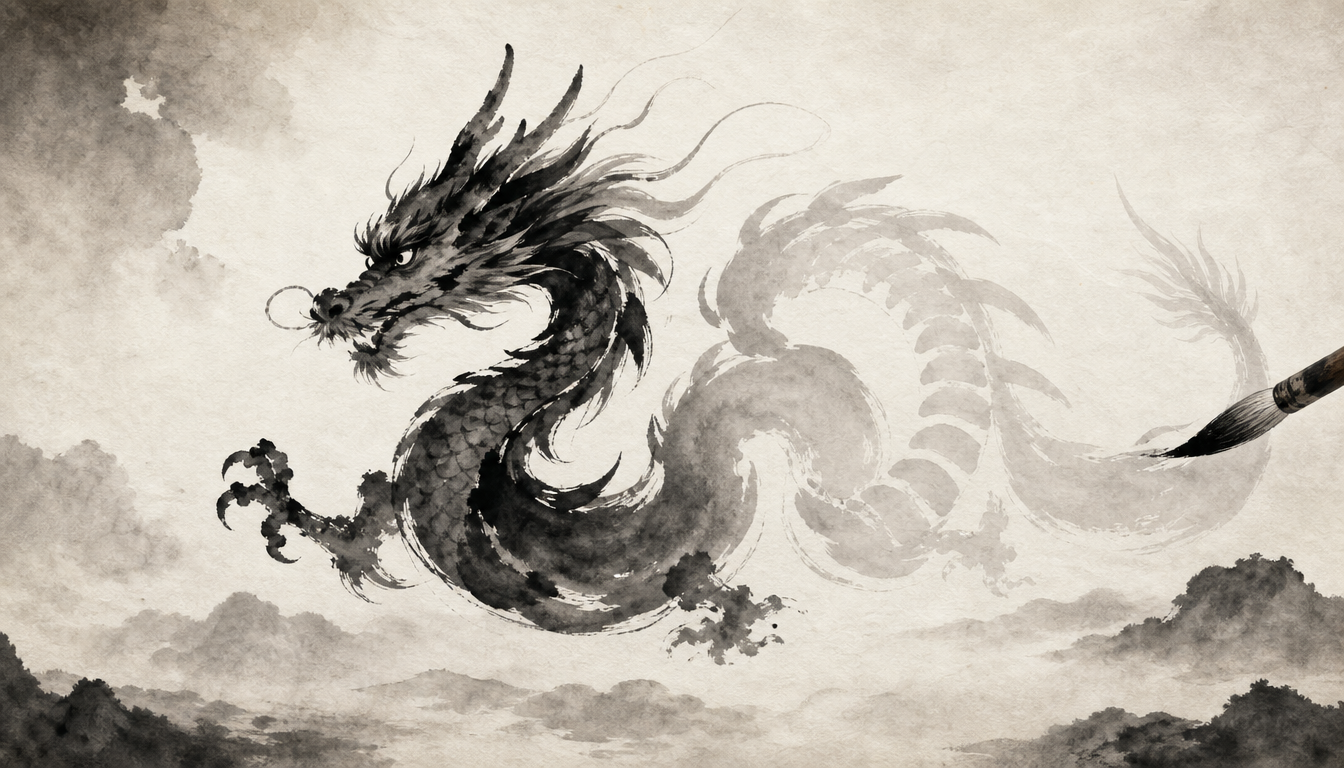
Every kanji is written as a fixed sequence of strokes in a fixed order. As Elon.io puts it, that order is not decorative tradition. It is what produces a balanced, legible character, and it is what the handwriting-recognition software on your phone silently assumes you are following. Learn the rules once and you can deduce the order of characters you have never written before.
English speakers often treat a kanji as a little picture and draw the lines in whatever order looks convenient. That habit produces characters that look subtly wrong to a Japanese reader, the way a signature traced by someone else looks off. The rules exist so each stroke lands in the right place at the right size.
The diagram below summarizes the core rules you will apply to the dragon.
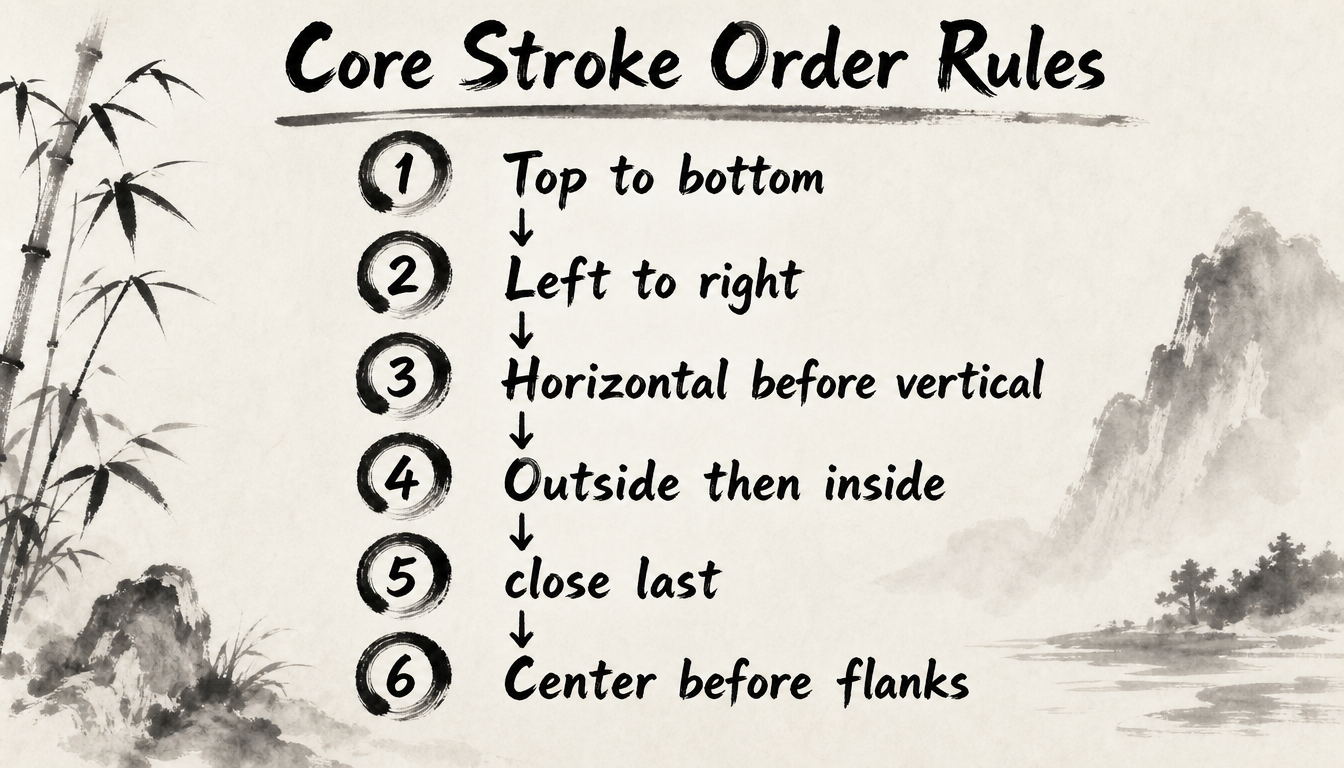
Here are the principles that carry you through almost any character:
- Top to bottom. Upper strokes and components come before lower ones.
- Left to right. Left-hand strokes and components come first.
- Horizontal before vertical when they cross. In 十 you draw the horizontal bar left to right, then the vertical top to bottom.
- Outside before inside, then close the box. For an enclosure like 国, you draw the outer frame, fill the inside, then seal the bottom line last.
- Center before flanking strokes in symmetrical characters such as 水.
Master these five rules and you already know most of how to write dragon kanji. The dragon simply asks you to apply them many times in a row, on the left side first, then on the right.
How to Write Dragon Kanji: Step-by-Step
The dragon character breaks cleanly into two halves. The left side (立 over 月-like body) is built first, then the tall right side with its stacked horizontal lines. Work through it slowly and keep each component inside its own imaginary square.
Step 1: Build the top-left component
Start at the top left and write the 立 ("stand") shape: a short top dot and horizontal, then the two short side strokes, then the wide base line. Go top to bottom, left to right within the shape.
→ You should have a compact, balanced 立 sitting in the upper-left quarter.
Step 2: Write the left-side body beneath it
Below the 立, add the moon-like 月 body: the outer frame first (left vertical, then the top-and-right hook), then the two short horizontal strokes inside, top one first.
→ The whole left half now reads as a stacked column, roughly half the character's width.
Step 3: Anchor the top of the right side
Move to the right half. Begin its top strokes, working from the upper marks downward. Keep this side slightly taller and narrower than the left so the two halves balance rather than fight.
→ The right column should start clearly to the right of the left half, not overlapping it.
Step 4: Stack the horizontal lines
The right side of 龍 is famous for its ladder of short horizontal strokes crossed by a vertical. Draw each horizontal left to right, working top to bottom, then the vertical that binds them. This is the top-to-bottom rule repeated in miniature.
→ The horizontals should be evenly spaced, like rungs, not crowded at one end.
Step 5: Finish the lower-right strokes
Complete the remaining short strokes at the base of the right side, closing the character from the bottom. Lift your pen cleanly on the final stroke.
→ Standing back, both halves should share the same top and bottom lines and feel equal in visual weight.
Count your strokes as you go. If you finish and the total is not 16, retrace slowly against an animated reference. A wrong count almost always means two strokes were merged into one, which is the single most common beginner error with complex kanji.
Completed Character and Common Mistakes
If you completed all five steps correctly, your 龍 will sit as two balanced columns of equal height, the left slightly wider, the right a neat ladder of horizontals bound by a vertical, and the whole thing filling its square without spilling over any edge. Held next to a printed 龍, the proportions should match.
Before you move on, check your work against the errors below. These are the mistakes that make a dragon look shaky even when every stroke is present.
| Symptom | Cause | Fix |
|---|---|---|
| Character leans or looks lopsided | Left and right halves drawn at different heights | Align both halves to the same top and bottom lines |
| Right side looks crowded | Horizontal "rungs" spaced unevenly | Space the horizontals equally, top to bottom |
| Stroke count comes out below 16 | Two strokes merged into a single pen movement | Lift the pen between strokes; retrace with an animation |
| Reader says it "looks wrong" | Strokes drawn bottom-up or right-to-left | Re-apply top-to-bottom, left-to-right order |
Dragon Kanji Variants: 龍 vs 竜
There are two dragon characters in Japanese, and choosing between them matters more than most learners realize. Both mean the same creature and share the same reading, りゅう. The difference is form and feeling.
竜 is the modern, simplified standard form (shinjitai), listed among the everyday-use kanji. 龍 is the older traditional form (kyūjitai), heavier with strokes and history. According to Kanji Pedia, the everyday-use form 竜 derives from an abbreviated popular variant of the older character.
| Aspect | 龍 (traditional) | 竜 (modern) |
|---|---|---|
| Status | Older traditional form | Everyday-use standard form |
| Feeling | Ornate, powerful, historical | Clean, simple, contemporary |
| Reading | りゅう / たつ | りゅう / たつ |
| Typical use | Names, brands, traditional or artistic contexts | General modern writing |
Research on modern usage from Hiroshima University notes that while 竜 has become the settled standard, the traditional 龍 remains stubbornly popular, especially in proper names and where writers want a nostalgic, aesthetic, or prestigious flavor. That is the practical takeaway for anyone planning a design.
If you want maximum visual drama and a sense of ancient power, 龍 delivers it with its dense strokes. If you want something legible and clean at small sizes, 竜 reads more clearly. Confirm the stroke order of whichever you choose, and never mirror the character for symmetry, since a reversed kanji reads as a mistake to anyone literate in Japanese.
This is exactly where meaning and form get lost in cheap character converters. A service like Oracle Kanji Writer, curated by Japanese creators, pairs each recommended character with its true readings, nuanced meanings, and cultural context, so the dragon you carry resonates as beautiful and correct in Japan rather than as a well-meaning error.
FAQ
What does 々 mean?
々 is not a kanji at all. It is a repetition mark that tells the reader to repeat the preceding kanji, so 人々 reads as "hitobito" (people) rather than requiring the character 人 to be written twice. It has no reading of its own and simply saves a stroke-heavy character from being drawn again.
What is 𱁬?
𱁬 is taito, a kokuji (a kanji invented in Japan) famous for being the most graphically complex CJK character. According to Wikipedia, it is written with 84 strokes and stacks tripled cloud and tripled dragon components, the dragon element being 龘, itself three 龍 characters. It is a curiosity rather than a practical character, but it shows how far the dragon radical can be piled up.
How many strokes does the dragon kanji have?
The traditional dragon 龍 has 16 strokes, according to Wikipedia, where it also serves as one of the 214 Kangxi radicals. The modern form 竜 is written with fewer strokes and is quicker to produce by hand.
Conclusion and Next Steps
You built the dragon in five moves: top-left component, left body, right-side top, the stacked horizontals, and the closing strokes, all governed by the top-to-bottom, left-to-right rules. Apply that same discipline and you can approach any character, which is why learning how to write dragon kanji teaches you far more than a single word. Next, practice 竜 for speed, then explore a character that reflects your own nature, so the kanji you write, or wear, carries meaning that is truly yours.
Discover Your Soul Kanji
Experience the depth of Japanese characters: each kanji carries timeless meaning, guiding your life's path.
No credit card required • 2-minute process