Kanji of the Day Vol.55 | "Kanji 樂 (Raku): The Joy Kanji Awakening Your Soul's Delight & Music"

楽 (raku / tanoshii) is the Japanese kanji for joy that also means music, ease, and comfort. Explore how it differs from 喜 and 悦, learn its kun and on readings, trace its origin from an ancient instrument on a wooden stand, and see why this gentle character resonates with mindfulness seekers choosing a meaningful personal symbol.
Kanji 樂 (Raku): The Joy Kanji Awakening Your Soul's Delight & Music

The kanji for joy written as 楽 (raku / tanoshii) carries a rare kind of double meaning: it points at once to lighthearted pleasure and to music itself. People drawn to this character tend to be seekers of ease, players of instruments, and anyone who wants their delight to feel effortless rather than forced. If you have ever chosen a Japanese character to represent your inner life, 楽 belongs on your shortlist as one of the most beautiful and versatile symbols of joy.

Discover Your Soul Kanji
Experience the depth of Japanese characters: each kanji carries timeless meaning, guiding your life's path.
No credit card required • 2-minute process
What 楽 Means as the Kanji for Joy
楽 sits at the center of a small family of Japanese characters that all orbit the idea of happiness. Its surface meanings are pleasure, comfort, ease, and music, and those threads run together rather than compete. When something feels 楽 in Japanese, it feels light, unstrained, the way a favorite melody carries you along without effort.
This is the flavor of joy that appeals to wellness and mindfulness communities. It is not a firework of excitement but a settled contentment, a sense that life can be lived without constant tension. That quality is why 楽 shows up in words about optimism and carefree living, and why it resonates so strongly with people practicing to soften their grip on stress.
楽 blends two experiences the West often keeps separate: the joy of ease and the joy of music. In Japanese, both live inside a single brushstroke.
| Item | Detail |
|---|---|
| Kanji | 楽 |
| Readings (On / Kun) | ラク・ガク / たの.しい・たの.しむ・この.む |
| Core meanings | Joy, pleasure, comfort, ease, music |
| Category | Emotion / spirit character |
| Related concepts | 喜 (rejoice), 悦 (delight), 笑 (laughter) |
| Contrast concept | 苦 (suffering, hardship) |
Multiple Kanji for Joy: 悦, 楽, and 喜 Compared
English collapses many shades of happiness into one word, but Japanese spreads them across several characters. Three of the most common kanji for joy are 楽, 喜, and 悦, and knowing the difference keeps you from choosing a character whose feeling does not match your intention.
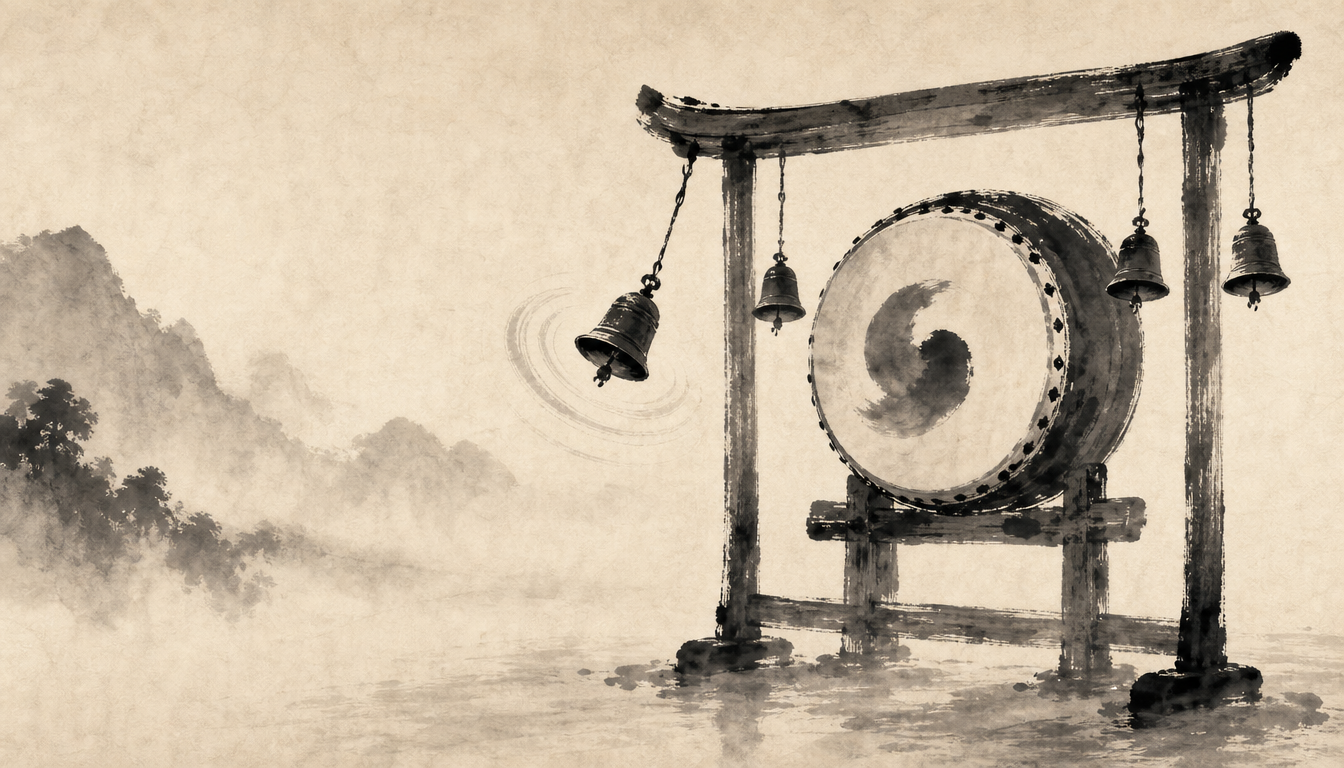
楽 leans toward ease and enjoyment, the pleasure of a comfortable moment or a piece of music. 喜 is a more active, celebratory joy. According to Kanji Code, 喜 is a pictograph showing a drum on a stand above a mouth, the image of someone beating a drum and singing in celebration, so its joy bursts outward. 悦 describes an inward, quietly savored delight; Jitenon lists its meanings as joy, pleasure, delighted, and ecstasy, with the on-reading エツ (etsu).
The comparison below sorts these three characters by the texture of the joy each one carries.
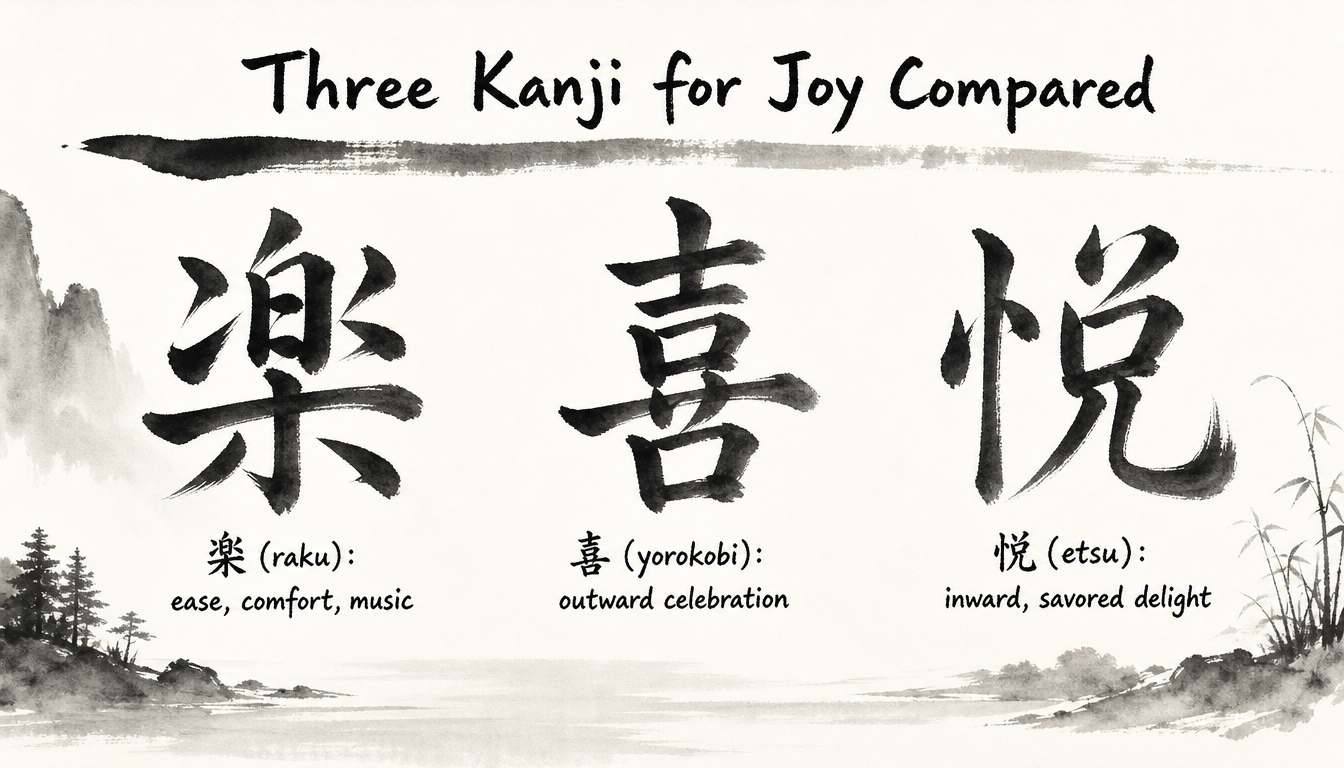
| Kanji | Feeling of joy | Typical use |
|---|---|---|
| 楽 | Ease, comfort, effortless enjoyment | Everyday pleasure, music, relaxed living |
| 喜 | Bright, outward celebration | Rejoicing at good news, congratulations |
| 悦 | Quiet, inward, savored delight | Refined or private satisfaction |
All three are authentic and beautiful. The right one depends on whether your joy is loud, restful, or turned inward, which is exactly the kind of nuance that separates a thoughtful choice from a dictionary grab.
From Ancient Ritual to the Modern Kanji for Joy

The origin of 楽 explains why it means both music and happiness. Ancient forms of the character are believed to depict a ritual object, a drum with bells or ornaments set upon a wooden stand. You can still see the wood element 木 anchoring the bottom of the modern character. Playing that instrument produced music, and music brought pleasure to those who heard it, so Kanji Code notes that this etymological root ties the character's two great meanings together in one image.
That history matters for anyone choosing 楽 as a personal symbol. The joy inside this character is not abstract. It grew out of sound, ceremony, and shared celebration, which gives it a warmth that a purely modern coinage could never have. When you wear or display 楽, you carry the memory of an instrument made to lift the human spirit.
The wood radical 木 at the base of 楽 is a fossil of its earliest form: an instrument on a wooden stand, built to make joyful sound.
Readings and Pronunciations of the Kanji for Joy
Like most Japanese characters, 楽 has two families of readings. The on'yomi come from the imitation of the original Chinese sounds, while the kun'yomi come from native Japanese words. According to Jisho.org, 楽 has kun-readings たの.しい (tanoshii), たの.しむ (tanoshimu), and この.む (konomu), and on-readings ラク (raku) and ガク (gaku).
The split is not random. The reading changes with the shade of meaning:
- ラク (raku) carries ease and comfort, as in feeling relaxed or at ease.
- ガク (gaku) attaches to music, as in the words for musical instruments and bands.
- たのしい (tanoshii) is the everyday adjective for fun and enjoyable.
- たのしむ (tanoshimu) is the verb, to enjoy oneself.
For a personal symbol, this flexibility is a gift. You can read your kanji for joy as raku for ease, gaku for music, or tanoshii for everyday fun, and each reading tells a slightly different story about you.
Compound Words and Everyday Life with 楽
Kanji rarely travel alone. Seeing 楽 inside common compounds shows how deeply the idea of joyful ease is woven into daily Japanese, and each pairing sharpens a different facet of the character.
- 楽しみ (tanoshimi) means enjoyment or looking forward to something. One reading of it, noted by a Japanese language writer, is "waiting to be happy," a lovely picture of anticipatory joy.
- 気楽 (kiraku) means carefree and at ease, a favorite of anyone chasing a lighter mindset.
- 楽観 (rakkan) means optimism, the disposition to expect good things.
- 快楽 (kairaku) means pleasure in a fuller, sensory sense.
These compounds come from Japanesetest4you, which lists 楽 at JLPT level N4, a sign of how common and foundational the character is. The same source shows 楽 in words for music too, such as the term for a military band, keeping both meanings alive in modern usage.
The character even sits inside 喜怒哀楽 (kidoairaku), the classic four-part expression for the full range of human emotion: joy, anger, sorrow, and pleasure. To hold 楽 is to hold one corner of the whole emotional map.
Choosing 楽 as Your Soul Kanji or Tattoo
楽 makes a strong personal symbol precisely because its joy is gentle and grounded. It suits people who value calm over chaos, who find happiness in music, quiet mornings, or the art of not overcomplicating life. Wellness practitioners often connect with it because ease is the goal of so much mindfulness work.
If you are considering it as a tattoo, a few practical points protect you from the classic mistakes that turn a meaningful character into an embarrassing one.
Confirm the correct stroke order and never mirror or rotate the character. A flipped or distorted 楽 reads as a mistake to any Japanese speaker, no matter how elegant the font looks.
Balance matters visually. 楽 has a symmetrical, layered structure that sits well vertically on a forearm or spine, and its wood base gives it a stable, rooted feel. Pairing it with a related character such as 喜 or 心 (heart) can deepen the meaning, though a single clean 楽 often speaks loudest.
This is where getting the meaning right becomes the whole point. A cheap converter might hand you a character that technically says "pleasure" but carries a sensory or even crude connotation you never intended. Oracle Kanji Writer, the Personalized Soul Kanji Diagnosis Tool, was built by Japanese creators to prevent exactly that. It matches a character to your name, birthdate, and inner qualities, then explains the pronunciation, layered meanings, and compound words so the symbol resonates in Japan as beautiful and true, not as a cliché.
FAQ
What is the Kanji symbol for joy?
Several kanji express joy, and 楽 is one of the most versatile, meaning joy, ease, comfort, and music. Others include 喜, an outward celebratory rejoicing, and 悦, a quiet inward delight. The best choice depends on the texture of joy you want to convey.
What is the Kanji for cheerful?
The everyday word tied to a cheerful, fun feeling is 楽しい (tanoshii), built from the kanji 楽. It describes something enjoyable and lighthearted, which is close to the English sense of cheerful when talking about experiences and moods.
What is the Japanese word for joy?
Japanese has several. 楽しみ (tanoshimi) captures enjoyment and happy anticipation, 喜び (yorokobi) captures rejoicing, and 悦 (etsu) captures a refined inner delight. Each word draws on a different kanji for joy, so the nuance shifts with your choice.
Conclusion
楽 rewards a closer look, and understanding it well makes it a far more meaningful choice than a random dictionary pick.
- 楽 (raku / tanoshii) means joy, ease, comfort, and music, all growing from one ancient image of an instrument on a wooden stand.
- Its readings split by meaning: raku for ease, gaku for music, and tanoshii for everyday fun.
- Among the kanji for joy, 楽 is restful, 喜 is celebratory, and 悦 is inward, so match the character to the joy you actually feel.
- Common words like 楽しみ, 気楽, and 楽観 show how deeply joyful ease runs through daily Japanese life.
If 楽 speaks to your sense of calm and delight, take the next step and let the right kanji for joy find you through a diagnosis grounded in authentic Japanese culture, so the character you carry is one that truly reflects your spirit.
Discover Your Soul Kanji
Experience the depth of Japanese characters: each kanji carries timeless meaning, guiding your life's path.
No credit card required • 2-minute process