Kanji of the Day Vol.9 | "Kanji 風 (Kaze): The Wind Kanji Carrying Your Spirit's Free Flow"

The wind kanji 風 (kaze) carries one of the most evocative meanings in Japanese: wind, breeze, and the intangible style of a person or place. In Vol.9 of Kanji of the Day, we unpack the kaze meaning, its on'yomi and kun'yomi readings, common compound words like wafū and taifū, and why this character speaks so deeply to free spirits, travelers, and anyone choosing a personal kanji symbol.
Kanji of the Day Vol.9 | Kanji 風 (Kaze): The Wind Kanji Carrying Your Spirit's Free Flow
Welcome to Vol.9 of Kanji of the Day. Today we sit with one of the most evocative characters in the Japanese language: kanji kaze — 風. The wind kanji, kaze meaning wind, breeze, and by extension style or manner, is the character chosen by people who refuse to be pinned down. It moves. It changes shape. It carries scent, sound, and season. If your spirit prefers flow over fixed form, this kanji may already feel like home.
風 (kaze) is the kanji for wind — a JLPT N5 character meaning wind, breeze, and the intangible way something feels. It belongs to free spirits, travelers, and seekers of unscripted lives.

Discover Your Soul Kanji
Experience the depth of Japanese characters: each kanji carries timeless meaning, guiding your life's path.
No credit card required • 2-minute process
The Kaze Meaning: One Character, Many Currents
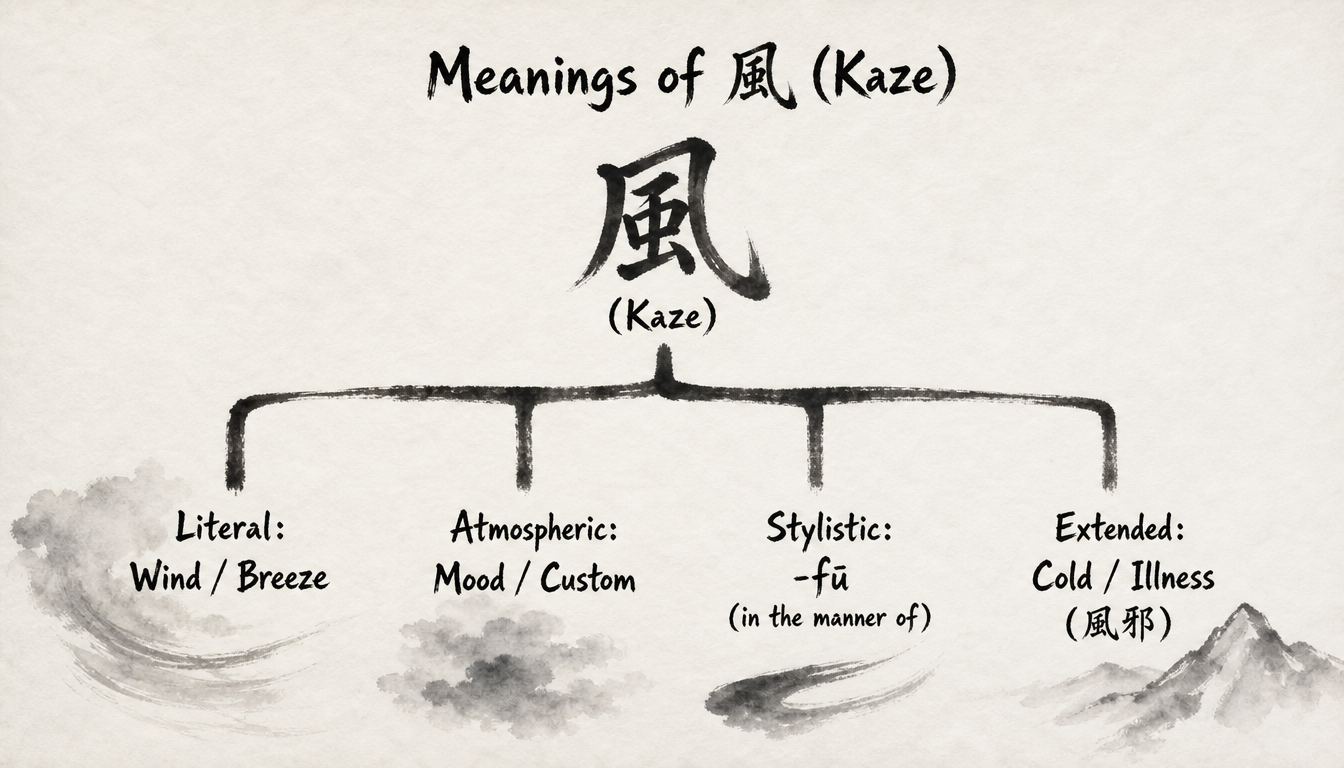
At its surface, the wind kanji 風 simply names a natural force — moving air. But Japanese has layered centuries of nuance onto this single glyph. 風 can mean wind, breeze, atmosphere, custom, appearance, or style. When a Japanese speaker says something has a certain fū, they are pointing to its overall feel — the invisible character that surrounds it, the way it carries itself.
This is why the kaze meaning resonates far beyond meteorology. The wind kanji captures something Japanese aesthetics value deeply: the beauty of what cannot be grasped, only felt. You don't see wind. You see what wind moves — leaves, hair, smoke, water. In the same way, 風 names the quality of a person, a place, or a moment that you can only sense.
Quick Facts: Kanji 風
| Item | Detail |
|---|---|
| Kanji | 風 |
| Primary meaning | Wind, breeze, style, manner |
| On'yomi | フウ (fū), フ (fu) |
| Kun'yomi | かぜ (kaze), かざ- (kaza-) |
| JLPT level | N5 (most sources); N4 (Kanshudo) |
| School grade | Grade 2 (Kanshudo) |
| Strokes | 9 |
| Category | Jōyō kanji (Wikipedia) |
The fact that 風 appears in the elementary kyōiku set — among the 1,026 characters Japanese children learn by graduation — tells you how foundational this concept is to Japanese life. Wind is not a poetic abstraction here. It is daily vocabulary, taught early, used constantly.
Onyomi and Kunyomi Readings of the Wind Kanji
Like most kanji, 風 carries two reading systems: the Chinese-derived on'yomi and the native Japanese kun'yomi. Knowing when each appears is the difference between sounding bookish and sounding natural.
On'yomi: フウ (Fū)
The on'yomi フウ (fū) — sometimes shortened to フ (fu) — appears in compound words, especially those that lean toward the abstract meaning of style or manner. Think of fū as the formal, conceptual voice of the kanji. When you describe a Japanese-style room as washitsu in a wafū aesthetic, that fū is doing the work of saying "in the manner of."
Kun'yomi: かぜ (Kaze)
The kun'yomi かぜ (kaze) is the warm, sensory native reading — the one you hear when someone opens a window and says kaze ga kimochii ("the breeze feels good"). According to Jisho.org, 風 read as kaze is a Common word at JLPT N5 level, meaning wind; breeze. There is also a bound form kaza- (as in kazakami, windward), used in older compounds.
Rule of thumb: kaze when the wind is literal and felt; fū when the wind has become a style, a flavor, or a mood.
Origin and Evolution: From Oracle Bone to Modern Form
The character 風 has an unusually poetic etymology. In its ancient forms, the glyph combined a sail-like enclosure with the element 虫 (which in old usage referred broadly to small creatures, including insects and serpents). Early Chinese cosmology associated certain winds with the movements of mythical creatures — dragons stirring storms, insects emerging on the warm spring breeze. Wind was something living things announced.
Over centuries, the form simplified into the elegant shape we know: an outer frame enclosing 虫. The frame suggests the curve of a sail or the sweep of moving air; the inner element preserves the ancient sense that wind brings life with it. This is why the wind kanji feels so alive on a page — its very structure remembers that air carries seeds, scents, and stories.
Common Jukugo: Compound Words with 風
To truly understand the kaze meaning, you need to see how Japanese builds with it. Here are common compounds (jukugo) that show 風 in action.
| Compound | Reading | Meaning | Nuance |
|---|---|---|---|
| 風邪 | kaze | A cold, the flu | Literally "evil wind" — illness believed to ride on bad air |
| 和風 | wafū | Japanese-style | Used for food, architecture, design |
| 洋風 | yōfū | Western-style | The natural counterpart to wafū |
| 台風 | taifū | Typhoon | The source of the English word "typhoon" |
| 風景 | fūkei | Scenery, landscape | Literally "wind + view" — what the wind reveals |
| 風呂 | furo | Bath | Often written お風呂 (ofuro); a daily ritual |
| 神風 | kamikaze | Divine wind | Originally the typhoons said to have saved Japan from invasion |
Notice the range. From the mundane (catching a cold, taking a bath) to the cosmic (divine winds, typhoons, sweeping landscapes), 風 threads through every register of Japanese life. The suffix -fū (KanjiDamage) attaches to countless words to mean "in the style of" — Itariafū (Italian-style), kofū (old-fashioned), jiyūfū (free-spirited).
Example Sentences
- 風が強い。 (Kaze ga tsuyoi.) — The wind is strong.
- 風邪をひいた。 (Kaze o hiita.) — I caught a cold.
- 和風の家が好きです。 (Wafū no ie ga suki desu.) — I like Japanese-style houses.
- 風のように自由。 (Kaze no yō ni jiyū.) — As free as the wind.
Symbolism: Why the Wind Kanji Speaks to Free Spirits
If you are drawn to 風, you are likely drawn to a certain way of being in the world. The wind kanji has gathered, over centuries, a constellation of meanings that reward people who live by feel rather than by formula.
Freedom and Movement
Wind goes where it wants. It does not negotiate with mountains; it shapes itself around them. People who choose 風 as a personal symbol often value autonomy, travel, and the refusal to be held in place. The phrase kaze no yō ni jiyū — free like the wind — is almost cliché in Japanese precisely because it captures something universal.
Change and Transience
Wind is the perfect Buddhist teacher: it arrives, it touches everything, it leaves. To live with the wind kanji as your symbol is to accept mujō — impermanence — not as loss but as the natural breath of existence. Seasons turn because wind turns them.
Influence Without Force
Wind doesn't push; it persuades. A reed bends because the wind has style, not strength. This is why fū also came to mean style and manner: real influence is atmospheric. You don't argue someone into your worldview — you let your presence move them, the way a breeze moves a chime.
Those who resonate with 風 tend to be adaptable, curious, allergic to rigidity, and quietly powerful. They lead through atmosphere, not authority.
The Wind Kanji as a Tattoo or Personal Symbol
For tattoo enthusiasts and anyone considering 風 as a personal emblem, a few honest notes:
Visual Balance
風 is visually beautiful — a closed outer frame that gives it weight and stability, with the inner 虫 element adding intricate movement. At 9 strokes, it is detailed enough to feel substantial but not so dense that it becomes a blot at small sizes. It sits well vertically (down the spine, along a forearm) and horizontally (across the collarbone, on the ribs).
Pairings That Work
- 風 + 自由 (kaze + jiyū) — wind and freedom; the explicit free-spirit statement
- 風 + 道 (kaze + michi) — wind and path; the wanderer's mark
- 風 + 心 (kaze + kokoro) — wind and heart; an inner life that moves
- 風 + 月 (kaze + tsuki) — wind and moon; classical Japanese aesthetic shorthand for natural beauty
A Word of Caution
Always confirm the final stroke order and orientation with a calligraphy reference or a native speaker before committing to ink. Mirrored or rotated kanji are unfortunately common in foreign tattoos and instantly read as inauthentic to Japanese eyes. The wind kanji deserves to flow correctly.
Common Misunderstandings About Kaze
| Misconception | Reality |
|---|---|
| "Kaze always means wind." | The reading kaze can also be 風邪 — a cold or flu. Context distinguishes them. |
| "風 is interchangeable with 空気 (kūki, air)." | 空気 is air as substance or atmosphere; 風 is air in motion, with feeling and direction. |
| "Kamikaze just means suicide pilot." | Originally kamikaze meant "divine wind" — the typhoons said to have repelled Mongol invasions. The wartime usage is a modern overlay. |
| "風 only has poetic meanings." | It's also everyday vocabulary — bath (風呂), cold (風邪), typhoon (台風), landscape (風景). |
Related Kanji in the Same Family
If 風 speaks to you, these neighboring characters likely do too:
| Kanji | Reading | Meaning | How it relates to 風 |
|---|---|---|---|
| 空 | sora / kū | Sky, empty | The space wind moves through |
| 雲 | kumo / un | Cloud | What wind sculpts and carries |
| 自由 | jiyū | Freedom | The value 風 most embodies |
| 気 | ki | Spirit, energy, air | The invisible life-force; wind's metaphysical cousin |
FAQ
What does Kaze mean in Japanese?
Kaze (風) primarily means wind or breeze in Japanese. It also carries the extended meanings of style, manner, or way — as in wafū (Japanese-style). Confusingly, the same sound kaze can also be written 風邪, meaning a cold or the flu, so context matters when you hear it spoken.
What is the kanji for kaze?
The kanji for kaze meaning wind is 風. It is a 9-stroke character, classified as JLPT N5 and taught in Grade 2 of Japanese elementary school according to Kanshudo. Its on'yomi readings are フウ (fū) and フ (fu); its kun'yomi is かぜ (kaze).
Is 風 a good kanji for a tattoo?
Yes — 風 is one of the most aesthetically and symbolically rich choices for a tattoo. It carries clean cultural meaning (wind, freedom, style), has a balanced visual form, and is universally understood in Japan. Just make sure the calligraphy is authentic and the stroke order is correct before committing.
What is the difference between fū and kaze?
Both are readings of 風. Kaze is the native Japanese reading, used for literal wind and in standalone contexts. Fū is the Sino-Japanese reading, used in compound words, especially those meaning style or manner — like wafū (Japanese-style) or fūkei (landscape).
Discover the Kanji That Represents You
The wind kanji is not for everyone — and that is exactly the point. The right kanji finds you because it already describes how you move through the world. If kanji kaze, wind kanji, kaze meaning has stirred something in you while reading this, that recognition matters. It might be your character. Or your character might be waiting for you under a different glyph entirely — one tied to your name, your birthdate, and the quiet shape of who you are.
Oracle Kanji Writer exists for exactly this moment. In about two minutes — no credit card, no email gate — our diagnosis tool reads your name, birthdate, and blood type to recommend a personalized Soul Kanji, complete with authentic pronunciation, layered meanings, a personal message, and downloadable art curated by Japanese creators. Whether you're planning a tattoo, designing a keepsake, or simply curious which character carries your spirit, this is where authentic meaning begins. Let the wind kanji lead you toward the one that's truly yours.
Discover Your Soul Kanji
Experience the depth of Japanese characters: each kanji carries timeless meaning, guiding your life's path.
No credit card required • 2-minute process