Kanji of the Day Vol.8 | "Kanji 花 (Hana): The Flower Kanji Blooming with Beauty & Soul"

The kanji hana (花) is far more than a word for flower — it's a 3,000-year-old symbol of beauty, transformation, and the bittersweet grace of impermanence. In this Vol.8 of Kanji of the Day, we explore the layered hana meaning, the structure of the flower kanji, its evolution from ancient pictograph, and why 花 remains one of the most beloved and meaningful characters in Japanese culture, names, and personal symbolism today.
Kanji of the Day Vol.8 | Kanji 花 (Hana): The Flower Kanji Blooming with Beauty & Soul
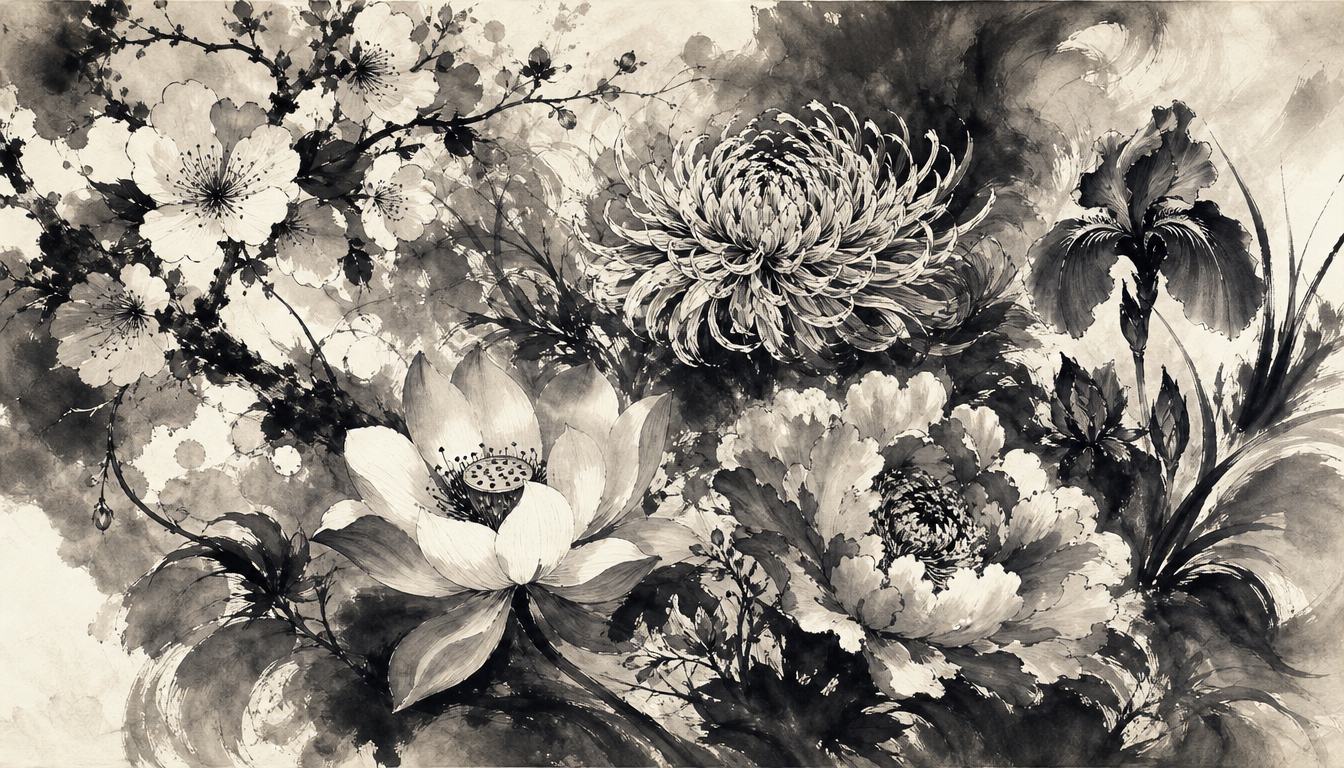
The kanji hana (花) is one of the most beloved characters in the Japanese language — a single brushstroke arrangement that captures the very essence of bloom, beauty, and fleeting grace. Whether you're drawn to the flower kanji for its visual elegance, its poetic depth, or its spiritual resonance, understanding the full hana meaning opens a doorway into Japanese aesthetics, philosophy, and the quiet art of noticing what blossoms around — and within — us.
In this Vol.8 entry of our Kanji of the Day series, we'll explore 花 not just as a word for "flower," but as a layered symbol that has shaped poetry, names, games, and even the philosophy of how the Japanese see life itself.
Discover Your Soul Kanji
Experience the depth of Japanese characters: each kanji carries timeless meaning, guiding your life's path.
No credit card required • 2-minute process
Quick Facts: The Flower Kanji at a Glance

Before we bloom into the deeper layers, here's a snapshot of 花 — its readings, structure, and place in the writing system.
| Attribute | Detail |
|---|---|
| Kanji | 花 |
| Kun'yomi (Japanese reading) | はな (hana) |
| On'yomi (Sino-Japanese reading) | カ (ka) |
| Core Meaning | Flower, blossom, bloom |
| Radical | 艹 (kusakanmuri — "grass" radical) |
| JLPT Level | N5 (introductory) |
| Common Variant | 華 (also read hana, more ornate nuance) |
According to Jisho.org, 花 appears in over 400 distinct words, making it one of the most generative single characters in the Japanese lexicon.
Multiple Meanings of 花 (Hana): Flower, Beauty, and Beyond
Ask a Japanese speaker what 花 means, and they'll likely smile and say "flower." But that's only the first petal. The kanji hana carries a constellation of meanings that ripple outward from the literal bloom.
1. Flower, Blossom, Petal
The most direct meaning. 花 refers to any flower — a rose, a lily, a dandelion. It's the word a child learns first, and the word a poet returns to forever.
2. Cherry Blossom (Sakura), by Default
Here's something beautiful: in classical and even modern Japanese context, when someone simply says hana without specifying, it often means cherry blossom specifically. The sakura is so culturally central that it became the default flower. As Jisho.org notes, this secondary meaning is officially recognized in dictionaries.
3. Beauty, Glory, the "Best" of Something
花 also means beauty itself — the prime, the peak, the most splendid version of a thing. There's a Japanese proverb, iwanu ga hana (言わぬが花) — literally "not saying is the flower" — meaning some things are more beautiful left unspoken.
4. Hanafuda — The Flower Cards
花 lives on in hanafuda (花札), a traditional Japanese card game where each card depicts plants, animals, and seasonal motifs. The very name means "flower cards."
When a Japanese person calls someone or something hana, they may mean "flower" — but they might also mean "the most beautiful," "the highlight," or "the soul of the moment." Context is everything.
Kanji Stroke Order, Radicals, and Writing System
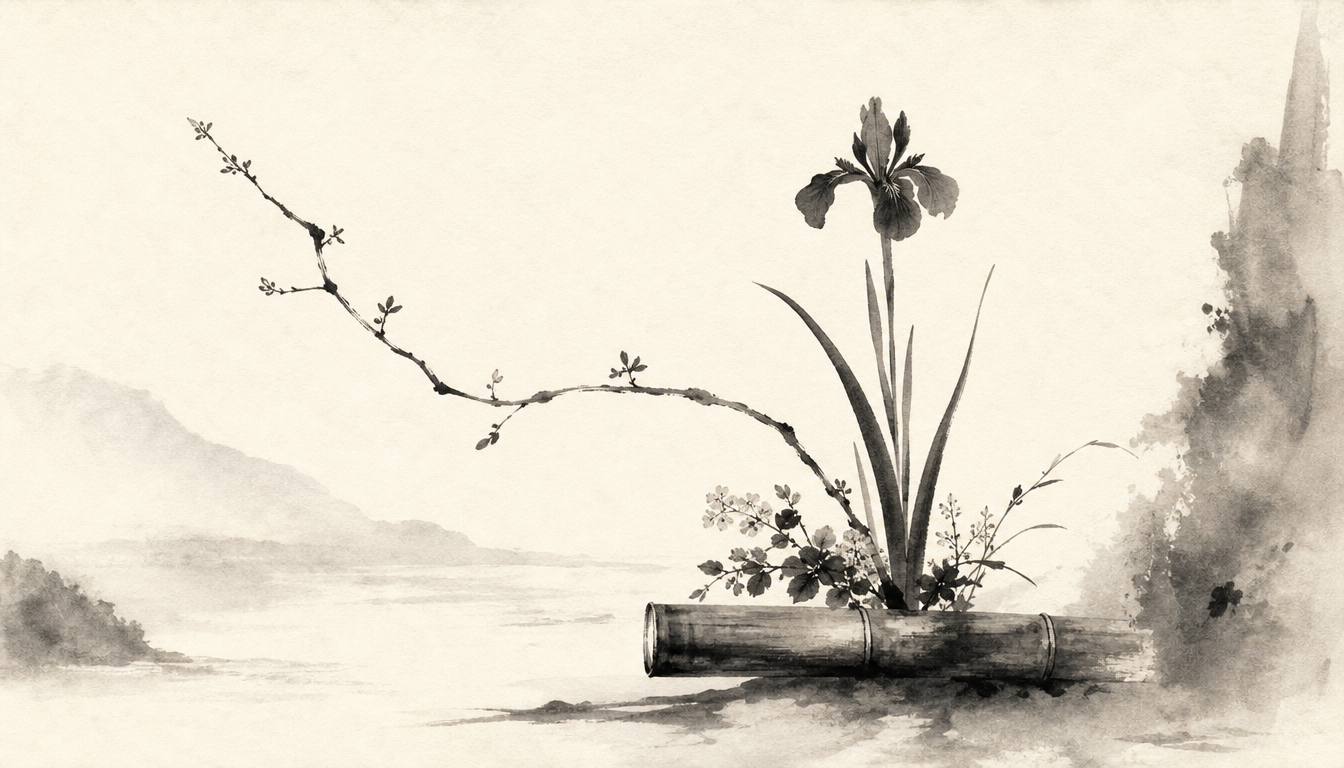
The visual structure of 花 is a small lesson in how Japanese characters carry meaning through their parts. The flower kanji is composed of two clear elements stacked vertically.
The Radical: 艹 (Kusakanmuri)
At the top sits 艹, the "grass" or "plant" radical, called kusakanmuri ("grass crown"). It's a stylized image of two small sprouts and instantly tells the reader: this character has something to do with plants. You'll see this same radical in 草 (grass), 茶 (tea), and 葉 (leaf).
The Phonetic-Semantic Component: 化
Below the grass crown is 化 (ka), which on its own means "change" or "transformation." In 花, it serves a dual role: it hints at the on'yomi reading ka, and poetically suggests the transformation of a bud into a bloom. A flower, after all, is a plant in the act of changing.
Stroke Order (7 strokes total)
- Horizontal line of the grass radical (left side)
- Horizontal line of the grass radical (right side)
- Vertical drop on the left of 艹
- Vertical drop on the right of 艹
- Left-falling stroke of 化 (the person radical 亻)
- Vertical line of 亻
- The hooked finishing stroke of 匕
Always write top-to-bottom, left-to-right. The grass radical comes first, then the lower component.
Stroke counts for the most common characters are officially fixed for the 1,026 kanji taught in Japanese elementary schools, the kyōiku kanji, per the Ministry of Education (Japanese Stack Exchange). 花 is among the very first kanji children learn.
花 in the Jōyō Kanji System
花 is part of the official jōyō kanji list — the 2,136 characters designated for everyday use in Japan (Wikipedia). It's classified as a Grade 1 kanji, meaning it's introduced in the first year of elementary school.
From Ancient Pictograph to Modern Bloom: The Origin of 花
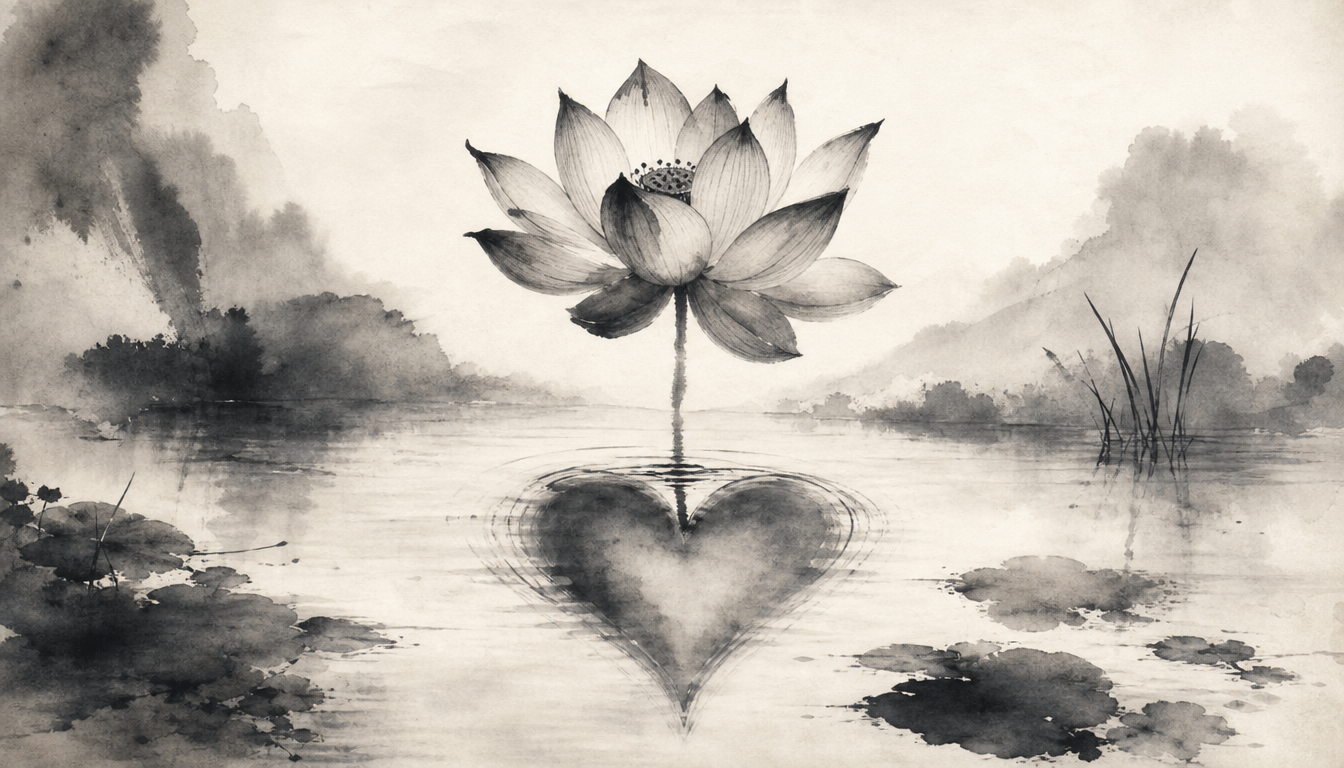
The story of how 花 became 花 is a quiet 3,000-year journey from earth to ink.
The diagram below illustrates how the flower kanji evolved from its ancient components to the modern form we recognize today.
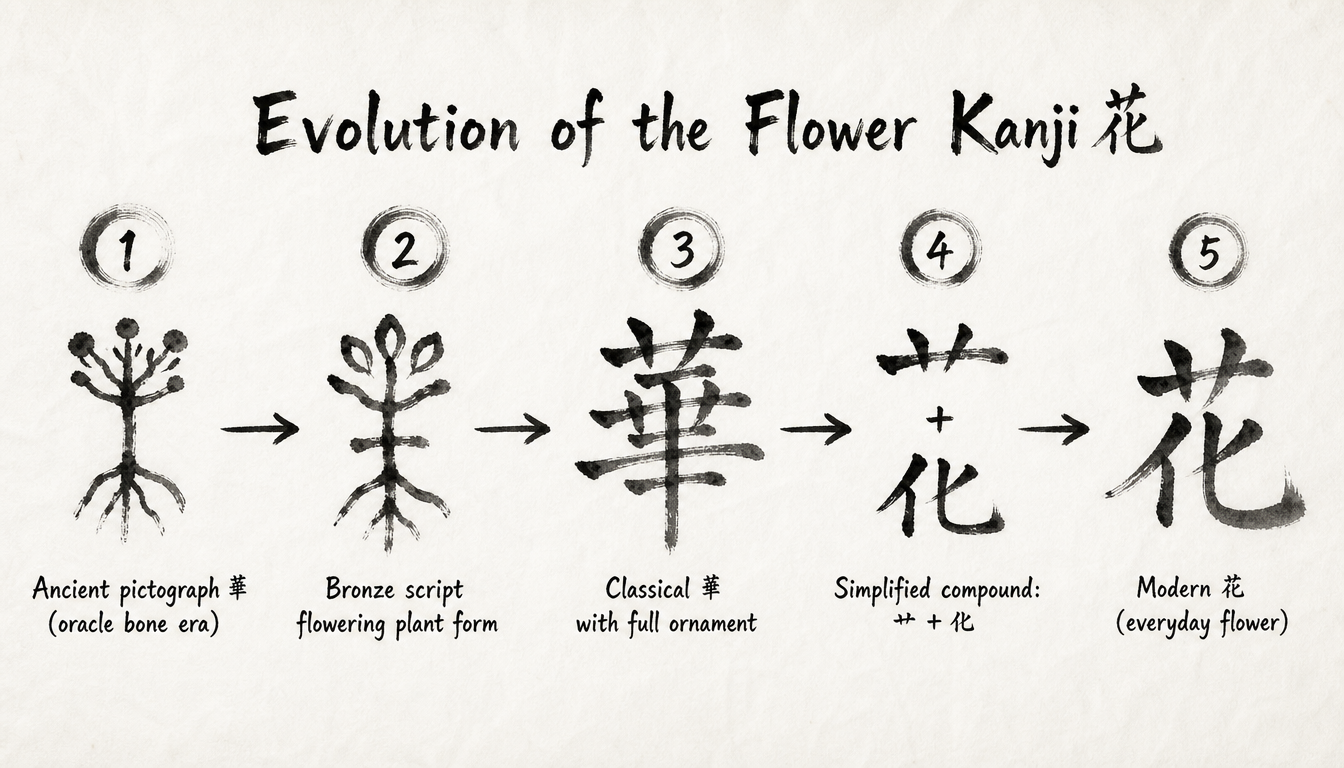
In the earliest oracle bone and bronze inscriptions of ancient China, the concept of "flower" was often written as 華 — a complex pictograph depicting a flowering plant with drooping blossoms. Over centuries, scribes sought a simpler, more efficient form, and 花 emerged as a phonetic-semantic compound: the grass radical 艹 for category, plus 化 for sound and the poetic hint of transformation.
Today, both 華 and 花 are read as hana in Japanese, but they carry slightly different flavors:
- 花 — the everyday, organic flower; warm, natural, accessible.
- 華 — splendor, glamour, ornate beauty; often used in names and elevated contexts.
This is why ikebana (生け花) — the Japanese art of flower arrangement — uses 花, while words like 華麗 (karei, "splendid") use 華.
Hana in Names, Compounds, and Daily Life
Few kanji are as versatile or as widely loved as 花. Here are some of the most evocative compounds and uses.
Beautiful Compound Words (Jukugo)
- 花火 (hanabi) — "flower fire" → fireworks. A bloom in the night sky.
- 花見 (hanami) — "flower viewing" → the spring tradition of picnicking under cherry blossoms.
- 花束 (hanataba) — "flower bundle" → bouquet.
- 花瓶 (kabin) — "flower vessel" → flower vase (uses the on'yomi ka).
- 生け花 (ikebana) — "living flowers" → the meditative art of arrangement.
- 花嫁 (hanayome) — "flower bride" → bride.
Hana as a Name
Hana is one of the most popular Japanese girls' names, written variously as 花, 華, 葉菜, or in hiragana はな. It carries connotations of grace, natural beauty, and gentle strength. It's also a name that travels well internationally — Hana is recognized in Czech, Arabic, Korean, and Hawaiian cultures, each with its own meaning.
Symbolism, Philosophy, and the Soul of 花
To understand why kanji hana resonates so deeply, we have to look past botany and into Japanese philosophy.
Mono no Aware: The Pathos of Things
Japanese culture famously cherishes mono no aware — a bittersweet awareness of impermanence. Nothing embodies this more than the cherry blossom, which blooms gloriously for only a week before scattering. The hana meaning isn't just "flower" — it's the beauty that exists precisely because it doesn't last.
The Flower as Inner Essence
The legendary Noh theater master Zeami wrote that a true performer must possess hana — an inner flower, a vital presence that captivates without effort. In this sense, 花 became a metaphor for charisma, soul, and authentic personal magnetism. To have hana is to bloom in the eyes of others, not by trying, but by being.
Choosing 花 as a Personal Symbol
People drawn to the flower kanji often share certain qualities: a sensitivity to beauty, a respect for cycles and seasons, and a quiet confidence in their own unfolding. If 花 feels like "your" character, it may be reflecting something already true about you.
The kanji 花 reminds us that blooming is not a performance — it's a release. The flower doesn't try to be beautiful. It simply opens.
Hana as a Tattoo or Personal Kanji
The flower kanji is one of the most requested kanji tattoos worldwide — and for good reason. It's visually balanced, instantly readable to Japanese viewers, and carries layered meaning without being aggressive or cliché.
Visual Strengths
- Symmetrical top (the grass radical) for clean composition.
- Compact 7-stroke form — works at small or medium sizes.
- Pairs gracefully with other natural kanji (月 moon, 風 wind, 光 light).
What to Watch For
Always confirm stroke order from a reliable source before getting inked — a mirrored or distorted 花 reads as nonsense to a Japanese viewer. Also consider whether you want 花 (organic, gentle) or 華 (ornate, glamorous). They sound the same but carry different feelings.
Beautiful Pairings
- 花月 (kagetsu) — flower and moon, an aesthetic of natural beauty.
- 花心 (hanagokoro) — "flower heart," a tender, blossoming spirit.
- 桜花 (ōka) — cherry blossom, doubled for emphasis.
Finding the Right Personal Kanji
While 花 is gorgeous, it isn't right for everyone. If you're searching for a character that truly reflects your inner essence, tools like Oracle Kanji Writer can match you with a personalized "Soul Kanji" based on your name, birthdate, and personal qualities — ensuring the character you choose actually represents who you are, not just what looks pretty.
FAQ
What does the kanji hana mean?
The kanji 花 (hana) primarily means "flower," "blossom," or "bloom." But it also carries secondary meanings of "beauty," "the best of something," and even "cherry blossom" by default in Japanese. In poetry and philosophy, 花 represents inner essence, charisma, and the bittersweet beauty of impermanence.
Is 花 a good kanji for a tattoo?
Yes — 花 is one of the most popular and visually balanced kanji choices for tattoos. It's universally understood, carries positive meaning, and works well in many styles. Just make sure the stroke order is correct and the character isn't mirrored. Pairing it with another kanji can deepen the personal meaning.
What's the difference between 花 and 華?
Both are read hana and both relate to flowers, but 花 refers to the organic, everyday flower, while 華 conveys ornate splendor, glamour, and elevated beauty. 華 is more common in names and refined compounds; 花 is the natural, gentle choice for daily use.
How many strokes does 花 have?
The kanji 花 is written in 7 strokes, beginning with the grass radical 艹 on top and finishing with the 化 component below. It's one of the first kanji taught in Japanese elementary schools.
Conclusion: The Flower That Keeps Blooming
The kanji hana is far more than a word for flower. It's a 3,000-year-old meditation on beauty, change, and the quiet power of letting yourself unfold. Whether you're drawn to 花 for its visual elegance, its poetic depth, or its philosophical weight, here's what's worth carrying forward:
- 花 means flower, blossom, beauty, and the "best" of something — all at once.
- It's built from 艹 (grass radical) + 化 (change), suggesting a plant in the act of transforming.
- It appears in beloved words like 花火 (fireworks), 花見 (cherry blossom viewing), and 生け花 (ikebana).
- Philosophically, 花 embodies mono no aware — beauty made deeper by its impermanence.
- As a personal symbol, it suits people who value grace, sensitivity, and authentic presence.
If the flower kanji speaks to you, let it. And if you'd like to discover the kanji that truly reflects your own soul — beyond the obvious picks — explore your personalized Soul Kanji and find the character meant for you.
Related Kanji to Explore: 美 (Beauty) · 光 (Light) · 月 (Moon) · 春 (Spring)
Discover Your Soul Kanji
Experience the depth of Japanese characters: each kanji carries timeless meaning, guiding your life's path.
No credit card required • 2-minute process