Kanji of the Day Vol.7 | "Kanji 光 (Hikari): The Light Kanji Illuminating Your Inner Radiance"

The kanji 光 (hikari) means light — but it carries far more than physical brightness. From its six-stroke pictographic origin of a person bearing a flame to its modern role as a beloved name and tattoo symbol, 光 represents hope, guidance, and inner radiance. In Vol.7 of our Kanji of the Day series, we explore its readings, structure, compound words, and why this light kanji resonates so deeply with seekers of meaningful Japanese symbols.
Kanji of the Day Vol.7 | "Kanji 光 (Hikari): The Light Kanji Illuminating Your Inner Radiance"
The kanji hikari (光) is one of the most beloved characters in the Japanese language — a single brushstroke composition that captures something universal: light, radiance, hope, and the quiet glow within. Whether you're researching the light kanji for a tattoo, drawn to its meaning for a personal symbol, or simply curious about Japanese aesthetics, understanding the full hikari meaning reveals layers of beauty far beyond a literal translation.
In this seventh issue of our Kanji of the Day series, we explore 光 — its readings, structure, symbolism, and why it resonates so deeply with people seeking a kanji that reflects their inner essence.
Discover Your Soul Kanji
Experience the depth of Japanese characters: each kanji carries timeless meaning, guiding your life's path.
No credit card required • 2-minute process
What 光 Means at a Glance
光 means light — but not just any light. It carries the warmth of sunlight, the gentleness of moonlight, the spark of hope in darkness, and metaphorically, the radiance of a person's spirit or future.
| 項目 (Item) | 内容 (Detail) |
|---|---|
| Kanji | 光 |
| English meaning | Light, radiance, brightness, hope |
| On'yomi (Chinese reading) | コウ (kō) |
| Kun'yomi (Japanese reading) | ひか-る (hika-ru) / ひかり (hikari) |
| Category | Jōyō kanji, Kyōiku kanji (Grade 2) |
| Related concepts | 明 (bright), 輝 (shine), 照 (illuminate) |
| Contrasting concept | 闇 (yami / darkness) |
| Usage frequency | Very high — everyday vocabulary |
According to the List of jōyō kanji, 光 carries the on-reading コウ (kō) and the kun-reading ひか-る (hika-ru). It belongs to the Kyōiku kanji set, which the Kyōiku kanji entry describes as a subset of 1,026 characters out of the 2,136 characters of jōyō kanji — meaning Japanese children learn 光 in elementary school.
The Deeper Meaning of the Light Kanji
On the surface, 光 simply means "light." Yet in Japanese culture, light is rarely just a physical phenomenon. It is a metaphor for hope, guidance, clarity of mind, and the unseen radiance of a person's character.
Think of how often we use light metaphorically in English: "a guiding light," "the light at the end of the tunnel," "she lit up the room." Japanese deploys 光 in remarkably similar ways — but with a softer, more contemplative tone. To call someone 光 is to suggest they bring warmth and clarity to those around them, often without effort or announcement.
This is why 光 appears so frequently in poetry, prayer, lyrics, and personal names. It speaks of the kind of brightness that does not blind — the brightness that comforts.
The hikari meaning extends beyond physical light to encompass hope, guidance, and inner radiance — the qualities that quietly illuminate one's path through life.
Why 光 Resonates with Modern Seekers
For tattoo enthusiasts, mindfulness practitioners, and anyone drawn to Eastern philosophy, the appeal of 光 is its dual nature. It feels both grounded and transcendent. A single character — six strokes — and yet it can represent a lifetime of intention: to live with clarity, to bring warmth to others, to remain hopeful in difficult times.
On'yomi, Kun'yomi, and How to Read 光
The light kanji has two main reading categories used in modern Japanese: the on'yomi (Sino-Japanese reading) and the kun'yomi (native Japanese reading).
- On'yomi: コウ (kō) — used primarily in compound words (jukugo), such as 光線 (kōsen, "light ray") or 観光 (kankō, "sightseeing").
- Kun'yomi: ひかり (hikari) — used as a standalone noun meaning "light," and as the verb 光る (hikaru), "to shine."
The reading hikari is also one of the most popular Japanese given names, particularly for girls, though it works as a unisex choice. The name evokes purity, hope, and a quiet inner brilliance — qualities Japanese parents treasure.
Common Compounds Using 光
| Compound | Reading | Meaning |
|---|---|---|
| 光線 | kōsen | Light ray, beam |
| 観光 | kankō | Sightseeing, tourism |
| 日光 | nikkō | Sunlight (also a famous city) |
| 月光 | gekkō | Moonlight |
| 栄光 | eikō | Glory, honor |
Notice how each compound layers meaning onto the base concept of light — sunlight, moonlight, glory, the radiance of travel and discovery. The kanji 光 acts almost like a prefix of luminosity.
Stroke Count, Radical, and Visual Structure
Visually, 光 is one of the most elegant kanji in the entire Japanese writing system. It is composed of 6 strokes, a number that gives it a balanced, easy-to-write quality without sacrificing visual richness.
The top portion of the character is often interpreted as flickering rays or flames, while the bottom portion (儿) represents a person — sometimes read as legs or a kneeling human figure. Put together, the imagery is striking: light rising above a person, or a person carrying light. In ancient pictographic interpretations, 光 is thought to depict a person bearing a flame above their head — a torchbearer, a beacon, a living source of brightness.
This pictographic reading is one reason 光 feels so personal. Unlike abstract kanji, it shows a human relationship to light: we are not separate from light; we carry it.
When practicing 光, start with the three small strokes at the top (left dot, right dot, central downward stroke), then write the horizontal line, and finish with the curved "legs" at the bottom. Stroke order matters for visual balance — especially if you plan to use it in art or tattoo work.
Good Uses vs. Common Mistakes with 光
Because 光 is so visually appealing, it is one of the most-requested kanji for tattoos and personal art. But meaning and context matter enormously. Here is a quick comparison:
| Aspect | Good Use | Poor Use |
|---|---|---|
| Intention | Chosen to reflect personal hope, guidance, or inner warmth | Picked purely because it "looks cool" |
| Context | Standalone or paired with a meaningful complementary kanji (e.g., 光道, "path of light") | Combined with random kanji that produce awkward or unintended meanings |
| Visual execution | Authentic brushwork or clean typography by someone familiar with Japanese | Mirrored, distorted, or written in incorrect stroke order |
Frequent Misunderstandings
| Misconception | Correct Understanding |
|---|---|
| "光 and 明 mean the same thing" | 光 emphasizes light as substance/radiance; 明 emphasizes brightness as a state or clarity. |
| "光 is only a feminine name" | While popular for girls, 光 (Hikaru) is also common as a male name and works as unisex. |
| "光 just means a light bulb's light" | It includes physical light but also hope, guidance, and metaphorical inner radiance. |
| "光 is a complicated kanji" | It's actually a Grade 2 elementary kanji — simple to write but rich in meaning. |
How 光 Compares to Related Light Kanji
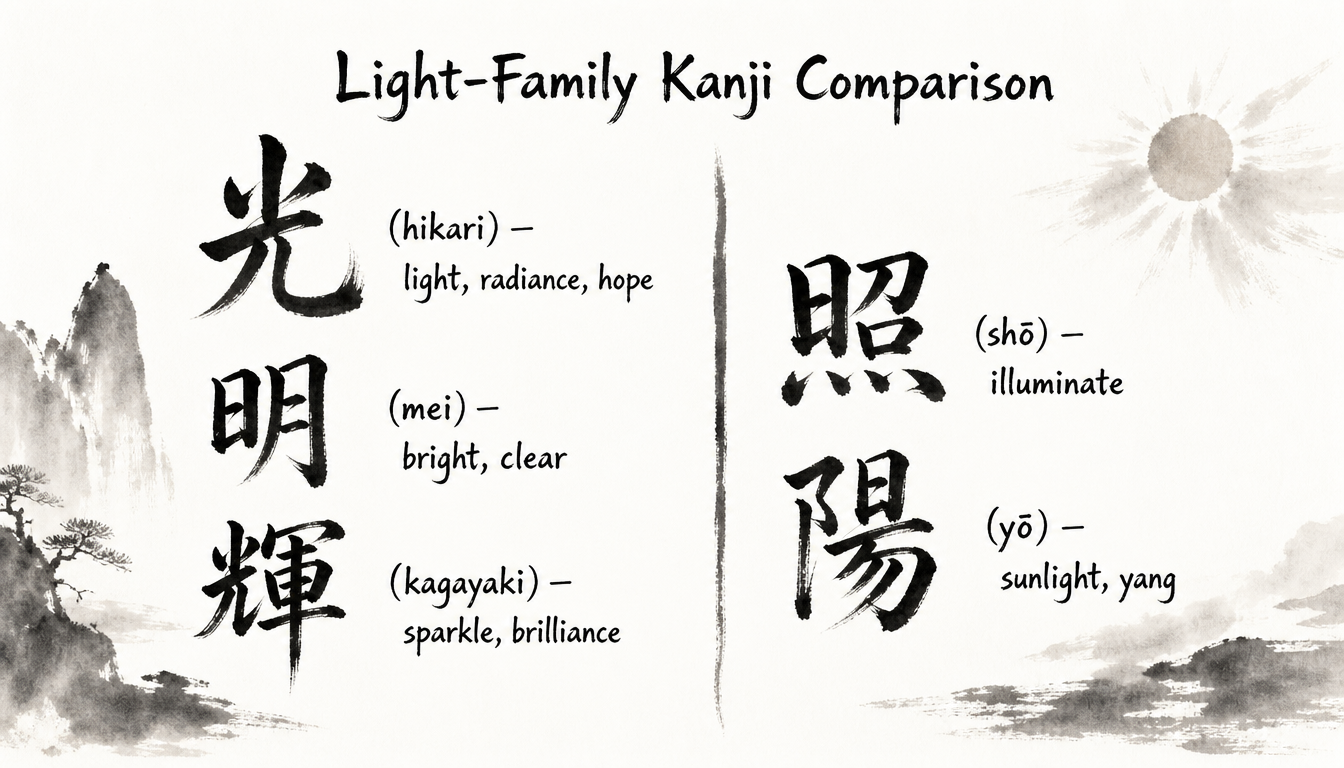
Several kanji in Japanese share territory with 光, but each carries a distinct nuance. Choosing the right one is the difference between a meaningful personal symbol and a generic translation.
| Kanji | Meaning | How it differs from 光 |
|---|---|---|
| 明 (mei / akari) | Bright, clear | Emphasizes brightness as clarity or understanding (also "tomorrow") |
| 輝 (ki / kagayaki) | Sparkle, brilliance | Suggests dazzling, intense, almost theatrical shine |
| 照 (shō / terasu) | To illuminate | An active verb — light directed onto something |
| 陽 (yō / hi) | Sunlight, yang | Specifically solar warmth and positivity |
Where 輝 dazzles and 照 illuminates outward, 光 simply is. It exists. It glows. It does not demand attention — and this quiet quality is precisely why so many people choose it as their personal kanji.
Using 光 as a Personal Symbol or Tattoo
Choosing 光 as a tattoo or personal emblem is a thoughtful decision. Its symmetry makes it visually appealing on the forearm, shoulder blade, or behind the ear, while its compact six-stroke form translates beautifully in calligraphic styles — from bold sumi-e brushwork to minimalist line art.
If you are considering 光, here are a few practical suggestions:
- Confirm stroke order. A character written in the wrong order can look subtly "off" to Japanese eyes, even if the final shape is correct.
- Avoid mirroring. Never flip the character — a mirrored 光 is not 光.
- Consider pairings carefully. 光 pairs beautifully with kanji like 道 (path), 心 (heart), or 希 (hope) — but only when the combination forms a coherent meaning.
- Choose a calligraphic style intentionally. Kaisho (block) feels formal and clear; gyōsho (semi-cursive) feels organic and warm; sōsho (cursive) feels artistic and abstract.
Before committing 光 to skin or art, see it written by hand. The character changes character — pun intended — depending on the brush. A printed font version and a hand-brushed version can feel like two different symbols.
Discovering Your Own Soul Kanji
If 光 resonates with you, that's no accident — it speaks to something many people quietly long for: to be a source of warmth, to walk forward with hope, to illuminate without overpowering. But 光 is just one of thousands of meaningful kanji, and the one that truly reflects your essence may be different.
This is where Oracle Kanji Writer comes in. Rather than guessing or relying on a translator that misses cultural nuance, Oracle Kanji Writer offers a personalized Soul Kanji diagnosis — a two-minute, no-credit-card process that uses your name, birthdate, and blood type to suggest a kanji aligned with your inner qualities and life path. Each result is curated by Japanese creators who understand both the aesthetics and the cultural weight of the character, complete with readings, layered meanings, and a personal message.
Whether 光 turns out to be your kanji or simply a doorway into the world of Japanese symbolism, the journey of discovering a character that truly fits you is one of the most quietly powerful forms of self-discovery.
Key Takeaways
- 光 (hikari / kō) is a six-stroke Grade 2 kanji meaning light, radiance, and hope.
- The character pictographically suggests a person carrying or radiating light.
- Its on'yomi is コウ (kō); its kun'yomi includes ひかる (hikaru) and the noun form ひかり (hikari).
- 光 is distinct from related kanji like 明, 輝, and 照 — choose intentionally.
- As a personal symbol or tattoo, 光 represents quiet, enduring brightness — the kind that guides rather than overwhelms.
The kanji hikari reminds us that light is not always loud. Sometimes the most powerful light kanji is the one that glows softly, steadily, from within — and discovering its full hikari meaning is the first step toward carrying that radiance with you.
Discover Your Soul Kanji
Experience the depth of Japanese characters: each kanji carries timeless meaning, guiding your life's path.
No credit card required • 2-minute process