Kanji of the Day Vol.69 | "Kanji 鏡 (Kagami): The Mirror Kanji Reflecting Your Soul's True Self"

The kanji 鏡 (kagami) means mirror, but its structure and history say far more. Built from the metal radical 金 and the phonetic 竟, it records the bronze discs of ancient Japan and carries centuries of association with truth and honest self-examination. This Vol.69 entry unpacks the character's composition, its readings and real compounds, its role as Yata no Kagami among the Three Sacred Treasures, and what choosing 鏡 as a personal symbol says about you.
Kanji 鏡 (Kagami): The Mirror Kanji Reflecting Your Soul's True Self
The kanji kagami mirror character, written 鏡, means mirror — a polished surface that returns your image without flattery or distortion. In Japan it carries a second life as a sacred object, a symbol of truth, and a metaphor for looking honestly at yourself.
Discover Your Soul Kanji
Experience the depth of Japanese characters: each kanji carries timeless meaning, guiding your life's path.
No credit card required • 2-minute process
Quick Facts About the Kanji Kagami Mirror Character
| Item | Detail |
|---|---|
| Kanji | 鏡 |
| Readings (On / Kun) | キョウ (kyō) / かがみ (kagami) |
| Core meaning | Mirror; lens; reflecting surface |
| Radical | 金 (kane / kanehen, "metal") |
| Structure | Semantic 金 + phonetic 竟 |
| Related concepts | Truth, self-reflection, honesty, clarity |
| Contrasting idea | 影 (kage, shadow) — the unreflected, the hidden |
Everyday Japanese uses 鏡 constantly, from bathroom mirrors to camera lenses, yet the character still keeps a ceremonial weight that few other household words carry.
Kanji Composition and Etymology of 鏡
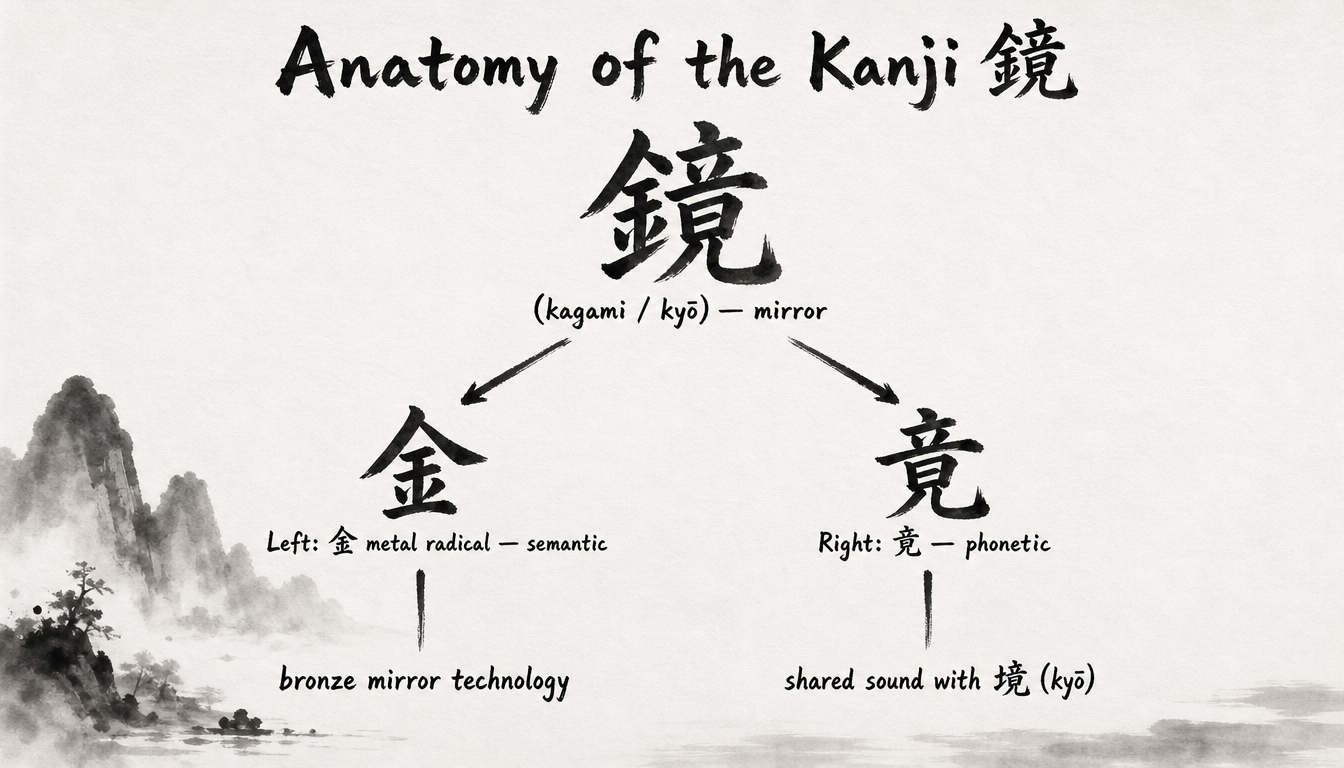
Split 鏡 down the middle and the logic appears immediately. The left side is 金, the metal radical. The right side, 竟, supplies the sound.
Why the Metal Radical?
Before glass mirrors arrived, a mirror was a disc of bronze, cast and then polished to a shine. Ancient Japanese mirrors excavated from burial mounds are metal objects, not glass ones. The radical 金 records a technology, not a poetic idea: to make a mirror, you needed metallurgy.
This matters for anyone choosing 鏡 as a personal symbol. The character carries a sense of craft and labor. A bronze mirror only reflects after someone grinds and burnishes it for a long time. Clarity is earned.
The Right Side: 竟
竟 functions as the phonetic element, giving 鏡 its on'yomi reading キョウ (kyō). You can see the same phonetic in 境 (kyō / sakai, "boundary") — the pattern of a shared right-hand component driving the sound is one of the most reliable structures in kanji, and it covers a large share of all characters.
A memory trick circulating among learners breaks the character into 金 (gold), 立 (stand), and 見 (see): you stand to see yourself as gold, as The Japanese Page puts it. It is a mnemonic rather than a scholarly etymology, but it sticks.
Where the Word Kagami Came From
The native Japanese word かがみ may derive from 影 (kage, meaning shadow, reflection, or image) combined with 見 (mi, to see) — kage-mi, "looking at one's image," according to The Japanese Page. The derivation is a traditional proposal rather than settled fact, so treat it as a plausible reading of the word's history.
The character 鏡 tells you what a mirror was made of. The word kagami tells you what a mirror was for. Together they cover both the object and the act of looking.
The diagram below breaks the character into its two working parts so you can see how meaning and sound divide the space.
Yata no Kagami: The Sacred Imperial Mirror
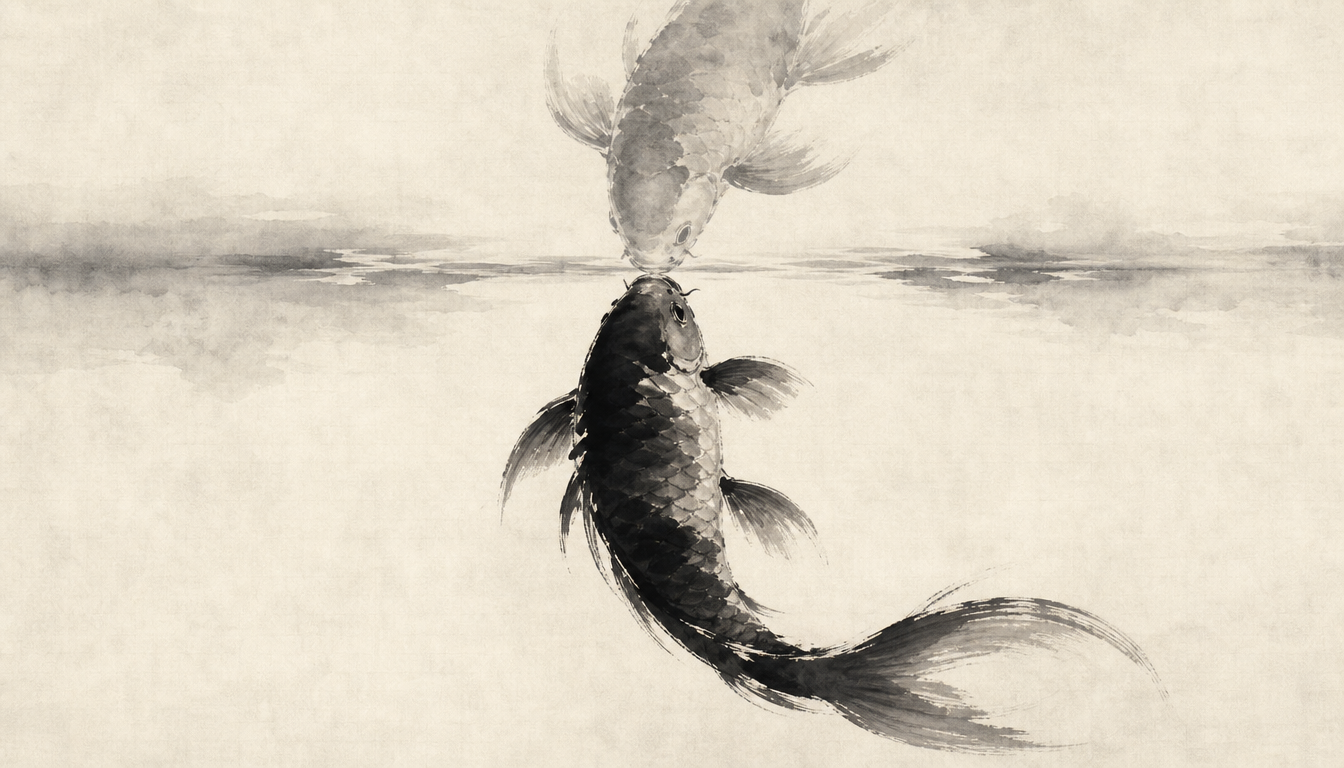
The most famous mirror in Japan is one almost nobody has seen. Yata no Kagami (八咫鏡) is a sacred bronze mirror and part of the Imperial Regalia of Japan, and it represents wisdom, according to Wikipedia. Its name refers to its size, built on 咫 (ata), an ancient unit of measurement.
The mirror belongs to the set known as the Three Sacred Treasures, alongside a sword and a jewel. Shinto tradition holds that the sun goddess Amaterasu passed these objects down, and the mirror is enshrined as a symbol of Amaterasu within the main sanctuary of the Inner Shrine at Ise-jingu, per the Japan National Tourism Organization. The same myth says the mirror was used to draw Amaterasu out of the cave where she had hidden.
Why a Mirror, of All Things?
Of the three treasures, two are what you would expect from a founding myth: a blade and a jewel, power and beauty. The third is a mirror, an object with no content of its own. It shows only what stands in front of it.
That emptiness is the point. Mirrors in ancient Japan represented truth because they merely reflected what was shown, and they became objects of mystique and reverence, according to Wikipedia. A ruler holding a mirror holds an instrument that cannot lie on his behalf.
Mirrors in Shrines Today
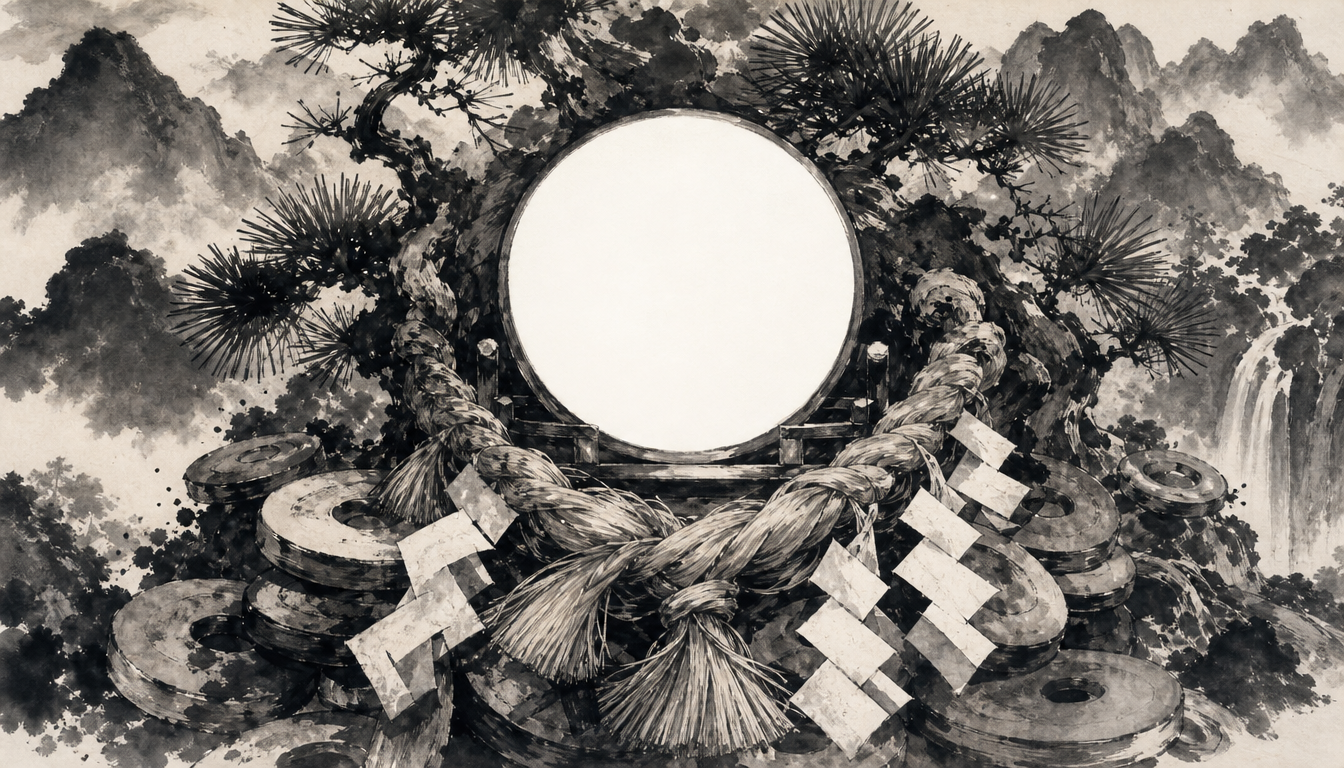
Walk into almost any Shinto shrine and look toward the inner sanctuary. You will often find a round mirror, called a shinkyō (神鏡), placed as a sacred object of the divine spirit or set before the deity in the hall of worship, as Wikipedia describes. Worshippers approaching it see themselves. Whether that is meant as a reminder of the divine within, or a demand for honesty before the gods, has been read both ways for centuries.
Readings, Compounds, and Real Usage
鏡 behaves predictably. The kun'yomi kagami appears when the character stands alone or in native compounds. The on'yomi kyō appears in Sino-Japanese compounds, especially technical ones.
| Word | Reading | Meaning | Nuance |
|---|---|---|---|
| 鏡 | kagami | Mirror | The standalone noun; also barrel head and mirror-shaped mochi |
| 手鏡 | tekagami | Hand mirror | 手 (hand) + 鏡; portable, personal |
| 合わせ鏡 | awase-kagami | Facing mirrors | Two mirrors set opposite each other to see your own back |
| 万華鏡 | mangekyō | Kaleidoscope | Literally "ten-thousand-flower mirror"; uses the on'yomi |
| 鏡餅 | kagami-mochi | New Year rice-cake offering | Round stacked mochi named for its resemblance to an old bronze mirror |
Two of these deserve a closer look. Awase-kagami describes placing two mirrors face to face: you put one behind you, catch your back in it, and view that image in the mirror in front. The reflections then nest inside each other, theoretically without end, as Japanese Wikipedia explains. Japanese folklore has attached a fair amount of superstition to that infinite corridor.
Mangekyō (万華鏡) means kaleidoscope: a tube of two or more mirrors that multiplies an object inside into a pattern, per Japanese Wikipedia. It is the same character doing very different work — sacred bronze in one context, optical toy in another.
Common Misunderstandings About 鏡
The mirror kanji gets misread often, particularly by people planning tattoos or personal designs. A few corrections:
| Misconception | Accurate understanding |
|---|---|
| "鏡 just means vanity or appearance." | In Japanese cultural usage, the dominant association is truth and honesty, not self-admiration. |
| "鏡 and 影 are basically the same idea." | 影 is shadow or a cast image; 鏡 is the reflecting object itself. The word kagami may descend from 影 + 見, but the characters are not interchangeable. |
| "鏡 only means a bathroom mirror." | It also covers lenses, barrel heads, and the round New Year mochi offering. |
| "Mirroring the kanji for a tattoo design looks cool." | A reversed kanji reads as an error to any Japanese speaker. Never flip the character, however tempting the symmetry. |
If you are commissioning 鏡 as artwork, ask the artist to work from a proper brush or font reference and confirm stroke order. The character has a dense left-right balance, and a sloppy 金 radical is the first thing a native reader will notice.
Related Kanji and How They Differ
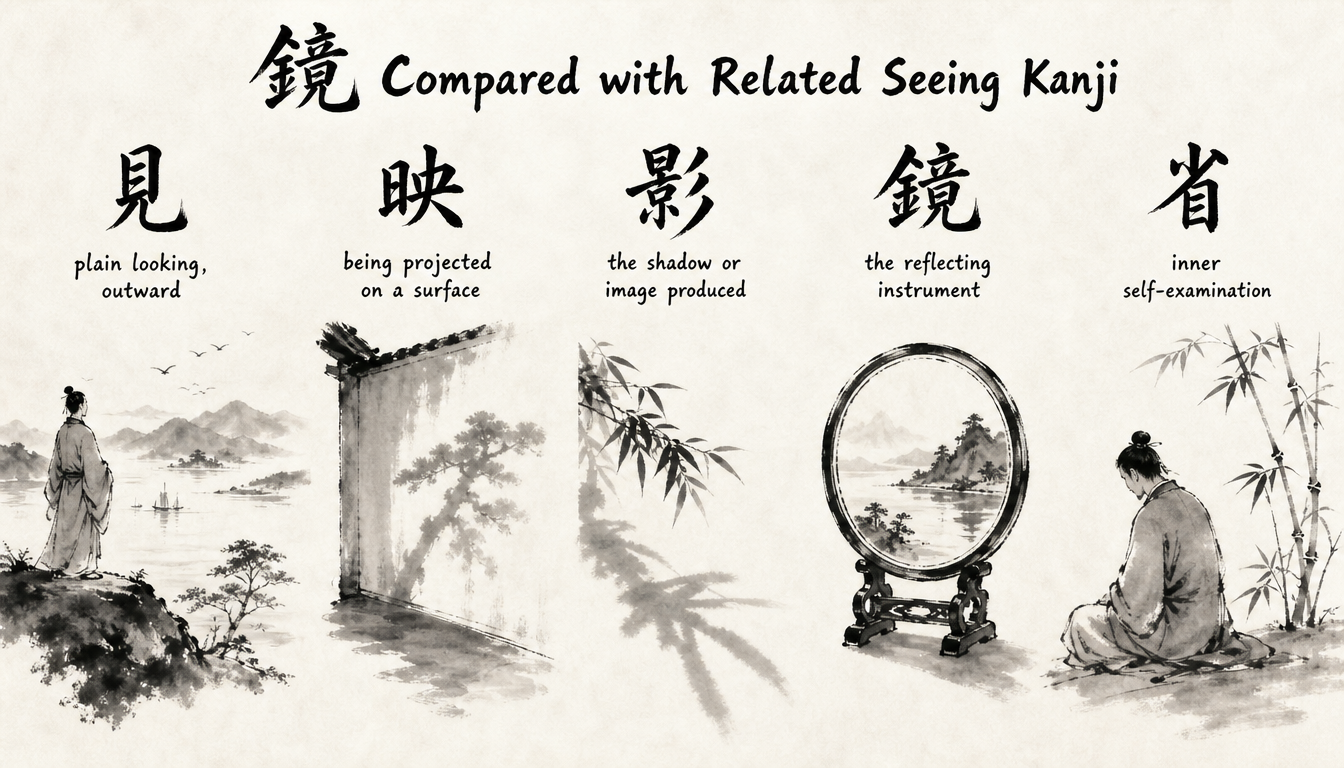
Several characters orbit the same theme of seeing and reflecting. Knowing the differences prevents the classic mistranslation.
| Kanji | Meaning | Difference from 鏡 |
|---|---|---|
| 影 (kage) | Shadow, silhouette, reflected image | The image itself, often dim or fleeting; 鏡 is the instrument producing it |
| 映 (ei / utsuru) | To be reflected, projected | A verb of appearance on a surface; 鏡 is the surface |
| 見 (ken / miru) | To see, to look | Plain visual perception, outward-facing; 鏡 turns sight back on the viewer |
| 省 (sei / kaeriminu) | Reflection in the sense of self-examination | An inner, moral act; 鏡 supplies the physical metaphor for it |
The comparison below maps where each character sits between outward looking and inward examining.
Using 鏡 as a Personal Symbol
People drawn to 鏡 tend to share a temperament. They value seeing things as they are, resist self-deception, and often serve as the honest voice in a group. If you have ever been the friend who says the uncomfortable true thing kindly, this character describes you.
A few ways the symbolism plays out in practice:
- In daily practice: 鏡 pairs naturally with any reflective habit, such as journaling or an evening review of the day. The character frames self-examination as an act of clarity, not judgment.
- In relationships: the mirror metaphor cuts both ways. What irritates you in someone often reflects something of your own. 鏡 is a useful reminder before a difficult conversation.
- As artwork or a tattoo: the character has strong vertical structure and holds up well in a narrow placement such as the forearm or spine. Written in a classical brush hand, the 金 radical gives it visual weight that thin sans-serif renderings lose.
Choosing well takes more than picking a character whose dictionary gloss sounds good in English. Meaning in Japanese lives in compounds, cultural association, and register, all of which are invisible to a word-for-word converter. This is where Oracle Kanji Writer – Personalized Soul Kanji Diagnosis Tool is built to help: it matches a character to your inner qualities and life path, then explains the reading, the layered meanings, and the compound words that shape how Japanese speakers actually hear it. Curated by Japanese creators, it aims to give you a character that reads as beautiful and meaningful in Japan, not as a puzzling import.
FAQ
What is the kanji for mirror?
The kanji for mirror is 鏡, read kagami on its own and kyō in Sino-Japanese compounds. It combines the metal radical 金, reflecting the bronze mirrors of antiquity, with the phonetic component 竟. Beyond a physical mirror, 鏡 also refers to lenses and to the round New Year rice-cake offering called kagami-mochi.
What is the kanji for "Kagami"?
かがみ is written 鏡 when it means mirror. The word may come from 影 (kage, shadow or image) plus 見 (mi, to see), giving a sense of "looking at one's image," as The Japanese Page notes. Kagami also exists as a Japanese surname, where families may write it with different characters.
What is the forbidden mirror of Japan?
People usually mean Yata no Kagami (八咫鏡), the sacred bronze mirror among the Imperial Regalia of Japan, which represents wisdom according to Wikipedia. It is kept hidden from public view and enshrined as a symbol of Amaterasu at Ise-jingu, per the Japan National Tourism Organization. Its concealment, rather than any prohibition on the object itself, is what fuels the "forbidden" label.
What is the significance of mirrors in Shintoism?
A shinkyō (神鏡) is a ritual mirror enshrined in a shrine's main hall as a sacred object of the divine spirit, or placed before the deity in the hall of worship, as described by Wikipedia. Mirrors in ancient Japan represented truth because they returned only what was placed before them, which made them objects of mystique and reverence.
Key Takeaways
- 鏡 combines the metal radical 金, recording the bronze construction of ancient mirrors, with the phonetic 竟 that gives the reading kyō.
- The kun'yomi kagami may trace back to 影 + 見, "seeing one's image."
- Yata no Kagami, a sacred bronze mirror of the Imperial Regalia, represents wisdom and is enshrined at Ise-jingu as a symbol of Amaterasu.
- Mirrors symbolize truth in Japanese tradition because they reflect without adding or subtracting anything.
- Common compounds range from the ordinary 手鏡 to the ceremonial 鏡餅 and the optical 万華鏡.
If the kanji kagami mirror character resonates with how you move through the world, treat it as a starting point rather than a conclusion. Explore neighboring characters like 真 (truth), 明 (clarity), and 心 (heart), or let Oracle Kanji Writer suggest the character that reflects your own nature back at you.
Discover Your Soul Kanji
Experience the depth of Japanese characters: each kanji carries timeless meaning, guiding your life's path.
No credit card required • 2-minute process