Kanji of the Day Vol.68 | "Kanji 明 (Aki): The Brightness Kanji Where Sun & Moon Awaken Your Clarity"

The kanji 明 places the sun beside the moon to form a single idea: brightness, and by extension, clarity. This Vol.68 entry of Kanji of the Day breaks down its two radicals, its many readings from Aki and Akira to mei and myo, real compounds like 透明 and 証明, common misconceptions, and how it compares to 光, 陽, and 晴. Practical guidance for anyone considering it as a personal symbol or tattoo.
Kanji of the Day Vol.68 | Kanji 明 (Aki): The Brightness Kanji Where Sun and Moon Awaken Your Clarity

The brightness kanji 明 means bright, clear, and illuminated, and it is written by placing the sun (日) directly beside the moon (月). One character, two light sources, a single idea: what you can finally see clearly.
Discover Your Soul Kanji
Experience the depth of Japanese characters: each kanji carries timeless meaning, guiding your life's path.
No credit card required • 2-minute process
Quick Facts: The Brightness Kanji at a Glance
| Item | Detail |
|---|---|
| Character | 明 |
| Core meaning | Bright, clear, light, to become clear, to dawn |
| Components | 日 (sun) + 月 (moon) |
| Strokes | 8 strokes (Jisho.org) |
| School grade | Jōyō kanji, taught in grade 2 (Jisho.org) |
| JLPT level | N4 (Jisho.org) |
| Name readings | Includes Aki, Akira, Akari, Mei, Haru, Teru (pon-navi) |
Grade 2 placement matters more than it sounds. Japanese children write 明 before they turn eight, which means every adult in Japan reads it instantly and without effort. For anyone choosing a character to wear, display, or carry, that familiarity is an asset. Nobody squints at it.
Kanji Composition: The Sun (日) and Moon (月) Radicals
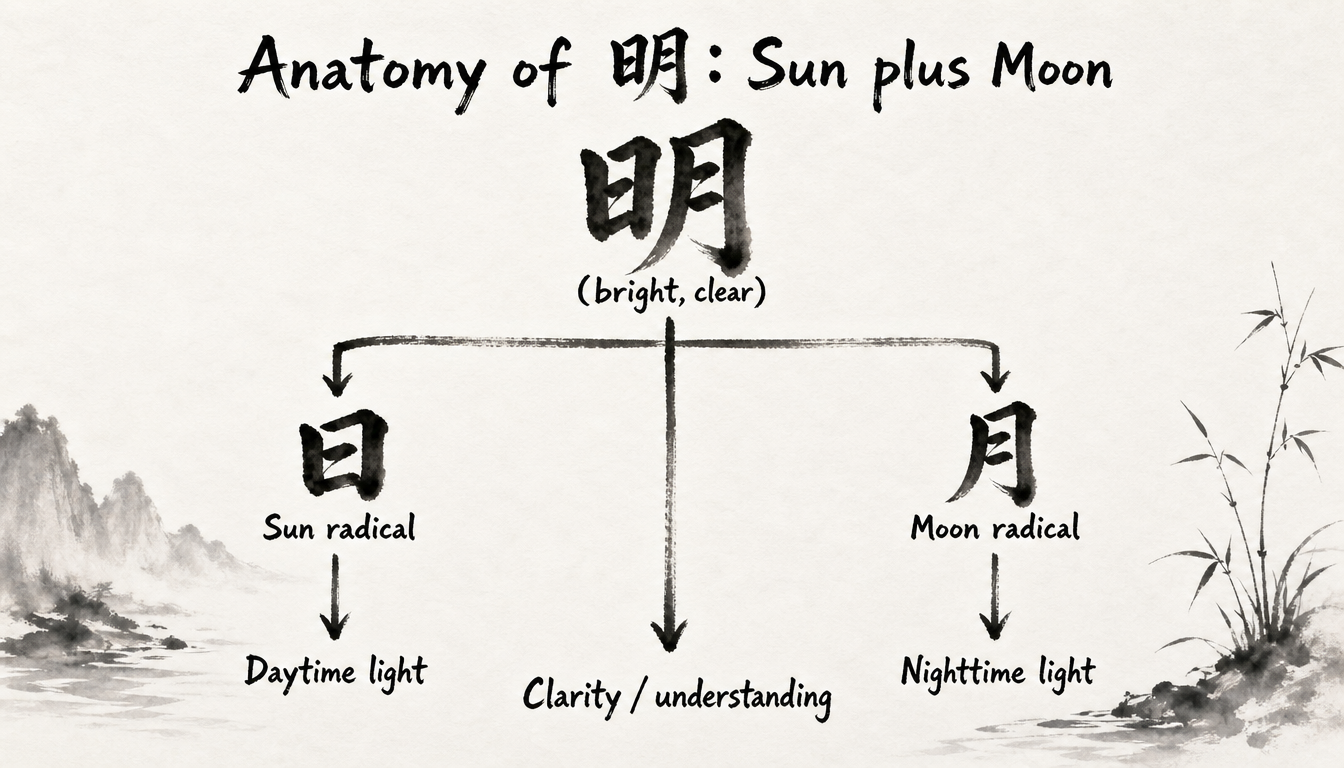
Split 明 down the middle and you get two of the oldest pictographs in the writing system. On the left sits 日, the sun, a circle with a mark at its center that flattened into a rectangle over centuries of brush and chisel. On the right stands 月, the moon, drawn as a crescent because a crescent is unmistakable in a way a full disc is not.
The mnemonic that Japanese learners pass around is straightforward: the sun lights your day and the moon lights your night, so together they mean brightness, an image also used by Japanesetest4you. Light that never runs out. Illumination on both shifts.
The diagram below breaks the brightness kanji into its two halves and shows how each contributes to the combined meaning.
A note on the moon radical
The 月 shape carries a well-known ambiguity in kanji. In many characters it is not the moon at all but a compressed form of 肉, meaning flesh, which is why body-part characters like 腕 and 胸 appear to contain a moon. Scholars distinguish the two by name and position, as Joy o' Kanji discusses in its radical notes. In 明, paired with the sun and pointing toward light, the celestial reading is the one that survives in everyday interpretation.
Some paleographers argue that the left element in the oldest forms depicted a window rather than the sun, with moonlight entering a room. The composition still resolves to the same idea: a dark space becoming visible. Where the record is contested, treat both readings as part of the character's depth rather than picking a winner.
On'yomi and Kun'yomi Readings of the Brightness Kanji
明 is a reading-heavy character, which is part of why it appears in so many Japanese names with so many different pronunciations. The kun readings recorded by Jisho.org include あ-かり (akari), あか-るい (akarui), あか-るむ (akarumu), あか-らむ (akaramu), あき-らか (akiraka), あ-ける (akeru), あ-く (aku), あ-くる (akuru), and あ-かす (akasu).
Those native readings all orbit a single sensation. Akarui is a bright room or a cheerful personality. Akiraka is something obvious, laid open, no longer in doubt. Akeru is what the night does when it ends. The character moves between physical light and mental clarity without changing shape.
The on'yomi, the readings imported from Chinese, are mei, myo, and min according to pon-navi. These surface inside compound words rather than standing alone.
| Reading type | Examples | Where you meet it |
|---|---|---|
| Kun'yomi (native) | akarui, akiraka, akeru | Adjectives and verbs in daily speech |
| On'yomi (Sino-Japanese) | mei, myo, min | Two-character compounds and formal vocabulary |
| Nanori (name-only) | aki, akira, haru, teru, sayaka | Personal names, where flexibility is highest |
Aki, Akira, Akari: the character as a name
Read as Aki, the character becomes a soft, unisex given name, one of the many readings pon-navi lists for 明. Read as Akira it takes on a firmer, more classical masculine feel. Akari leans warm and feminine, and it also forms popular combinations such as 明莉, pairing brightness with jasmine.
The naming dictionary describes the character's meaning as being illuminated by light and seeing clearly, a hopeful and positive attitude, a detailed understanding of things, wise. Parents in Japan choose it for a child they hope will be perceptive and warm at once.
Real Compounds: How 明 Behaves in Sentences
Compounds are where a character proves it is alive rather than decorative. The brightness kanji shows up across science, law, and ordinary conversation.
- 解明 (kaimei) — clarification, elucidation. Used for solving a mystery or unraveling a mechanism (Japanesetest4you).
- 透明 (tōmei) — transparency. Physical glass-clear, and also organizational openness (Japanesetest4you).
- 証明 (shōmei) — proof, demonstration. To make something undeniably visible, as in the example sentence about proving guilt.
- 賢明 (kenmei) — wise, prudent. Literally clever plus clear, describing judgment rather than intelligence alone.
- 明るい (akarui) — bright. Listed among the early vocabulary items on WaniKani, and used equally for rooms and for people.
Notice the pattern. Almost none of these compounds are about lamps. They are about knowing, proving, and understanding. Physical light became the metaphor and then the metaphor became the primary sense.
Good and Bad Ways to Use the Brightness Kanji
People who choose Japanese characters for personal use tend to fall into a small set of predictable errors. The contrast below separates the choices that read well in Japan from the ones that make native speakers wince.
| Consideration | Good example | Poor example |
|---|---|---|
| Meaning intent | Choosing 明 for clarity of mind or an optimistic outlook | Choosing it because a converter output it for the English word 'lit' |
| Reading | Naming the reading you intend, such as Aki or Akira | Assuming a single fixed pronunciation exists |
| Form | Balanced left-right proportion with 日 slightly narrower | Mirrored, stretched, or rotated for design reasons |
| Pairing | Combining with a character that shares its tone, like 明生 | Stacking unrelated characters into a phrase no one says |
Never mirror or flip a kanji for visual symmetry. 明 has a fixed left-right structure, and reversing it produces a shape that is not a character at all. If the design is going onto skin, confirm the stroke order and the final proportions with someone who reads Japanese.
Common misunderstandings
| Misconception | Accurate understanding |
|---|---|
| "明 just means light" | Its dominant modern uses concern clarity, proof, and understanding as much as illumination |
| "Every kanji has one reading" | 明 alone carries multiple kun readings plus mei, myo, and min, and further name-only readings |
| "The 月 in 明 is always the moon" | The same shape represents flesh in many other characters; context decides |
| "A simple kanji is a weak choice" | Grade-2 characters are the most universally recognized, which strengthens a personal symbol rather than cheapening it |
Related Characters and How They Differ
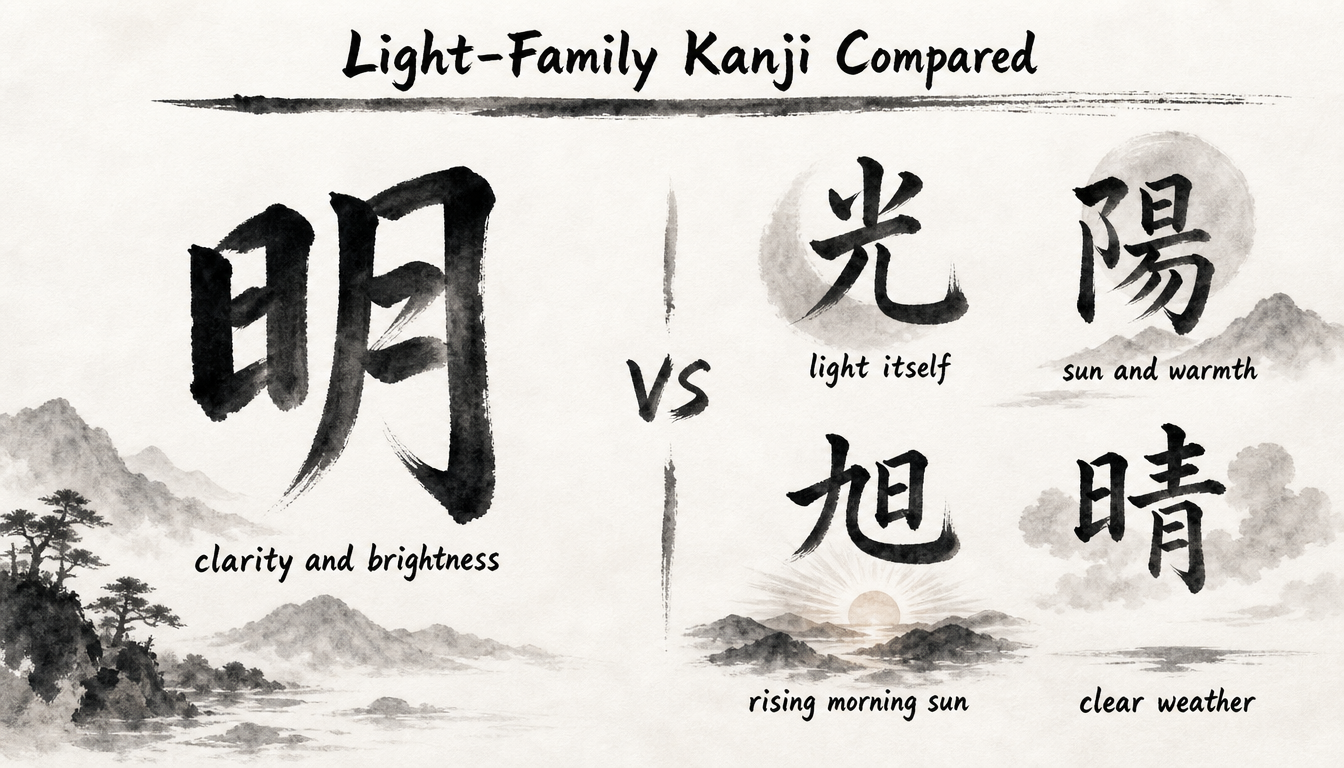
Several kanji cluster around the idea of light, and they are not interchangeable. Picking the wrong one is the most common way a well-intentioned design goes off target.
| Kanji | Core sense | Difference from 明 |
|---|---|---|
| 光 | Light itself, radiance | Names the substance of light; 明 names the condition of being lit and clear |
| 陽 | Sun, sunlight, the yang principle | Warmth and outward energy rather than clarity of perception (pon-navi) |
| 旭 | Morning sun, rising sun | A specific moment of dawn; 明 spans the whole span of visibility |
| 晴 | Clear weather, fair skies | Meteorological clearing, while 明 extends to mental and logical clarity |
| 彰 | Obvious, conspicuously displayed | Emphasizes being shown to others; 明 works inwardly too |
The comparison below maps these light-family characters against each other so you can see where 明 sits.
Choosing 明 as a Personal Symbol
People gravitate toward this character for two different reasons, and both are legitimate. The first is temperament: 明るい as a description of a person means cheerful, open, easy to be around. The second is cognition: the person who values seeing things as they are, who would rather have an uncomfortable clear answer than a comfortable vague one.
Structurally, 明 is friendly to design. Eight strokes leave breathing room, and the balanced left-right split reads cleanly at small sizes, on a forearm, along a spine, or as a single seal-style square. It also pairs naturally, which is why combinations like 明生 and 明依 appear frequently in Japanese given names according to pon-navi.
Getting the choice right takes more than matching an English dictionary entry to a character. Nuance, register, and the way a character lands with a Japanese reader all matter, and those are exactly the things automated converters ignore. Oracle Kanji Writer – Personalized Soul Kanji Diagnosis Tool approaches it from the other direction: you enter your name, birthdate, and blood type, and the result comes back with pronunciation, layered meanings, a personal message, and curated compound words that show the character in real use. The characters are selected by Japanese creators, so what you receive reads as beautiful in Japan rather than merely exotic abroad.
If 明 resonates but you want to know whether it is genuinely your character, a Soul Kanji diagnosis takes about two minutes and returns a reading, a meaning breakdown, and downloadable kanji art you can use for wallpaper or tattoo planning.
FAQ
What does 々 do?
々 is not a kanji. It is a repetition mark that tells the reader to repeat the preceding character, so 人々 is read hitobito and means people. It saves writing the same character twice and often triggers a small sound change in the second element. You will never see it standing alone or used as a meaningful symbol.
What does 光 mean in Japanese?
光 means light or radiance, and it functions as a noun in a way 明 does not. It appears in the given names Hikari and Hikaru, both meaning light, as Behind the Name notes. Choose 光 when you want the beam itself; choose 明 when you want the state of things being clear and visible.
What does 美 mean in Japanese?
美 means beauty. It is common in feminine given names and in words for aesthetics and fine art. Unlike 明, which points at perception and clarity, 美 points at the quality of what is perceived, so the two work as a natural pairing rather than as competitors.
What does 天 mean in Japanese?
天 means heaven, sky, or the celestial realm, and it carries a heavier philosophical weight than 明. Where 明 is intimate and everyday, taught to second-graders and used to describe a cheerful friend, 天 reaches toward fate and the divine. Both belong to the sky, but they sit at very different altitudes.
Key Takeaways
- 明 combines 日 (sun) and 月 (moon) into a single 8-stroke, grade-2 Jōyō character at JLPT N4 level (Jisho.org).
- Its kun readings cluster around akarui, akiraka, and akeru, while its on readings are mei, myo, and min.
- As a name it can be read Aki, Akira, Akari, Mei, Haru, Teru and more, which makes intent worth stating explicitly.
- Real compounds like 解明, 透明, 証明, and 賢明 show that the character's center of gravity is clarity and proof, not lamplight.
- Never mirror or restructure the character for design symmetry, and confirm stroke order before committing it permanently.
If the brightness kanji speaks to how you move through the world, the natural next step is finding out which character the tradition would actually assign you. A Soul Kanji diagnosis from Oracle Kanji Writer gives you a reading, a meaning, and cultural context, so the brightness kanji you carry is one that a Japanese reader would recognize as fitting.
Discover Your Soul Kanji
Experience the depth of Japanese characters: each kanji carries timeless meaning, guiding your life's path.
No credit card required • 2-minute process