Kanji of the Day Vol.61 | "Kanji 花火 (Hanabi): The Fireworks Kanji Sparking Your Soul's Fleeting Brilliance"

花火 (hanabi) joins the kanji for flower and fire into a single word for fireworks, a 'flower fire' that blooms and vanishes in one breath. Discover how each character shapes the meaning, the three kinds of hanabi in Japanese summer, and why this fleeting image carries such quiet philosophical weight.
Kanji 花火 (Hanabi): The Fireworks Kanji Sparking Your Soul's Fleeting Brilliance
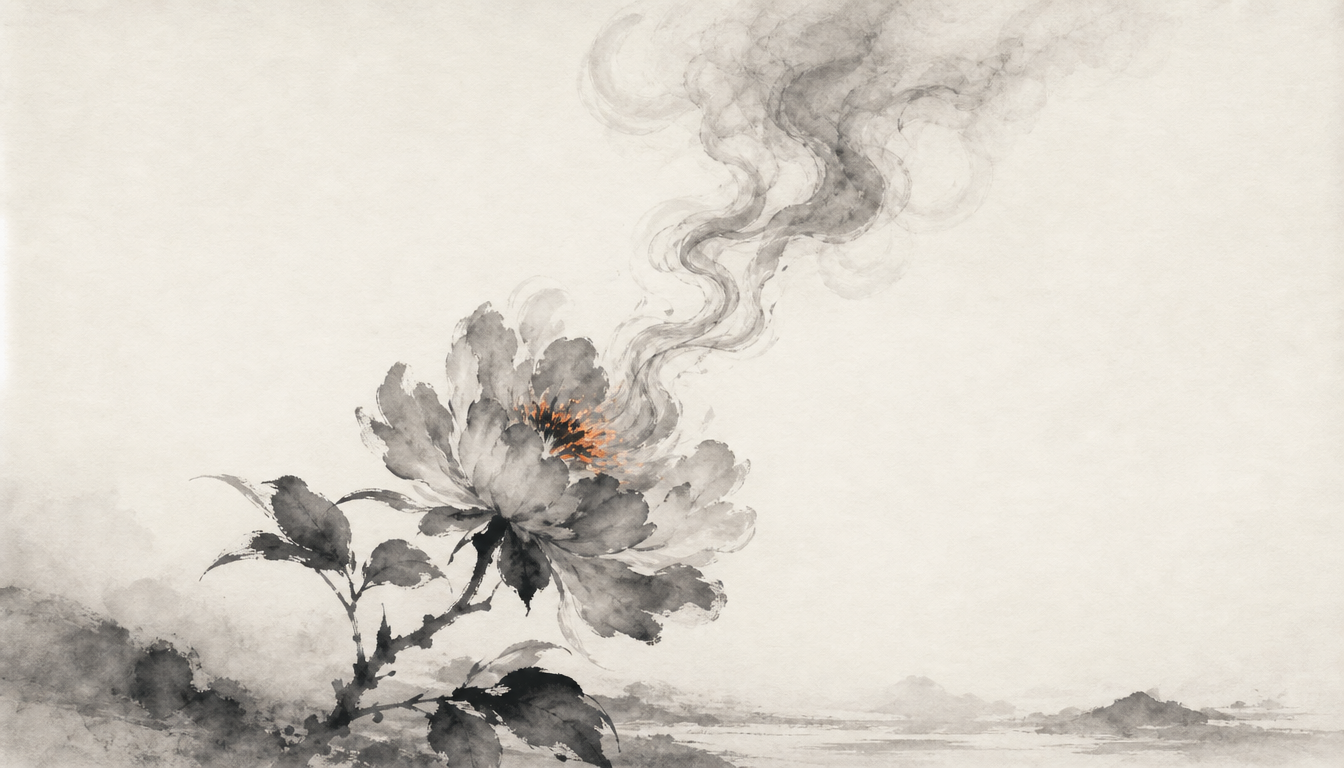
The kanji hanabi fireworks (花火) is one of the most poetic compounds in the Japanese language: two characters, 花 (flower) and 火 (fire), joined to name the blossoms of light that bloom across a summer night sky. Read as hanabi, it turns a burst of gunpowder into a flower that lives for a single breath. For anyone drawn to Japanese aesthetics, this word carries something deeper than spectacle, a quiet meditation on beauty that ends the moment it begins.
Below, we trace the meaning behind each character, look at the different kinds of hanabi Japan celebrates every summer, and explore why this fleeting image speaks so directly to the human soul.
Discover Your Soul Kanji
Experience the depth of Japanese characters: each kanji carries timeless meaning, guiding your life's path.
No credit card required • 2-minute process
What the Kanji Hanabi Fireworks (花火) Actually Means
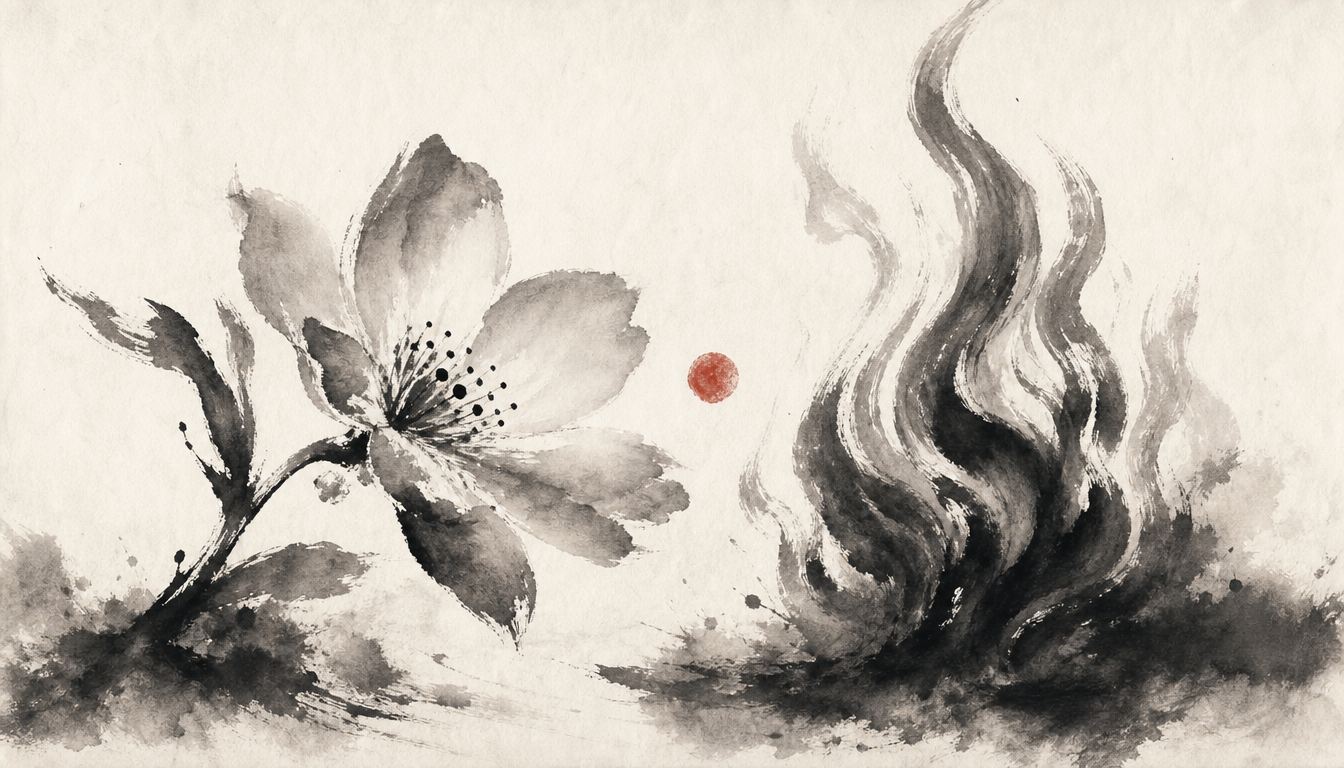
At its simplest, hanabi means "fireworks." But the word is built from a visual metaphor that no English equivalent captures. According to Japanese Particles Master, 花 is a kanji widely used to mean "flower" and 火 is a kanji widely used to mean "fire," so the compound literally reads as a "flower fire." A firework, to the Japanese eye, is a flower made of fire, opening in the dark and scattering its petals before you can name its color.
| Item | Detail |
|---|---|
| Word | 花火 (はなび) |
| Romaji | hanabi |
| Literal meaning | "flower fire" |
| English meaning | fireworks |
| Category / field | Japanese summer culture, seasonal vocabulary |
| Related concepts | 夏 (summer), 祭り (festival), 線香花火 (sparkler) |
| JLPT level | N2 noun |
The reading itself rewards attention. On its own, 火 is often read hi, as in the everyday word for fire. Inside 花火, that hi softens into bi through a sound change Japanese calls rendaku, the voicing that smooths compounds into a single flowing word. So 花 (hana) plus 火 (hi) becomes hana-bi. The Tanoshii Japanese dictionary lists the reading as 花(はな)・火(び), confirming this shift.
花火 is not a translation of "fireworks." It is an original image. Where English describes the mechanism (fire that works), Japanese describes the result: a flower opening in fire.
Kanji Breakdown: 花 (Flower) Meets 火 (Fire)
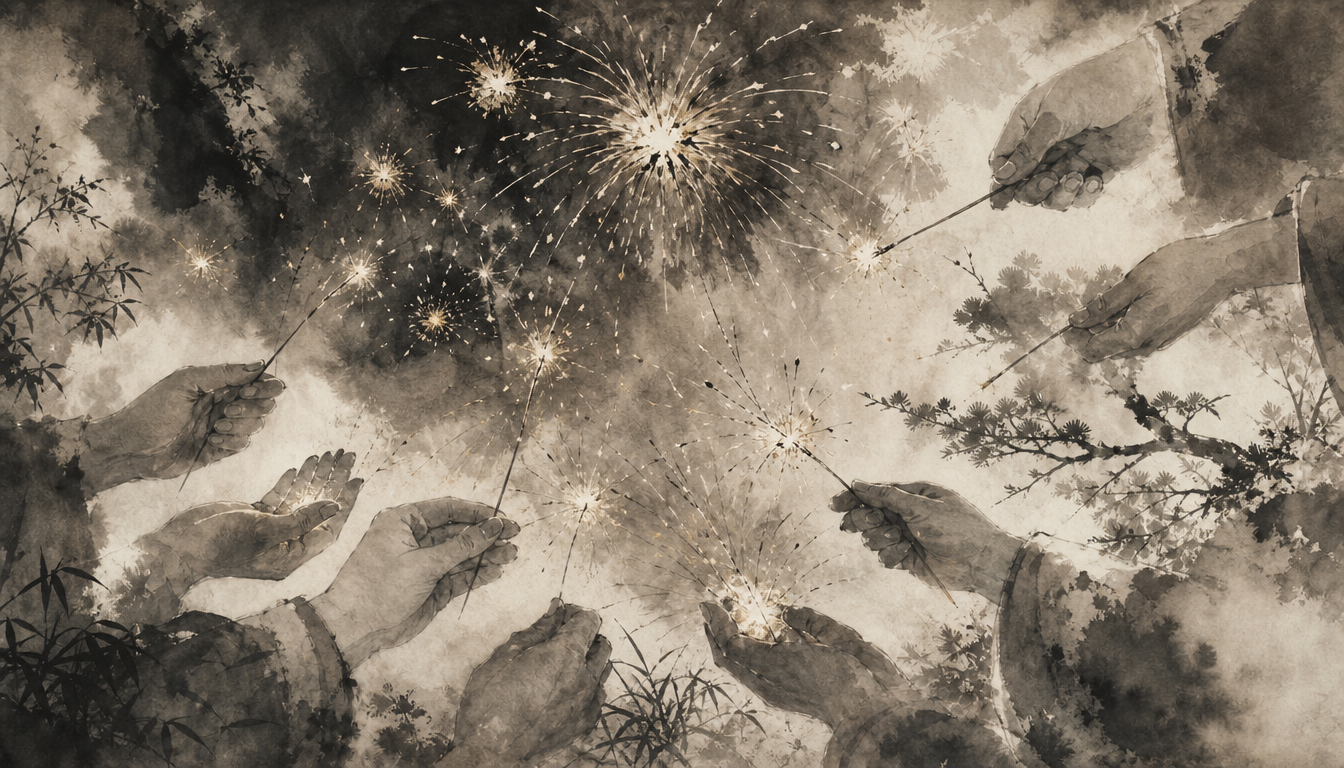
To feel the weight of hanabi, you have to sit with each character separately. The diagram below shows how the two kanji combine into a single seasonal image.
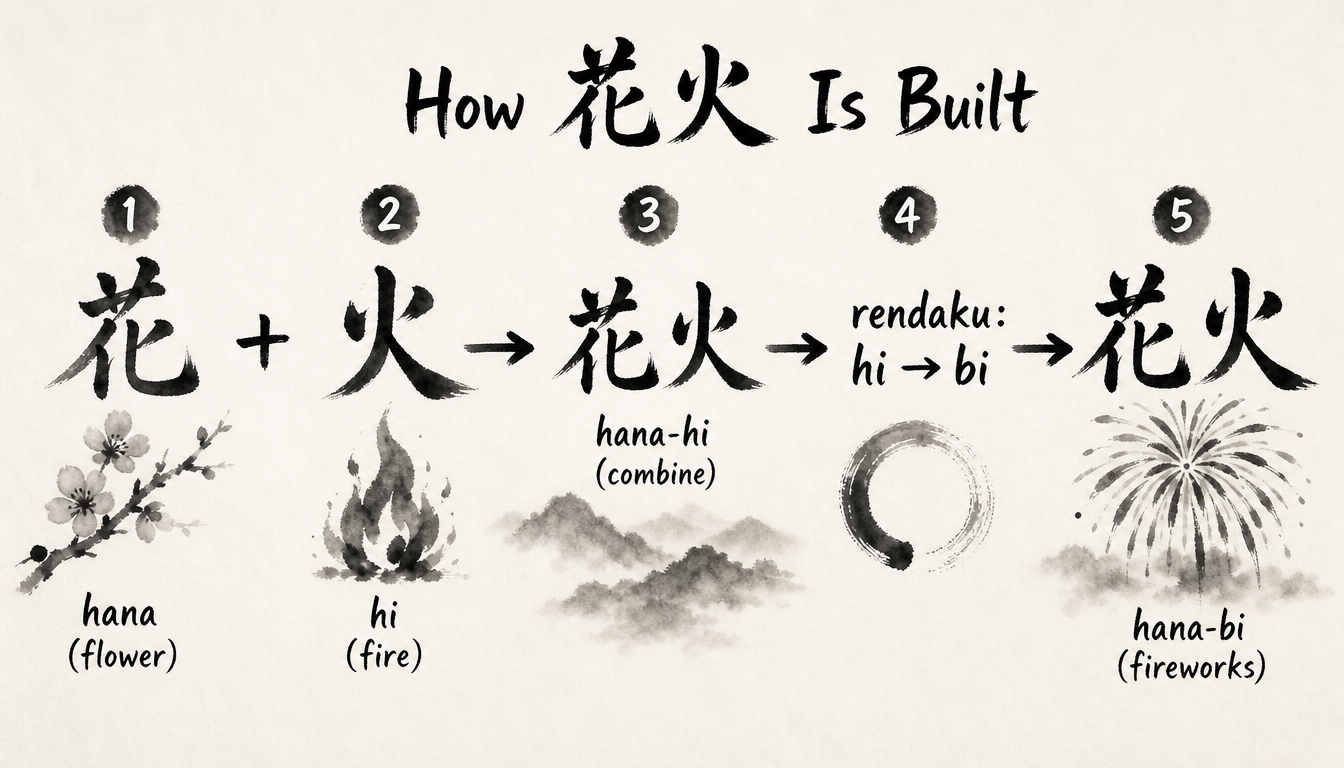
花 — The Flower
花 means "flower," and according to Kanshudo it is a grade 1, JLPT N4 character written in seven strokes. The grass radical (艹) crowns the top, marking it as something that grows, while the lower element carries the phonetic reading ka. It is one of the first kanji Japanese children learn, and it appears in words for cherry blossoms, bouquets, and the fleeting beauty the culture prizes so highly. A flower in Japanese thought is never only decoration. It is the emblem of impermanence, lovely precisely because it will fall.
火 — The Fire
火 means "fire." Its ancient form pictured rising flames, a central tongue of fire flanked by smaller sparks, and the modern character still keeps that flickering, upward shape. As Japanese Particles Master notes, 火 appears across the vocabulary of light and heat, from hi (fire) to compounds for flame and spark. Where 花 is soft and organic, 火 is volatile and alive.
Put them together and the tension resolves into poetry. Fire is destruction; the flower is fragile life. A firework marries the two: it destroys itself in the act of becoming beautiful. That paradox sits at the heart of why hanabi is the perfect kanji for a moment that matters more because it cannot last.
The Three Kinds of Hanabi Fireworks in Japan
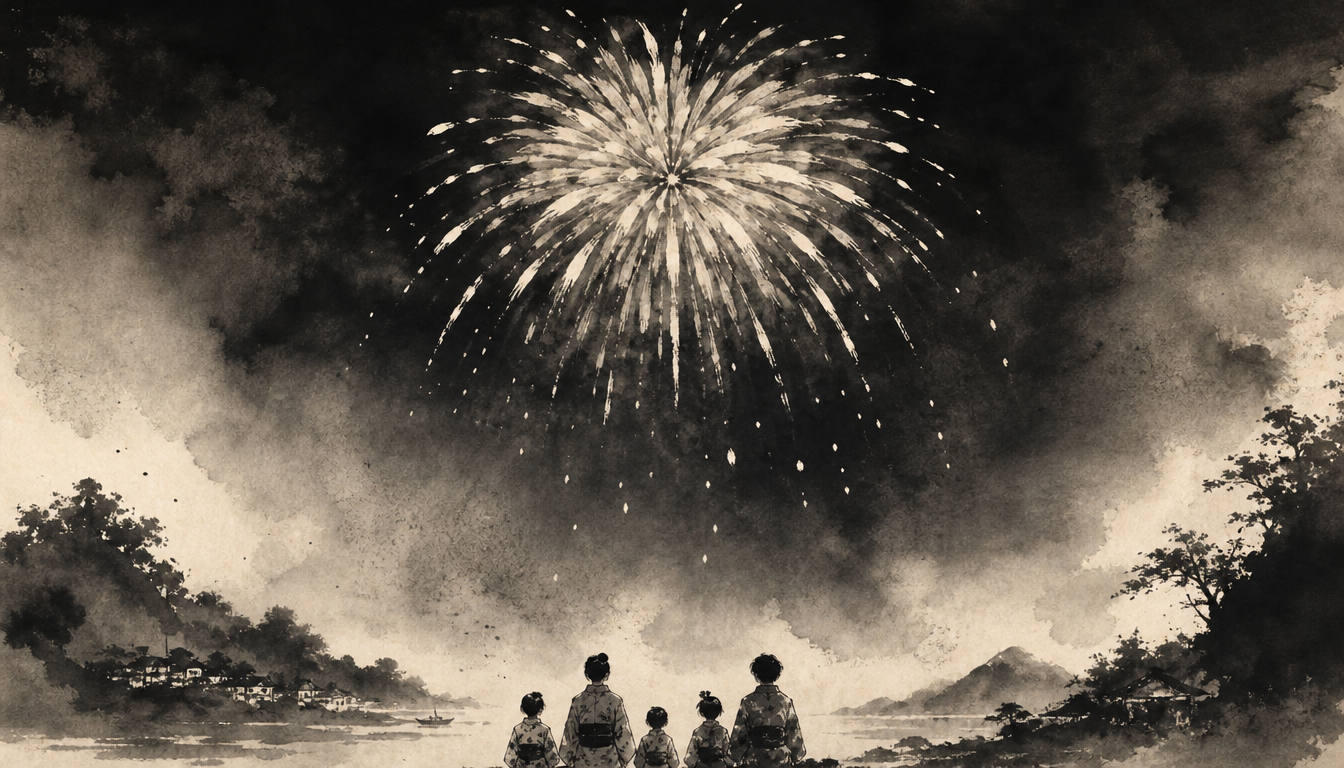
Japanese summer offers hanabi at many scales, from a sparkler held between two fingers to shells the size of a house bursting over a river. Broadly, they fall into three families.
| Type | Japanese | Where you meet it |
|---|---|---|
| Toy fireworks | おもちゃ花火 (omocha-hanabi) | Bought in packs, enjoyed at home with family |
| Handheld fireworks | 手持ち花火 (temochi-hanabi) | Held in the hand, backyards and beaches |
| Festival displays | 打ち上げ花火 (uchiage-hanabi) | Launched skyward at large summer festivals |
Toy and Handheld Fireworks
The intimate end of hanabi is where most Japanese childhoods begin. As the Nagoya International Center explains, the small fireworks sold in assorted summer packs are known as omocha-hanabi (toy fireworks) or temochi-hanabi (handheld fireworks). The most beloved of these is the senkō-hanabi (線香花火), a sparkler whose name means "incense firework." It is a thin twist of tissue paper, roughly 20 centimeters long, with a few grains of gunpowder at one end. Lit, it forms a tiny red fireball that trembles and sputters, and it has been a traditional favorite since the Edo period.
There is a whole quiet ritual around the senkō-hanabi. You watch the fragile spark cling to life, waiting for the inevitable moment it drops and goes dark. Losing it feels like losing something you loved.
Festival Displays
At the other extreme are the great uchiage-hanabi, the launched shells that anchor Japan's summer festivals. Crowds gather along rivers and shorelines in cotton yukata, food stalls line the banks, and thousands of faces tilt upward as chrysanthemum and peony patterns unfold across the sky. These displays are civic events, tied to specific towns and dates, and they turn a single evening into a shared memory for an entire community.
The word uchiage-hanabi reached global audiences through the 2017 song "Uchiage Hanabi" by Daoko featuring Kenshi Yonezu, released on August 9, 2017, which ranked number one in Billboard Japan Hot Animation for 25 weeks (Wikipedia).
Why Fireworks Carry So Much Meaning in Japanese Summer Culture
Many Japanese people associate fireworks with summer, and the association runs deeper than seasonal fun. Hanabi embodies mono no aware, the gentle sadness of being moved by things that pass. The firework is gorgeous for one second, then gone. You cannot pause it, replay it, or keep it. You can only be present for it.
That is why the image has endured in Japanese art, music, and film. The 2017 anime film Fireworks (打ち上げ花火、下から見るか? 横から見るか?), released on August 18, 2017, grossed over $26 million worldwide and became one of the highest-grossing anime films of that year, according to Wikipedia. Its very title, asking whether to watch fireworks from below or from the side, treats a single burst of light as something worth choosing a lifetime perspective on.
Good and Bad Ways to Read the Symbolism
| Deeper reading | Shallow reading | |
|---|---|---|
| What hanabi represents | Beauty that matters because it ends | Just a pretty light show |
| Emotional tone | Bittersweet, reflective, present | Loud, celebratory only |
If you choose hanabi as a personal symbol, the shallow reading sells it short. The character speaks to anyone who has learned that a moment's brilliance can outweigh its brevity, a first love, a summer that could not repeat, a burst of courage that changed everything.
Common Misunderstandings About the Kanji Hanabi Fireworks
Because 花火 is so visual, foreigners often misread how it works. A few clarifications matter, especially if you plan to use it as art or a tattoo.
| Misunderstanding | Correct understanding |
|---|---|
| "花 alone means fireworks" | 花 means flower; you need both 花 and 火 for fireworks |
| "火 in hanabi is read hi" | Inside 花火 it voices to bi through rendaku, giving hana-bi |
| "Hanabi and uchiage-hanabi are the same word" | Uchiage-hanabi names launched festival shells specifically; hanabi is the general term |
This is where accuracy becomes the whole point. A character that reads as "beautiful flower fire" to a native speaker can look clumsy if the pairing or reading is off. Getting the meaning right is what separates a resonant symbol from a cliché.
If hanabi speaks to your temperament, tools like Oracle Kanji Writer – Personalized Soul Kanji Diagnosis Tool can help you confirm a character truly reflects your inner qualities, complete with correct readings, nuanced meanings, and cultural context, so the kanji you carry resonates in Japan as beautiful rather than accidental.
Related Words and How They Differ From Hanabi
Several words orbit hanabi in the vocabulary of summer light. Knowing the difference deepens your feel for the compound.
| Word | Meaning | Difference from hanabi |
|---|---|---|
| 線香花火 (senkō-hanabi) | Sparkler, "incense firework" | A specific handheld type, not the general category |
| 打ち上げ花火 (uchiage-hanabi) | Launched festival fireworks | Refers only to shells shot into the sky |
| 火 (hi) | Fire | One half of the compound; raw element, not the flower image |
| 花 (hana) | Flower | The other half; carries the impermanence, not the fire |
FAQ
What is the kanji for hanabi?
The kanji for hanabi is 花火, written with 花 (flower) followed by 火 (fire). Together they form a "flower fire," the Japanese image of fireworks. It is read hanabi, with the second character voicing from hi to bi.
Does hanabi mean fireworks?
Yes. Native speakers use 花火 (hanabi) to mean "fireworks" in Japanese, from small handheld sparklers to enormous festival displays. The literal reading is "flower fire," which describes a burst of light as a blossom made of flame.
What is the kanji for fireworks?
The standard kanji for fireworks is the compound 花火. There is no single character that means fireworks on its own; the meaning emerges from combining the flower kanji 花 with the fire kanji 火.
Is fireworks the same as uchiage hanabi?
Not exactly. Hanabi (花火) is the general word for all fireworks, while uchiage-hanabi (打ち上げ花火) specifically names the launched shells fired into the sky at festivals. All uchiage-hanabi are hanabi, but not all hanabi are launched shells.
Conclusion
The kanji hanabi fireworks (花火) distills an entire philosophy into two characters and one soft, voiced word.
- 花 means flower and 火 means fire, joining to form hana-bi, a "flower fire."
- The reading shifts through rendaku, so 火 (hi) becomes bi inside the compound.
- Hanabi comes in three families: toy fireworks, handheld fireworks, and launched festival displays.
- The image embodies mono no aware, beauty made precious by its brevity.
- As a personal symbol, it honors anyone who values a bright, fleeting moment over a dull, lasting one.
If the kanji hanabi fireworks resonates with you, treat it as an invitation to find the single character that mirrors your own inner light, and let a tool like Oracle Kanji Writer help you carry it with the meaning intact.
Discover Your Soul Kanji
Experience the depth of Japanese characters: each kanji carries timeless meaning, guiding your life's path.
No credit card required • 2-minute process