Kanji of the Day Vol.59 | "Kanji for Beginners: How to Read Kanji & Awaken Your Soul's First Symbol"

Kanji look intimidating, but reading them starts with a few simple ideas. This beginner's guide explains how kanji differ from hiragana and katakana, why each character carries two readings, why stroke order matters, and how just 80 to 100 characters unlock everyday Japanese. Perfect for culture lovers, mindfulness seekers, and anyone planning a meaningful, accurate kanji symbol.
Kanji for Beginners: How to Read Kanji & Awaken Your Soul's First Symbol

By the end of this guide you will know what kanji are, how they differ from hiragana and katakana, and how to read kanji well enough to recognize your first characters in the wild. This is beginner-friendly, and if you follow along you will finish with a working method you can practice today.
Goal: Read and recognize your first kanji, and understand the dual reading system that trips up every newcomer. Estimated time: about 15 minutes to read, a lifetime to enjoy. Difficulty: Beginner.

Discover Your Soul Kanji
Experience the depth of Japanese characters: each kanji carries timeless meaning, guiding your life's path.
No credit card required • 2-minute process
What You Need Before You Start Reading Kanji
Learning how to read kanji becomes far less intimidating once you understand what you are actually looking at. Kanji are one of three scripts Japanese uses together. Hiragana and katakana are phonetic, meaning each symbol carries a sound with no meaning of its own. Kanji are logographic, so each character carries meaning, and often more than one sound.
Necessary tools:
- A notebook and a pen or brush, for writing practice
- Access to a kanji dictionary or a study app such as Kanji alive or Kanshudo
- Optional: the Oracle Kanji Writer tool if you want a personalized character to anchor your motivation
Prerequisites:
- Ideally, basic familiarity with hiragana (it helps you spot okurigana, the kana that follow a kanji)
- Patience with ambiguity, since one character can be read several ways
You do not need to know all three scripts before touching kanji. Many learners start recognizing simple characters like 人 (person) and 山 (mountain) within their first week.
How to Read Kanji: On'yomi and Kun'yomi Explained
The single biggest hurdle in learning how to read kanji is that most characters carry two families of readings. Understanding why solves most of the confusion.
Why Kanji Have Two Readings
Japan borrowed Chinese characters over a thousand years ago, and it borrowed both the written form and an approximation of the original Chinese pronunciation. That imported sound became the on'yomi (音読み), literally the "sound reading." Meanwhile, Japanese already had its own spoken words, so speakers attached native Japanese pronunciations to the same characters. That native reading is the kun'yomi (訓読み).
The diagram below illustrates how a single character branches into these two reading families.
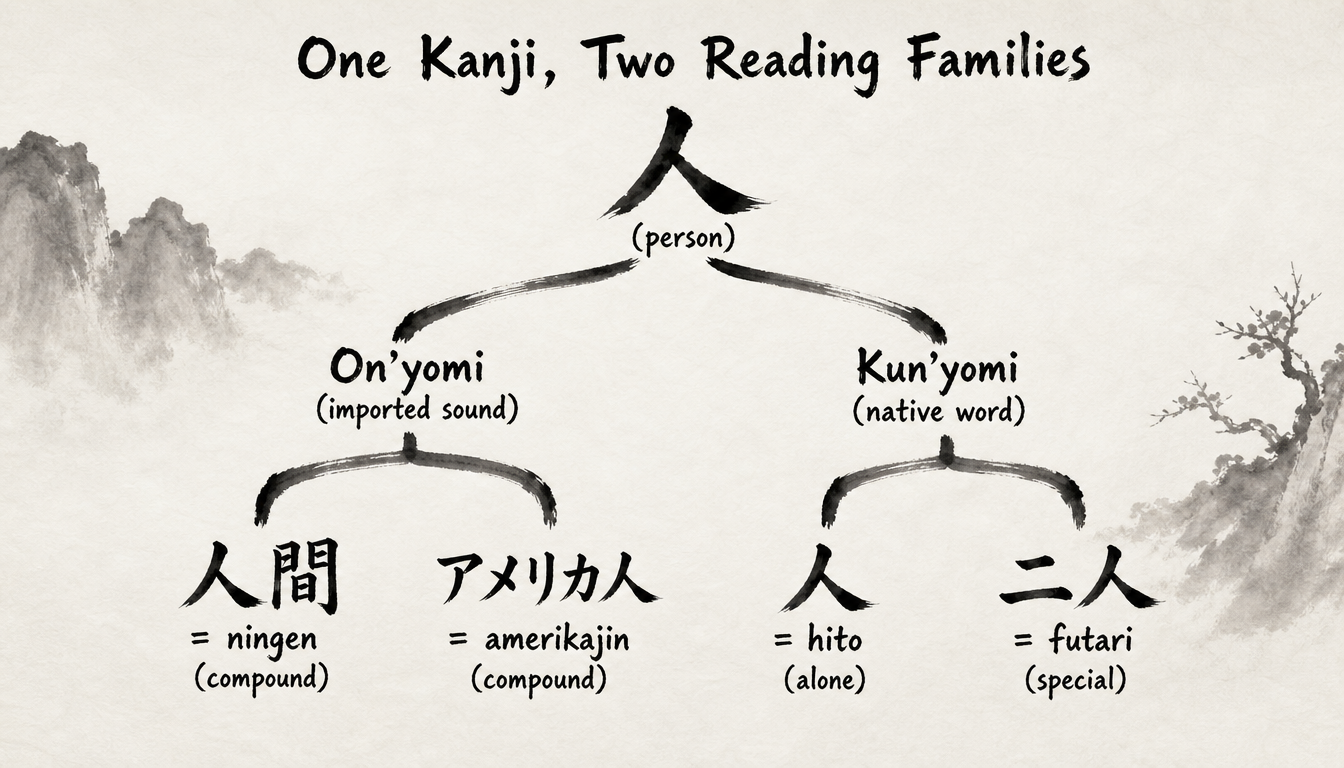
According to Wikipedia, on'yomi readings appear most often inside multi-kanji compound words, called jukugo (熟語), many of which entered Japanese alongside the Chinese concepts they described.
A Concrete Example: The Character 人
The character 人 means person, and it shows both reading types clearly:
- 人 = hito (person) — kun'yomi, standing alone
- 二人 = futari (two people) — a special native reading
- アメリカ人 = amerikajin (an American) — on'yomi in a compound
- 人間 = ningen (human being) — on'yomi in a compound
Every word above refers to people and uses the same character, yet the sound changes completely. This example comes from the Wyzant blog, and it captures the core lesson: you do not read a kanji in isolation. You read it in context.
A Simple Rule of Thumb
When a kanji stands alone or carries hiragana tails (okurigana), it usually takes its kun'yomi. When two or more kanji sit together as a compound, they usually take on'yomi. This is a tendency, not a law, but it will guide you correctly most of the time.
| Feature | On'yomi (音読み) | Kun'yomi (訓読み) |
|---|---|---|
| Origin | Imported Chinese sound | Native Japanese word |
| Typical context | Compound words (jukugo) | Kanji alone or with okurigana |
| Example (人) | jin / nin (人間 = ningen) | hito (person) |
| Feeling | Formal, technical | Everyday, concrete |
Stroke Order and Writing Practice for Kanji Mastery

Reading and writing reinforce each other, and this is why serious learners write kanji by hand even in a digital age. Writing a character several times builds muscle memory of the stroke order and sharpens your visual recognition, which is the skill you need to read kanji quickly.
Why Stroke Order Matters
Stroke order is not decorative tradition. Following the correct sequence produces balanced, legible characters and makes handwriting recognizable to native readers. It also helps your brain chunk complex characters into familiar parts. A few universal principles apply to almost every kanji:
- Write from top to bottom
- Write from left to right
- Horizontal strokes before vertical ones that cross them
- Draw the central stroke before the wings in symmetric characters
- Close a box last, after filling its contents
Start with radicals, the recurring building blocks of kanji. There are 214 historical radicals, and each lends meaning to the characters it appears in. Learn a handful and complex kanji suddenly stop looking random.
Radicals: The Hidden Logic
Every kanji contains exactly one radical, its classifying root. The radical 日 (sun, day) appears in 時 (time) and gives it a temporal sense. Once you recognize radicals, you can guess at both meaning and pronunciation before you ever look a character up. This pattern recognition is the real secret behind learning how to read kanji efficiently.
A Practice Routine That Works
- Choose one kanji per day, matching the "one a day" spirit of this series
- Write its meaning and its important on'yomi and kun'yomi, kept clearly separate
- Write the character five to ten times, following stroke order
- Copy two or three real compound words that use it
→ If you can recall the character's shape from memory the next morning, it has entered your long-term memory.
How Many Kanji Do Beginners Really Need?
The total number of kanji sounds terrifying until you see how few you need to start. The Japanese government maintains the jōyō kanji, an official list of 2,136 characters that natives are expected to know by the end of high school, according to Migaku.
Beginners do not chase that number. The JLPT N5 level, the entry point of the standardized proficiency test, requires roughly 80 to 100 of the most basic and common kanji, according to Kanshudo. Learn those first, and you unlock everyday signs, menus, and simple sentences.
Your Completion Check
If you have followed this guide correctly, you should now be able to look at a character like 山 and know it means mountain, recognize when a character sits in a compound versus standing alone, and understand why 人 sounds different in hito and ningen. That awareness is the foundation of reading Japanese.
Common Beginner Mistakes and How to Fix Them
Most stumbling blocks in learning how to read kanji fall into a few predictable patterns.
| Symptom | Cause | Fix |
|---|---|---|
| You read every kanji with the same sound | Ignoring on'yomi versus kun'yomi context | Check whether the character is alone or in a compound before choosing a reading |
| Your handwriting looks unbalanced | Wrong or skipped stroke order | Follow a stroke-order animation and rewrite slowly |
| You confuse similar characters | Not noticing the radical | Identify the radical first, then the remaining component |
| A tattoo or design reads oddly to natives | A machine converter picked a rare or clumsy meaning | Verify with a culturally grounded source before committing |
Choosing a Personal Kanji Without the Clichés
Tattoo enthusiasts and symbolism seekers face a specific trap. Free converters translate letter by letter or grab the first dictionary hit, which produces characters that feel cold, comical, or wrong to Japanese eyes. Because kanji carry meaning rather than sound, a mistranslation is permanent and visible.
Before you ink or frame any kanji, confirm the reading, the primary meaning, the stroke order, and that the character is not mirrored. Ask a native reader or use a curated service rather than an automated converter.
This is where Oracle Kanji Writer fits into a beginner's journey. Rather than converting your name letter by letter, its personalized Soul Kanji diagnosis recommends a single character aligned with your inner qualities, using your name, birthdate, and blood type. Each result arrives with pronunciation, primary and nuanced meanings, a personal message, and hand-picked compound words that show the character in real use. Curated by Japanese creators, it aims to give you a symbol that resonates as beautiful and meaningful in Japan, not one that raises eyebrows.
FAQ
How are you supposed to read kanji?
Read a kanji in context rather than in isolation. When a character stands alone or has hiragana tails, it usually takes its native kun'yomi reading. When it appears inside a compound with other kanji, it usually takes the imported on'yomi reading. Recognizing the radical and the surrounding characters tells you which sound applies.
Is kanji hard to read?
Kanji is challenging because most characters carry multiple readings, but it is very learnable in stages. Beginners only need around 80 to 100 characters to handle everyday text at the JLPT N5 level. Daily writing practice and radical recognition make the process steadily easier.
Can I pass N5 without knowing kanji?
Not comfortably. The N5 test expects roughly 100 basic kanji, and the reading section relies on recognizing them. You can lean on hiragana knowledge for grammar and vocabulary, but learning the core N5 characters will meaningfully raise your score and your real reading ability.
Are kanji read right to left?
Modern Japanese, including most books, websites, and signage, reads left to right in horizontal lines, and top to bottom in vertical columns. You will occasionally see right-to-left horizontal text on traditional storefronts or older signs, but this is a historical style, not the standard way to read kanji today.
Conclusion: Your First Step Into Reading Kanji
You now understand the three Japanese scripts, the on'yomi and kun'yomi dual reading system, why stroke order matters, and how few characters a beginner actually needs to begin. Learning how to read kanji is a slow, rewarding practice built one character at a time, exactly the spirit of this daily series. Your next step is to pick a single meaningful character and write it until it feels like your own, and if you want that first character to reflect who you are, let a curated diagnosis help you choose it well.
Discover Your Soul Kanji
Experience the depth of Japanese characters: each kanji carries timeless meaning, guiding your life's path.
No credit card required • 2-minute process