Kanji of the Day Vol.48 | "Kanji 響 (Hibiki): The Echo Kanji Resonating with Your Soul's True Sound"

The kanji 響 (hibiki) means echo, resonance, and the sound that carries. Explore its 20-stroke structure, the sound radical 音, its readings and compounds, and why people drawn to music, mindfulness, and connection choose this character as a meaningful personal symbol or culturally accurate tattoo.
Kanji of the Day Vol.48 | Kanji 響 (Hibiki): The Echo Kanji Resonating with Your Soul's True Sound
The kanji hibiki echo character, 響, means to resound, to reverberate, to ripple outward until sound becomes feeling. People drawn to this character tend to think in vibrations. Musicians, meditators, empaths, and anyone who believes that what you put into the world comes back to you all find something of themselves in 響 (hibiki). This edition of Kanji of the Day explores the structure, readings, and quiet philosophy of a character that has become a favorite for meaningful tattoos and personal symbols.
Discover Your Soul Kanji
Experience the depth of Japanese characters: each kanji carries timeless meaning, guiding your life's path.
No credit card required • 2-minute process
What the Kanji Hibiki Echo (響) Actually Means
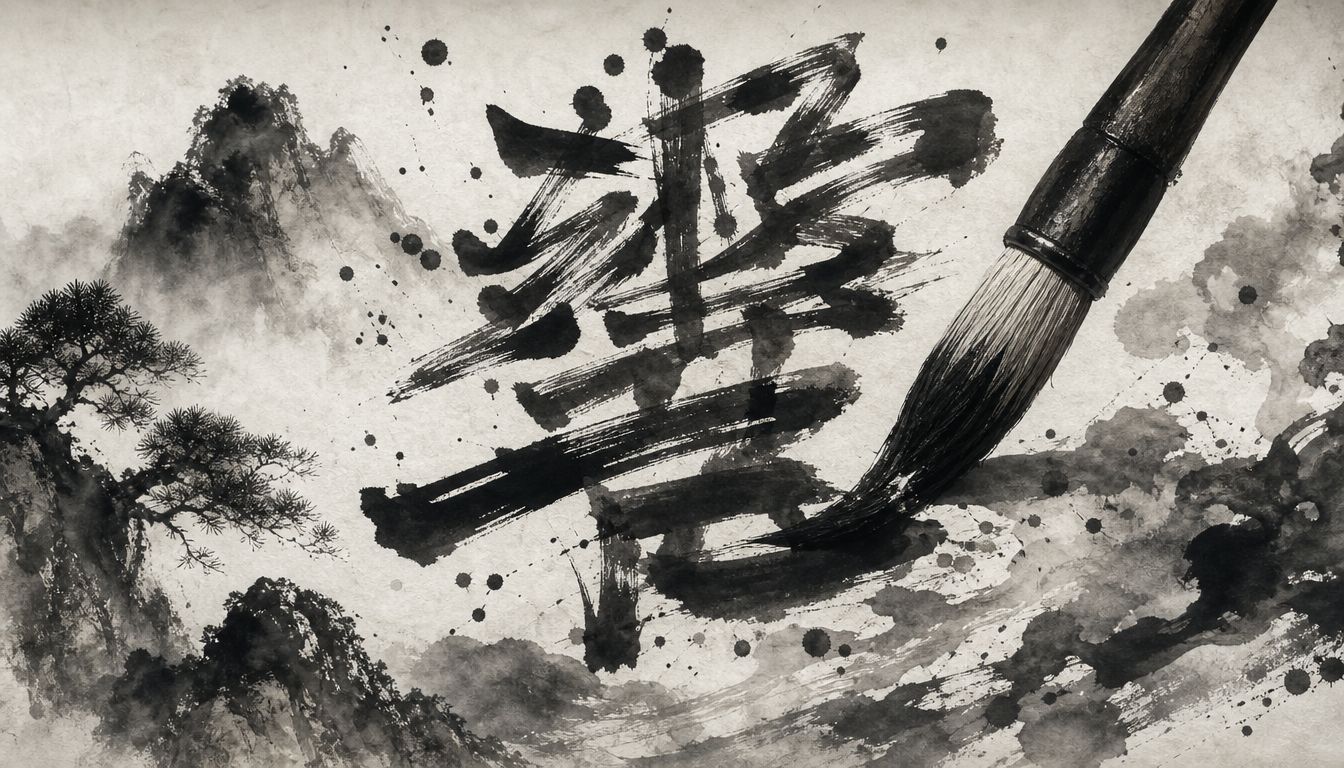
At its most direct, 響 means echo, reverberation, and the sound that carries. According to Jisho.org, the noun 響き (hibiki) covers echo and reverberation, as well as the distinctive sound of a specific object or activity, such as rain, thunder, or a bell. There is a second, quieter layer to the word. Japanese also uses 響き for the emotional resonance a word or piece of music leaves in you, the way a phrase "has a nice ring to it."
That double meaning, physical sound and inner feeling, is what makes 響 special. A shout in a canyon and a truth that stays with you for years are the same verb in Japanese. The character treats influence as a kind of acoustics: you make a sound, the world sends it back changed.
| Item | Details |
|---|---|
| Kanji | 響 |
| Meaning | Echo, resound, reverberate |
| Strokes | 20 |
| Radical | 音 (sound) |
| Kun-reading | ひび-く (hibiku) |
| Common as a name | Hibiki (unisex) |
Kanji Structure and Radicals: Breaking Down 響

According to Jitenon, 響 has 20 strokes in its Japanese shinjitai form and its radical is 音 (oto / otohen), meaning "sound." That radical placement is the whole point of the character. Whatever else is happening in 響, it is anchored to sound.
Look at the character and you can see it splits into an upper element and the sound component beneath. The top carries a component historically linked to 鄉 (village, the space between people), and the bottom is 音, sound itself. Read together, the character sketches sound traveling across a space and returning, which is exactly what an echo is. The image below breaks the character down into its two main structural zones.
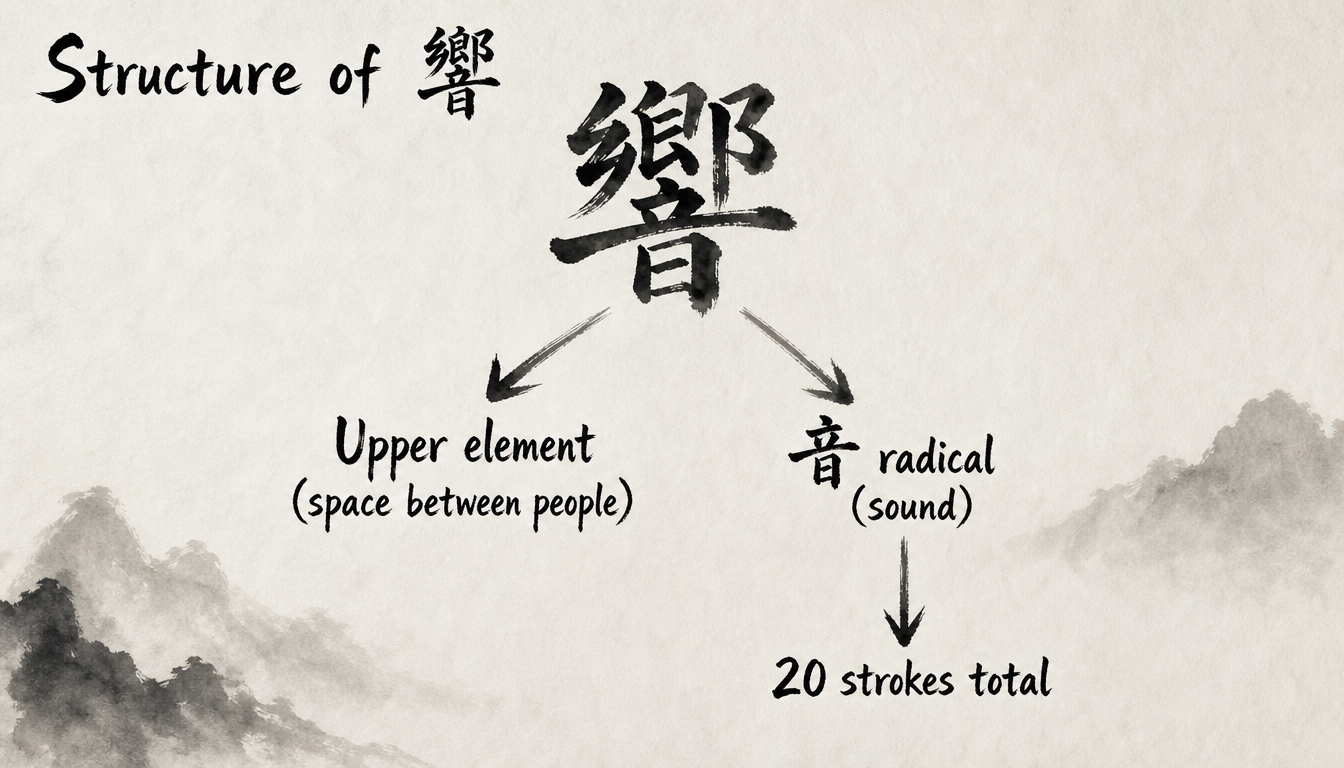
At 20 strokes, 響 is a dense, architectural character. That density is part of its appeal as a written symbol. It looks substantial. When brushed in calligraphy, the mass of strokes at the bottom gives the whole character a grounded weight, as if the sound has somewhere solid to land.
Because 響 has 20 strokes, stroke order and spacing matter more than with simpler kanji. For a tattoo or a piece of framed art, a rushed or cramped 響 loses the balance that makes it beautiful. Give it room to breathe.
Readings and Pronunciations of 響
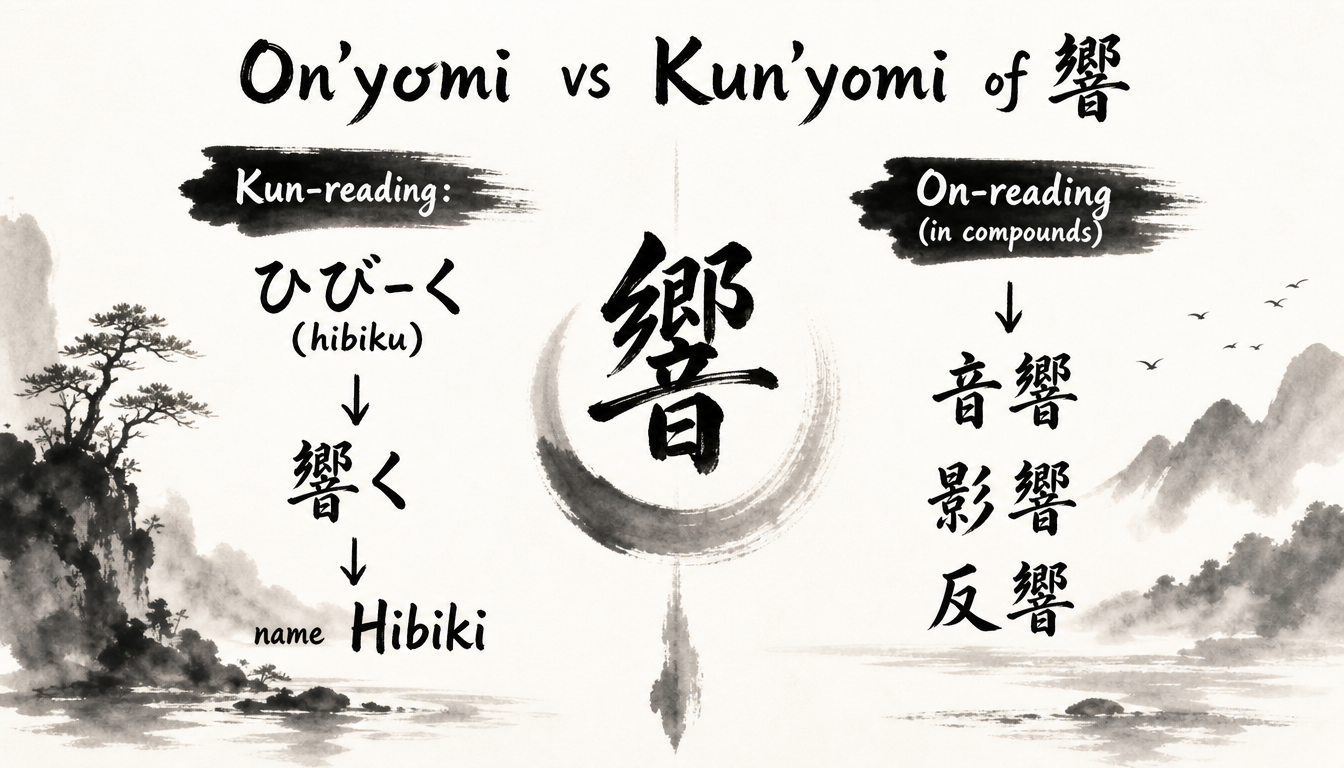
Like most kanji, 響 has both a native Japanese reading (kun'yomi) and a Chinese-derived reading (on'yomi). Knowing which is which helps you use the character correctly and avoid the mismatches that plague cheap kanji converters.
The kun-reading is ひび-く (hibiku), meaning "to resound" or "to echo," as documented on Jisho.org. This is the verb form you meet in everyday Japanese, and its noun form 響き (hibiki) is the source of the popular name. The on-reading, used mostly inside compound words, gives 響 its role in more formal vocabulary. The diagram below contrasts when each reading appears.
The name Hibiki has grown into a genuinely contemporary given name, used for boys and increasingly as a unisex option. According to Japanese-Names.info, the single-kanji writing 響 is by far the most evocative form, lending the name a musical, atmospheric register, and the name rose into wider use from the 2000s onward. Variants like 響貴 (echo + noble) and 響喜 (echo + joy) keep 響 as the leading character while elaborating on the theme.
Real Compound Words Using 響
Compounds show how the sound-and-resonance idea stretches across the language:
- 音響 (onkyō) — acoustics, sound. The word behind "sound systems" and audio engineering.
- 影響 (eikyō) — influence, effect. Here 響 leaves the world of literal sound entirely and means the ripple one thing sends through another.
- 反響 (hankyō) — echo, repercussion, public response. The reaction a book, speech, or event provokes.
- 交響曲 (kōkyōkyoku) — symphony. Literally sounds resounding together.
The jump from 音響 (physical acoustics) to 影響 (influence) is the entire philosophy of the character in two words. Japanese decided long ago that having an effect on someone is a form of resonance.
The Symbolism and Philosophy of the Echo Kanji
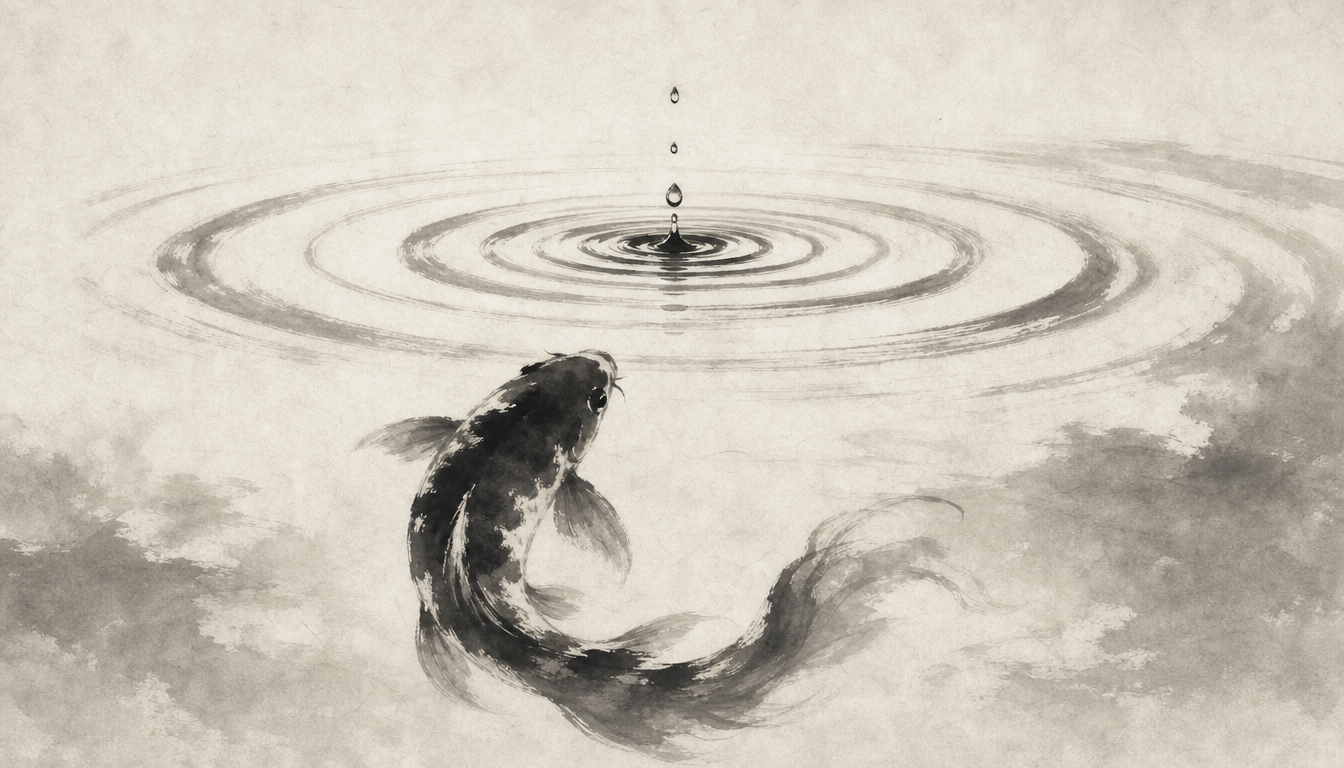
Choosing 響 as a personal symbol says something specific about how you see your place in the world. An echo is not a solo act. It needs a source and a surface, a voice and something to return it. People who resonate with the kanji hibiki echo tend to believe that they exist in relationship, that their actions travel outward and come back, and that connection is the medium they move through.
There is also a mindfulness dimension. In many contemplative traditions, sound and vibration are gateways to presence, the ringing of a bowl, the fading of a bell, the space after a note. 響 lives in that fading space, the moment a sound leaves its source and belongs to the room. For meditation and wellness practitioners, the character captures the idea that what matters is not only the strike, but the resonance that follows.
| Good fit for 響 | Poor fit for 響 | |
|---|---|---|
| Core value | Connection, influence, resonance | Isolation, standing apart |
| Creative field | Music, sound, spoken word, healing | Purely visual or silent work |
| Personality | Empathic, people-affecting, expressive | Withdrawn, effect-averse |
If your guiding belief is that your presence changes the rooms you enter, 響 is close to a literal portrait of you. It is the character for a person whose influence outlasts the moment.
Common Misunderstandings About 響
| Misunderstanding | Accurate understanding |
|---|---|
| "響 only means literal sound." | It equally means emotional resonance and influence, as in 影響 (eikyō). |
| "Hibiki is a girl's name." | Hibiki is used for boys and is increasingly unisex. |
| "響 and echo are identical concepts." | Japanese 響 includes the returning sound and the feeling it leaves, a wider idea than the English "echo." |
Using 響 as a Tattoo or Personal Symbol
As a tattoo, 響 rewards patience. Its 20 strokes make it one of the more visually complex kanji, which is a strength when the piece is large and well-placed, and a liability when it is shrunk too small. At tiny sizes, the fine internal strokes can blur together as the tattoo ages. Give it scale: a forearm, a shoulder blade, the ribs, or a back piece where the density reads as intentional rather than crowded.
A few practical cautions before you commit:
- Confirm the stroke order with a reliable dictionary source so the character is drawn, not copied as a shape.
- Never mirror or rotate the character for the sake of composition. A flipped 響 stops being real Japanese.
- Pair thoughtfully. 響 sits well beside kanji from the same emotional family, such as 音 (sound), 和 (harmony), and 縁 (connection).
The single most important safeguard is meaning, not aesthetics. A character that looks beautiful but was chosen from a clip-art chart can carry a reading or nuance you never intended. This is where cultural grounding matters, and where a service curated by native creators earns its place.
Oracle Kanji Writer approaches this from the meaning first. Its Personalized Soul Kanji Diagnosis Tool takes your name, birthdate, and blood type, then recommends a character aligned with your inner qualities, complete with pronunciation, primary and nuanced meanings, a personal message, and hand-picked compound words for context. For someone drawn to 響 and the themes of sound and resonance, that context prevents the mistranslations and clichés that turn a meaningful symbol into an embarrassing one.
FAQ
What is the kanji for hibiki?
The kanji for hibiki is 響, meaning echo, resound, and reverberation. Its kun-reading is ひび-く (hibiku), "to resound," and as a noun 響き (hibiki) means echo or the distinctive sound of something. It is also a popular unisex given name in modern Japan.
What is the kanji for echo?
響 is the primary kanji for echo. According to Jisho.org, 響き (hibiki) is defined as "echo; reverberation," and the character is built on the radical 音, meaning sound. It carries both the literal returning sound and the emotional resonance a sound or word leaves behind.
Is 響 a good choice for a tattoo?
Yes, if you give it enough size. With 20 strokes, 響 is visually rich but can blur if inked too small. Confirm the stroke order, avoid mirroring the character, and choose the meaning deliberately. It suits people drawn to music, connection, and the idea that their influence ripples outward.
Conclusion
響 turns sound into philosophy. Here are the key points to carry with you:
- The kanji hibiki echo character means echo, reverberation, and the resonance a sound or word leaves in you.
- It has 20 strokes and the radical 音 (sound), which anchors its entire meaning.
- The kun-reading is ひび-く (hibiku); compounds like 影響 (influence) show how far the resonance idea reaches.
- As a personal symbol, 響 speaks to people who see their lives as connected, influential, and vibration-driven.
- For a tattoo or keepsake, meaning and accuracy matter more than looks, which is why the kanji hibiki echo deserves a culturally grounded source like Oracle Kanji Writer's Soul Kanji diagnosis.
If 響 speaks to you, explore the related characters in the same family and consider a personalized reading to find the character that truly resonates with your soul's own sound.
Discover Your Soul Kanji
Experience the depth of Japanese characters: each kanji carries timeless meaning, guiding your life's path.
No credit card required • 2-minute process