Kanji of the Day Vol.4 | Kanji 夢 (Yume): The Dream Kanji Awakening Your Soul's Vision"

The kanji yume (夢) carries a dual soul — it means both the dreams we see in sleep and the aspirations that guide our waking life. In this fourth installment of our Kanji of the Day series, we explore the meaning, stroke order, compounds, and symbolism of this beloved 13-stroke character. Learn how to write it beautifully, use it meaningfully, and decide whether 夢 is the right kanji for your tattoo, calligraphy, or personal symbol.
Kanji of the Day Vol.4 | Kanji 夢 (Yume): The Dream Kanji Awakening Your Soul's Vision
The kanji yume (夢) is one of the most beloved characters in the Japanese language — a single brushstroke world that holds both the soft mystery of nighttime visions and the fierce light of a life's ambition. Whether you're drawn to it for a tattoo, a wallpaper, or a meditation on your own path, 夢 carries a quiet power that resonates across cultures. In this fourth installment of our Kanji of the Day series, we explore what makes the kanji yume such a profound symbol of inner aspiration.
Discover Your Soul Kanji
Experience the depth of Japanese characters: each kanji carries timeless meaning, guiding your life's path.
No credit card required • 2-minute process
One-Line Definition
The kanji yume (夢) means "dream" — encompassing both the visions we experience in sleep and the aspirations that guide our waking life.
Overview Table: The Kanji 夢 at a Glance
| Item | Details |
|---|---|
| Character | 夢 |
| English meaning | Dream, vision, aspiration |
| On'yomi (Chinese reading) | ム (mu) |
| Kun'yomi (Japanese reading) | ゆめ (yume) |
| Stroke count | 13 strokes (Kanshudo) |
| JLPT level | N3 (Kanshudo) |
| School grade | Grade 5 (Kanshudo) |
| Category | Jōyō kanji (one of the 2,136 characters for daily use, per Wikipedia) |
| Related concepts | 希望 (kibou, hope), 志 (kokorozashi, will) |
| Contrasting concept | 現実 (genjitsu, reality) |
Detailed Explanation: Why the Kanji Yume Matters
At first glance, 夢 looks like a single elegant character — but it is composed of layered components that suggest something seen dimly, as if through twilight. The upper portion evokes grass or covering, while the lower element 夕 (yuu) means "evening." Together, the character paints a poetic image: a vision that emerges when the world grows dark and the mind turns inward.
What makes the kanji yume remarkable is its dual nature. In Japanese, 夢 is not confined to the literal — those strange narratives our sleeping mind weaves. It is also the word for hope, ambition, and the destiny we reach toward. When a Japanese parent asks a child, "あなたの夢は何ですか?" ("What is your dream?"), they are asking about life's calling, not last night's sleep.
In Japanese, the word "dream" (夢) is used not only for those mysterious visions we have while asleep, but also to mean "hope" or "aspiration" (Self Taught Japanese). This makes 夢 one of the most spiritually layered characters in the language.
The Visual Composition
The character 夢 sits among the more visually complex kanji at 13 strokes. The flowing canopy at the top, the horizontal layers in the middle, and the final 夕 (evening moon) at the bottom create a balance that feels like a landscape — sky, mist, and the rising crescent of dusk. For calligraphers and tattoo artists alike, this composition makes 夢 deeply photogenic. It has weight without being heavy, and softness without being weak.
Meaning and Usage: Dream as Both Sleep Vision and Aspiration
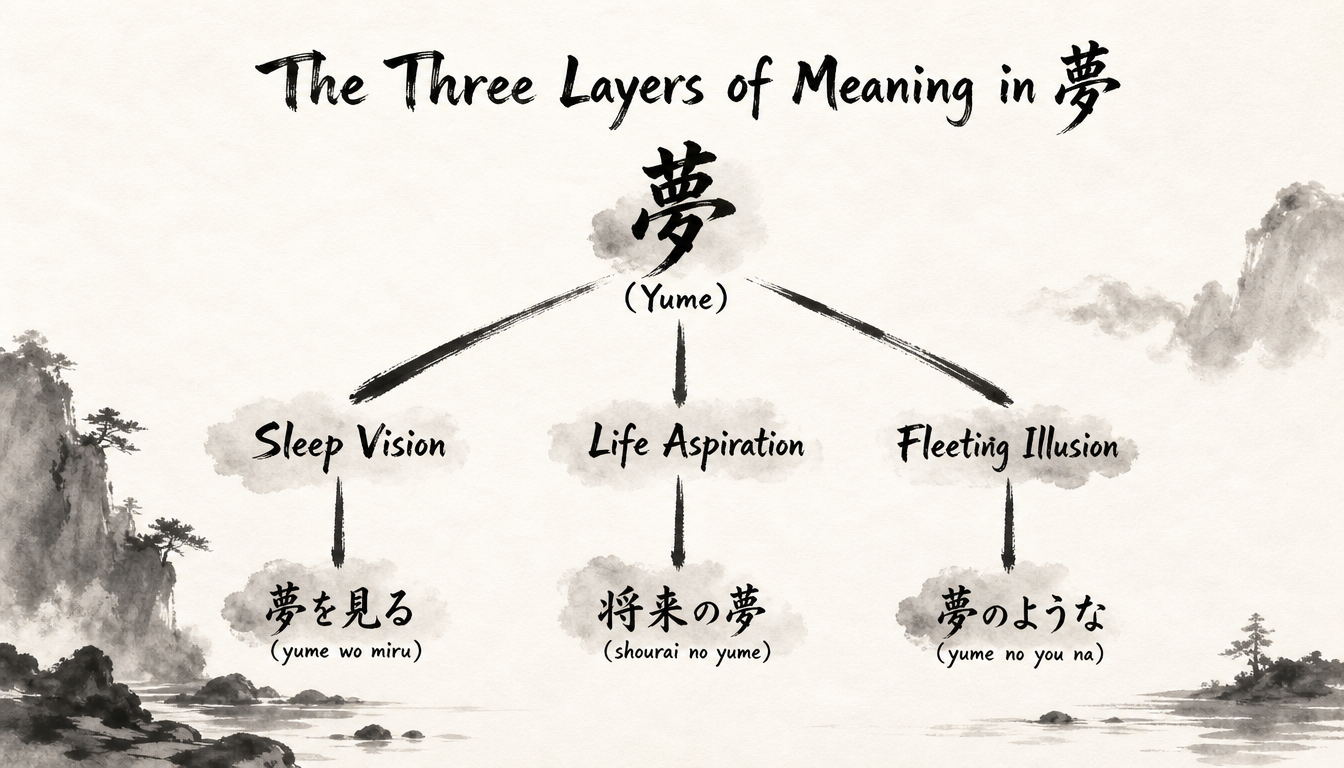
The dual meaning of the kanji yume is what gives it such enduring emotional gravity. Let's break down how it operates in everyday Japanese.
1. Dream as a Sleeping Vision
This is the most literal use. When you say "昨夜、変な夢を見た" (sakuya, hen na yume wo mita — "I had a strange dream last night"), you're using 夢 in its oldest sense. The verb 夢見る (yumemiru) literally means "to see a dream" (Nihongo Master) — note that Japanese "sees" a dream rather than "has" one, framing it as something witnessed rather than produced.
2. Dream as Life Aspiration
This is where 夢 takes flight. "将来の夢" (shourai no yume) means "future dream" — the life one hopes to build. A young athlete might say, "オリンピックに出るのが夢です" ("My dream is to compete in the Olympics"). Here, 夢 carries the same weight as the English word "vocation" — something between wish, calling, and destiny.
3. Dream as Illusion or Fleeting Beauty
There is also a third, more melancholy layer. In classical literature and Buddhist thought, 夢 can mean "illusion" — the transient, fleeting quality of all worldly things. The phrase "夢のような" (yume no you na — "like a dream") often describes something beautiful but impermanent. This nuance gives the kanji yume its bittersweet philosophical depth.
Common Compounds Featuring the Kanji Yume
The character 夢 appears in many evocative jukugo (compound words). Each one expands the emotional vocabulary of the dream concept.
- 夢中 (muchuu) — "in a dream / absorbed." Used when someone is so engrossed in something they lose track of time. "ゲームに夢中になる" = "to be absorbed in a game."
- 正夢 (masayume) — "a prophetic dream that comes true." A dream that turns out to predict reality.
- 悪夢 (akumu) — "nightmare." The dark side of the dreaming mind.
- 初夢 (hatsuyume) — "the first dream of the new year." In Japanese tradition, this dream is believed to foretell the year ahead.
- 夢想 (musou) — "daydream / reverie." A poetic, philosophical state of imagining.
Stroke Order and Writing Practice
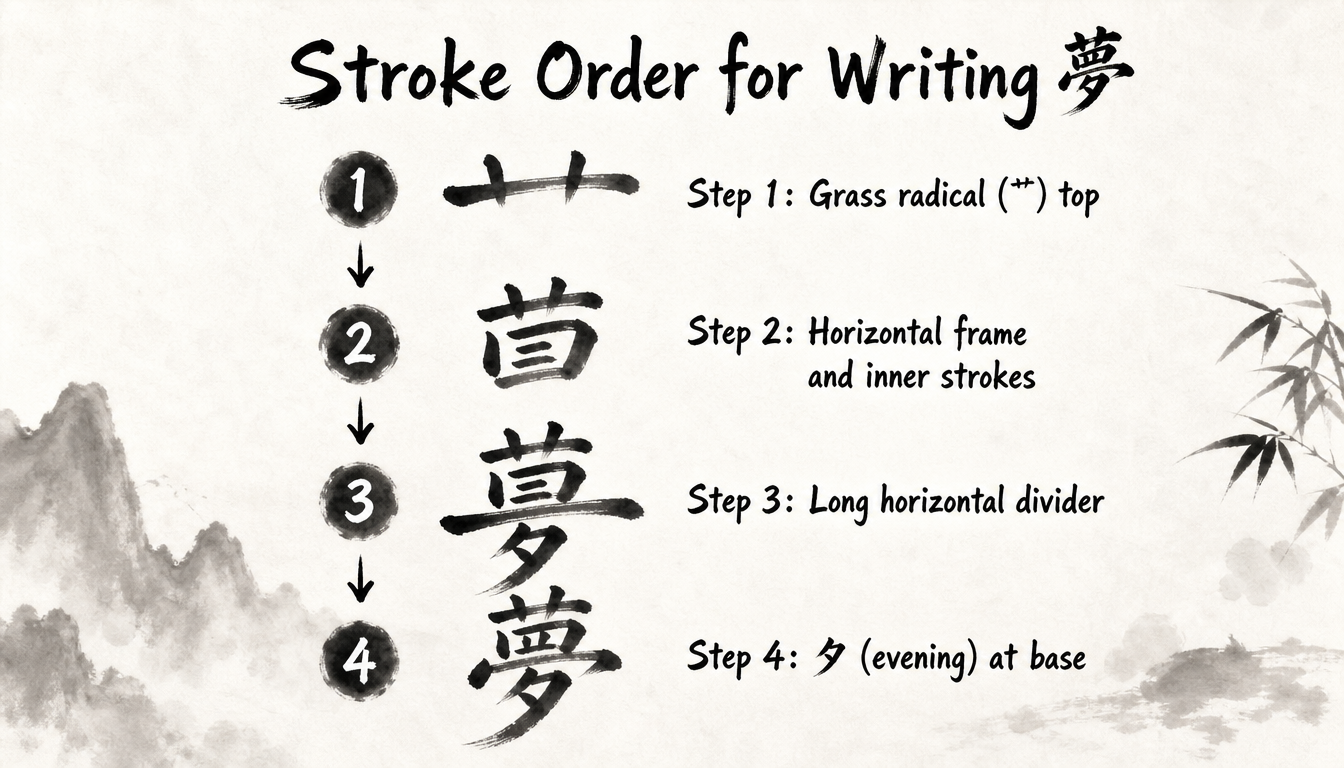
Writing the kanji yume by hand is a meditative experience. Its 13 strokes flow from top to bottom, left to right, following the universal principles of Japanese calligraphy. Let's walk through the structure.
Stroke Order Overview
- Begin at the top with the grass radical (艹) — two short vertical strokes crowned by a horizontal sweep. This is written in 4 strokes that establish the "canopy" of the character.
- The middle section contains a horizontal box-like structure with internal strokes. Move from the outer frame inward, finishing the inside before closing any enclosure.
- A long horizontal stroke bisects the character, anchoring the upper and lower halves.
- Finish with 夕 (evening) at the bottom — a curved diagonal stroke, a smaller diagonal, and a final dot that lands like a moon settling into night.
Tips for Beautiful Writing
- Balance vertical proportions. The top, middle, and bottom thirds should feel roughly equal in visual weight, even though stroke counts differ.
- Keep the central horizontals parallel. The horizontal lines in the middle of 夢 are what give the character its calm, layered feel.
- Let 夕 breathe. The final "evening" component shouldn't feel cramped. Give it room to settle at the base.
- Practice with grid paper. Genkō yōshi (Japanese writing grid paper) helps maintain proportion until your eye learns the rhythm.
If you plan to use 夢 as a tattoo, always have the design reviewed by a native Japanese speaker or a trusted kanji-savvy source. A mirrored or stroke-incorrect version can transform a beautiful character into something illegible — or worse, embarrassing. Stroke order matters because it shapes the natural flow and weight of each line.
Concrete Examples: The Kanji Yume in Use
| Context | Good Usage | Awkward Usage |
|---|---|---|
| Personal aspiration | 夢を追いかける (yume wo oikakeru) — "chase a dream" | Using 夢 to mean "a casual wish" — too lightweight for the word's gravity |
| Tattoo design | Single 夢 in clean brush style, vertical orientation | 夢 paired randomly with another kanji that creates an unintended compound |
| Conversation | 子供の頃の夢 (kodomo no koro no yume) — "childhood dream" | Using 夢 to describe a vague preference (e.g., favorite food) |
Common Misconceptions About the Kanji Yume
| Misconception | Accurate Understanding |
|---|---|
| "夢 only means sleep dreams." | 夢 equally means life aspiration, hope, and calling. |
| "夢 is a feminine or soft character." | 夢 is gender-neutral and carries weight, ambition, and resolve. |
| "Any kanji that looks pretty will do for a tattoo." | Kanji are meaning-bearing characters; aesthetic alone isn't enough — meaning, balance, and stroke accuracy all matter. |
| "夢中 means 'inside a dream.'" | 夢中 idiomatically means "absorbed / engrossed" — not literally inside a dream. |
Related Terms and Similar Concepts
| Term | Meaning | Difference from 夢 |
|---|---|---|
| 希望 (kibou) | Hope | More rational and outward; 夢 is more personal and visionary |
| 志 (kokorozashi) | Will, ambition, resolve | Emphasizes determination; 夢 emphasizes imagination |
| 理想 (risou) | Ideal | An abstract standard; 夢 is more emotional and lived |
| 幻 (maboroshi) | Illusion, phantom | Stresses unreality; 夢 holds both beauty and possibility |
How to Use the Kanji Yume in Your Life
If 夢 speaks to you, there are many meaningful ways to integrate it into your personal practice or aesthetic life.
- As a daily reminder. Write 夢 on a small card and place it where you'll see it each morning. The act of seeing your aspiration as a single visual symbol can anchor your day.
- As a calligraphy practice. Tracing 夢 with a brush is a moving meditation. The 13 strokes invite slow, intentional attention.
- As body art. 夢 is one of the most popular kanji choices for tattoos among foreign enthusiasts of Japanese culture. Its single-character density makes it visually striking on the wrist, forearm, or spine.
- As a name kanji. 夢 is sometimes used in Japanese given names, often for girls, conveying a hope-filled future.
If you're drawn to 夢 but unsure whether it truly reflects your inner essence, a personalized approach can help. Oracle Kanji Writer offers a two-minute Soul Kanji diagnosis that pairs your name, birthdate, and personality with a kanji selected by Japanese creators — ensuring the character you choose is not only beautiful but culturally accurate and aligned with your spirit.
FAQ
What is the kanji for yume?
The kanji for yume is 夢, a 13-stroke character meaning "dream." It is read as yume in its native Japanese (kun'yomi) reading and as mu in its Chinese-derived (on'yomi) reading. The character carries both the meaning of dreams experienced during sleep and the broader sense of life aspirations or hopes.
Is 夢 a good kanji for a tattoo?
Yes, 夢 is one of the most popular and culturally respected kanji for tattoos. Its dual meaning of sleep visions and life aspirations resonates with people across cultures, and its 13-stroke composition is visually balanced. Just be sure to verify stroke order with a reliable source and confirm the orientation isn't mirrored before getting inked.
What does 夢中 (muchuu) mean?
夢中 literally combines "dream" (夢) and "middle" (中), but idiomatically it means "absorbed," "engrossed," or "lost in something." When a Japanese person says they are 夢中 about a hobby or passion, they mean they're so deeply immersed in it that the outside world fades — much like being inside a dream.
Summary
- The kanji yume (夢) means both "dream while sleeping" and "life aspiration," making it one of Japanese's most spiritually layered characters.
- It is composed of grass, layered horizontal elements, and 夕 (evening) — evoking a vision seen at twilight.
- 夢 is a Grade 5 jōyō kanji with 13 strokes, classified at JLPT N3 level.
- Compounds like 夢中 (absorbed), 初夢 (first dream of the year), and 正夢 (prophetic dream) expand its emotional range.
- Stroke order matters — especially for tattoos and calligraphy. Top to bottom, left to right, with 夕 closing the character like a setting moon.
To go deeper into the world of Japanese characters as personal symbols, explore related kanji like 希望 (hope), 志 (resolve), and 心 (heart) — each offering its own portal to self-discovery. The kanji yume is a beautiful starting point, but the journey of finding the character that truly reflects your soul is uniquely yours.
References
Discover Your Soul Kanji
Experience the depth of Japanese characters: each kanji carries timeless meaning, guiding your life's path.
No credit card required • 2-minute process