Kanji of the Day Vol.3 | Kanji 静 (Sei): The Stillness Kanji for Inner Calm & Clarity"

The kanji sei (静) means stillness, calm, and inner tranquility — a cornerstone of Japanese aesthetics and Zen philosophy. In Vol.3 of our Kanji of the Day series, we explore its readings, common compounds like 冷静 and 静寂, its visual origin, and how to use it authentically in tattoos, calligraphy, or personal symbols. A grounded, beautiful character for anyone seeking meaning in stillness.
Kanji of the Day Vol.3 | Kanji 静 (Sei): The Stillness Kanji for Inner Calm & Clarity
The kanji sei (静) is the Japanese character for stillness, quietness, and inner calm. In a world that never stops scrolling, 静 stands as a single brushstroke philosophy: a reminder that peace is not the absence of life, but the presence of awareness. Welcome to Vol.3 of our Kanji of the Day series, where we explore one character a day to deepen your understanding of Japanese culture and self-symbolism.
静 (sei) is more than "quiet" — it represents a cultivated, awake stillness that Japanese aesthetics treat as a virtue rather than an emptiness.
Discover Your Soul Kanji
Experience the depth of Japanese characters: each kanji carries timeless meaning, guiding your life's path.
No credit card required • 2-minute process
What Is the Kanji 静 (Sei)?
The kanji sei (静) means stillness, calm, tranquility, and quietude. It is one of the most beloved characters in Japanese calligraphy, often hung in tea rooms, meditation spaces, and Zen monasteries. According to Jisho, when read on its own as sei, 静 functions as a noun meaning "stillness," and its antonym is 動 (dō, "movement"). This pairing of stillness and motion sits at the heart of East Asian thought, much like yin and yang.
For wellness seekers, tattoo enthusiasts, and lovers of Japanese aesthetics, 静 carries a layered beauty: it is visually balanced, philosophically rich, and instantly recognizable to native readers.
Overview Table
| Item | Details |
|---|---|
| Character | 静 |
| English meaning | Stillness, quiet, calm, tranquility |
| On'yomi (Chinese reading) | セイ (sei), ジョウ (jō) |
| Kun'yomi (Japanese reading) | しず (shizu), しず-か (shizuka), しず-まる (shizumaru), しず-める (shizumeru) |
| Category | Jōyō kanji (regular-use) |
| Traditional form | 靜 (used in older texts and some names) |
| Antonym | 動 (dō, movement) |
| Cultural weight | High — central to Zen, tea ceremony, calligraphy |
The character belongs to the jōyō kanji list of 2,136 characters that the Japanese government designates for daily use, meaning every literate adult in Japan recognizes it instantly.
Readings and Pronunciations of 静 (Sei)
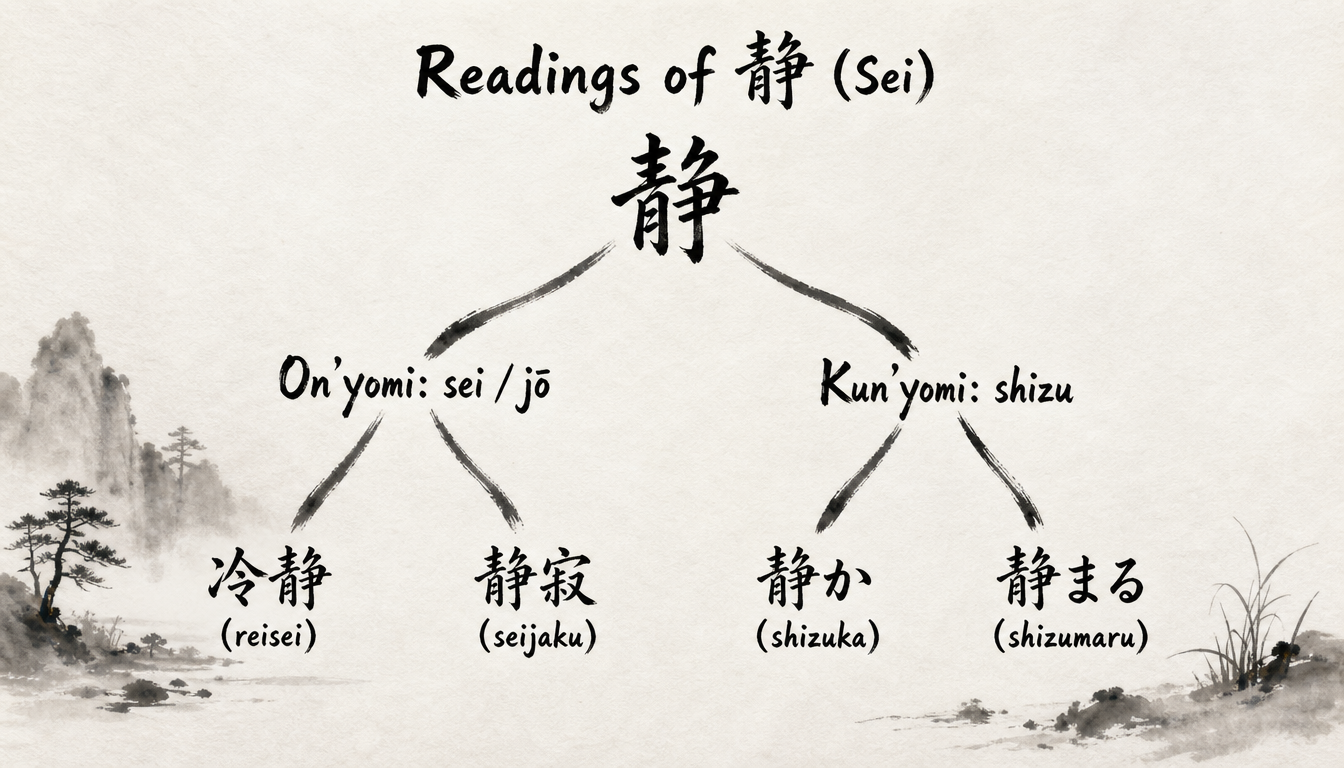
Like most kanji, 静 has multiple readings, and which one is used depends on whether the character stands alone or is combined with others. Understanding these readings is key if you want to use the kanji sei meaningfully in a name, tattoo, or piece of calligraphy.
On'yomi: Sei and Jō
The on'yomi (Sino-Japanese readings) are セイ (sei) and ジョウ (jō). These are used almost exclusively in compound words (jukugo). Sei is by far the most common, appearing in words such as 静止 (seishi, "stillness") and 冷静 (reisei, "composure"). The reading jō is rarer and tends to appear in Buddhist or classical vocabulary, such as 寂靜 (jakujō, "tranquility, enlightenment"), as recorded in the traditional form 靜.
Kun'yomi: Shizu and Its Family
The kun'yomi (native Japanese readings) revolve around the root しず (shizu). From this root come a small family of words:
- 静か (shizuka) — a na-adjective meaning "quiet, calm, peaceful," confirmed by Jisho.
- 静まる (shizumaru) — an intransitive verb meaning "to quiet down, to become calm," listed as a JLPT N2 common word.
- 静める (shizumeru) — the transitive counterpart, "to calm something down, to soothe."
Shizuka is also a popular Japanese given name, especially for girls, derived directly from the adjective meaning "quiet and peaceful."
If you are designing a personal symbol or tattoo, the reading you choose subtly shifts the feeling. Sei sounds formal and philosophical; shizuka sounds gentle and personal.
Origin and Visual Structure of 静
The kanji sei is composed of two main parts: 青 (ao/sei, "blue/green, fresh") on the left and 争 (sō, "to contend, to strive") on the right. The radical is 青 (blue), which gives the character a visual coolness — the color of clear water, dawn skies, and young bamboo.
The pairing is philosophically beautiful. 青 suggests freshness and clarity; 争 suggests struggle and motion. Together, 静 can be interpreted as the clear stillness that emerges after struggle has settled — not a void, but a resolved calm. This is precisely the kind of stillness Zen practitioners describe: a quiet earned through presence, not avoidance.
Common Words and Compounds Using 静 (Sei)
To truly appreciate the kanji sei, it helps to see it in context. Below are the most common and culturally important compounds, drawn from standard kanji dictionaries.
| Compound | Reading | Meaning |
|---|---|---|
| 静止 | seishi | Stillness, standing still, static |
| 冷静 | reisei | Calmness, composure, level-headedness |
| 平静 | heisei | Calm, serenity, tranquility |
| 静寂 | seijaku | Silence, deep stillness (often poetic) |
| 安静 | ansei | Rest, repose (often medical) |
| 静養 | seiyō | Convalescent rest, recuperation |
| 閑静 | kansei | Quiet, peaceful (of a neighborhood) |
| 動静 | dōsei | State of affairs, developments, movements |
| 静脈 | jōmyaku | Vein (anatomy) |
| 静電気 | seidenki | Static electricity |
Notice how the meaning of 静 flexes across contexts: in 冷静 (reisei) it describes a cool, unshaken mind; in 静寂 (seijaku) it points to the kind of silence you feel in a forest at dawn; in 静脈 (jōmyaku) it even names the veins, the "quiet vessels" that return blood gently to the heart, contrasted with the active arteries.
Good Examples vs. Misused Examples
| Context | Good Use | Awkward Use |
|---|---|---|
| Tattoo / personal symbol | 静 alone, or 冷静 (composure) | Random pairing like 静争 (not a real word) |
| Naming a space | 閑静 for a quiet residence | 静止 for a meditation room (means "static," too clinical) |
| Describing a person | 物静か (mono-shizuka, "soft-spoken") | 静脈 (jōmyaku) — that means a vein |
Common Misunderstandings About 静
| Misconception | Correct Understanding |
|---|---|
| "静 just means silent or mute." | 静 means an alive, aware stillness — not muteness. The word for mute is 黙 (moku). |
| "静 and 寂 mean the same thing." | 寂 (jaku/sabi) carries a tinge of loneliness or impermanence; 静 is neutral, peaceful calm. They often appear together as 静寂. |
| "靜 is a different kanji from 静." | 靜 is the traditional form; 静 is the modern simplified form used in Japan today. They share meaning and readings. |
| "静 always reads as sei." | It reads as sei in compounds, but as shizu(ka) when used as a standalone word or adjective. |
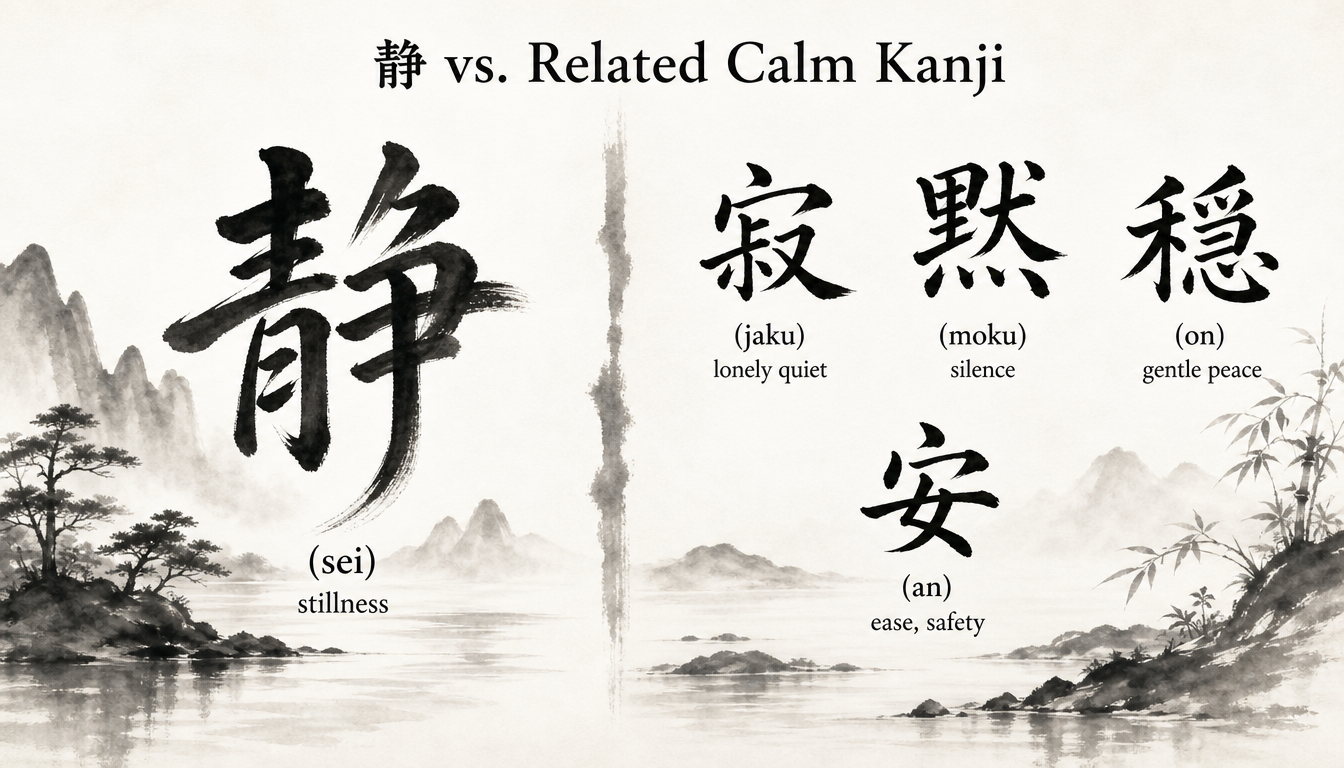
Related Concepts and How They Differ
| Kanji | Meaning | Difference from 静 |
|---|---|---|
| 寂 (jaku/sabi) | Loneliness, quiet melancholy | Carries emotional solitude; 静 is neutral calm |
| 黙 (moku) | Silence, being silent | Refers to not speaking; 静 refers to overall stillness |
| 穏 (on) | Gentle, mild, peaceful | Describes temperament; 静 describes a state or environment |
| 禅 (zen) | Zen, meditative practice | A spiritual discipline; 静 is the quality cultivated by it |
| 安 (an) | Peace, ease, safety | Emphasizes safety and ease; 静 emphasizes quiet stillness |
How to Apply 静 in Your Life and Aesthetic
The kanji sei is one of the most popular characters chosen by people drawn to mindfulness, minimalism, and intentional living. Here are a few authentic ways to bring it into your world:
- As a tattoo: 静 works beautifully as a single-character tattoo on the inner forearm, ribcage, or back of the neck. Its visual symmetry — the cool 青 balancing the dynamic 争 — makes it elegant in both brushed and printed styles.
- As wall art or wallpaper: Hand-brushed prints of 静 are a staple of Japanese calligraphy shops and are often placed in meditation corners or reading nooks.
- As a daily mantra: Writing 静 by hand each morning is a simple, grounding ritual. Many practitioners say it functions like a visual breath.
- In journaling: Use 冷静 (reisei) to remind yourself to stay composed, or 静寂 (seijaku) to evoke deep, restorative silence.
Before getting any kanji tattoo, verify stroke order and orientation with a native source. Mirrored or stylistically distorted kanji are one of the most common — and avoidable — mistakes among non-Japanese clients.
Is 静 the Right Kanji for You?
Many people gravitate toward 静 because they sense, often before they can articulate it, that stillness is what they are missing. But authenticity matters: the kanji you choose should reflect who you actually are, not just an aesthetic. This is where personalized guidance helps. Oracle Kanji Writer offers a two-minute Soul Kanji diagnosis that considers your name, birthdate, and inner qualities to recommend a character that genuinely fits your essence — whether that turns out to be 静, or something equally meaningful you hadn't considered.
FAQ
What is sei in kanji?
Sei is the on'yomi (Sino-Japanese reading) of several kanji, but in the context of stillness and calm, it refers to 静. According to Jisho, 静 read as sei functions as a noun meaning "stillness," and it is the direct antonym of 動 (dō, "movement").
How do you pronounce 静?
It depends on context. As an on'yomi in compounds, it is read sei (rhymes with "say") or occasionally jō. As a kun'yomi in native Japanese words, it is read shizu, as in 静か (shizuka, "quiet") and 静まる (shizumaru, "to become calm").
Is 静 a good kanji for a tattoo?
Yes — 静 is one of the most aesthetically and culturally sound choices for a single-character tattoo, especially for people drawn to mindfulness, meditation, or Japanese aesthetics. It is universally understood in Japan, carries no negative connotations, and has strong visual symmetry. Just confirm the stroke order with a reliable source and avoid stylized fonts that distort the character.
What is the difference between 静 and 静か?
静 alone is most often used in compound words and reads as sei. 静か (shizuka) is the everyday adjective form that means "quiet" or "peaceful," used to describe places, people, or atmospheres in conversation.
Summary
Key takeaways about the kanji sei (静):
- 静 means stillness, calm, and tranquility — an alive, aware peace rather than mere silence.
- Its main readings are sei and jō (on'yomi), and shizu, shizuka, shizumaru, shizumeru (kun'yomi).
- It appears in essential compounds like 冷静 (composure), 静寂 (deep silence), and 平静 (serenity).
- It is part of Japan's jōyō kanji list and recognized by every literate adult in Japan.
- It is a culturally safe and beautiful choice for tattoos, wall art, and personal symbols — but pairing matters.
If 静 resonates with you, explore related kanji such as 禅 (Zen), 穏 (gentle peace), and 安 (ease and safety) in upcoming volumes of Kanji of the Day. And if you want to discover the kanji that truly belongs to you — not just the one that looks right, but the one that reads right in Japan — try the personalized Soul Kanji diagnosis from Oracle Kanji Writer. Sometimes, the journey toward stillness begins with a single character: 静, the kanji sei.
References
Discover Your Soul Kanji
Experience the depth of Japanese characters: each kanji carries timeless meaning, guiding your life's path.
No credit card required • 2-minute process