Kanji of the Day Vol.17 | "Kanji 火 (Hi): The Fire Kanji Igniting Your Soul's Passion & Power"

The fire kanji 火 (hi) is one of the oldest and most evocative characters in Japanese. From its pictographic origin as a stylized flame to its dual readings — hi and ka — this single glyph carries the meaning of literal fire, inner passion, and transformation. Explore the hi meaning, pronunciation, symbolism, and what choosing the japanese fire symbol reveals about your spirit.
Kanji of the Day Vol.17 | Kanji 火 (Hi): The Fire Kanji Igniting Your Soul's Passion & Power
The fire kanji 火 is one of the oldest and most elemental characters in the Japanese writing system. Pronounced hi in its native Japanese reading, this single glyph carries millennia of meaning — from the literal flame on a hearth to the inner blaze of passion, courage, and transformation. If you've ever felt drawn to the japanese fire symbol as a personal emblem, you're tapping into one of the most universally resonant kanji in existence. In this guide, we'll explore the hi meaning, its pictographic origins, pronunciation, and what choosing the kanji hi says about your spirit.
Discover Your Soul Kanji
Experience the depth of Japanese characters: each kanji carries timeless meaning, guiding your life's path.
No credit card required • 2-minute process
A Single-Sentence Definition
The kanji 火 (hi) means fire — both the physical flame and the metaphorical fire of human passion, energy, and willpower.
Overview Table
| Item | Detail |
|---|---|
| Kanji | 火 |
| Kun'yomi (Japanese reading) | ひ (hi) |
| On'yomi (Sino-Japanese reading) | カ (ka), コ (ko) |
| Primary meaning | Fire, flame |
| Extended meanings | Passion, intensity, urgency, light |
| Category | Elemental kanji (五行 / Five Elements) |
| Related concepts | 水 (water), 木 (wood/tree), 土 (earth), 金 (metal) |
| Usage frequency | Very high — one of the first kanji learned |
According to Wikipedia's entry on Radical 86, 火 has the kun'yomi reading ひ (hi) and the on'yomi readings カ (ka) and コ (ko). It also functions as a radical — the classifier under which many fire-related kanji are grouped.
Detailed Explanation: Why the Fire Kanji Matters
Fire is humanity's oldest companion. It cooks our food, warms our homes, lights our nights, and — symbolically — fuels our ambition. The kanji hi compresses all of this into four elegant strokes. In Japanese culture, 火 is one of the five classical elements (五行, gogyō), and it represents transformation: the force that turns raw into refined, cold into warm, and dormant into alive.
For modern readers, 火 carries a dual personality. On one hand, it is gentle — the hi of a candle, a hearth, a tea ceremony brazier. On the other, it is dangerous — the hi of wildfire, of urgency, of passions that consume. This duality is precisely what makes the japanese fire symbol so compelling as a personal emblem.
Fire as a Radical
火 is also Radical 86 in the traditional Kangxi classification system. According to Wikipedia, 639 characters out of 49,030 in the Kangxi Dictionary are found under this radical — a testament to how foundational fire is in the conceptual architecture of East Asian writing. When you see 火 (or its compressed bottom form 灬, four small dots), you're looking at a clue that the kanji relates to heat, cooking, burning, or light.
Kanji Origin: The Pictographic Flame
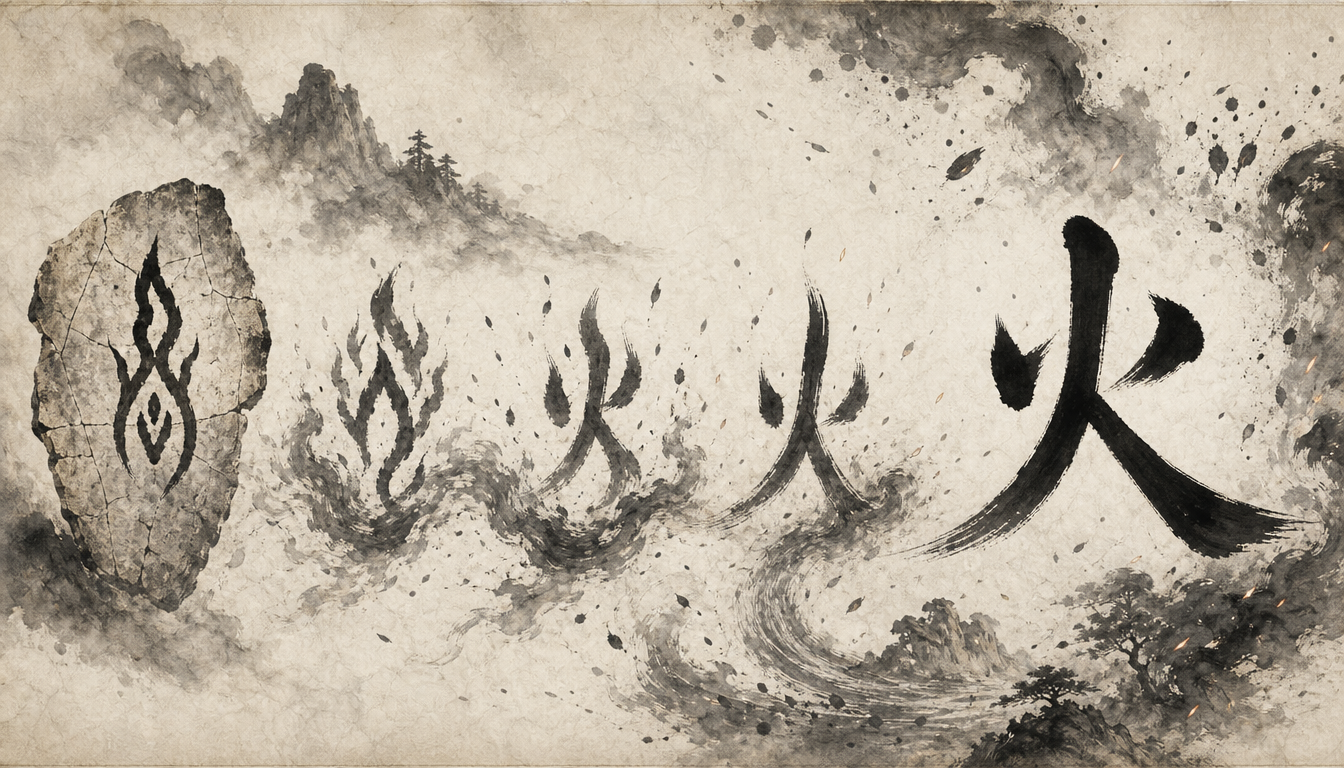
The origin of 火 is purely pictographic. In its earliest oracle-bone forms, the character depicted a literal flame — a central plume of fire with sparks or tongues of heat rising on either side. Over centuries of brush refinement, this organic flame was stylized into the four-stroke form we know today.
Look closely at 火. The central vertical stroke is the core of the flame. The two outer strokes — angled outward like flickering tongues — represent the dancing edges of fire. The small dashes at the top are the sparks rising into the air.
This is one of the rare kanji where the modern shape still visually echoes its ancient meaning. Unlike many characters that have drifted into abstraction, 火 remains a small drawing of what it represents. That's part of why it resonates so powerfully across cultures — even someone with no Japanese background can often intuit that this character is a flame.
From Oracle Bone to Modern Brush
The evolution moved through several stages: oracle-bone script (jagged, asymmetric flame), bronze-script (smoother, more symmetrical), seal script (curvilinear and ornate), clerical script (flattened and squared), and finally the regular script form used today. Each stage preserved the essential idea — a flame radiating outward — while making it easier to write with brush and ink.
Pronunciation: On'yomi (Ka) vs Kun'yomi (Hi)
Japanese kanji typically have two layers of pronunciation, and 火 is a classic example.
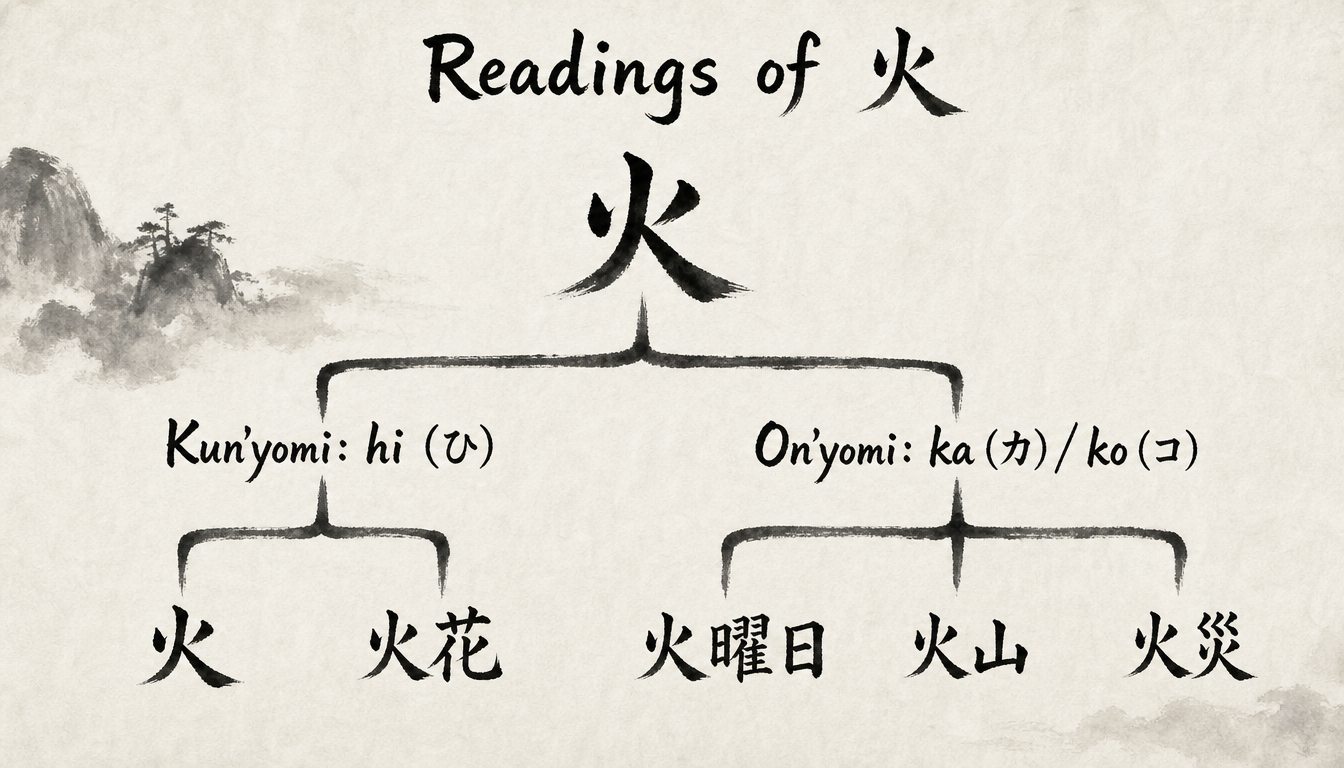
Kun'yomi: ひ (hi)
The kun'yomi is the native Japanese reading, used when 火 stands alone or appears in everyday vocabulary. When a Japanese person points at a flame on the stove and says hi, they're using this reading. Examples:
- 火 (hi) — fire, flame
- 火花 (hibana) — spark
- 火種 (hidane) — kindling; the seed of a fire (literal or metaphorical)
On'yomi: カ (ka) and コ (ko)
The on'yomi is the Sino-Japanese reading, derived from the original Chinese pronunciation when the character was imported. It's used primarily in compound words (jukugo). Examples:
- 火曜日 (kayōbi) — Tuesday (literally "fire day")
- 火災 (kasai) — fire disaster, conflagration
- 火山 (kazan) — volcano ("fire mountain")
A useful rule of thumb: if 火 appears alone or with hiragana, read it hi. If it's stuck to other kanji in a compound, it's usually ka.
Symbolism: What the Fire Kanji Says About You
Choosing 火 as a personal symbol is a bold statement. It says you identify with energy, transformation, and visible presence. People drawn to the fire kanji often share certain traits:
- Passionate — you commit fully to what you love
- Catalytic — you spark change in others and in situations
- Warm — you draw people toward you, like a hearth
- Transformative — you don't fear endings, because you understand that fire clears the way for new growth
- Urgent — you live with intensity and refuse to be lukewarm
In Japanese philosophy, fire is also linked to the heart (心) and to summer — the season of fullest expression. If your inner season is summer, 火 may be your kanji.
Good Example vs. Bad Example: Using 火 Meaningfully
| Aspect | Good Use | Poor Use |
|---|---|---|
| Tattoo intent | Chosen because you've survived a transformative life chapter | Picked because "fire looks cool" with no personal link |
| Pairing | 火 paired with 心 (heart) to mean "fire of the heart" | 火 paired randomly with characters that create unintended slang |
| Placement | Visible spot honoring its bold energy (forearm, shoulder) | Hidden away — contradicts the character's outward-radiating nature |
Common Misunderstandings About 火
| Misconception | Reality |
|---|---|
| "火 always means destruction" | 火 is just as often warmth, light, and life-giving energy. Context determines tone. |
| "火 and 炎 mean the same thing" | 火 is the general, everyday fire (a candle, a stove). 炎 (honō) is a larger, blazing flame — more dramatic and poetic. |
| "It's pronounced 'ka' in all situations" | Standalone, it's hi. In compounds, usually ka. Both readings are correct in their proper context. |
| "火曜日 means 'fire day' as in a dangerous day" | It just means Tuesday. The Japanese week is named after the five elements plus sun and moon — fire was simply assigned to Tuesday. |
Related and Contrasting Kanji
| Kanji | Reading | Meaning | Relationship to 火 |
|---|---|---|---|
| 炎 | honō / en | Blaze, large flame | Intensified version — 火 doubled |
| 灯 | tomoshibi / tō | Lamp, light | Fire tamed for illumination |
| 焼 | yaki / shō | To burn, to bake | Fire as action and process |
| 水 | mizu / sui | Water | Elemental opposite |
| 熱 | netsu | Heat, fever, passion | The sensation fire produces |
Compound Words Worth Knowing
- 火曜日 (kayōbi) — Tuesday
- 火山 (kazan) — volcano
- 火事 (kaji) — house fire, conflagration
- 花火 (hanabi) — fireworks (literally "flower fire")
- 火影 (hokage) — light/shadow of a flame (also a famous title in popular culture)
- 聖火 (seika) — sacred flame (e.g., the Olympic torch)
花火 (hanabi) deserves special attention. It captures the Japanese aesthetic perfectly: fire as something beautiful, brief, and shared. Summer hanabi festivals are among the most beloved cultural events in Japan, and the word itself shows how 火 can be reframed as something delicate rather than destructive.
Using the Fire Kanji as a Personal Symbol
If you're considering 火 for a tattoo, a piece of artwork, or a personal emblem, here are some practical points:
- Stroke order matters. The character is written in four strokes — left dot, right dot, central vertical, then the long sweeping bottom stroke. Correct stroke order produces correct visual balance.
- Avoid mirroring. 火 is asymmetric in subtle ways. Flipping it horizontally creates a character that looks "wrong" to Japanese eyes.
- Consider pairings carefully. 火 combined with 心 (heart) evokes inner passion. With 龍 (dragon), it becomes mythic. With 道 (way/path), it suggests a fiery life journey.
- Mind the placement. Fire radiates outward, so visible placements (forearm, shoulder, upper back) honor the character's energy better than hidden ones.
Before committing to any kanji tattoo, have a native Japanese speaker or a trusted cultural source confirm the character, stroke order, and meaning. Many tattoo flash sheets contain errors or use characters that read as nonsense in Japan.
FAQ
What does the fire kanji mean?
The fire kanji 火 means literal fire or flame, and by extension passion, intensity, urgency, and transformation. It is one of the five classical elements in East Asian philosophy and one of the first kanji Japanese children learn. The hi meaning spans everything from a candle flame to the inner fire of human will.
How do you pronounce 火 in Japanese?
When 火 stands alone or appears in native Japanese words, it's pronounced hi (ひ) — the kun'yomi reading. In Sino-Japanese compound words like 火曜日 (Tuesday) or 火山 (volcano), it's pronounced ka (カ). A less common on'yomi reading is ko (コ).
Is 火 a good kanji for a tattoo?
Yes, if it genuinely reflects your spirit. 火 is visually striking, instantly recognizable, and culturally authentic. It works best for people who identify with passion, transformation, or catalytic energy. Just ensure your design uses correct stroke order and isn't mirrored.
What's the difference between 火 and 炎?
火 (hi) is the everyday word for fire — a candle, a stove, a campfire. 炎 (honō) is a larger, more dramatic blaze, often used poetically for raging flames or the "fire" of strong emotion. Think of 火 as fire in general and 炎 as fire turned up to maximum intensity.
Discover Your Own Soul Kanji
The kanji hi is a beautiful starting point for anyone exploring Japanese culture through personal symbolism. But fire isn't the only character that might speak to you. Each kanji carries its own spirit — water's adaptability, wood's patience, light's clarity. If 火 resonates but you sense there's something even more specifically yours waiting to be discovered, Oracle Kanji Writer offers a personalized Soul Kanji diagnosis. In about two minutes, the platform suggests a kanji aligned with your name, birthdate, and inner essence — with full cultural context, pronunciation, and meaning, curated by Japanese creators who care about authenticity.
Summary
- The fire kanji 火 means fire, flame, and by extension passion, energy, and transformation.
- Its readings are ひ (hi) in kun'yomi and カ (ka) or コ (ko) in on'yomi, per established references.
- The character is pictographic — a stylized drawing of a central flame with sparks rising on either side.
- 火 is also Radical 86, classifying hundreds of fire-related kanji.
- Choosing the japanese fire symbol as a personal emblem signals warmth, intensity, and a transformative spirit.
If this guide to the kanji hi sparked something in you, explore related elemental kanji next — water (水), tree (木), and light (光) each carry their own deep symbolism, and together they form a vocabulary for understanding both Japanese culture and your own inner landscape.
Discover Your Soul Kanji
Experience the depth of Japanese characters: each kanji carries timeless meaning, guiding your life's path.
No credit card required • 2-minute process