Kanji of the Day Vol.16 | "Kanji 龍 (Ryu): The Dragon Kanji Unleashing Your Soul's Mythic Power"

The kanji ryu (龍) is far more than the Japanese word for dragon. Written in 16 traditional strokes, it carries centuries of symbolism — strength held in reserve, wisdom, protection, and the balance between water and sky. This guide unpacks the ryu meaning, compares the traditional 龍 with the simplified 竜, clears up common misconceptions, and shows how the Japanese dragon symbol can become a personal emblem rooted in authentic cultural meaning.
Kanji 龍 (Ryu): The Dragon Kanji Unleashing Your Soul's Mythic Power

The kanji ryu (龍) is the traditional Japanese character for dragon, carrying centuries of myth, spiritual weight, and quiet authority within its sixteen brushstrokes. For anyone drawn to the dragon kanji as a personal symbol — whether for a tattoo, a piece of art, or a meditation on identity — understanding the true ryu meaning matters more than a quick translation. The Japanese dragon symbol is not the fire-breathing menace of Western lore. It is a guardian of water, a bringer of wisdom, and a mirror for the strength you carry but rarely name.
Discover Your Soul Kanji
Experience the depth of Japanese characters: each kanji carries timeless meaning, guiding your life's path.
No credit card required • 2-minute process
What 龍 (Ryu) Means at a Glance
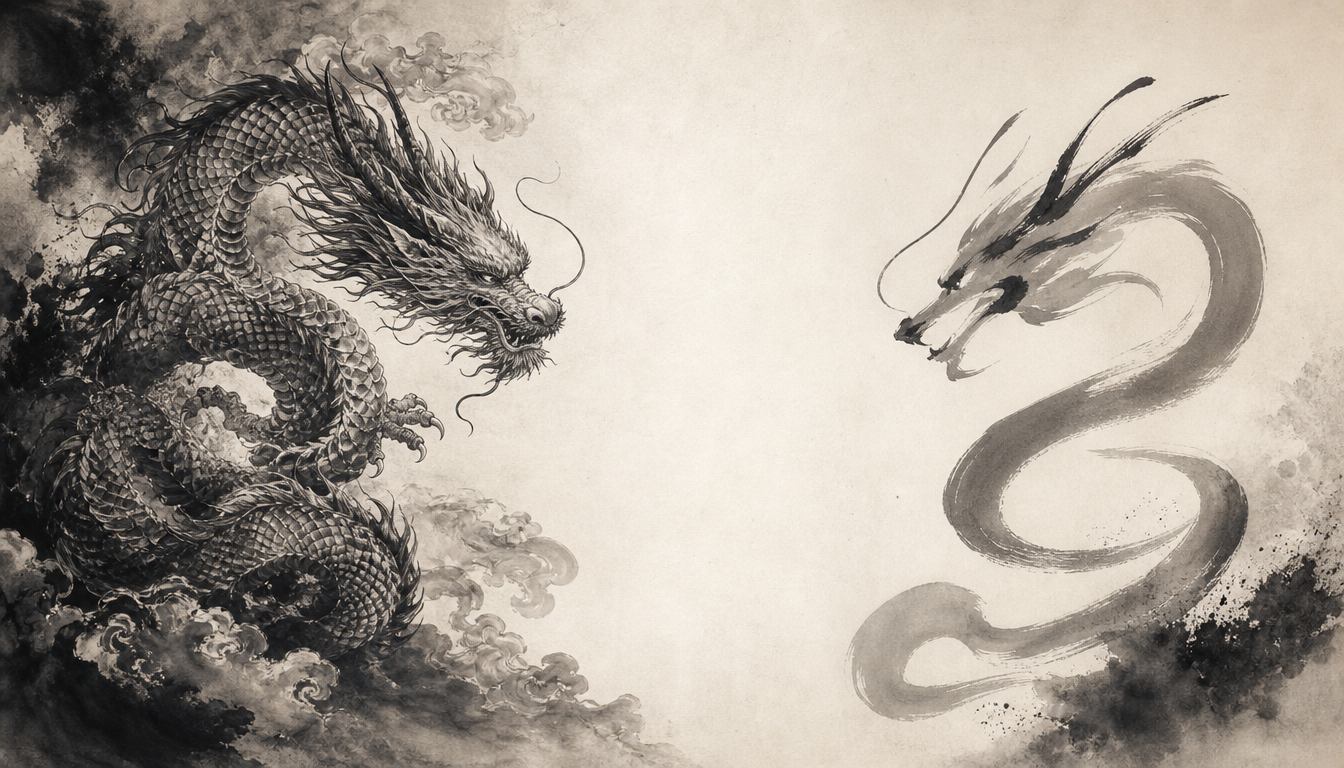
Before we dive into mythology and brushwork, here is the essential framing of this character — the kind of summary you'd want before committing it to skin, paper, or memory.
| Item | Detail |
|---|---|
| Kanji | 龍 (traditional) / 竜 (simplified) |
| English meaning | Dragon |
| On'yomi (Sino-Japanese reading) | りゅう (ryū), りょう (ryō) |
| Kun'yomi (native Japanese reading) | たつ (tatsu) |
| Stroke count (traditional 龍) | 16 strokes |
| Category | Mythological creature, name kanji, symbolic character |
| Related concepts | Water, sky, sovereignty, wisdom, fortune |
| Opposing/paired symbol | Tiger (虎) — earth balancing sky |
According to Jitenon, the traditional form 龍 is written in 16 strokes and reads たつ (tatsu) in its native Japanese form. That single line of data already hints at something important: this is not a casual character. Each stroke is a deliberate act, like carving a creature out of fog.
Traditional vs. Simplified: 龍 and 竜 Side by Side
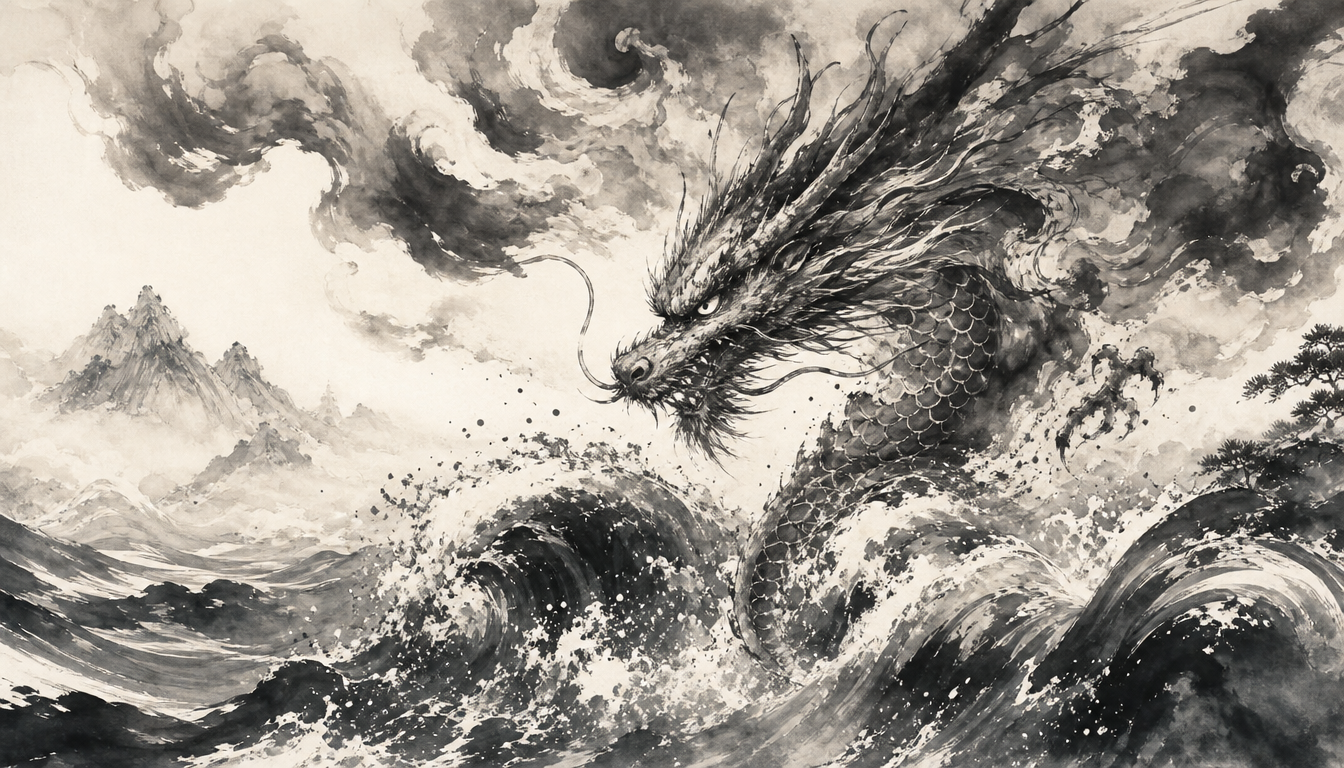
One of the first surprises for newcomers to the kanji ryu is that there are two valid forms in modern Japanese: the older, ornate 龍 and the streamlined 竜. Both mean dragon. Both are pronounced the same. But they carry very different visual energies, and choosing between them is a small act of self-expression.
The traditional form 龍 is the kyūjitai — the "old character form" used widely before Japan's postwar script reforms. It has 16 strokes packed into a single dense, scaly silhouette, and per Kanshudo, it is treated today as a variant of 竜. The simplified shinjitai form, 竜, is the standard taught in modern Japanese schools and used in everyday writing.
| Aspect | 龍 (Traditional) | 竜 (Simplified) |
|---|---|---|
| Strokes | 16 | 10 |
| Era of dominance | Pre-reform; classical texts | Modern standard |
| Visual feel | Ornate, coiled, mythic | Clean, graphic, modern |
| Common use today | Names, tattoos, calligraphy, brand marks | Newspapers, textbooks, signage |
| Reading | りゅう / たつ | りゅう / たつ |
If you are choosing the dragon kanji for a tattoo or a personal emblem, 龍 tends to be the more popular choice precisely because of its density. Its 16 strokes look like the creature itself — a scaled body coiling around an unseen pearl. The simplified 竜 is no less authentic; it simply speaks in a quieter, more contemporary voice.
Both forms are correct, and neither is "more Japanese" than the other. Choose 龍 for mythic weight and traditional aesthetics; choose 竜 for clean modernity. What matters is that you choose with intention.
Detailed Meaning: Why the Ryu Meaning Is Bigger Than "Dragon"
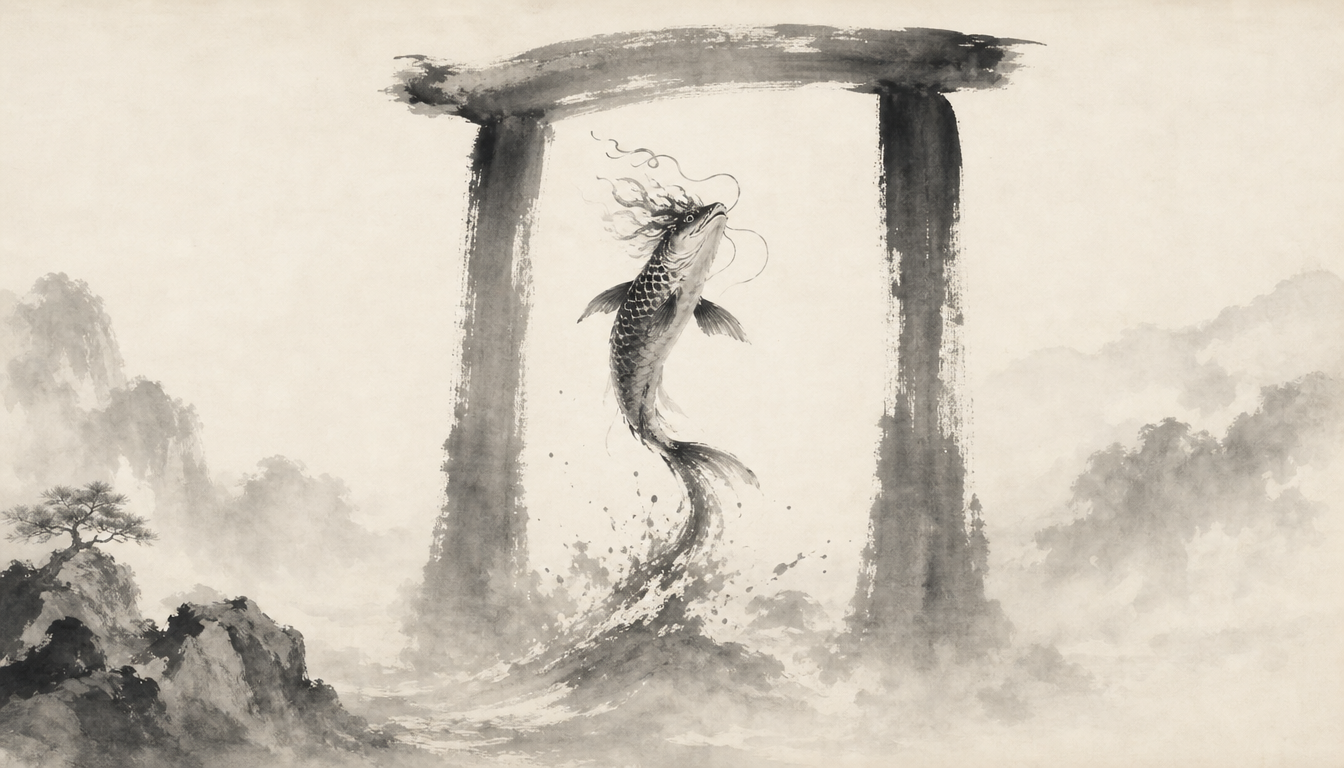
The English word "dragon" carries a lot of baggage — fairy-tale villains, hoarded gold, princesses in towers. The ryu meaning in Japanese is built from completely different raw material. The Japanese dragon descends from East Asian mythology, where the dragon is an aquatic, celestial being, not a terrestrial monster.
Strength Without Aggression
The ryu is powerful, but its power is contained, fluid, and self-aware. It moves like a river: it can carve a canyon over time or surge in an instant, but it never lashes out for sport. People drawn to this kanji often share that quality — a steady reserve of strength that doesn't need to announce itself.
Wisdom and Watchfulness
In countless temple paintings and woodblock prints, the ryu is shown gazing outward, often clutching a glowing pearl said to symbolize wisdom or the moon. The dragon sees what others miss. To take 龍 as a personal symbol is to align yourself with that quality of patient, far-seeing intelligence.
Protection and Sovereignty
According to Wikipedia, Ryūjin (龍神, "Dragon God") was the tutelary deity of the sea in Japanese mythology. He governed tides, storms, and the safety of those who sailed. The ryu is, at its core, a guardian — a being of immense power whose primary role is to protect.
Balance Between Worlds
The Japanese ryu lives in water but flies through sky. It is the only mythical creature that moves freely between elements, which is why it has long been a symbol of balance — the ability to hold opposites within one body without breaking.
Compounds and Real-World Uses of 龍
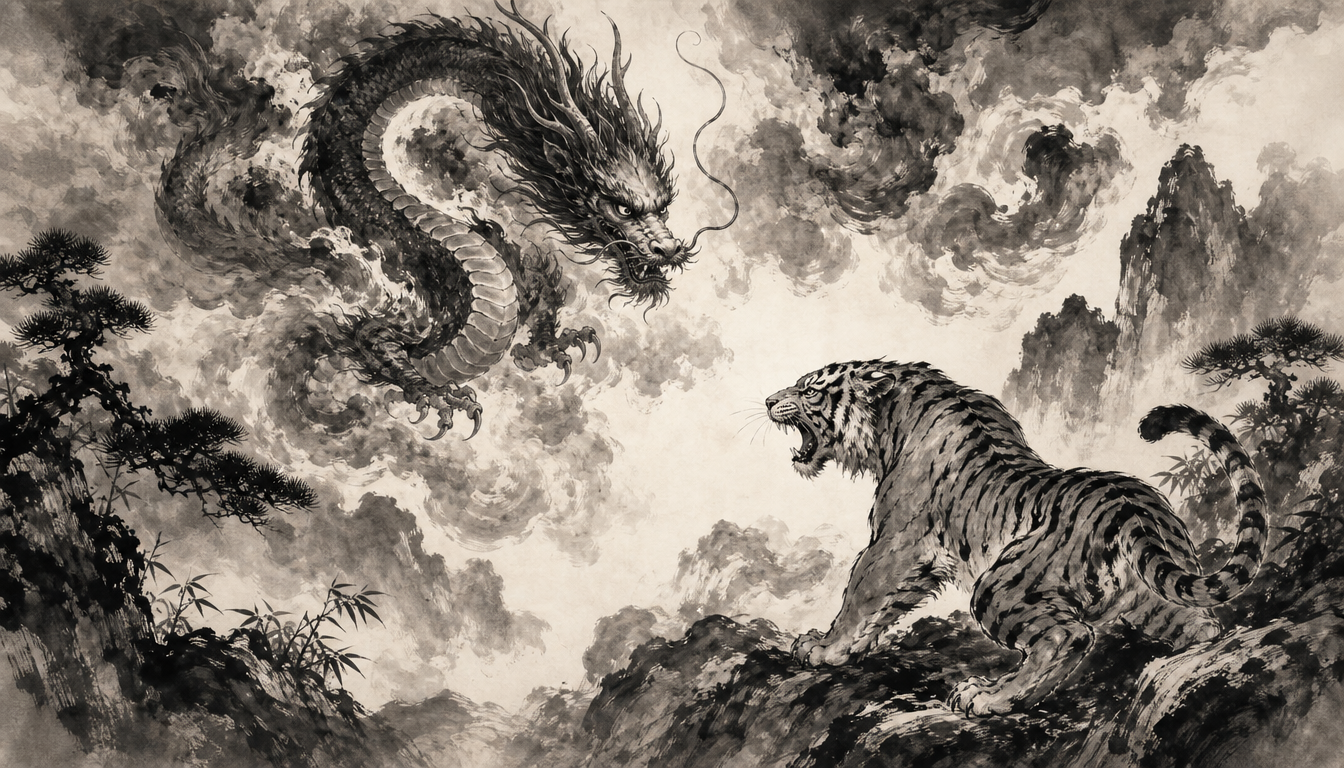
Seeing 龍 inside compound words is the fastest way to feel how alive it remains in the modern language. These are not dusty classical phrases — they appear in names, weather reports, mythology, and everyday speech.
- 龍神 (ryūjin) — dragon god; protector deity of the sea.
- 龍宮 (ryūgū) — the underwater palace of the dragon king, central to the Urashima Tarō legend.
- 恐竜 (kyōryū) — dinosaur; literally "fearsome dragon."
- 龍巻 / 竜巻 (tatsumaki) — tornado; literally "dragon coil." A vivid reminder that the ryu lives in the sky as well as the sea.
- 登龍門 (tōryūmon) — "the dragon gate"; an idiom for a difficult passage that, once cleared, transforms you. Origin: a carp that swims upstream and leaps the gate becomes a dragon.
That last one — 登龍門 — is the philosophical heart of the kanji ryu. The dragon is not born; it is earned. Anyone who endures the upstream climb can transform.
Common Misconceptions About the Japanese Dragon Symbol
Because the Japanese dragon symbol is so widely used in pop culture and tattoo art, several myths have hardened into accepted facts. Let's clear them up.
| Misconception | Accurate Understanding |
|---|---|
| "Japanese dragons are evil, like Western ones." | The Japanese ryu is overwhelmingly benevolent — a protector, a deity, a symbol of good fortune. |
| "龍 and 竜 mean different things." | They mean the same thing. 龍 is the traditional form; 竜 is the modern simplified form. |
| "All East Asian dragons are identical." | Per Wikipedia, Japanese dragons amalgamate native legends with Chinese, Korean, and Indian influences, and tend to be water-dwelling serpents tied to Shinto belief. |
| "Ryu always means dragon." | The sound ryū has many homophones in Japanese, written with different kanji: 流 (flow), 隆 (prosperity), 柳 (willow). Only 龍/竜 mean dragon. |
Before committing 龍 to skin, always confirm stroke order with a calligrapher or trusted source, and never accept a mirrored or rotated version from a stencil. A flipped kanji reads as broken to any Japanese eye.
Related Kanji and How They Differ
Several characters share sounds or themes with 龍 but carry distinct meanings. Knowing the difference protects you from the classic mistake of choosing the wrong ryu.
| Kanji | Reading | Meaning | How it differs from 龍 |
|---|---|---|---|
| 竜 | ryū / tatsu | Dragon | Simplified form of 龍; identical in meaning. |
| 流 | ryū / nagare | Flow, style, school | Same sound, completely different concept — water flowing or a school of thought. |
| 隆 | ryū / takashi | Prosperity, noble | Common in given names; carries auspiciousness but no dragon imagery. |
| 虎 | ko / tora | Tiger | The classical counterpart to 龍 — earth balancing sky, often paired in art. |
Choosing 龍 as a Personal or Soul Kanji
People drawn to the kanji ryu tend to share a certain inner architecture: a quiet sense of capability, a love of depth over surface, a willingness to wait for the right moment rather than force one. If those qualities resonate, 龍 may already be circling you.
That said, choosing a personal kanji is more than picking the coolest character. It should reflect who you actually are — your name, your timing, your temperament. This is exactly what Oracle Kanji Writer, our Personalized Soul Kanji Diagnosis Tool, was built for. In about two minutes, with no credit card and no signup friction, you enter your name, birthdate, and blood type, and a culturally grounded algorithm matches you with a kanji that fits your inner pattern. You receive the pronunciation, layered meanings, a personal message, and curated compound words — plus a downloadable piece of kanji art designed by Japanese creators.
If 龍 turns out to be your soul kanji, you'll know it was chosen for you, not just chosen by you. And if it's not, you'll discover a character that fits you even better than the one you would have picked from a list.
FAQ
What does the Ryu dragon symbolize?
The Japanese ryu symbolizes strength held in reserve, wisdom, protection, and balance between elements. Unlike Western dragons, it is a benevolent water-and-sky deity associated with rain, the sea, good fortune, and transformation. To choose it as a personal symbol is to align with steady, far-seeing power rather than aggression.
What is the kanji symbol for dragon?
The kanji for dragon is 龍 in its traditional form and 竜 in its modern simplified form. Both are read りゅう (ryū) or たつ (tatsu) and mean exactly the same thing. The traditional 龍 is favored for tattoos and calligraphy because of its dense, mythic visual weight, while 竜 is the standard form in everyday modern Japanese.
Is 龍 a good kanji for a tattoo?
Yes — 龍 is one of the most respected and visually striking kanji for tattoos when rendered correctly. Confirm the stroke order with a calligrapher, avoid stencils that mirror or rotate the character, and consider pairing it thoughtfully (for example, with 虎, the tiger, for the classic dragon-tiger balance).
Key Takeaways
- The kanji ryu exists in two valid forms: traditional 龍 (16 strokes) and simplified 竜.
- The ryu meaning goes far beyond "dragon" — it encompasses strength, wisdom, protection, and the balance between water and sky.
- The Japanese dragon symbol is benevolent, not menacing, and is rooted in Shinto and East Asian mythological traditions including the sea deity Ryūjin.
- 龍 appears in living, modern compounds — from 恐竜 (dinosaur) to 竜巻 (tornado) to 登龍門 (the gate of transformation).
- If the dragon kanji speaks to you, consider whether it truly reflects your inner pattern — or let a personalized diagnosis surface the character that fits you most precisely.
The dragon kanji is one of the most powerful symbols in the Japanese language, but power without self-knowledge is just noise. Whether 龍 becomes your personal emblem or simply opens the door to a deeper exploration of kanji and meaning, let it remind you that the most enduring symbols are the ones chosen with care.
Discover Your Soul Kanji
Experience the depth of Japanese characters: each kanji carries timeless meaning, guiding your life's path.
No credit card required • 2-minute process