Kanji of the Day Vol.15 | "Kanji 侍 (Samurai): The Warrior Kanji Embodying Honor & Soul's Code"

The kanji 侍 (samurai) means far more than "warrior." Built from 亻 (person) + 寺 (temple), this 8-stroke character captures a soul code of service, honor, and discipline. In Vol.15 of Kanji of the Day, we decode the true samurai meaning, compare 侍 vs 武士, walk through etymology and readings, and offer guidance for anyone considering this warrior kanji as a personal symbol or tattoo.
Kanji 侍 (Samurai): The Warrior Kanji Embodying Honor & Soul's Code
The kanji samurai — written 侍 and read samurai — is one of the most globally recognized characters in the Japanese writing system. Beyond its surface translation as "warrior," this single character carries centuries of loyalty, discipline, and quiet strength. In this Vol.15 of Kanji of the Day, we'll unpack the true samurai meaning, decode the kanji's structure, and explore why this warrior kanji still resonates with seekers of honor and inner code today.
Discover Your Soul Kanji
Experience the depth of Japanese characters: each kanji carries timeless meaning, guiding your life's path.
No credit card required • 2-minute process
Quick Facts About 侍
Before diving into the philosophy, here are the verified essentials of the 侍 kanji at a glance.
| Item | Detail |
|---|---|
| Kanji | 侍 |
| Primary Reading (Kun) | さむらい (samurai) |
| Alternate Reading (Kun) | はべる (haberu — to wait upon, to serve) |
| On-reading | ジ (ji) |
| Strokes | 8 (Kanshudo) |
| Composition | 亻 (person) + 寺 (temple) |
| Core Meaning | Warrior, retainer, one who serves |
| Category | Cultural / Historical / Personal Symbol |
The True Samurai Meaning: More Than a Warrior
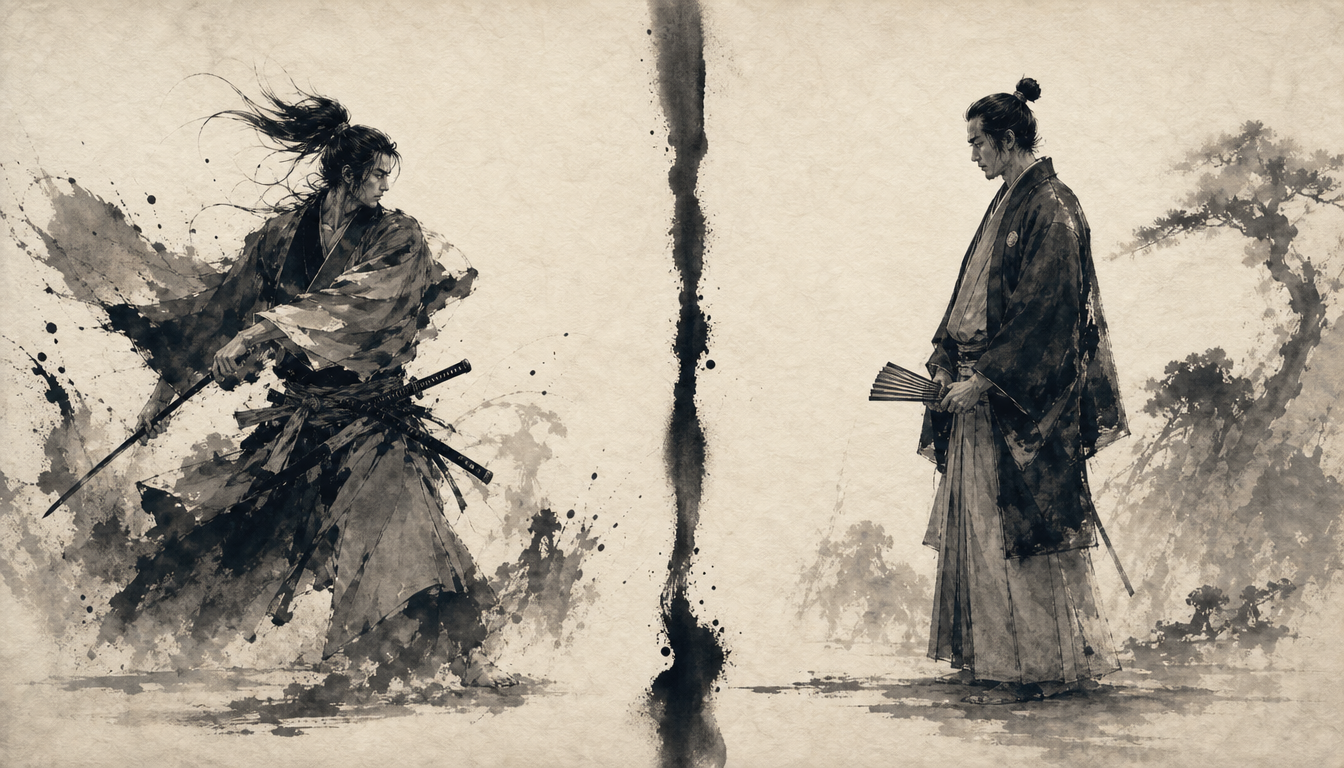
Western pop culture often paints the samurai as a sword-swinging fighter. Linguistically, however, the kanji samurai tells a far more nuanced story. The verb form 侍る (haberu) means "to wait upon" or "to serve" (Jisho.org). The samurai was, at heart, a servant — bound by duty to a lord, a clan, and a code.
This is why the samurai meaning cannot be reduced to combat. It encompasses:
- Loyalty — service to something greater than the self
- Discipline — mastery of body, mind, and emotion
- Honor — living and dying by one's word
- Refinement — many samurai were also poets, calligraphers, and tea practitioners
Choosing 侍 as a personal symbol is less about asserting toughness and more about declaring an allegiance — to a value, a craft, or a person worth serving.
Kanji Composition & Etymology: Person (人) + Temple (寺)
The 侍 character is a compound built from two meaningful parts. On the left sits the radical 亻, the compressed form of 人 (hito, person). On the right stands 寺 (tera, temple).
The diagram below shows how these two components combine into the warrior kanji.
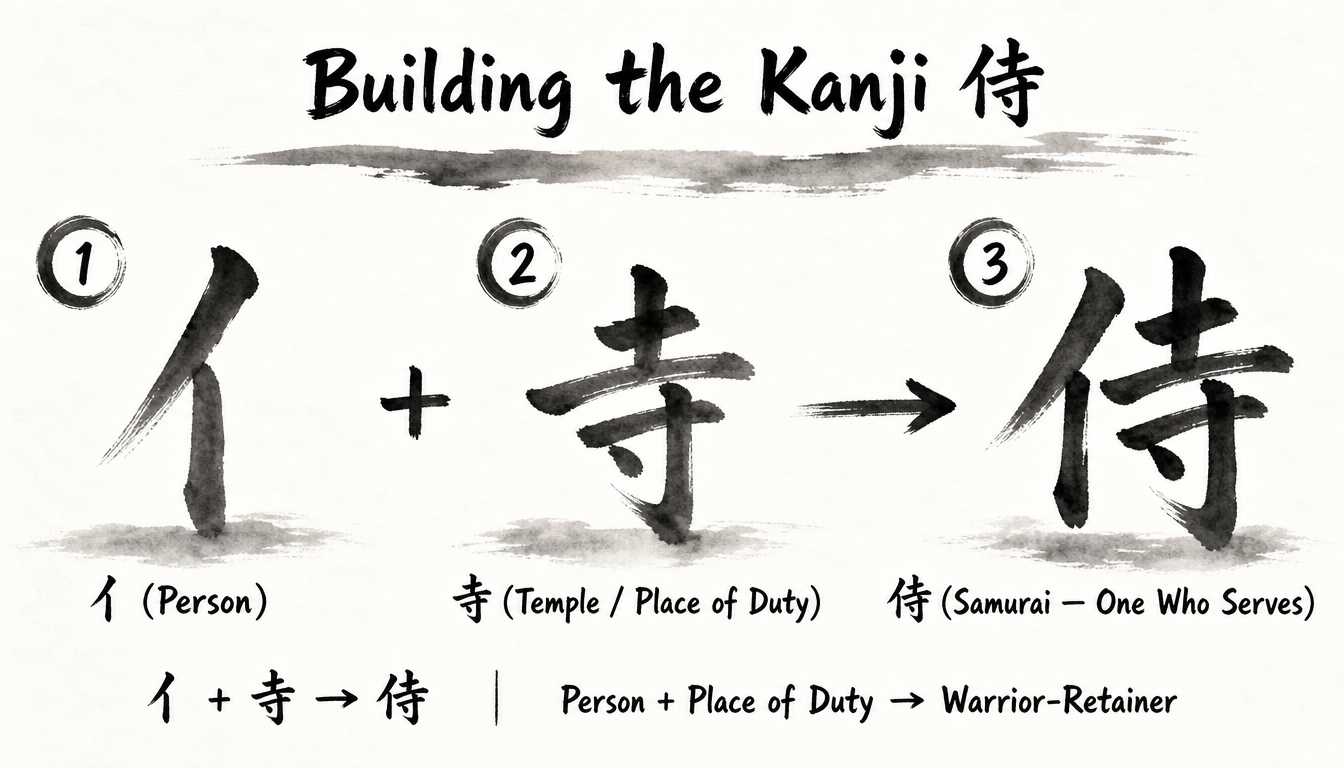
Read literally, 侍 depicts a person at the temple — or more precisely, a person standing in attendance at a place of authority. In ancient China, 寺 originally referred not only to Buddhist temples but to government offices and official residences. A 侍 was therefore a person who attended upon nobility — present, watchful, ready to serve.
The warrior kanji literally pictures someone standing in service at a place of higher authority. The blade came later — the bond of service came first.
This etymology reframes the samurai not as a free-roaming fighter but as a disciplined presence in service of something sacred. The temple element infuses the character with a spiritual dimension that pure "warrior" translations miss.
侍 (Samurai) vs 武士 (Bushi): The Distinction in Modern Japanese Usage
One of the most common misconceptions among non-Japanese fans of samurai culture is treating 侍 and 武士 as perfect synonyms. In modern Japanese, they are not used interchangeably.
武士 (bushi) is the term Japanese speakers actually use when discussing the warrior class as a social, philosophical, or historical phenomenon. You'll see it in compounds like 武士道 (bushidō, the way of the warrior) and 武士精神 (bushi seishin, the warrior spirit). According to Wikipedia, bushidō formalized a code emphasizing sincerity, frugality, loyalty, martial mastery, and honor unto death.
侍 (samurai), by contrast, tends to appear in more concrete or stylistic contexts — a samurai-style haircut, a samurai TV drama, a samurai film. It's the word that traveled abroad and became globally famous, but inside Japan, it carries a slightly more romantic, almost theatrical flavor.
| Aspect | 侍 (Samurai) | 武士 (Bushi) |
|---|---|---|
| Literal sense | One who serves / attends | Martial gentleman / warrior |
| Common usage | Pop culture, foreign-facing, concrete imagery | Historical, philosophical, social class |
| Used in compounds | Rarely for abstract concepts | 武士道, 武士精神, 武士階級 |
| Emotional tone | Romantic, iconic, visual | Formal, dignified, scholarly |
| Best for tattoo of "the warrior way" | Less precise | More culturally accurate |
For tattoo enthusiasts, this distinction matters. If you want a single character that says "warrior of honor," 侍 works beautifully as an icon. If you want to evoke the full philosophy of bushidō, you may want to pair it with 武 or 道.
From Oracle Bone to Modern Kanji
The right-side component, 寺, has its own fascinating history. In earliest oracle-bone and bronze inscriptions, the elements that became 寺 depicted a hand acting at a place — suggesting administrative work, holding, or attendance at a hall of duty. Later, after Buddhism arrived in China, 寺 came to denote temples specifically, but its earlier nuance of official place of duty never fully disappeared.
When 亻 (person) was added in front, the meaning crystallized: a person dedicated to attending at a place of duty. Over centuries — and especially after the character migrated to Japan and attached itself to the rising warrior class of the Heian and Kamakura periods — 侍 came to specifically denote the warrior-retainer. By the Edo period, the samurai class was codified, and the character became inseparable from the iconic image we know today.
Readings & Common Compounds
The kanji 侍 is read in a few distinct ways depending on context.
- さむらい (samurai) — the standalone noun, meaning warrior-retainer
- はべる (haberu) — the verb form, meaning to wait upon or attend (now mostly literary)
- ジ (ji) — the on-reading, used in compound words
A few real compounds that use 侍:
- 侍女 (jijo) — a lady-in-waiting; a female attendant
- 侍史 (jishi) — an honorific used after a recipient's name in formal letters, originally referring to a secretary who served a noble (Jisho.org)
- 侍従 (jijū) — a chamberlain; a court attendant
Notice that all of these compounds carry the thread of service — the character never escapes its etymological root.
Symbolism & Philosophy: Why People Choose 侍 Today
Modern people drawn to the warrior kanji rarely want to literally take up the sword. What they're often reaching for is the inner architecture of the samurai — the personal code.
To choose 侍 is to declare that you live by an internal compass — that your discipline, loyalty, and honor are not for show, but for service to what you hold sacred.
The kanji resonates with three modern archetypes:
- The Craftsman — someone who serves their art with relentless devotion
- The Protector — someone whose strength exists to shield others
- The Seeker — someone walking a path of self-mastery, treating life as practice
If any of these descriptions feel like a mirror, 侍 may be more than an aesthetic — it may be a soul kanji.
As a Tattoo or Personal Symbol
The 8-stroke structure of 侍 lends itself well to ink. Its left-right balance (亻 narrow and vertical, 寺 broader and stacked) gives the character strong visual rhythm — almost like a person standing beside a pillar.
Practical guidance for those considering 侍 as a tattoo:
- Confirm stroke order with a reliable source before any artist begins — a mirrored or stroke-flipped kanji is the most common foreigner-tattoo mistake
- Consider pairings like 侍道 ("the samurai's way") or 侍魂 ("samurai soul") for added depth, though these are stylistic rather than dictionary terms
- Choose calligraphy style intentionally — 楷書 (kaisho, block) feels disciplined; 行書 (gyōsho, semi-cursive) feels alive
- Placement on the forearm, upper back, or chest suits the character's vertical weight
Avoid pairing 侍 with random kanji just because they "look cool together." Japanese readers will read the combination literally — and an unintended phrase can undermine the dignity you wanted to express.
FAQ
What is the meaning of samurai warrior?
The phrase "samurai warrior" combines two layers of meaning. "Samurai" (侍) comes from the verb haberu, meaning to wait upon or serve, so a samurai was historically a warrior-retainer bound by loyalty to a lord. The "warrior" aspect refers to their martial skill in swordsmanship, archery, and horsemanship — but the deeper samurai meaning emphasizes honor, discipline, and service over mere combat ability.
What is the Kanji of samurai?
The kanji for samurai is 侍, written with 8 strokes. It combines 亻 (the person radical, a compressed form of 人) on the left with 寺 (temple, or originally an official place of duty) on the right. Together, the character pictures a person standing in attendance at a place of authority — capturing the samurai's essence as one who serves with discipline and honor. The same warrior concept is also expressed by 武士 (bushi) in more philosophical contexts.
Discover the Kanji That Represents You
The kanji samurai proves that a single character can hold a lifetime of meaning — honor, service, discipline, and soul. If 侍 stirs something in you, it may be pointing to your own inner code. Oracle Kanji Writer — Personalized Soul Kanji Diagnosis Tool takes two minutes, no credit card, and reveals the kanji aligned with your spiritual essence — complete with readings, nuanced meanings, and culturally grounded explanations so you never settle for a clichéd or mistranslated symbol. Whether you're planning a tattoo, designing a personal emblem, or simply searching for a word to live by, the warrior kanji and its kin are waiting.
Summary
- 侍 (samurai) literally means "a person who serves at a temple or place of duty" — its samurai meaning is rooted in loyalty, not just combat.
- The kanji combines 亻 (person) + 寺 (temple), forming an 8-stroke warrior kanji with deep spiritual undertones.
- In modern Japanese, 武士 (bushi) is preferred for abstract or philosophical contexts, while 侍 dominates concrete and stylistic usage.
- 侍 resonates with craftsmen, protectors, and seekers who live by an internal code of honor.
- To go deeper, explore related kanji of strength and spirit — or discover your personal soul kanji through a culturally authentic diagnosis.
Discover Your Soul Kanji
Experience the depth of Japanese characters: each kanji carries timeless meaning, guiding your life's path.
No credit card required • 2-minute process