Kanji of the Day Vol.14 | "Kanji 空 (Sora): The Sky Kanji Embracing Emptiness & Soul's Infinite Space"

The kanji sora (空) means both sky and emptiness — a single character that holds the heavens and the Buddhist void. Discover the readings (sora, kū), origin, compound words, and symbolism behind this iconic sky kanji, plus what choosing it as a personal symbol or tattoo says about your spirit.
Kanji for Sky: 空 (Sora / Kū) — Meaning, Origin & Symbolism of the Sky Kanji
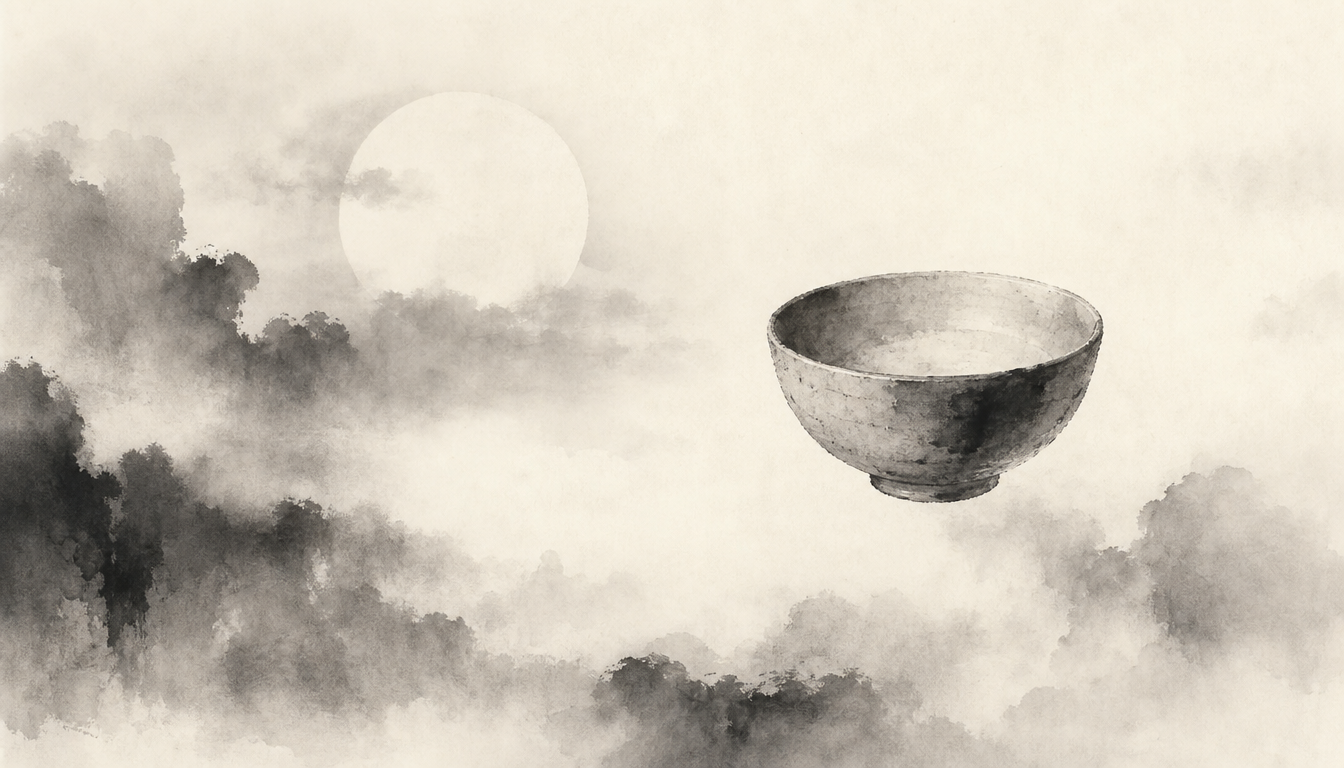
The kanji sora (空) is one of the most evocative characters in the Japanese writing system. It paints the open sky, names the philosophical concept of emptiness, and quietly hints at infinite possibility. For travelers, dreamers, mindfulness seekers, and tattoo enthusiasts, the sora meaning resonates as both a literal landscape and a spiritual mirror — a single brushstroke that holds the universe.
Discover Your Soul Kanji
Experience the depth of Japanese characters: each kanji carries timeless meaning, guiding your life's path.
No credit card required • 2-minute process
Quick Facts About the Kanji 空
Before we dive into symbolism, here is a snapshot of the essentials.
| Item | Details |
|---|---|
| Kanji | 空 |
| On'yomi (Sino-Japanese reading) | クウ (kū) |
| Kun'yomi (native Japanese reading) | そら (sora) |
| Primary Meanings | Sky, empty, void, vacant, hollow |
| Category | Jōyō kanji (regular-use) |
| Related Concepts | Mu (無 nothingness), Ma (間 space), Ten (天 heaven) |
| Common Use | Daily vocabulary, names, philosophy, Buddhism |
According to the List of jōyō kanji, 空 carries the kun'yomi そら (sora) and the on'yomi クウ (kū) — two readings that open two completely different doors of meaning.
Meaning of 空 (Sora): Sky, Emptiness, and Beyond
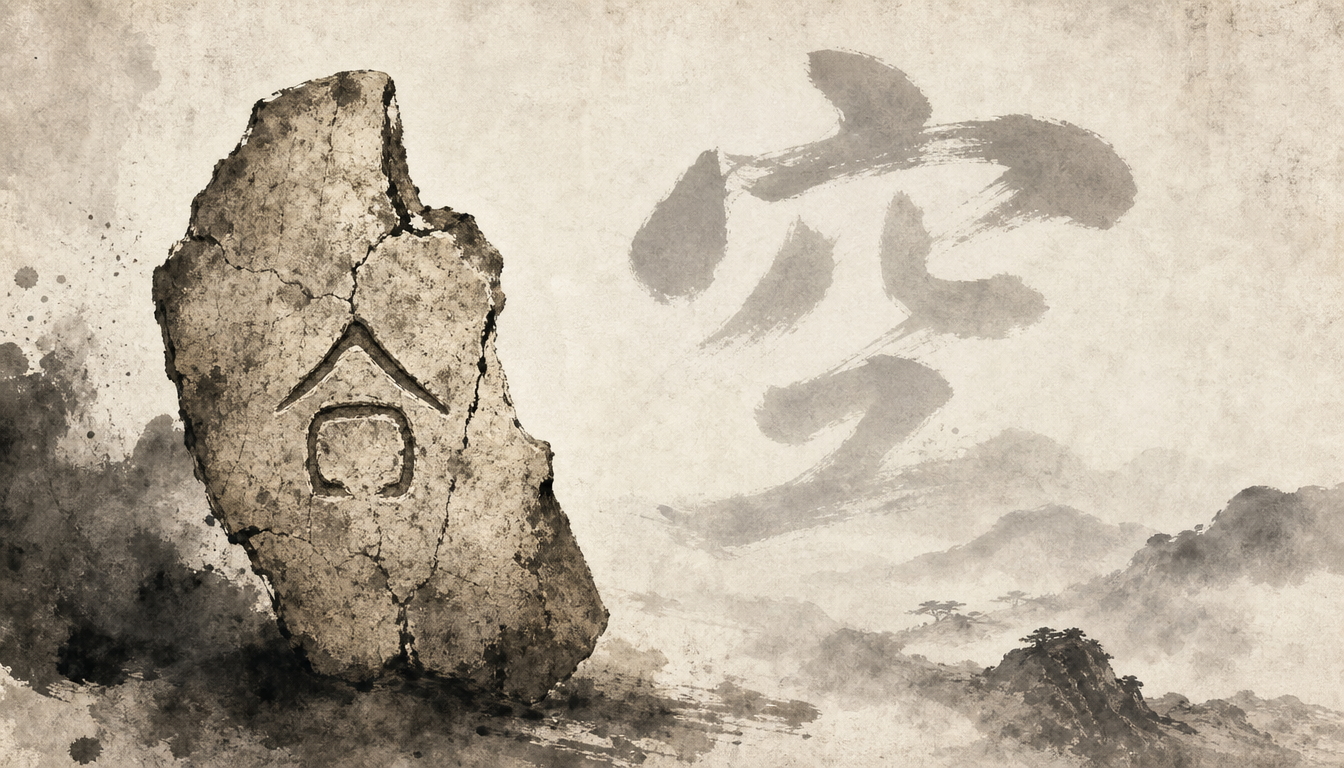
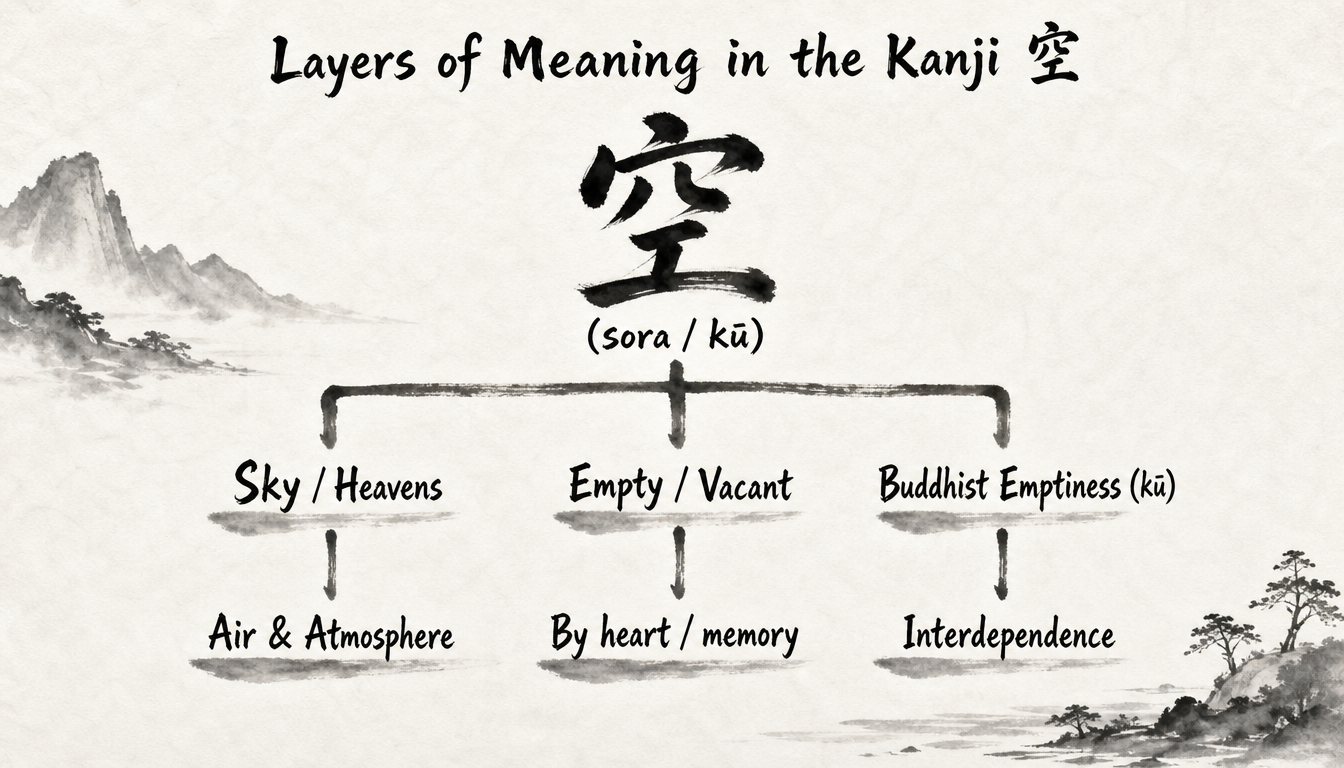
At first glance, the sky kanji 空 simply means "sky." Look up at a clear afternoon, and that wide blue expanse is sora. But Japanese — and the Chinese characters it borrowed — rarely stop at the surface. 空 also means empty, vacant, hollow, and by extension, illusory or without substance.
This double life is not a coincidence. The sky, after all, looks vast yet contains "nothing" you can touch. It is full of air, light, and weather — yet to the eye it is open, unobstructed, free. That paradox is the heart of the sora meaning: a presence that is also an absence.
In daily Japanese, 空 stretches across many shades:
- Sky / heavens — 空を見上げる (sora o miageru), "to look up at the sky."
- Empty — 空の箱 (kara no hako), "an empty box."
- Air / atmosphere — 空気 (kūki), "air" or "mood."
- By heart, from memory — 空で覚える (sora de oboeru), "to memorize."
- State of mind — a poetic use suggesting feelings as wide and unsettled as the sky itself.
In Mahayana Buddhism, 空 takes on its deepest dimension as kū — the doctrine of emptiness (Sanskrit: śūnyatā). Here, "empty" does not mean nihilistic nothingness. It means that nothing exists in isolation; everything arises through relationships and conditions. The Heart Sutra's famous line, "form is emptiness, emptiness is form," is precisely this 空.
The genius of 空 is that the sky and emptiness share one character. To gaze at the open sky is, in a sense, to glimpse the Buddhist void — vast, clear, and quietly full of everything.
Readings and Pronunciations of 空 (Kō, Kuu, Sora)
One reason 空 feels so layered is that its readings carry distinct moods. Japanese kanji generally have two reading families: on'yomi, the Sino-Japanese readings imported with the characters from China, and kun'yomi, the native Japanese pronunciations attached to the meaning.
For 空, the official jōyō readings are クウ (kū) as on'yomi and そら (sora) as kun'yomi (List of jōyō kanji). Beyond those, 空 also picks up additional readings in compounds and names — kara (empty), aku / aki (to become vacant), and the name-reading a — but kū and sora are the two pillars.
そら (sora) — the poetic, native reading
When you point at the sky, hum a song lyric, or name a child, you almost always reach for sora. It feels soft, native, and emotional. Sora is the sky as you feel it — open, personal, atmospheric.
クウ (kū) — the conceptual, philosophical reading
In compound words and Buddhist vocabulary, the character shifts to kū. This reading carries an abstract, intellectual register: aviation, vacuum, empty space, the philosophical void. When monks chant about 空, they say kū, not sora.
Other readings you may encounter
- から (kara) — used for "empty," as in 空っぽ (karappo, "completely empty") or 空手 (karate, literally "empty hand").
- あく / あける (aku / akeru) — verbs meaning "to become vacant" or "to leave empty," as in 席が空く (seki ga aku, "a seat opens up").
Note that "Kō" is sometimes listed informally for 空 in older or non-standard sources, but the standard on'yomi is kū. If you ever see the reading written as "kuu" in romaji, it is the same sound — a long "oo" vowel.
From Oracle Bone to Modern Form: The Origin of 空
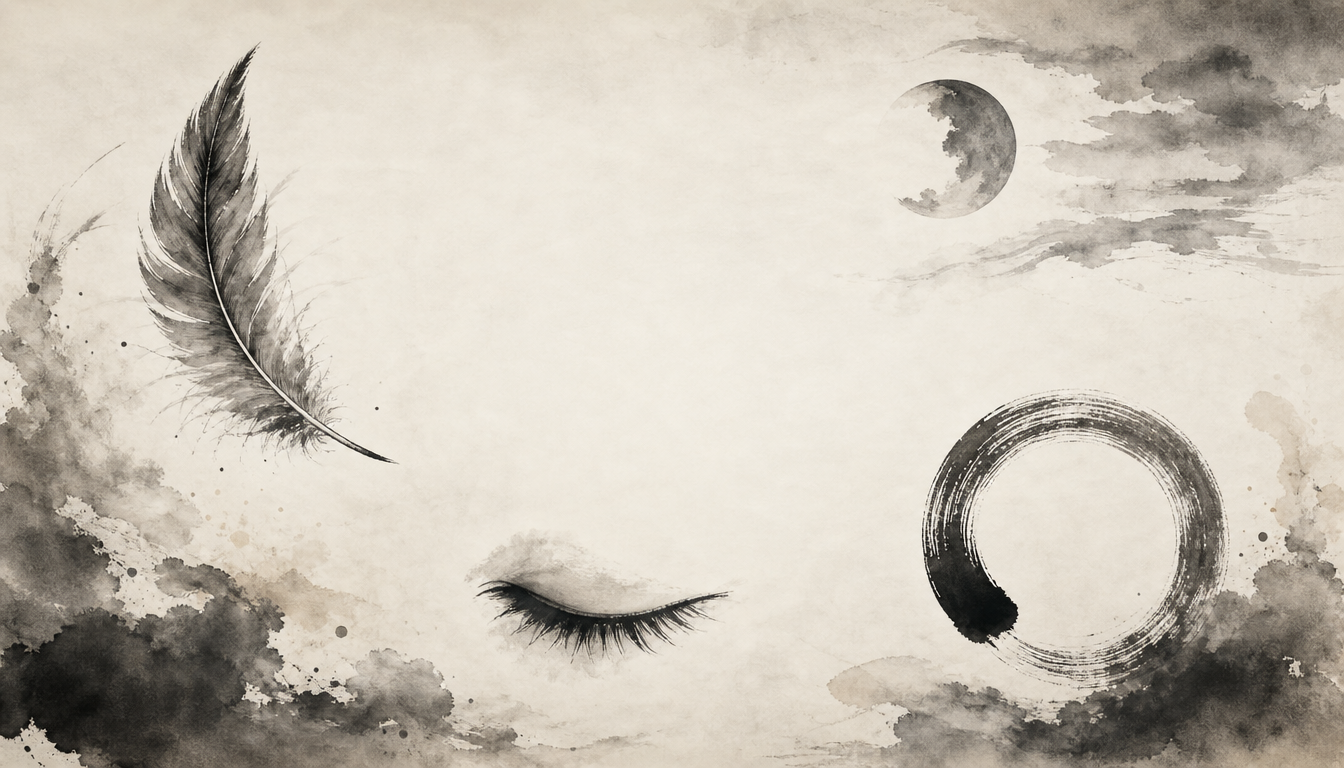
The character 空 is built from two parts: the radical 穴 (ana, "hole" or "cave") on top, and the phonetic component 工 (kō, "work" or "craft") below. The mainstream scholarly view reads this as a phono-semantic compound: 穴 supplies the meaning (a hollow or opening), while 工 hints at the ancient pronunciation.
The original image is striking. A "hole" or "cavity" — an opening carved into rock or earth — became a metaphor for any open, hollow space. From there, the meaning expanded outward: the cavity above us, the great hollow of the heavens, the sky. And from sky, it stretched further still into the abstract — emptiness as a quality, then emptiness as a philosophical principle.
Think of 空 as a doorway: a hole in the rock became a window onto the sky, and the sky became a symbol for the openness of all things. One character, three scales of vastness.
Compound Words That Reveal the Sora Meaning
Compounds (jukugo) are where the personality of a kanji really shows. Here are common, useful jukugo built on 空 that show how widely the sky kanji travels.
- 空気 (kūki) — "air" or "atmosphere/mood." You breathe kūki, and you also "read the kūki" of a room — a famously Japanese social skill.
- 空港 (kūkō) — "airport." Literally "sky harbor" — a port for things that travel through the open air.
- 航空 (kōkū) — "aviation, flight." The vocabulary of airlines and the wider sky industry.
- 空想 (kūsō) — "daydream, fantasy." Thought that floats free, like clouds.
- 青空 (aozora) — "blue sky." A favorite poetic image, evoking hope and clarity.
- 空手 (karate) — "empty hand," the martial art of fighting without weapons.
Notice the rhythm: when 空 leads a compound, it is usually kū; when it stands alone or sits in a softer, native pairing, it becomes sora or kara.
Common Misunderstandings About the Sky Kanji
Because 空 spans so many meanings, learners and tattoo seekers often slip into a few classic misreadings. The table below clears them up.
| Misconception | Accurate Understanding |
|---|---|
| "空 just means sky." | It means sky and empty, vacant, and the Buddhist concept of emptiness. Context decides which. |
| "空 means nihilistic nothingness." | In Buddhism, 空 (kū) is not nihilism. It points to interdependence — things exist through relationships, not as isolated essences. |
| "Sora is the only correct reading." | Sora is the native reading, but kū, kara, and aku are all standard depending on the word. |
| "空 means heaven (the religious afterlife)." | "Heaven" in that sense is usually 天 (ten). 空 is the physical/poetic sky and philosophical emptiness, not the Christian heaven. |
Symbolism, Philosophy, and Personal Meaning
So what does it say about you to choose 空 as a personal symbol?
People drawn to the kanji sora often share a certain temperament: spacious, open-minded, comfortable with not-knowing. They value freedom over accumulation. They find peace in stillness. They are often creatives, travelers, meditators, or quiet philosophers — people who understand that an empty cup is a useful cup.
In Japanese aesthetics, 空 connects to ma (間), the meaningful pause; to wabi-sabi, the beauty of impermanence; and to the Zen ideal of a clear, untroubled mind. Choosing 空 is choosing a horizon over a wall.
As a Tattoo or Personal Symbol
Visually, 空 is gorgeously balanced. The square cave-radical on top gives stability; the "work" component below grounds it. It looks elegant in both blocky kaisho (standard script) and flowing gyōsho (semi-cursive). Good placements include the inner forearm, the spine, the ribcage, or the back of the shoulder — anywhere the character can breathe.
Always confirm stroke order and orientation with a native Japanese reference before getting inked. Mirrored or stroke-broken kanji can look childish or simply wrong to Japanese eyes — and 空 deserves to be done right.
Related Kanji in the Same Family of Meaning
If 空 speaks to you, these related characters share its spiritual neighborhood:
- 天 (Heaven) — the sky as divine canopy.
- 無 (Nothingness) — the void as absence, complement to 空.
- 風 (Wind) — the invisible movement of the sky.
- 夢 (Dream) — what fills the inner sky.
FAQ
Does Sora mean sky in Japanese?
Yes. Sora (そら) is the native Japanese reading of 空 and most commonly means "sky" — the open expanse above. It can also extend poetically to "the air," "the heavens," or a wide, distant feeling. In compounds and Buddhist contexts the same character is read kū and shifts toward "empty" or "void."
Does Sora mean heaven?
Not in the religious sense. The kanji for "heaven" as a divine realm is usually 天 (ten). 空 (sora) refers to the physical sky and, by extension, philosophical emptiness. In poetry, "sora" may evoke a heavenly feeling of vastness or transcendence, but it is not the standard word for a paradise or afterlife.
Is 空 a good kanji for a tattoo?
It can be excellent — visually balanced, meaningfully deep, and instantly recognizable to Japanese readers. The key is to confirm the meaning resonates with you (sky and emptiness, not just one), choose a script style that fits your design, and verify stroke order so the character looks authentic rather than copied from a font.
Discover the Kanji That Represents You
If the kanji sora — the sky kanji that holds both vastness and emptiness — speaks to something in you, there may be a character that fits your spirit even more precisely. The sora meaning is just one of thousands of personal stories waiting in the Japanese writing system, and finding yours can be a small but profound act of self-discovery.
Oracle Kanji Writer uses your name, birthdate, and blood type to recommend a personalized Soul Kanji curated by Japanese creators — so you receive a character that is beautiful, accurate, and truly yours.
Summary
- 空 (sora / kū) means both sky and emptiness, united in one character.
- The official jōyō readings are kun'yomi sora and on'yomi kū.
- Its origin combines 穴 (cave/hole) and 工 (work), evolving from "hollow" to "sky" to philosophical "void."
- Common compounds include 空気 (air), 空港 (airport), 青空 (blue sky), and 空手 (karate).
- Choosing 空 reflects a spacious, open, freedom-loving spirit drawn to Zen aesthetics and infinite possibility.
Discover Your Soul Kanji
Experience the depth of Japanese characters: each kanji carries timeless meaning, guiding your life's path.
No credit card required • 2-minute process