Kanji of the Day Vol.12 | "Kanji 愛 (Ai): The Love Kanji Embracing Your Soul's Deepest Bond"

The kanji ai (愛) is Japan's most enduring symbol of love — covering devotion, compassion, and lifelong bond. This Vol.12 of Kanji of the Day explores the love kanji's readings, its ai meaning beyond romance, the crucial difference between 愛 and 恋 (koi), and how to use it authentically as a personal symbol, tattoo, or mindfulness anchor. A culturally grounded guide for anyone seeking a kanji that truly mirrors the heart.
Kanji 愛 (Ai): The Love Kanji Embracing Your Soul's Deepest Bond
The kanji ai (愛) is one of the most universally recognized symbols of love in East Asian culture — a single character carrying the weight of devotion, compassion, and lifelong bond. For anyone drawn to the love kanji as a personal symbol, tattoo, or meditative emblem, understanding the true ai meaning goes far beyond a dictionary line. This is a character of the heart, literally and structurally. In this Vol.12 of Kanji of the Day, we explore the kanji ai (愛) — its readings, its origins, its difference from 恋 (koi), and why it remains one of the most chosen kanji for soul-deep self-expression.
Love, in Japanese, isn't one feeling. It's a spectrum — and 愛 sits at its most expansive, enduring end.
Discover Your Soul Kanji
Experience the depth of Japanese characters: each kanji carries timeless meaning, guiding your life's path.
No credit card required • 2-minute process
愛 (Ai) at a Glance: The Love Kanji in One Frame
Before we dive into nuance, here is the essential profile of the kanji ai. This snapshot helps you anchor the character before exploring its deeper symbolism.
| Item | Detail |
|---|---|
| Kanji | 愛 |
| Primary Meaning | love; affection; care |
| On'yomi (Chinese reading) | アイ (ai) |
| Kun'yomi (Japanese reading) | いとしい (itoshii) — dear, beloved |
| Category | Emotion / Virtue / Name kanji |
| Related concepts | 恋 (koi), 情 (jou), 慈 (ji) |
| Contrasting concept | 憎 (nikumi, hatred) |
| Cultural status | Among the most widely used love-related kanji in Japan |
愛 is also part of the standardized list of common-use characters in Japan — the jōyō kanji system, which currently consists of 2,136 characters according to the List of jōyō kanji on Wikipedia. In other words, 愛 isn't a rare or exotic pick — it's part of the bedrock vocabulary every literate Japanese person reads daily, which is precisely what gives it such cultural gravity.
The Deeper Meaning of 愛: More Than Romance
At surface level, 愛 translates as love. But the ai meaning in Japanese is wider and quieter than the English word suggests. Where English "love" leans toward romance, 愛 stretches across a much larger emotional landscape: parental devotion, loyalty to friends, compassion for strangers, even reverence for one's craft or country.
The character is built around the radical 心 (kokoro, heart), tucked at its core. Look closely and you can see a claw or fingernail (爫) holding something carefully, a covering or shield (冖), a heart (心), and the component 夂 suggesting moving forward with care — together evoking the image of something cherished, carefully held and protected. The form suggests a love that acts on behalf of another, not just feels.
愛 is love expressed through action and continuity — the kind that nurtures, protects, and endures. It is closer to the Greek agape than to the rush of infatuation.
This is why 愛 is the kanji you'll find in words for charity (慈愛), patriotism (愛国), beloved pets (愛犬), and even cherished objects (愛用 — "a thing one loves to use"). It is love as a lasting orientation, not a passing mood.
Why People Choose 愛 as a Personal Symbol
For tattoo seekers, mindfulness practitioners, and anyone exploring Japanese aesthetics, 愛 resonates because it claims something brave: that love is a discipline, not just an emotion. Choosing 愛 says, "I want to live as someone who loves with care, intention, and depth."
Readings of 愛: How to Pronounce the Love Kanji
Like most kanji, 愛 has multiple readings depending on context. Getting the reading right matters — especially if you plan to wear it or share it.
On'yomi: アイ (ai)
This is the most common reading, used in nearly all compound words. According to Jisho.org, 愛 read as あい (ai) directly means "love; affection; care." It is also extremely popular as a given name in Japan — short, soft, and instantly meaningful.
Kun'yomi: いとしい (itoshii)
The native Japanese reading いとしい (itoshii), written 愛しい, is an adjective meaning lovely, dear, beloved, darling, as confirmed by Jisho.org. You'll hear it in poetry, ballads, and tender conversations — a word people reserve for what is truly precious.
Common Compounds (Jukugo)
- 愛情 (aijou) — affection, deep emotional love
- 愛犬 (aiken) — beloved dog, pet dog
- 友愛 (yuuai) — fraternity, friendship
- 愛国 (aikoku) — love of one's country
The compound 愛犬 (aiken), meaning pet dog or beloved dog, is documented on Jisho.org — a small but telling example of how 愛 attaches itself to almost anything one holds dear.
愛 vs 恋: The Two Kanji for Love in Japanese
Here is where Japanese reveals one of its most beautiful linguistic distinctions. The language has two main kanji for love — 愛 (ai) and 恋 (koi) — and they describe fundamentally different emotional textures.
The diagram below compares how these two love kanji sit on the spectrum of feeling.
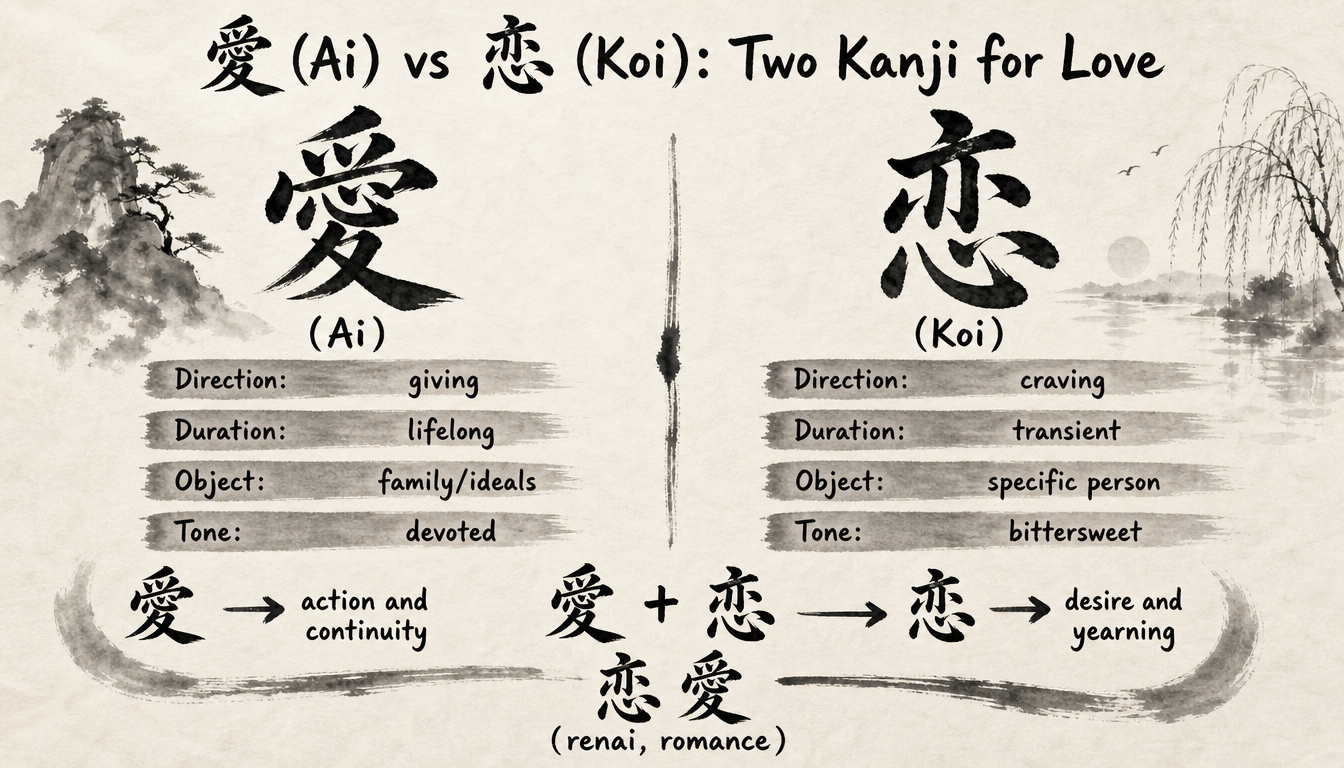
| Aspect | 愛 (Ai) | 恋 (Koi) |
|---|---|---|
| Core feeling | Deep, enduring love | Passionate longing, romantic yearning |
| Direction | Outward — giving, protecting | Inward — craving, missing |
| Duration | Long-term, lifelong | Often intense but transient |
| Typical objects | Family, friends, country, pets, ideals | A specific romantic person |
| Emotional tone | Calm, devoted, mature | Bittersweet, restless, youthful |
| Example word | 愛情 (aijou) — deep affection | 恋愛 (renai) — romantic relationship |
A common Japanese saying captures it well: 恋 is the love you fall into; 愛 is the love you build. Koi is the heart racing across a crowded street. Ai is the quiet hand held thirty years later.
Interestingly, the word 恋愛 (renai) combines both kanji — capturing the full arc of romance, from the spark of koi to the depth of ai.
This distinction, explored beautifully by Hirakan, is why tattoo artists and Japanese learners often advise: if you want to express lasting love — for a partner, a child, a calling — choose 愛. If you want to express the ache of romantic longing, 恋 is more honest.
Good and Poor Uses of the Love Kanji
Because 愛 is so emotionally loaded, context matters. Here are some examples of how 愛 lands well — and where it can feel off.
| Context | Good Use | Awkward Use |
|---|---|---|
| Personal tattoo | 愛 alone, as a vow to love deeply | 愛 paired with random kanji that don't form a real word |
| Gift or message | 愛情を込めて (aijou wo komete — "with love") | Using 愛 casually for a fleeting crush |
| Naming | 愛 as a given name (Ai) — common and elegant | Forcing 愛 into a name where it doesn't read naturally |
Common Misunderstandings About 愛
| Misconception | Accurate Understanding |
|---|---|
| "愛 means romantic love only" | 愛 covers love in its broadest sense — familial, platonic, philosophical |
| "愛 and 恋 are interchangeable" | They describe distinct emotional states; ai endures, koi burns |
| "愛 is only used in serious writing" | 愛 appears in everyday speech, names, songs, and product copy |
| "愛 is the same as Chinese 爱" | The simplified Chinese form 爱 omits the heart radical 心 — Japanese 愛 keeps it |
That last point matters culturally. Some Japanese commentators have noted, half-poetically, that simplified Chinese "love" lost its heart. The Japanese 愛 still carries 心 at its core — a small structural detail with outsized symbolic weight.
Related Kanji and How They Differ From 愛
Several kanji orbit the world of love and affection. Understanding their nuances helps you choose with precision.
| Kanji | Meaning | How It Differs From 愛 |
|---|---|---|
| 恋 (koi) | Romantic longing | Focused on a specific person; intense but not necessarily lasting |
| 情 (jou) | Feeling, emotion, compassion | Broader emotional category; 愛 is one type of 情 |
| 慈 (ji) | Mercy, compassion | Spiritual, almost maternal; 愛 is more personal and reciprocal |
| 好 (kou / suki) | To like, to be fond of | Casual liking; 愛 implies deeper commitment |
Living With 愛: How to Use This Kanji as a Personal Symbol
If 愛 speaks to you, the next question is how to honor it. Here are practical, culturally aware ways to integrate the love kanji into your life:
- As a tattoo: 愛 alone is powerful and unambiguous. Confirm stroke order with a calligrapher, never mirror the image, and avoid stacking it with unrelated kanji that don't form a real word.
- As wall art or wallpaper: A single 愛 in elegant brushwork serves as a daily reminder of intention — to love patiently, to act with care.
- As a mindfulness anchor: Use 愛 as a meditation focal point. Tracing the strokes slowly is itself a small practice in attentiveness.
- As a gift inscription: Pair 愛 with a name or with 情 (愛情, aijou) to convey enduring affection without sentimentality.
Before committing 愛 to skin, verify the character with a native reader or trusted source. Many tattoo-converter websites distort proportions or use Chinese variants. The Japanese 愛 keeps its heart 心 visible — make sure yours does too.
This is exactly where a service like Oracle Kanji Writer meets a real need. Instead of grabbing a kanji from a font generator, Oracle Kanji Writer recommends a personalized Soul Kanji — chosen based on your name, birthdate, and blood type — and delivers it with pronunciation, layered meanings, and cultural context curated by Japanese creators. For those drawn to 愛 but unsure whether it truly mirrors their inner story, the diagnosis often reveals a more precise match — or confirms that yes, 愛 really is the character your soul has been waiting to claim.
Summary: Why 愛 Endures as the Kanji of the Heart
The kanji ai (愛) is more than the love kanji you've seen on posters and song titles. It is a quiet declaration about how to live. Here are the essentials to carry with you:
- 愛 means love in its widest sense — romantic, familial, compassionate, devotional
- Its readings include アイ (ai) for compounds and いとしい (itoshii) for the adjective form meaning "beloved"
- 愛 differs from 恋 (koi): ai is enduring and outward-giving, koi is passionate and inward-longing
- The character contains 心 (heart) at its core — a structural symbol of love rooted in feeling
- 愛 makes a meaningful tattoo or personal emblem when chosen with cultural care
If 愛 resonates with you — or if you're curious whether another kanji might mirror your soul even more precisely — explore your personalized Soul Kanji with Oracle Kanji Writer. The right kanji ai, love kanji, or quieter character entirely is waiting to be discovered, not just chosen from a list. Let the character find you.
Discover Your Soul Kanji
Experience the depth of Japanese characters: each kanji carries timeless meaning, guiding your life's path.
No credit card required • 2-minute process