Kanji of the Day Vol.10 | "Kanji 月 (Tsuki): The Moon Kanji Reflecting Your Soul's Quiet Glow"

The kanji 月 (tsuki) means both moon and month — a four-stroke pictograph carrying centuries of lunar poetry and quiet introspection. Explore its origins, readings, symbolism, and what choosing the moon kanji says about your inner self in Vol.10 of our Kanji of the Day series.
Kanji 月 (Tsuki): The Moon Kanji Reflecting Your Soul's Quiet Glow
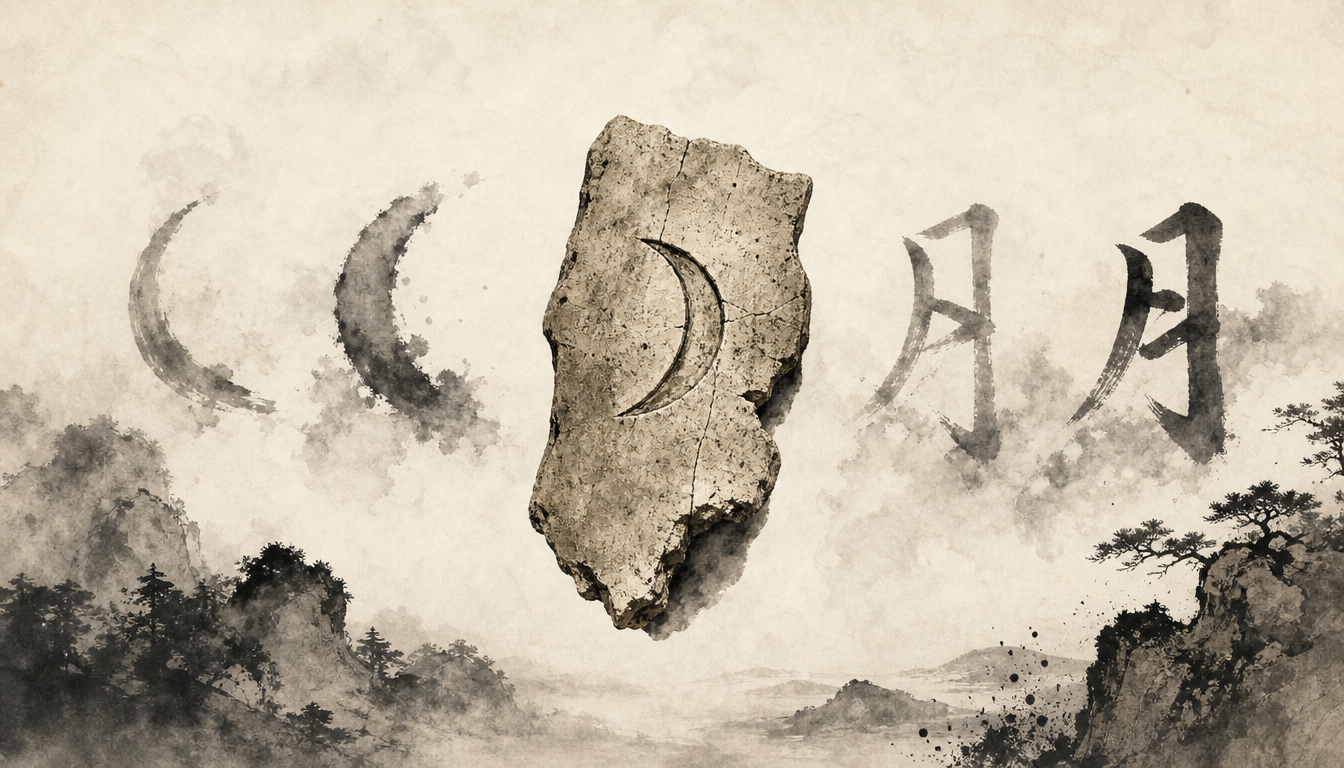
The kanji tsuki (月) is the Japanese character for moon and month — a single, simple symbol carrying centuries of poetry, lunar mysticism, and quiet introspection. For anyone drawn to Japanese aesthetics, tattoo art, or self-discovery, the moon kanji offers something rare: a character that is both universally recognizable and deeply personal. In this Vol.10 of our Kanji of the Day series, we explore the tsuki meaning from its pictographic roots to its modern symbolism.
月 is one of the very first kanji Japanese children learn, yet it remains one of the most beloved by poets, calligraphers, and seekers of meaning. Its appeal lies in restraint — four strokes that hold an entire night sky.
Discover Your Soul Kanji
Experience the depth of Japanese characters: each kanji carries timeless meaning, guiding your life's path.
No credit card required • 2-minute process
A One-Line Definition of 月
月 (tsuki) is the Japanese kanji meaning moon and, by extension, month, originally derived from a pictograph of the crescent moon.
月 is the kanji for both "moon" and "month" — because traditional Japanese months followed the lunar cycle.
Quick Reference Table
| Item | Detail |
|---|---|
| Kanji | 月 |
| Primary Meaning | Moon, month |
| Kun'yomi | つき (tsuki) |
| On'yomi | ゲツ (getsu) / ガツ (gatsu) |
| Stroke Count | 4 strokes |
| Category | Pictograph (象形文字 / shōkei moji) |
| Related Concepts | 日 (sun), 星 (star), 夜 (night) |
| Contrast With | 日 (hi / sun, day) |
According to japanesejlpt.com, the kanji 月 carries the kun-reading つき (tsuki) and the on-readings ゲツ (getsu) and ガツ (gatsu). Its stroke count of four is confirmed by en.wiktionary.org.
Pictographic Origin and Historical Evolution of 月
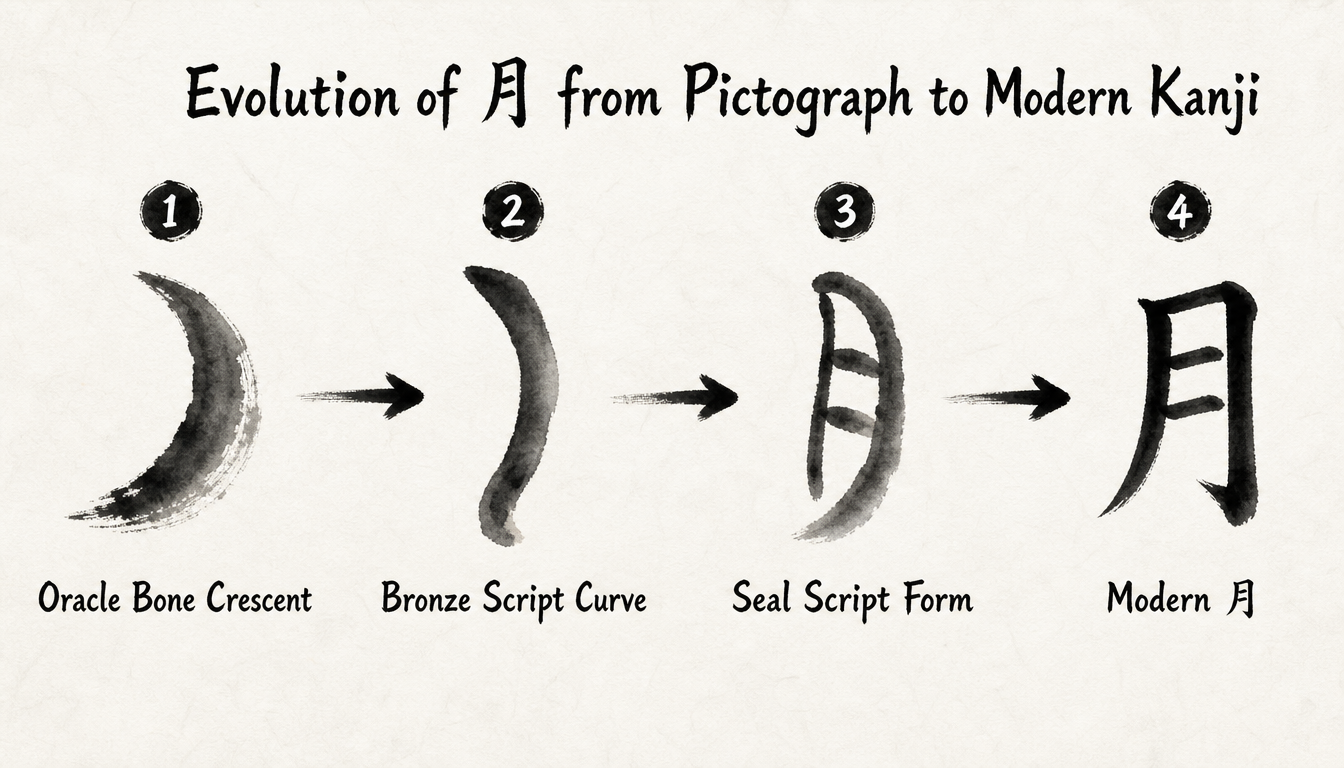
The story of the moon kanji begins long before brush and paper — it begins with bone. Like 日 (sun), 月 is a pictograph, meaning the character started as a literal drawing of what it represents.
From Crescent to Character
Early oracle bone and bronze inscriptions depicted 月 as a crescent shape, often with a small mark inside. Why a crescent rather than a full moon? Practical reasons: ancient scribes needed to distinguish the moon (月) from the sun (日). A full circle was already taken by the sun, so the moon naturally adopted its waxing or waning form — the silhouette most uniquely "moonlike" in the night sky.
The small inner mark is often interpreted as the moon's surface shadows — the mottled face the ancients saw when they looked up. Over centuries, the curved crescent was straightened into the angular, four-stroke form we recognize today. The connection to the original picture is faint in modern script, but the lower portion of 月 still echoes that ancient crescent silhouette.
The Lunar Calendar Connection
Because the traditional East Asian calendar tracked time by lunar phases, 月 came to mean not just "moon" but "month." This dual meaning is not unique to Japanese — English follows the same logic. The word "month" descends from the same ancient root as "moon." When you write 一月 (ichigatsu, January) or 三月 (sangatsu, March), you are literally writing "first moon" and "third moon."
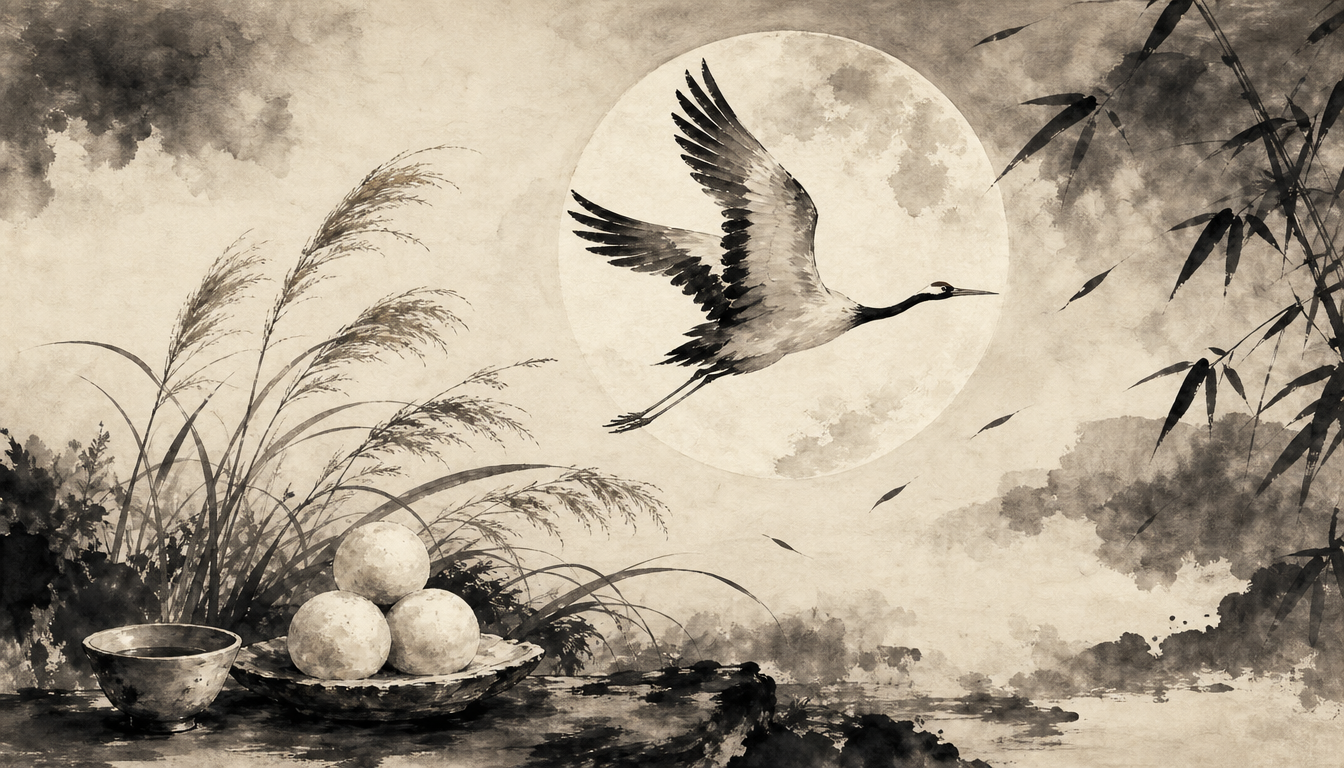
In Japan, the autumn moon-viewing festival 月見 (tsukimi) celebrates the harvest moon with offerings of rice dumplings and pampas grass — a tradition rooted in centuries of lunar reverence.
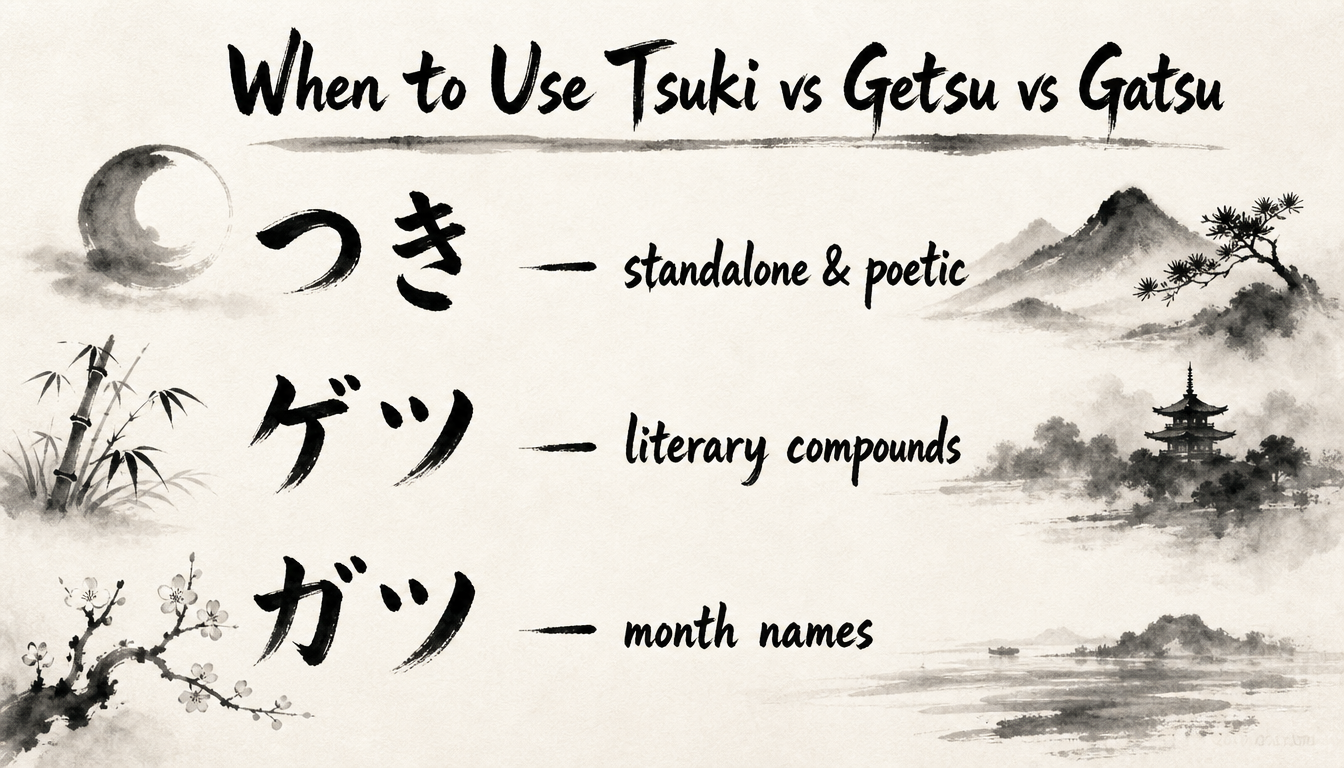
Readings: Kun'yomi (Tsuki) vs On'yomi (Getsu/Gatsu)
Understanding the tsuki meaning fully requires knowing when to use each reading. Like most Japanese kanji, 月 has both a native Japanese reading (kun'yomi) and Chinese-derived readings (on'yomi).
つき (Tsuki) — The Native Japanese Reading
The kun'yomi tsuki is used when 月 stands alone or refers poetically to the moon itself.
- 月 (tsuki) — the moon
- 月見 (tsukimi) — moon-viewing
- 三日月 (mikazuki) — crescent moon (literally "third-day moon")
This is the reading you'll encounter in haiku, song lyrics, and personal names. It carries softness, intimacy, and a sense of looking up at the sky yourself.
ゲツ (Getsu) and ガツ (Gatsu) — The On'yomi Readings
The on'yomi readings appear in compound words (jukugo), most often for months and time-related concepts.
- 一月 (ichigatsu) — January
- 月曜日 (getsuyōbi) — Monday
- 満月 (mangetsu) — full moon
- 月光 (gekkō) — moonlight
A general pattern: gatsu is commonly seen in month names (一月, 二月, 三月...), while getsu is frequently used in compound words like 月光 (moonlight) or 月食 (lunar eclipse) — though the distinction is not absolute, and both readings appear across a variety of contexts.
| Reading Type | Reading | Used For | Example |
|---|---|---|---|
| Kun'yomi | つき (tsuki) | Standalone moon, poetry, names | 月 (the moon) |
| On'yomi | ガツ (gatsu) | Month names | 四月 (April) |
| On'yomi | ゲツ (getsu) | Literary/abstract compounds | 満月 (full moon) |
Symbolism and Soul: What Choosing 月 Says About You
In Japanese aesthetics, the moon is the quiet counterpart to the sun's brilliance. Where 日 (hi) radiates outward energy, achievement, and visibility, 月 turns inward. It is reflective rather than radiant — literally and emotionally.
The Moon as a Mirror of the Inner Self
People drawn to the moon kanji often share certain qualities:
- Quiet observation — preferring to watch and understand before acting
- Emotional depth — feeling cycles, moods, and subtle shifts others overlook
- A reflective nature — finding meaning in solitude and stillness
- Adaptability — like the moon's phases, comfortable with change
In Japanese poetry, the moon often symbolizes mono no aware (もののあわれ) — the bittersweet awareness of impermanence. The moon waxes and wanes, never staying the same, yet it always returns. Choosing 月 as a personal symbol embraces this gentle truth: nothing is permanent, and that is precisely what makes it beautiful.
The Moon in Japanese Arts and Names
月 appears throughout Japanese names — for both people and places. It carries an air of elegance and old-soul wisdom. Anime fans will recognize it in characters and attack names like Zangetsu (斬月, "slicing moon"), where the kanji adds gravitas and beauty to the concept.
If you feel more like moonlight than sunlight — present but not loud, steady but ever-changing — 月 may be the kanji that mirrors your inner landscape.
Common Misunderstandings About 月
Because 月 is so simple, it's easy to misread its depth — or to confuse it with similar-looking kanji.
| Misconception | Reality |
|---|---|
| "月 only means moon" | It means both moon and month, and the meaning is decided by context. |
| "You always read 月 as tsuki" | The reading shifts to getsu or gatsu in compounds; tsuki is mainly for standalone or poetic use. |
| "月 and 肉 (meat) look the same" | The 月 radical inside body-part kanji (like 肝, 腕) is historically derived from 肉 (meat), not the moon — a famous false friend in kanji study. |
| "It's a childish kanji because it's simple" | Simplicity is its strength. Master calligraphers consider 月 one of the most expressive characters precisely because of its restraint. |
Related Kanji and How They Differ
| Kanji | Meaning | How It Differs from 月 |
|---|---|---|
| 日 (hi / nichi) | Sun, day | The outward, radiant counterpart to 月's inward reflection. |
| 星 (hoshi / sei) | Star | Distant, scattered light — where 月 is singular and central. |
| 夜 (yoru / ya) | Night | The setting; 月 is the protagonist within it. |
| 光 (hikari / kō) | Light | Often paired with 月 as 月光 (moonlight) — light is the quality, 月 is the source. |
Choosing 月 as a Tattoo or Personal Symbol
For those considering 月 as body art or a personal emblem, a few practical notes:
- Balance and stroke order matter — the four strokes should feel weighted yet open. Have a calligrapher or culturally fluent designer confirm proportions.
- Never mirror the character — a flipped 月 reads as a mistake to Japanese eyes.
- Consider pairings carefully — 月光 (moonlight), 満月 (full moon), or 三日月 (crescent moon) add nuance, but each carries its own visual rhythm.
- Avoid generic font renderings — the brush-stroke version of 月 carries far more soul than a digital print.
The 月-shaped radical inside kanji like 服 or 肺 historically comes from 肉 (meat/flesh), not the moon. If you're tattooing a compound, make sure you understand which 月 is in play.
Discovering Your Own Soul Kanji
The beauty of kanji like 月 is that they don't just describe — they reflect. A single character can hold your sense of self in a way no English word quite can. But choosing the right one takes more than browsing a list.
This is exactly why Oracle Kanji Writer exists. In a quick two-minute diagnosis, the tool considers your name, birthdate, and blood type to recommend a kanji aligned with your inner essence — complete with authentic readings, layered meanings, and a personal message. Whether your soul resonates with the quiet glow of 月 or another character entirely, the result is something culturally grounded, beautifully rendered, and unmistakably yours.
Summary: The Quiet Power of 月
- 月 means moon and month, rooted in a pictograph of the crescent moon.
- Its readings are tsuki (kun'yomi), getsu, and gatsu (on'yomi) — each fitting different contexts.
- With just four strokes, 月 expresses reflection, cycles, impermanence, and inner light.
- It pairs naturally with 光 (light), 満 (full), and 三日 (third day) to form evocative compound words.
- For those drawn to the kanji tsuki, the moon kanji, and the layered tsuki meaning, 月 offers a lifelong symbol of quiet, observant strength.
Next in our Kanji of the Day series, we'll continue exploring the characters that shape Japanese identity — one brushstroke, one soul, one day at a time.
Discover Your Soul Kanji
Experience the depth of Japanese characters: each kanji carries timeless meaning, guiding your life's path.
No credit card required • 2-minute process