Kanji of the Day Vol.47 | "Kanji 望 (Nozomi): The Hope Kanji Awakening Your Soul's Deepest Wish"

The kanji 望 (nozomi) means hope, wish, and aspiration, built from the elements for moon and king to evoke gazing upward toward something greater. Explore its etymology, readings, cultural roots in the Nozomi Shinkansen, and how to use this hope kanji accurately as a personal symbol or tattoo for self-discovery.
Kanji of the Day Vol.47 | Kanji 望 (Nozomi): The Hope Kanji Awakening Your Soul's Deepest Wish
The kanji nozomi hope character, written 望, means hope, wish, and aspiration. It carries the feeling of lifting your eyes toward something distant and worth reaching for. If you are drawn to the idea of a personal symbol that speaks of looking forward with intention, 望 is one of the most resonant characters in the Japanese language, and it rewards a closer look.
This is issue Vol.47 of our Kanji of the Day series, and today we sit with a character that many people carry as a name, a tattoo, or a quiet reminder etched onto a keepsake.
Discover Your Soul Kanji
Experience the depth of Japanese characters: each kanji carries timeless meaning, guiding your life's path.
No credit card required • 2-minute process
What the Kanji 望 (Nozomi) Means: Hope Made Active
At its surface, 望 translates to hope, wish, or desire. Look deeper and you find a more textured idea. According to Wiktionary, the noun 望み (nozomi) means both hope and wish, and also the expectation of something positive happening. The character does not describe passive daydreaming. It describes the stance of a person who envisions a better tomorrow and moves toward it.
In Japanese culture, hope is treated as an active pursuit rather than blind optimism. The kanji 望 embodies the strength to imagine what could be and the courage to take steps in that direction. That is why it appears across poetry, calligraphy, and personal names, and why it resonates with anyone on a path of self-discovery.
望 is not a wish you make and then forget. It is a wish you keep walking toward. The character built the idea of forward-looking hope into its very shape.
Overview of the Kanji 望
| Item | Detail |
|---|---|
| Kanji | 望 |
| Primary meaning | Hope, wish, aspiration, to gaze afar |
| On'yomi | bou |
| Kun'yomi | nozomu (望む), nozomi (望み), mochi (archaic) |
| Category | Emotion / aspiration kanji |
| Related concepts | 希望 (kibou), 願い (negai), 夢 (yume) |
Kanji Composition and Etymology: Moon, King, and the Gaze Upward
The visual story inside 望 is where it becomes memorable. The character combines the element for moon (月) and the element for king (王), a pairing that Kanji Soul describes as evoking the image of looking up toward the heavens, seeking something greater.
Picture the scene the ancient form suggests: a figure standing tall, eyes raised to the moon in the night sky. The moon sits far out of reach, yet it draws the gaze upward. That upward look, that reaching toward the distant and luminous, is the heart of 望. This is why the kanji carries the sense of gazing afar toward something you long for, not simply wanting it.
The diagram below breaks down how the two structural elements combine into the single idea of forward-looking hope.
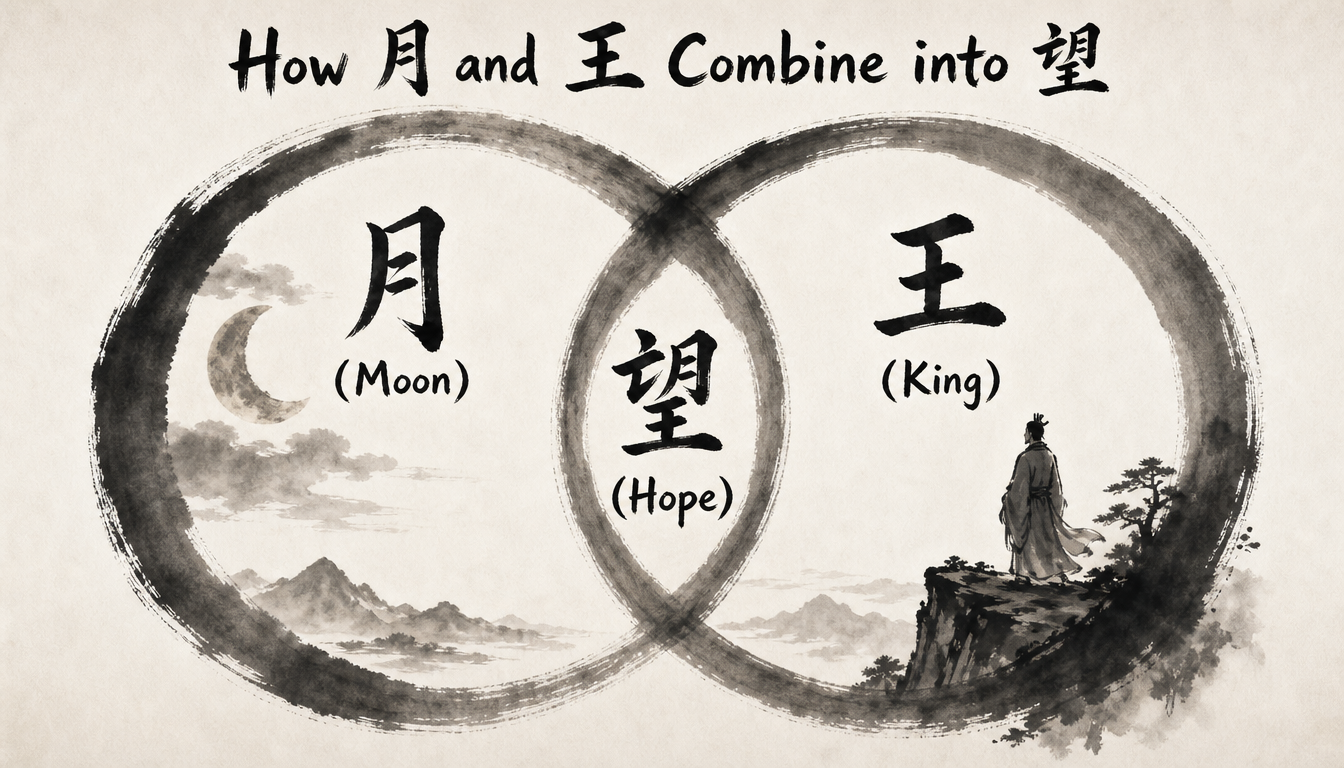
Understanding this construction matters if you plan to use 望 as a personal symbol. You are not choosing a flat word for hope. You are choosing an image of a person turning their face toward the light of the moon and refusing to look away.
Common Readings and Usage: Nozomi, Bou, Nozomu, Kibou
Japanese kanji usually carry two families of readings, and 望 is no exception. The on'yomi (the reading borrowed from Chinese) is bou, used mostly inside compound words. The kun'yomi (the native Japanese reading) gives us the everyday verb and noun forms that carry real emotional weight.
- 望む (nozomu) — to wish, to desire, to hope for. A common word, listed at JLPT N3 on Jisho.
- 望み (nozomi) — a wish, a hope. The reading is romanized as nozomi, according to Langoal.
- 希望 (kibou) — hope, wish. The go-to noun when Japanese speakers talk about hope in a formal or abstract sense.
The name Nozomi grew even more familiar after JR named its fastest Tokaido Shinkansen service Nozomi. The train, meaning 'Wish' or 'Hope', commenced service on March 14, 1992, lodging the word firmly in Japan's everyday soundscape. The 300 series trains used for that debut reached a maximum operational speed of 270 km/h, a fitting symbol of hope racing toward the horizon.
When Japanese people hear the reading nozomi, many think first of the bullet train. The name was chosen precisely because 望 means hope and forward motion, the perfect metaphor for the country's fastest service.
As a given name, Nozomi appears with more than one kanji. The character 望 emphasizes the active gaze of hoping, while 希 stresses rarity and aspiration, as Japanese Names notes. Anime audiences also meet the reading through characters in popular franchises, which keeps its connection to optimism alive across generations.
Nozomi in Practice: Good and Poor Choices for a Personal Symbol
If you are considering the kanji nozomi hope character for a tattoo, wallpaper, or keepsake, accuracy separates a meaningful piece from an embarrassing one. The character 望 has a specific stroke structure, and small distortions change how it reads to Japanese eyes.
| Consideration | Good choice | Poor choice |
|---|---|---|
| Character form | Faithful stroke shapes and proportions | Distorted strokes that alter the reading |
| Meaning fit | Chosen because forward-looking hope resonates with you | Picked only because it looks decorative |
| Reading awareness | Knowing it reads nozomi / bou / kibou | Assuming any hope kanji is interchangeable |
One community member sharing a laser design learned this the hard way when a fellow member pointed out that the top-left portion of the character had been rendered with a hard point rather than the correct curve, per a discussion on the Glowforge forum. A tiny slip like that reads as clumsy or wrong to a native speaker. This is where a culturally grounded service earns its keep.
Oracle Kanji Writer – Personalized Soul Kanji Diagnosis Tool exists to prevent exactly this kind of mistranslation. Rather than converting an English word through a cheap generator, you enter your name, birthdate, and blood type, and a tailored algorithm suggests a kanji aligned with your inner qualities. Each result arrives with pronunciation, primary and nuanced meanings, a personal message, and carefully chosen compound words, all curated by Japanese creators who care that the character resonates as beautiful and correct in Japan.
Common Misunderstandings About the Hope Kanji
Several confusions cluster around 望 and its cousins. Clearing them up helps you use the character with confidence.
| Misunderstanding | The accurate picture |
|---|---|
| "望 and 希 mean the same thing" | Both point at hope, but 望 emphasizes the active gaze outward while 希 stresses rarity and yearning. |
| "望む and 臨む are interchangeable" | They share an origin but differ in use. 望む means to gaze afar or desire; 臨む means to face or confront something directly. |
| "Any kanji for hope works for a tattoo" | Each character carries distinct nuance and stroke form. The wrong pick or a distorted stroke changes the meaning. |
On the 望む versus 臨む question, the Mainichi language salon explains that the meaning of gazing into the distance belongs to 望む, whereas 臨む carries the sense of being present before or facing something, even though the two words are said to share a common root.
Related Kanji in the Family of Hope and Aspiration
望 lives among a small circle of characters that express longing, dreaming, and looking forward. Knowing its neighbors helps you choose the character that fits you best.
| Kanji | Meaning | How it differs from 望 |
|---|---|---|
| 希 (ki) | Hope, rarity | Stresses something rare and precious rather than the active gaze. |
| 夢 (yume) | Dream | A vision that may be unbounded; 望 is a hope aimed at the reachable. |
| 願 (negai / gan) | Wish, prayer | Carries a devotional, requesting tone; 望 is more about self-directed aspiration. |
If any of these speak to you more than 望, they may be closer to your inner theme. You can explore them further through 望 (Hope), 夢 (Dream), and 願 (Wish).
How to Use the Nozomi Hope Kanji for Self-Discovery
The characters people carry as symbols often mirror what they are reaching for. Choosing 望 says something about you: that you keep your eyes on the horizon, that you believe tomorrow can be shaped, and that you find strength in aspiration rather than certainty.
Here are grounded ways to bring the character into your life:
- Set it as a wallpaper or desktop image so the upward gaze greets you daily.
- Commission a calligraphy piece and learn the correct stroke order before framing it.
- If you want it as a tattoo, confirm the stroke shapes with a reliable source and avoid mirroring the character.
- Pair 望 with a personal compound like 希望 (kibou) to expand its meaning.
For anyone unsure whether 望 truly reflects them, a personalized diagnosis removes the guesswork. The tool weighs your personal details and returns a character that matches your essence, complete with the cultural context that keeps you from a cliché pick.
FAQ
Does nozomi mean hope?
Yes. When written 望み or as the name Nozomi with the kanji 望, it means hope or wish. According to Wiktionary, 望み (nozomi) covers both hope and the expectation of something positive happening. The reading is built on the native verb nozomu, meaning to wish or to hope.
Is there a kanji for hope?
There are several, and 望 is one of the most recognized. It combines the elements for moon and king to suggest gazing upward toward something greater. The character 希 also means hope, with a nuance of rarity, and the two often appear together in the compound 希望 (kibou).
How do you write nozomi in kanji?
The most common single-kanji writing is 望, though 希 is also used, and some people simply write it in hiragana as のぞみ. As the noun form of the verb 望む, the standard spelling is 望み. Take care with the stroke shapes, since small distortions change how the kanji nozomi hope character reads to a native speaker.
Does kibo mean hope?
Yes. 希望 (kibou) is the standard Japanese noun for hope in a formal or abstract sense, combining 希 (rarity, hope) and 望 (aspiration, gaze afar). Where 望み feels personal and immediate, 希望 tends to appear in written and formal contexts.
Conclusion
望 rewards the attention you give it. The kanji nozomi hope character is not a passive daydream but an active, forward-looking stance, and its structure quietly tells that story every time you look at it.
- 望 means hope, wish, and aspiration, with the sense of gazing toward something worth reaching.
- Its form joins moon (月) and king (王), evoking a figure looking up toward the heavens.
- Its readings include bou (on'yomi) and nozomu, nozomi, and kibou through the kun'yomi and compounds.
- Accuracy of stroke form matters if you use it as a tattoo or keepsake.
If 望 speaks to your longing to keep moving toward the horizon, consider letting a curated diagnosis confirm whether the nozomi hope kanji is your true soul character, and explore the related kanji of dream, wish, and rarity to find the one that mirrors you most faithfully.
Discover Your Soul Kanji
Experience the depth of Japanese characters: each kanji carries timeless meaning, guiding your life's path.
No credit card required • 2-minute process