Kanji of the Day Vol.62 | "Kanji 名 (Na): Choosing Japanese Kanji Names & Their Soul-Deep Meaning"

The character 名 (na) means 'name,' and it opens the door to how Japanese kanji names are built. Discover why one sound can be written with many characters, how kun, on, and nanori readings work, and what the official jinmeiyō name-kanji list allows. A practical guide to choosing a kanji whose meaning truly resonates.
Kanji 名 (Na): Choosing Japanese Kanji Names & Their Soul-Deep Meaning
A Japanese kanji name is a personal name written with Chinese characters chosen so that both the sound and the meaning carry intention. The character 名 (na), meaning "name," sits at the heart of this practice. Understanding japanese kanji names meaning is the difference between a beautiful set of strokes and a name that actually resonates in Japan, which matters whether you are planning a tattoo, naming a character, or searching for a symbol that reflects who you are.
This walkthrough covers how names are built from kanji, why one sound can be written many ways, and how to choose characters that feel true.
Discover Your Soul Kanji
Experience the depth of Japanese characters: each kanji carries timeless meaning, guiding your life's path.
No credit card required • 2-minute process
What 名 (Na) Means and Why Kanji Names Carry Weight

| Item | Detail |
|---|---|
| Character | 名 |
| English | Name |
| Category | Japanese given names / kanji |
| On'yomi | mei, myō |
| Kun'yomi | na |
| Related concepts | Nanori, jinmeiyō kanji, myōji (surname) |
In Japan, a full name pairs a surname with a given name, and there are no middle names, as Behind the Name notes. The given name is composed of one or more kanji, so a single spoken name can hide thousands of possible written forms. That flexibility is the beauty and the trap. Parents often select characters less for how they sound than for the qualities they hope a child will grow into: strength, kindness, brightness, endurance.
Because kanji are logographic, each one is a small painting of meaning. Choosing them is a design act. The sound names a person, but the kanji tells the world what that person is meant to embody. This is why a serious approach to japanese kanji names meaning refuses to treat characters as decorative shapes.
How Kanji Readings Work in Names (Kun, On, and Nanori)
A single kanji can be read several ways, which is the first thing that trips up newcomers. The two core reading systems come from the character's long journey out of China and into Japanese.
On'yomi and Kun'yomi
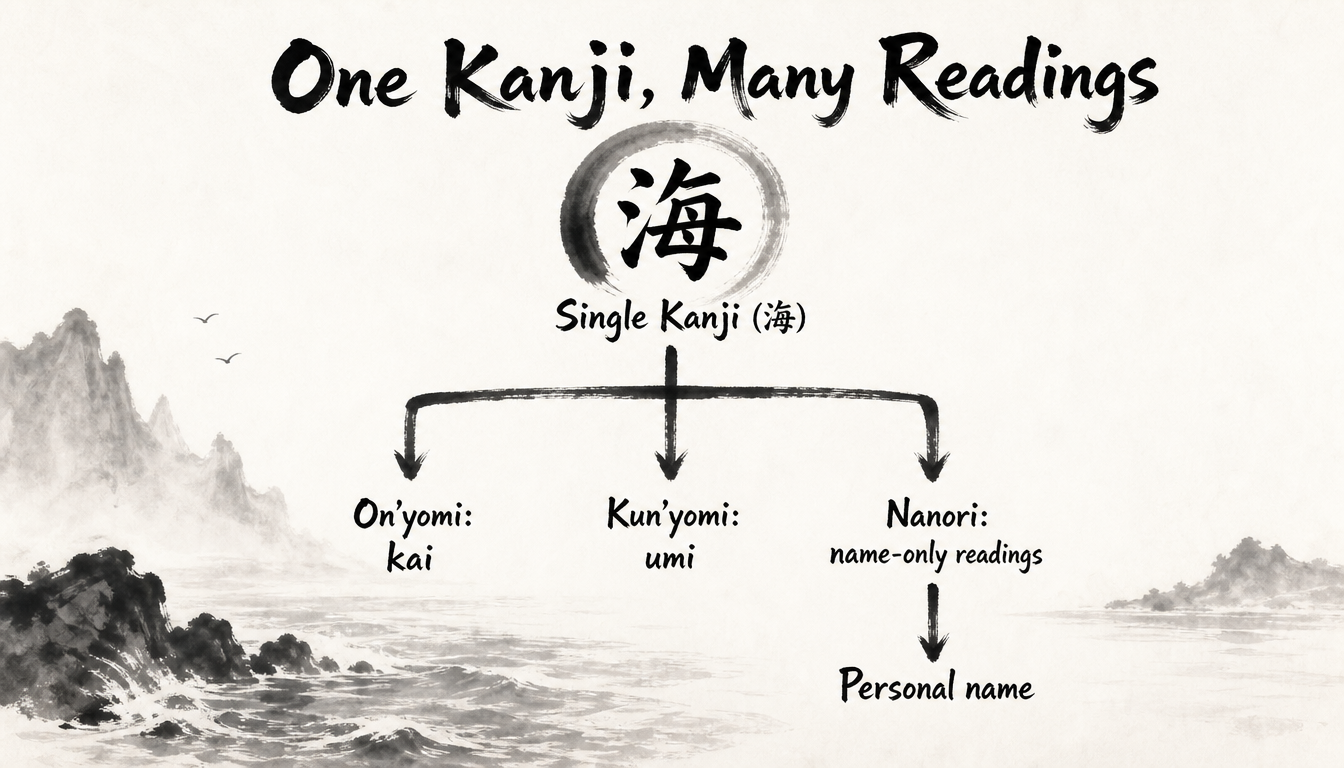
On'yomi is the "sound reading," an approximation of the character's original Chinese pronunciation, used mostly when kanji stack together in compounds. Kun'yomi is the native Japanese "meaning reading," used when a character stands alone. The character 海, meaning "ocean," reads umi in its kun form and kai in its on form, depending on context, as Behind the Name illustrates.
| Reading type | Origin | Typical use |
|---|---|---|
| On'yomi | Borrowed Chinese sound | Compounds, formal words |
| Kun'yomi | Native Japanese word | Standalone kanji |
| Nanori | Special name readings | Personal names only |
Nanori: The Readings Reserved for Names
Beyond on and kun, many kanji carry nanori, readings that appear only in personal names, described by Behind the Name. Nanori are why Japanese names can baffle even native speakers, who sometimes ask how a written name should be pronounced. A character might take a name-only reading that never surfaces in ordinary vocabulary, giving parents room to craft something distinctive while keeping a meaningful character.
The diagram below illustrates how one written name can branch into multiple valid readings.
Why the Same Sound Uses Different Kanji
Say the name "Ai" aloud in Japan and you have said almost nothing about how it is written. It could be 愛, meaning "love, affection," or 藍, meaning "indigo," among other characters that share the pronunciation, as Behind the Name documents. Each spelling carries a different soul.
Consider the name element na. One common choice is 菜, whose kun reading gives the meaning "vegetables, greens," a character that appears in names like Aina, Haruna, and Nanami, per Behind the Name. The same syllable could be written with 名 (name) or other homophonous kanji, each shifting the impression entirely. This is where meaning becomes a deliberate choice rather than an accident of spelling.
Because dozens of kanji can share one sound, two people with identically pronounced names may carry completely different meanings. Pick the character for the meaning first, then confirm the reading works.
Good and Poor Ways to Match Sound to Meaning
| Thoughtful choice | Careless choice | |
|---|---|---|
| Meaning | Character reflects a real quality you value | Character picked only because it "looks cool" |
| Reading | Reading confirmed as valid for names | Reading assumed from a dictionary front-page |
| Cultural fit | Feels natural to Japanese eyes | Reads as awkward or unintentionally comic |
Jinmeiyō Kanji: The Official Name Kanji List
Japan does not let parents use any character they please. Personal names must draw from an approved pool, and the supplementary set beyond everyday characters is the jinmeiyō kanji, literally "kanji for use in personal names."
According to Wikipedia, the jinmeiyō list stood at 985 characters as of April 30, 2009, then dropped to 861 in late 2010 when 129 characters moved into the everyday jōyō list. Later single-character additions in 2015, 2017, and 2026 brought the total to 864. These sit alongside the 2,136 jōyō kanji issued in the 2010 revision, since names can also be written entirely with those common characters.
| List | Purpose | Count |
|---|---|---|
| Jōyō kanji | Everyday general use | 2,136 |
| Jinmeiyō kanji | Extra characters allowed in names | 864 |
Legal name registration in Japan is limited to jōyō and jinmeiyō kanji. A character outside both lists cannot go on a Japanese family register, even if its meaning is lovely.
For a tattoo or a personal symbol you are not bound by these rules, but they are a useful sanity check. If a character is approved for real Japanese names, it almost certainly reads as legitimate and beautiful rather than obscure.
Common Misunderstandings About Japanese Kanji Names

Several myths travel widely online, and they lead to the mistranslations that make Japanese people wince at foreign tattoos.
| Misconception | The reality |
|---|---|
| "One kanji has one meaning" | Most carry layered meanings and several readings |
| "Any pretty kanji works as a name" | Names draw from approved lists and rely on name-friendly readings |
| "The dictionary's first reading is the name's reading" | Names often use nanori that dictionaries bury or omit |
| "Sound is all that matters" | The written character defines the meaning, and homophones diverge sharply |
The safest habit is to reason from meaning to character to reading, checking each step, rather than converting letters one by one. Machine tattoo converters skip the middle steps, which is how "strength" becomes something closer to a noodle-shop menu word.
Related Terms Worth Knowing
| Term | Meaning | Difference from 名 (na) |
|---|---|---|
| Myōji (名字) | Family name / surname | The inherited name, not the personal given name |
| Nanori | Name-only kanji readings | A reading category, not a name itself |
| Okurigana | Kana that follow a kanji stem | Grammatical suffixes, largely absent in names |
Most present-day surnames are surprisingly young. As one family history recounts, the majority of Japanese family names date back only about 150 years to the 1870s Meiji reforms, when ordinary households were required to register a myōji (tanuki2016.com). Given names, by contrast, remain a fresh canvas for each generation.
How to Choose a Meaningful Kanji for Yourself
If you are picking a personal kanji rather than registering a child, the process is freer but still deserves rigor. Work in this order:
- Start from a quality, not a sound. Name the trait you want to carry: patience, courage, calm, light.
- Find the authentic character for it. Confirm the mainstream meaning and that the character reads well in names.
- Check the readings. Note the on, kun, and any nanori, so you know how it would be spoken.
- Look at real compounds. Seeing the kanji inside common words reveals its lived nuance, not just its dictionary gloss.
- Test the visual balance. A character destined for skin or art should feel steady, with clean stroke flow.
This is the exact logic behind Oracle Kanji Writer, the Personalized Soul Kanji Diagnosis Tool. Rather than converting your Latin letters into look-alike strokes, it takes your name, birthdate, and blood type, then recommends a "Soul Kanji" chosen for inner qualities and life path. Each result arrives with pronunciation, primary and nuanced meanings, a personal message, and curated compound words that expand the context, all vetted by Japanese creators so the character resonates as beautiful and meaningful at home in Japan.
Meaning first, reading second, aesthetics third: that order protects you from cliché picks and mistranslations.
Frequently Asked Questions
Why can the same Japanese name be written with different kanji?
Many kanji share a pronunciation, and individual characters carry multiple readings. So a spoken name like "Ai" or "Na" can be written with several different characters, each holding a distinct meaning, which is why parents choose the spelling deliberately.
What is the difference between jōyō and jinmeiyō kanji?
Jōyō kanji are the 2,136 characters for everyday general use, while jinmeiyō kanji are the 864 additional characters permitted specifically in registered personal names in Japan.
Do I need to follow the official lists for a tattoo?
No. The lists govern legal name registration in Japan, not personal art. Still, choosing an approved character is a reliable way to ensure it reads as natural and carries a clear, respected meaning.
Bring Your Name Back to Its Soul
Understanding japanese kanji names meaning turns a string of strokes into something you can stand behind. Start from the quality you want to carry, find the authentic character, confirm its readings and nanori, and check it against the jinmeiyō and jōyō lists for legitimacy. Do that, and the kanji you wear or keep will mean exactly what you intend, in Japan and everywhere else.
- 名 (na) means "name" and anchors the whole practice of kanji naming.
- Kanji names blend on, kun, and name-only nanori readings.
- One sound can map to many characters, so meaning must drive the choice.
- Legal names draw from 864 jinmeiyō and 2,136 jōyō kanji.
- Reason meaning to character to reading to avoid mistranslations.
Discover Your Soul Kanji
Experience the depth of Japanese characters: each kanji carries timeless meaning, guiding your life's path.
No credit card required • 2-minute process