Kanji of the Day Vol.60 | "Kanji 空 (Kuu): The Emptiness Kanji Freeing Your Soul's Boundless Void"

The kanji 空 (kuu) holds one of Japan's deepest ideas: an emptiness full of potential. Explore its Buddhist meaning of śūnyatā, how it differs from 無 (mu), its everyday "sky" reading, key compounds, and what choosing this character says about your character and path.
Kanji of the Day Vol.60 | Kanji 空 (Kuu): The Emptiness Kanji Freeing Your Soul's Boundless Void
The kanji ku emptiness character, 空, names one of the most profound ideas in Japanese thought: a fullness disguised as absence. Read as kuu, it points to the Buddhist notion of emptiness, the open, unfixed nature of all things. This is not the emptiness of a hollow box. It is the spaciousness that lets everything arise, change, and return. People drawn to mindfulness, Zen aesthetics, and meaningful tattoos often gravitate toward this single, quiet stroke of meaning.
Below, we trace how 空 carries two very different lives. As sora it means the sky. As kuu it means voidness in the deepest philosophical sense. Both matter if you want to wear or write this character with intention.
Discover Your Soul Kanji
Experience the depth of Japanese characters: each kanji carries timeless meaning, guiding your life's path.
No credit card required • 2-minute process
What the Kanji Ku Emptiness (空) Really Means
The kanji 空 (kū) is the Japanese transliteration of the Sanskrit term śūnyatā, which carries the senses of emptiness, voidness, vacuity, openness, thusness, and nothingness, according to Wikipedia's entry on Śūnyatā. That range of translations already hints at why a single English word never quite lands. 空 holds absence and possibility in the same breath.
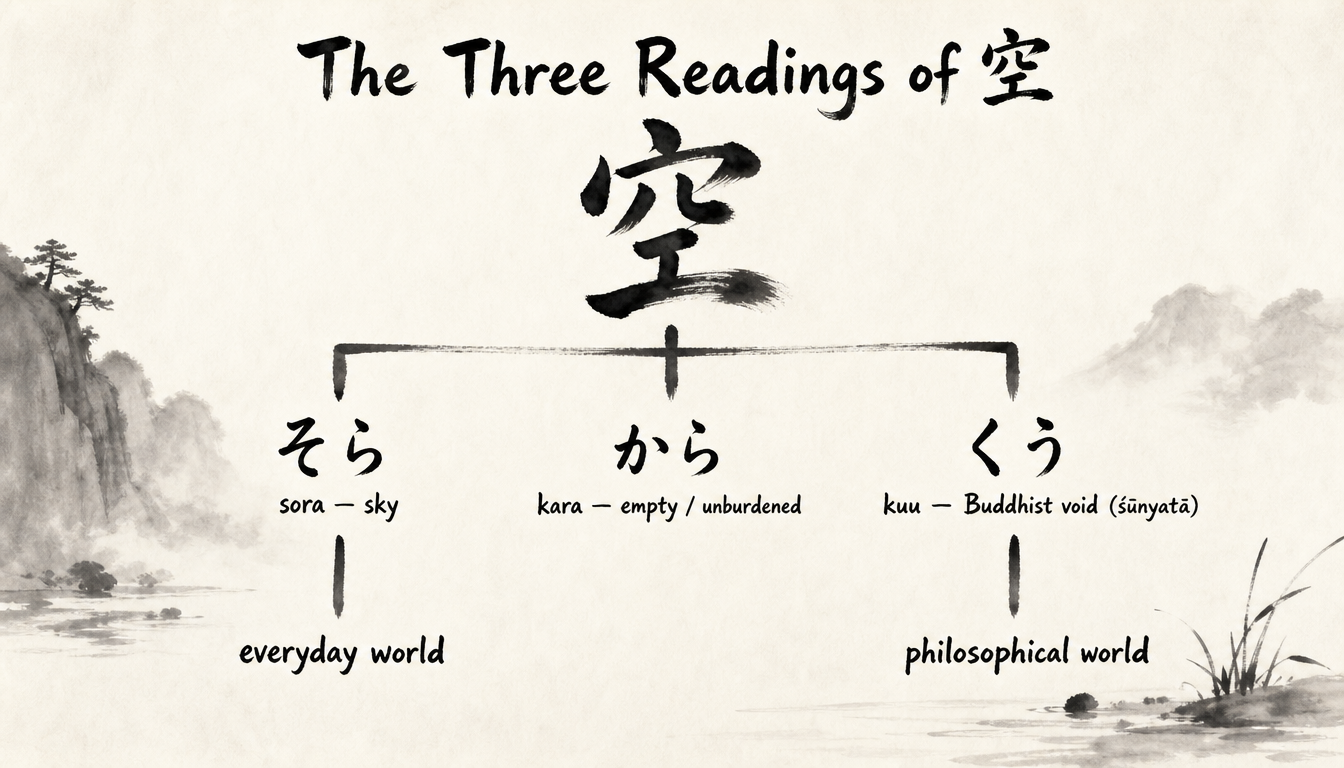
In its everyday Japanese life, 空 wears several hats. Read as sora, it means the sky. Read as kara, it means empty, as in an empty box or an unburdened traveler carrying nothing. Read as kuu, it climbs into philosophy and becomes the Buddhist concept of emptiness. One character, three moods, ranging from the physical heavens to the metaphysical void.
The same character that Japanese children learn as "sky" (sora) is also the character Zen masters brushed onto scrolls to represent the ungraspable nature of reality (kuu). The link is poetic: the sky looks like nothing, yet it holds everything.
This double life is part of why 空 feels so resonant. When you choose it as a personal symbol, you inherit both readings at once: the open sky above you and the open nature within you.
Overview of the Kanji 空
Here is the basic profile of the character before we go deeper into its philosophy and symbolism.
| Item | Detail |
|---|---|
| Kanji | 空 |
| On'yomi | クウ (kū) |
| Kun'yomi | そら (sora), あ.く / あ.ける (a.ku / a.keru), から (kara) |
| Core meanings | empty, sky, void, emptiness (śūnyatā) |
| Radical | 穴 (ana, "hole/cave") |
| Category | Buddhist philosophy, everyday vocabulary |
| Related concepts | 無 (mu), 虚 (kyo), Zen mindfulness |
Notice the radical: 穴 means a hole or cave. Above an opening sits 工, historically tied to a tool or work. The character grew from the image of a hollowed-out space, an opening bored into something solid. That origin quietly explains both the "sky" reading, the great hollow overhead, and the "empty" reading, the space where something could be.
Sunyata and 空 (Kuu): The Buddhist Philosophy Behind Emptiness
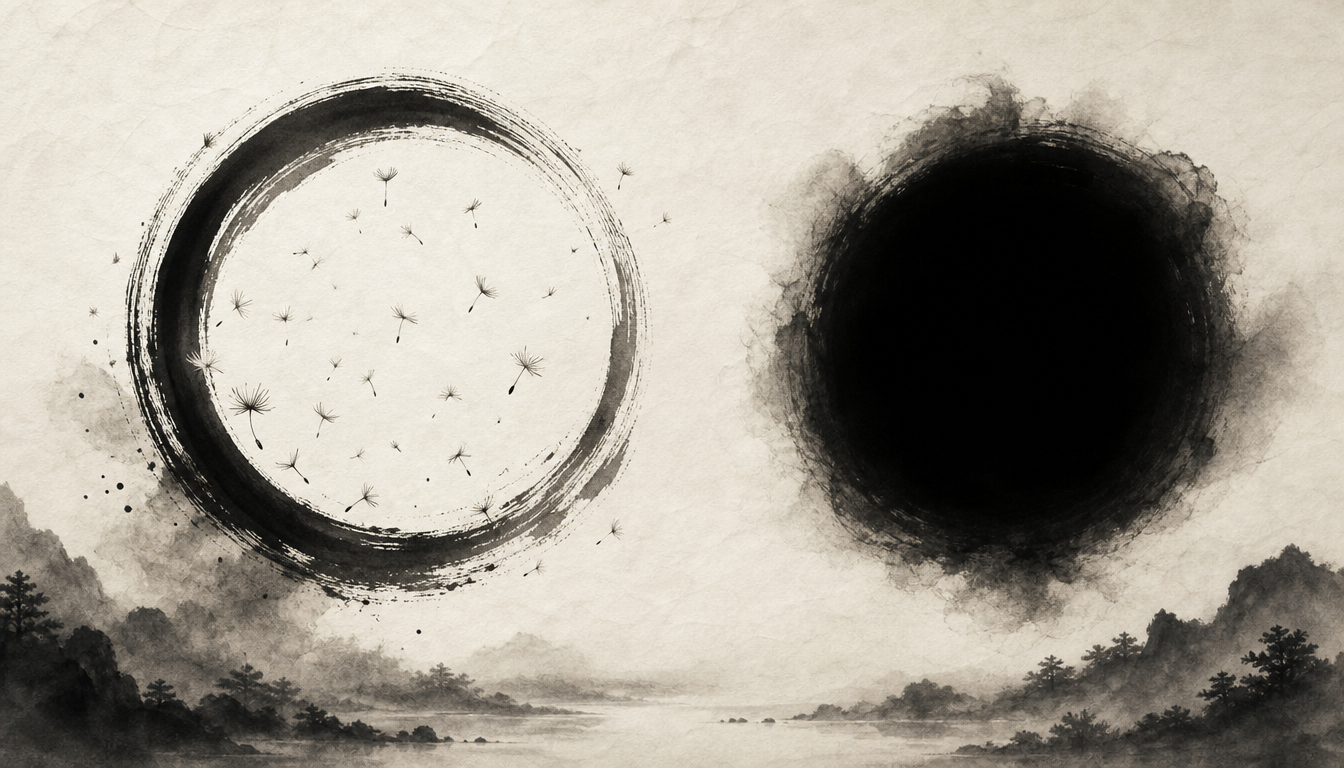
To understand kanji ku emptiness in its Zen sense, you have to set aside the Western instinct that empty means lacking. In Mahayana Buddhism, śūnyatā teaches that nothing possesses a fixed, independent, permanent essence. Everything exists in relationship, arising from causes and conditions, forever shifting. 空 names that truth.
In Zen Buddhism, kū refers to the non-manifest cosmic potential that is unchanging in nature, transcendent and immanent in all things, representing the true nature or Buddha nature present in every form and mental formation, according to the International Zen Association. Read that slowly. Emptiness here is not a hole in existence. It is the fertile ground from which all forms emerge and to which they return.
The Zen writer Dani Cavallaro captures this beautifully, describing sunyata as an emptiness so full of potentiality that all emerges from it, so full that when a person empties themselves of accumulated assumptions and judgments, they come closer to their original nature and can conceive fresh ideas. That is the practical heart of the concept. Emptiness is spaciousness for the new.
Why 空 Sits at the Center of Zen
Zen practice keeps circling back to 空 because meditation aims at exactly this experience: loosening the grip of fixed concepts until the mind rests in open awareness. When a Kyoto temple hangs a scroll bearing a single 空, it invites the viewer into that openness. The character is not decorating a wall. It is a pointing finger toward the nature of mind itself.
The diagram below lays out how the one character 空 branches into its three living readings and their worlds of meaning.
空 (Kuu) vs 無 (Mu): Two Japanese Words for Emptiness
Newcomers often ask why Zen uses 空 rather than 無 (mu) for "void" and "emptiness." Both words orbit the idea of nothing, yet they say different things, and choosing between them for a tattoo or personal symbol changes your message entirely.
無 (mu) points to sheer absence, negation, the state of there being nothing. It answers the question "is there something here?" with a flat no. 空 (kuu) is subtler. It does not deny that things exist. It says that things exist without any fixed, self-standing essence. A wave is real, yet it is only ever borrowed water. 空 describes that borrowed, relational, ever-shifting reality.
| Aspect | 空 (kuu) | 無 (mu) |
|---|---|---|
| Core sense | Emptiness of fixed essence; openness | Nothingness; absence, negation |
| Attitude to form | Forms exist but are impermanent and interdependent | Points to the total lack of a thing |
| Sanskrit root | Śūnyatā | Often linked to "nothing" / negation |
| Feeling it carries | Spacious, potential-rich, luminous | Stark, quiet, negating |
| Common everyday use | Sky, empty, vacant | Without, un-, nothing (as prefix) |
If you want a symbol of possibility, spaciousness, and release from rigid thinking, 空 fits. If you want to express pure absence or the discipline of a cleared mind, 無 may suit you better. The nuance is the whole point, and getting it wrong is the classic tattoo regret.
The distinction is why serious study, or a service curated by native Japanese creators, matters when you commit a kanji to your skin or your wall.
Living with 空: Compounds, Symbolism, and Personal Meaning
Because 空 leads a double life, its compound words (jukugo) sweep across the sky and the spirit. A few common ones:
- 青空 (aozora) — blue sky. The everyday, uplifting face of the character.
- 空気 (kuuki) — air, atmosphere. Literally "empty energy," the invisible medium we live inside.
- 空間 (kuukan) — space, the gap between things. Central to Japanese aesthetics and design.
- 空虚 (kuukyo) — hollowness, emptiness of feeling. A reminder that 空 can also name a lack.
That last compound matters. Depending on context, 空 can mean the luminous void of Zen or the aching emptiness of a life that feels hollow. Context and pairing decide which reading a Japanese reader takes. This is exactly where an authentic guide earns its keep.
What Choosing 空 Says About You
People who resonate with 空 tend to value openness over rigidity. They accept impermanence rather than clinging. They see space, silence, and stillness as full rather than empty. Wearing 空 signals a comfort with not-knowing, a willingness to release old assumptions and stay receptive to what comes.
This is where a tool like the Oracle Kanji Writer – Personalized Soul Kanji Diagnosis Tool becomes useful. Rather than picking a character off a chart, you enter your name, birthdate, and blood type, and the service suggests a kanji aligned with your inner nature. Each result arrives with pronunciation, primary and nuanced meanings, and carefully chosen compounds, all curated by Japanese creators so the character resonates as beautiful and meaningful in Japan. For a concept as easy to mistranslate as emptiness, that cultural grounding protects you from the clichés and errors that plague cheap converters.
If you are drawn to the family of quiet, contemplative characters, you may also explore related kanji such as 無 (Nothingness), 心 (Heart/Mind), 天 (Sky/Heaven), and 静 (Stillness).
FAQ
What is the Zen term for emptiness?
The Zen term is kū, written 空. It translates the Sanskrit śūnyatā and points to the idea that all things lack a fixed, independent essence and instead arise in relationship. In Zen Buddhism, 空 also names the non-manifest cosmic potential present in all forms, the Buddha nature within every thing.
What is the Japanese word for emptiness?
The most philosophically precise Japanese word is 空 read as kuu, the emptiness of śūnyatā. The character can also be read kara for a plain "empty" object and sora for the sky. For the deeper spiritual meaning of emptiness, kuu is the word Zen scrolls and Buddhist texts use.
What is the Japanese character for nothingness?
Nothingness is usually written 無 (mu), which stresses absence and negation. This differs from 空 (kuu), which describes emptiness of fixed essence rather than total absence. Both appear in Buddhist thought, but 無 leans toward "nothing at all" while 空 leans toward "open and interdependent."
Bringing the Void Home
The kanji ku emptiness character, 空, rewards anyone willing to sit with its paradox: an emptiness brimming with potential. To close, the essentials worth carrying:
- 空 (kū) transliterates the Sanskrit śūnyatā, meaning emptiness, voidness, openness, and thusness.
- Read as sora it means sky, as kara plain empty, and as kuu the Buddhist void.
- In Zen, 空 names the open, unchanging potential present in all forms, not mere absence.
- 空 (kuu) differs from 無 (mu): kuu is spacious interdependence, mu is stark negation.
- Context decides whether 空 reads as luminous Zen emptiness or hollow feeling, so nuance is everything.
If this idea speaks to you, the wisest next step is to choose your character with cultural care rather than guesswork. Whether you land on 空 or another kanji in its contemplative family, letting a tool like Oracle Kanji Writer match the kanji ku emptiness spirit to your own nature keeps the meaning as true and beautiful as the void it describes.
Discover Your Soul Kanji
Experience the depth of Japanese characters: each kanji carries timeless meaning, guiding your life's path.
No credit card required • 2-minute process