Kanji of the Day Vol.46 | "Kanji 樹 (Ki): The Standing Tree Kanji Rooting Your Soul's Growth"

Meet 樹, the kanji ki standing tree: a living, rooted tree that means growth, shelter, and endurance. Learn its ju and ki readings, its 16-stroke structure and tree radical, and how it differs from 木, 林, and 森. A grounded guide for anyone choosing a meaningful, culturally accurate personal kanji or tattoo.
Kanji of the Day Vol.46 | Kanji 樹 (Ki): The Standing Tree Kanji Rooting Your Soul's Growth

The kanji ki standing tree, written 樹, names a living, upright tree still rooted in the earth, not lumber or a felled log. It carries the feeling of vitality, endurance, and quiet upward growth. People drawn to this character often want a symbol of resilience, shelter, and steady flourishing, which is why 樹 appears so often in Japanese names and personal talismans.
In this Kanji of the Day entry, we look closely at how 樹 sounds, how it is built stroke by stroke, and why its meaning of a standing, growing tree sets it apart from the plainer kanji for wood.

Discover Your Soul Kanji
Experience the depth of Japanese characters: each kanji carries timeless meaning, guiding your life's path.
No credit card required • 2-minute process
What the Kanji Ki Standing Tree (樹) Means

樹 means "tree" and specifically a "standing tree," as recorded in the character dictionary entry for the character (Jitenon). Where the simpler character 木 covers tree, wood, and timber all at once, 樹 keeps its attention on the living plant, rooted and rising. The word also stretches into "to plant a tree" and, by extension, "to establish," as when something is set firmly in place to endure.
That extra layer matters. A tree that is planted and left to grow becomes a symbol of things built to last, families, ideals, institutions. When someone chooses 樹 as a personal kanji, they usually reach for that combined sense of being alive, being grounded, and standing tall through the seasons.
| Item | Detail |
|---|---|
| Kanji | 樹 |
| On-reading | ジュ (ju) |
| Kun-reading | き (ki) |
| Meaning | Tree, standing tree; to plant; to establish |
| Strokes | 16 |
| Radical | 木 (ki / kihen) |
| Kanji Kentei | Level 5 |
樹 is not just any tree. It is the living, standing tree, rooted and growing upward, which makes it a favorite for names and symbols about vitality and lasting strength.
Reading and Pronunciation of 樹 (Ki)
樹 carries two main pronunciations. The on-reading, borrowed long ago from Chinese, is ジュ (ju), confirmed by the character dictionary (Jitenon). The kun-reading, the native Japanese word, is き (ki), meaning "tree."
Here is the useful rule for readers new to kanji: the kun-reading tends to appear when the character stands alone or anchors a name, while the on-reading shows up inside compound words made of two or more kanji. So 樹 read as ki feels personal and standalone, while 樹 read as ju lives inside vocabulary like 樹木 (jumoku, tree) and 樹脂 (jushi, resin), both listed in the dictionary (Jitenon).
For a personal kanji or tattoo, the reading you most often want is ki. It matches the plain, grounded word for tree and blends naturally into Japanese given names such as those ending in -ki.
Ki, Ju, and How They Feel Different
The two readings color the character differently. Ki is intimate and earthy, the tree you can touch. Ju is more formal and scholarly, the register of orchards, botany, and set phrases. Neither is more correct; they simply belong to different moments in the language.
Stroke Count and Kanji Structure
樹 is a dense, balanced character built from 16 strokes (Jitenon). Its radical is 木 (ki / kihen), the very kanji for "tree," placed on the left as the meaning-carrying element. That left-side 木 tells you at a glance that this character belongs to the family of things related to trees and wood.
The right side of 樹 holds the component 尌, itself made of smaller parts including 壴 (a shape linked in ancient forms to a standing object or drum) and 寸 (a hand or measure). The diagram below breaks down how the character stacks together from these parts.
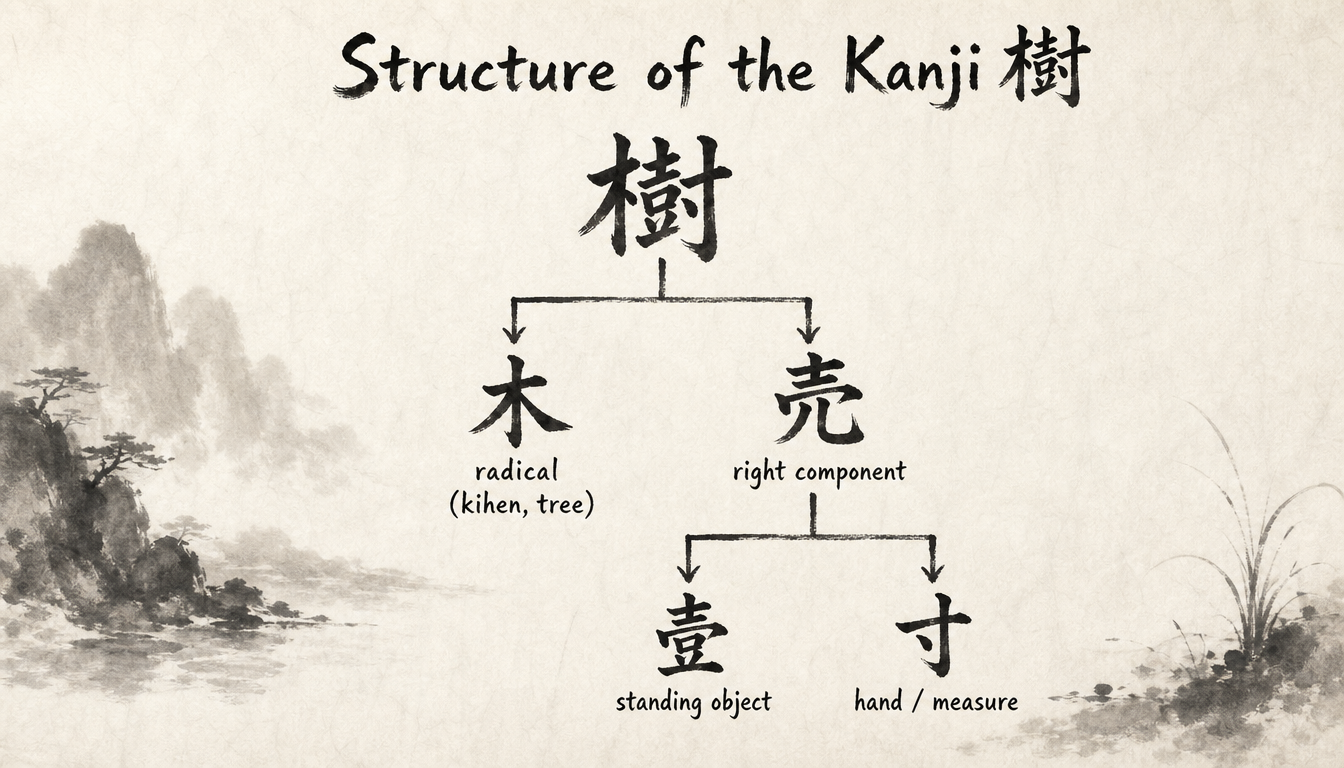
One scholarly reading of the origin, described in an etymology study of the character, sees an early form with a drum on one side and a hand on the other, evoking the ritual of planting seedlings while beating a drum to drive away evil; a tree element was later added to fix the meaning firmly as "tree" and "to plant" (Kanji Portraits). Whichever ancient image you favor, the modern character keeps both the living tree and the human act of planting it, which is exactly why 樹 leans toward "establishing" something meant to grow.
At 16 strokes, 樹 is one of the more intricate tree-family kanji. If you plan to use it as a tattoo or hand-lettered art, confirm the correct stroke order so the character reads as beautiful and intentional to Japanese eyes.
How 樹 Differs from Other Nature Kanji
Foreign learners often collapse several tree and nature kanji into one idea. In Japanese they carry distinct weights. The character 木 (ki) is the four-stroke root of the whole group, meaning tree, wood, or timber, and is taught to first-grade schoolchildren as one of the earliest kanji (EJable). It is broad and everyday. 樹, by contrast, narrows the focus to the living, standing tree and adds the sense of planting and establishing.
| Kanji | Core meaning | Feeling it carries |
|---|---|---|
| 樹 (ki / ju) | Living standing tree; to plant, to establish | Vitality, endurance, deliberate growth |
| 木 (ki / moku) | Tree, wood, timber | Everyday, elemental, material |
| 林 (hayashi) | Woods, small grove (two 木) | Gathering, modest wildness |
| 森 (mori) | Forest (three 木) | Depth, abundance, mystery |
The distinction is practical for anyone choosing a symbol. Pick 木 and you evoke the raw element. Pick 森 and you conjure a whole forest. Pick 樹 and you point to a single living tree that stands, roots deep, and keeps growing, a far more personal image of vitality.
Why 樹 Suits Growth and Vitality Symbolism
Because 樹 fuses "living tree" with "to establish," it works beautifully as a symbol for someone building a life with intention. In Japanese name culture the character is read as an aspiration: a wish that the child grow tall, offer shelter, and connect earth to sky, as one name-meaning resource phrases it for a boy's name using 樹 (Japanese Names). That blend of shelter and upward reach is what makes 樹 resonate with readers seeking growth, resilience, and rootedness.
Real Compound Words Built with 樹
Seeing 樹 inside everyday vocabulary makes its meaning concrete. Each of these compounds is a real, common word.
- 樹木 (jumoku) — trees; standing timber as living plants (Jitenon).
- 果樹園 (kajuen) — orchard; a place of cultivated fruit trees (Jitenon).
- 街路樹 (gairoju) — roadside trees planted along streets (Jitenon).
- 樹脂 (jushi) — resin, the sap that a tree produces (Jitenon).
Notice how each compound keeps a living, planted tree at its center, whether the tree lines a road, fills an orchard, or bleeds resin. This is the through-line of 樹: not dead wood, but the tree still alive and rooted.
This is also where a service like Oracle Kanji Writer earns its keep. Rather than converting a name letter by letter the way cheap tattoo generators do, it treats a kanji as a bundle of meaning, reading, and cultural nuance, then pairs you with a character and the compound words that expand its story, so 樹 arrives with context instead of guesswork.
FAQ
What does the kanji tree mean?
樹 means a living, standing tree, and by extension "to plant" and "to establish" (Jitenon). Unlike 木, which also covers wood and timber, 樹 keeps its focus on the rooted, growing plant, which is why it carries strong overtones of vitality and endurance.
Does ki mean tree?
Yes. Ki (き) is the native Japanese word for tree, and it is the kun-reading of both 木 and 樹. When 樹 stands alone or anchors a personal name, it is usually read ki, giving it that grounded, earthy feel.
What is the kanji symbol for Ki?
For the meaning "tree," the two kanji read ki are 木 (the simple, four-stroke element) and 樹 (the sixteen-stroke living standing tree). For a symbol emphasizing growth and lasting strength, 樹 is the richer choice; for the plain elemental idea, 木 works well (EJable).
Is 樹 a good choice for a tattoo?
樹 is visually striking and carries a warm, positive meaning, which makes it a strong candidate. Because it has 16 strokes and internal balance, confirm the correct stroke order and avoid mirroring the design so it reads as intentional and beautiful to Japanese eyes.
Conclusion
The kanji ki standing tree, 樹, rewards a closer look. To recap the essentials:
- 樹 means a living, standing tree, and extends to "planting" and "establishing" something meant to endure (Jitenon).
- It reads ジュ (ju) in compounds and き (ki) when standing alone or in names.
- It is built from 16 strokes around the tree radical 木 (Jitenon).
- It differs from 木, 林, and 森 by focusing on one rooted, growing tree, making it ideal for growth and vitality symbolism.
If the imagery of a rooted, upward-reaching tree speaks to your own path, the kanji ki standing tree is worth carrying with you. Tools like Oracle Kanji Writer can help you confirm whether 樹, or a related character, truly reflects your inner qualities before you commit it to art, a keepsake, or your skin.
Discover Your Soul Kanji
Experience the depth of Japanese characters: each kanji carries timeless meaning, guiding your life's path.
No credit card required • 2-minute process