Kanji of the Day Vol.58 | "Kanji 自由 (Jiyu): The Freedom Kanji Liberating Your Soul's True Self"

自由 (jiyuu) is the Japanese kanji for freedom, built from 自 (self) and 由 (reason). We break down each character's strokes and readings, trace the word from its Buddhist roots to its Meiji-era rebirth as civil liberty, and explore why this quietly powerful kanji resonates with people on a path of self-discovery and those planning a culturally accurate tattoo.
Kanji 自由 (Jiyu): The Freedom Kanji Liberating Your Soul's True Self
The kanji for freedom is 自由, read jiyuu, and it means freedom or liberty. Two characters carry it: 自, the self, and 由, reason or origin. Together they describe a life that follows from your own reasons rather than someone else's. That double meaning is why 自由 draws people who care about self-discovery, and why it appears so often on tattoos, wall art, and personal keepsakes across the world.
This entry in our Kanji of the Day series looks at how 自由 is built, where its meaning comes from, and what it says about the person who chooses it.
Discover Your Soul Kanji
Experience the depth of Japanese characters: each kanji carries timeless meaning, guiding your life's path.
No credit card required • 2-minute process
What the Kanji for Freedom Actually Means
自由 (jiyuu) works as both a noun and a na-adjective in Japanese. As a noun it means freedom or liberty. As an adjective it describes something done freely, on your own terms. A simple sentence like watashi wa jiyuu o taisetsu ni shite imasu ("I cherish freedom") shows how naturally it sits in everyday speech, according to gyanmirai.com.
The English words "freedom" and "liberty" carry a subtle split. Freedom often means the raw ability to act as you wish, while liberty implies the absence of arbitrary restraint within a system of shared rights, as Wikipedia notes. Japanese folds both senses into the single word 自由, which is part of why the character feels so complete on its own.
| Item | Detail | |
|---|---|---|
| Word | 自由 | |
| English | Freedom, liberty | |
| Reading | じゆう (jiyuu) | |
| Category | Noun / na-adjective | |
| Related concepts | Self (自己), free will (自由意志) | |
| Contrast concept | 不自由 (fujiyuu), lack of freedom |
Because 自由 already contains both "self" and "reason," it reads in Japan as a whole, dignified idea rather than a slogan. That completeness is exactly what makes it a strong personal symbol.
Kanji Breakdown: 自 (Self) and 由 (Reason)
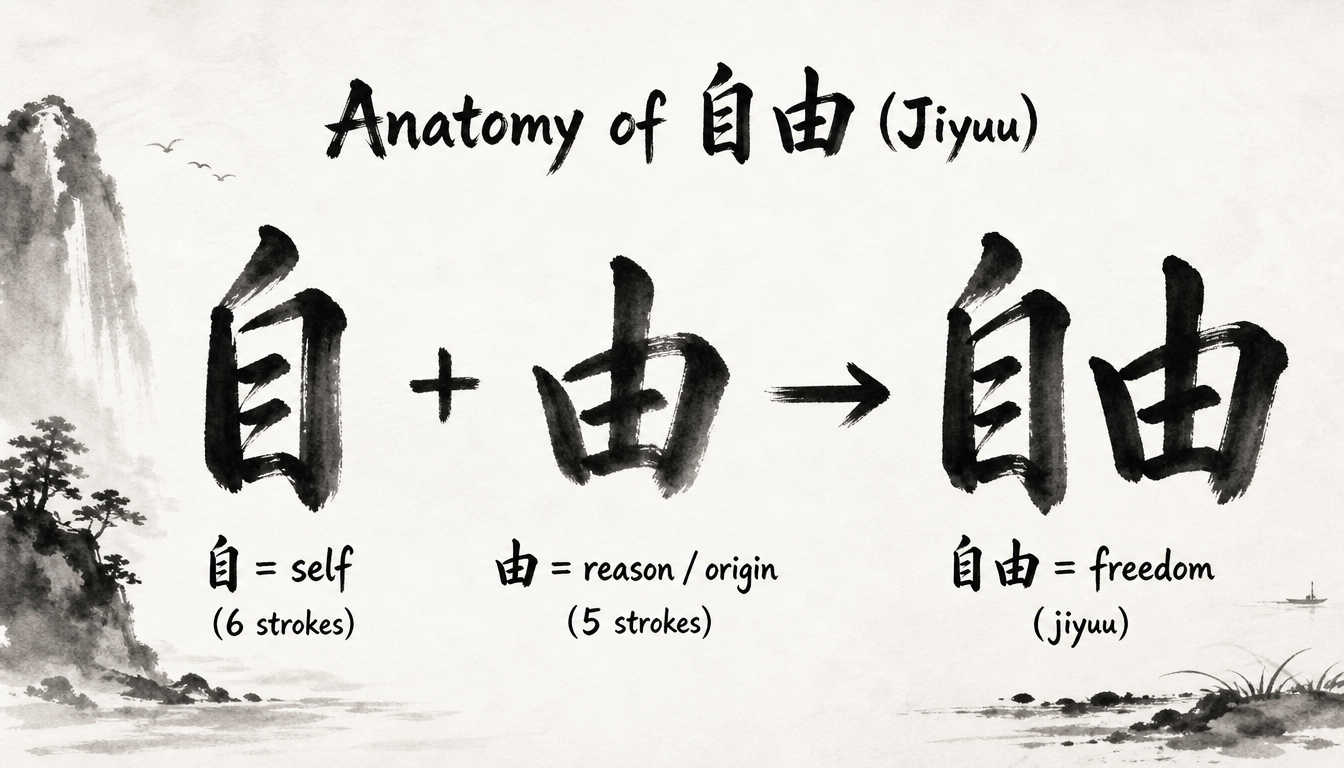
The strength of 自由 lives in its two halves. Each character stands on its own, and reading them separately reveals the quiet logic behind the word. The table below shows the breakdown of the kanji for freedom with stroke counts and readings from gyanmirai.com.
| Kanji | Meaning | Strokes | On'yomi | Kun'yomi |
|---|---|---|---|---|
| 自 | self, oneself | 6 | ji, shi | mizuka(ra) |
| 由 | reason, cause, origin | 5 | yuu, yu | yoshi, yo(ru) |
自 — the Self
自 originally pictured a nose. In East Asia the nose was long treated as the point people touch when referring to themselves, and that gesture carried into the character's meaning of "self" or "oneself." You still see 自 inside words about the personal and the automatic: 自分 (jibun, oneself), 自然 (shizen, nature, literally "of itself so"), and 自動 (jidou, automatic). The character always points inward, toward whatever acts from within.
由 — the Reason or Origin
由 carries the sense of a cause, a source, or a path something follows from. When you place "self" before "reason," the compound almost writes its own definition: to be free is to act from your own reasons. Freedom, in this reading, is not chaos. It is ownership of the source of your actions.
From Buddhist Term to Modern Ideal
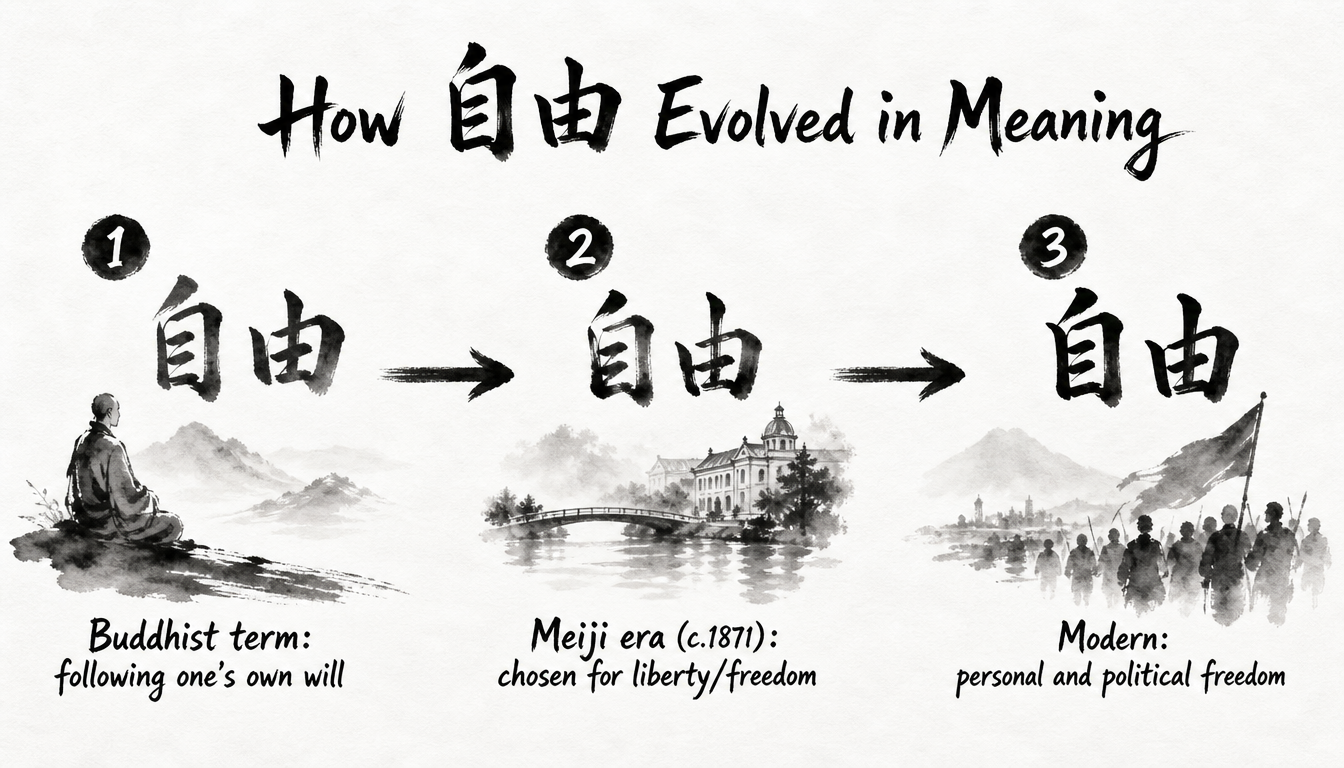
自由 has a history most people never suspect. It began as a Buddhist term meaning something close to "following one's own will," and in that older context the nuance leaned slightly negative, closer to self-indulgence than to political liberty, according to the translation-word dictionary Shaqai.
The modern meaning arrived during Japan's Meiji era, around 1871, when scholars searched for a Japanese equivalent to the Western concepts of "liberty" and "freedom," as Shaqai documents. The old Buddhist word was reborn as the language of individual rights and political freedom. In a single generation, 自由 shifted from a warning about willfulness into one of the defining ideals of a modernizing nation.
That layered past gives the character real depth. Eastern and Western thinkers have long read freedom differently. In much Confucian thought, for example, freedom means refusing to be either a slave to your own ego or a puppet of others, and seeking harmony between self and community. Western liberalism, in the tradition of thinkers like Mill and Berlin, tends to frame freedom as the absence of external restraint. 自由 has, over its history, held both.
When you choose 自由 today, you inherit all of these layers at once: the Buddhist root of acting from within, the Meiji rebirth as civil liberty, and the modern personal sense of living on your own terms.
Common Compounds and Related Words

Seeing 自由 inside larger words shows how flexible the idea is. The compounds below are common, everyday vocabulary, with readings and meanings drawn from gyanmirai.com and Jisho.
| Word | Romaji | Meaning |
|---|---|---|
| 自由人 | jiyuujin | a free spirit, an independent person |
| 不自由 | fujiyuu | lack of freedom, inconvenience |
| 自由意志 | jiyuuishi | free will |
| 言論の自由 | genron no jiyuu | freedom of speech |
Two of these deserve a closer look. 自由人 (jiyuujin) describes the person many tattoo seekers actually have in mind: someone who lives by their own compass. 不自由 (fujiyuu) is its shadow, formed by adding 不 (not) to the front, and it covers everything from political oppression to a physical limitation. Placing them side by side makes the value of freedom feel concrete rather than abstract.
自由 also belongs to a wider family of self-centered characters worth exploring. If this idea speaks to you, the same emotional territory is covered by 自 (self), 自然 (nature), and the closely linked notions of strength and the heart.
Why 自由 Speaks to Self-Discovery
Choosing the kanji for freedom as a personal symbol says something specific about you. It signals that you measure your life by your own reasons, the 由 in the word, rather than by external approval. That is why it resonates with people at a crossroads: leaving a job, moving abroad, healing from a controlling relationship, or simply deciding to live more deliberately.
There is a philosophical thread here too. Japanese thinkers have long written about the "true self," the idea that our deepest identity lies beneath the roles and masks we perform. Scholars describe this true self as our most authentic reality, and 自由 sits close to it: to be free is to let that inner self act without obstruction. For anyone drawn to Eastern philosophy or mindfulness, the character offers a compact way to carry that intention.
This is also where accuracy matters. A cheap online converter can hand you a character that looks close but carries the wrong nuance, or pair it with a compound that reads oddly to a native speaker. The whole point of a soul kanji is that it resonates in Japan as beautiful and true, not as a mistranslation. Oracle Kanji Writer was built for that: it matches a personalized "Soul Kanji" to your name, birthdate, and inner qualities, then explains the reading, the layered meanings, and the compounds that give it context, so the character you carry actually means what you think it means.
Using 自由 as a Tattoo or Keepsake
Visually, 自由 balances well. The two characters are close in stroke count, six and five, so neither overwhelms the other, and the pair sits cleanly in a vertical column or a horizontal line. A few practical notes for anyone planning ink or art:
- Confirm the stroke order and the final brushed form with a native source before committing. Small errors change the shape.
- Never mirror or rotate the characters to fit a design. A flipped kanji reads as a mistake in Japan.
- Consider whether you want the crisp printed form or a flowing calligraphic brush style, which carries more warmth and movement.
FAQ
What is the kanji for freedom?
The kanji for freedom is 自由, read jiyuu (じゆう). It combines 自 (self) and 由 (reason or origin), and functions as both a noun and a na-adjective meaning freedom or liberty, according to Jisho.
What is the Japanese word for liberty?
Japanese uses the same word, 自由 (jiyuu), for both "freedom" and "liberty." English sometimes separates the two, using "liberty" for freedom within a framework of shared rights, but Japanese folds both senses into 自由.
Is 自由 a good choice for a tattoo?
Yes. 自由 is the standard, natural way to write freedom in Japanese, its two characters are visually balanced, and its meaning reads as dignified rather than slangy. Confirm the exact brushed form with a reliable source, and avoid mirroring the characters.
Conclusion
自由 rewards a second look, and the more you learn about it, the more meaningful it becomes as a personal symbol.
- Meaning: 自由 (jiyuu) means freedom and liberty, joining 自 (self) and 由 (reason).
- Structure: 自 is six strokes, 由 is five, and together they say "to act from your own reasons."
- History: the word began as a Buddhist term and was reborn during the Meiji era as the language of civil liberty.
- Compounds: 自由人 (free spirit), 不自由 (lack of freedom), and 自由意志 (free will) expand its range.
- Personal use: it suits anyone marking a turn toward living on their own terms.
If 自由 resonates, take the time to get it right. The kanji for freedom deserves an accurate reading and an authentic form, and discovering the character that truly reflects your inner self, with the cultural context behind it, is what a service like Oracle Kanji Writer exists to help you do.
Discover Your Soul Kanji
Experience the depth of Japanese characters: each kanji carries timeless meaning, guiding your life's path.
No credit card required • 2-minute process