Kanji of the Day Vol.56 | "Kanji 平 (Hira): The Kanji for Peace Leveling Your Soul's Serene Balance"

Meet 平 (hei / taira), the kanji for peace that means even, flat, and calm. This Kanji of the Day guide unpacks its readings, five-stroke writing order, everyday compounds, and how it differs from 和 (harmony), so you can choose it with confidence for art, a tattoo, or personal symbolism.
Kanji 平 (Hira): The Kanji for Peace Leveling Your Soul's Serene Balance
The kanji for peace 平 carries the quiet confidence of a still lake at dawn. It means level, flat, even, and calm, and it belongs to anyone who values steadiness over drama, fairness over favoritism, and inner composure over noise. This is Vol.56 of our Kanji of the Day series, and 平 is a character that rewards a slow look: its simple shape hides a philosophy of balance that runs deep through Japanese thought.
平, read hei or taira, defines peace as a state of evenness rather than mere absence of conflict. When nothing tips too high or sinks too low, calm follows naturally.
Discover Your Soul Kanji
Experience the depth of Japanese characters: each kanji carries timeless meaning, guiding your life's path.
No credit card required • 2-minute process
What the Kanji for Peace 平 Actually Means
At its surface, 平 describes something flat and level. A horizon, a still pond, an unbowed road. From that physical evenness, the character extends into the emotional and social realms: composure, fairness, and peace itself. The logic is intuitive. A mind that stays level does not swing into panic or elation. A society where things are level treats people with equal weight.
This is why 平 shows up in words for weekdays (ordinary, unremarkable days), for calmness under pressure, and for impartial justice. The kanji frames peace not as a fragile ceasefire but as a durable equilibrium, the quiet that remains when nothing is pulling you off balance.
| Item | Detail |
|---|---|
| Kanji | 平 |
| Readings (On / Kun) | ヘイ (hei), ビョウ (byou) / たい(ら) taira, ひら hira |
| Core meanings | even, flat, level, peace, calm |
| Category | Common-use kanji, JLPT N3 |
| Related concepts | 和 (harmony), 安 (safety/ease), 静 (stillness) |
| Frequency | Among the most common kanji in Japanese newspapers |
The kanji 平 ranks among the top 2,500 most frequently used characters in Japanese newspapers, so it is a genuinely everyday word rather than a rare literary flourish (Kanjicards.org).
Peace in 平 is structural, not sentimental. It is the calm of a surface that has found its level, which is why the same character serves both a carpenter checking a beam and a person keeping their cool.
References: Kanjicards.org
Readings and Pronunciations of 平 (hei, byou, taira, hira)
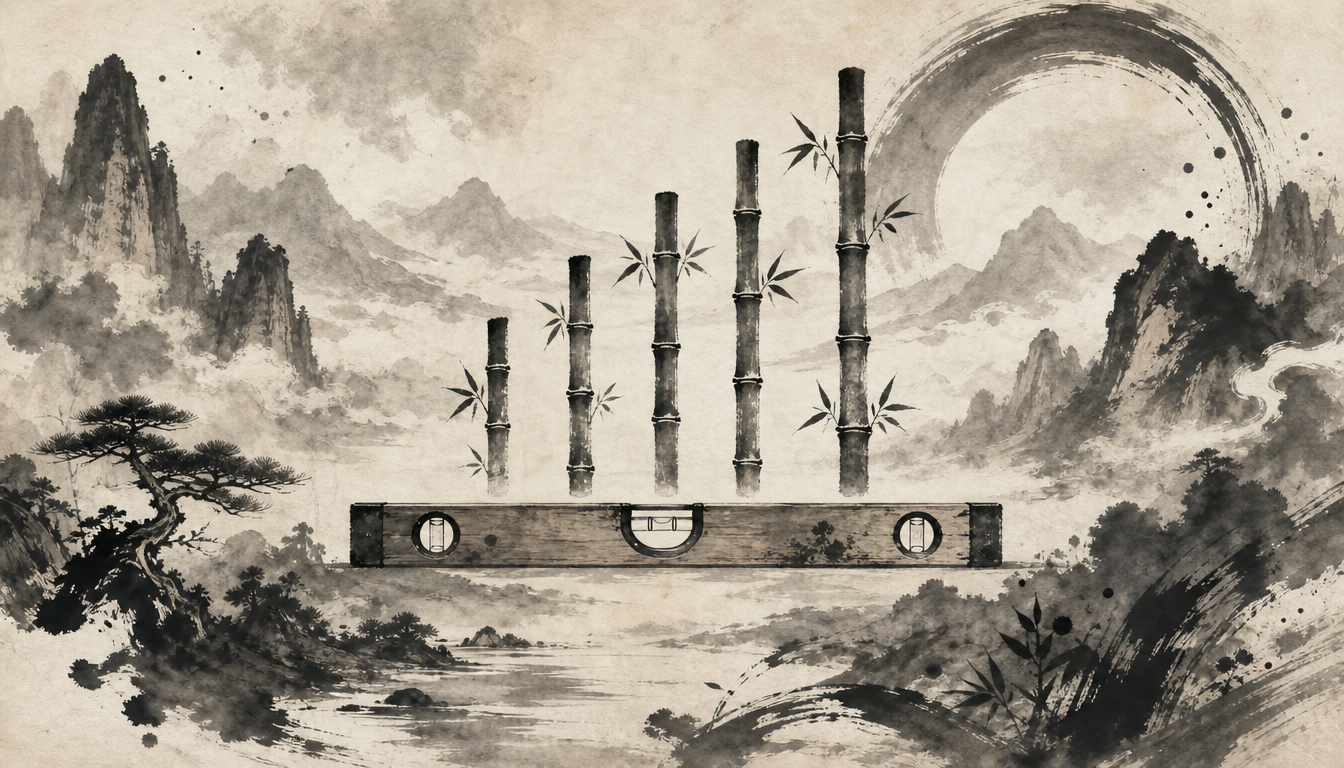
平 carries several readings, and knowing which to use is the difference between sounding natural and sounding like a machine translation. According to JLPTsensei, the character reads ヘイ (hei) and ビョウ (byou) in its on'yomi (Chinese-derived) forms, and たいら (taira) or ひら (hira) in its kun'yomi (native Japanese) forms.
The diagram below breaks down when each reading tends to appear.
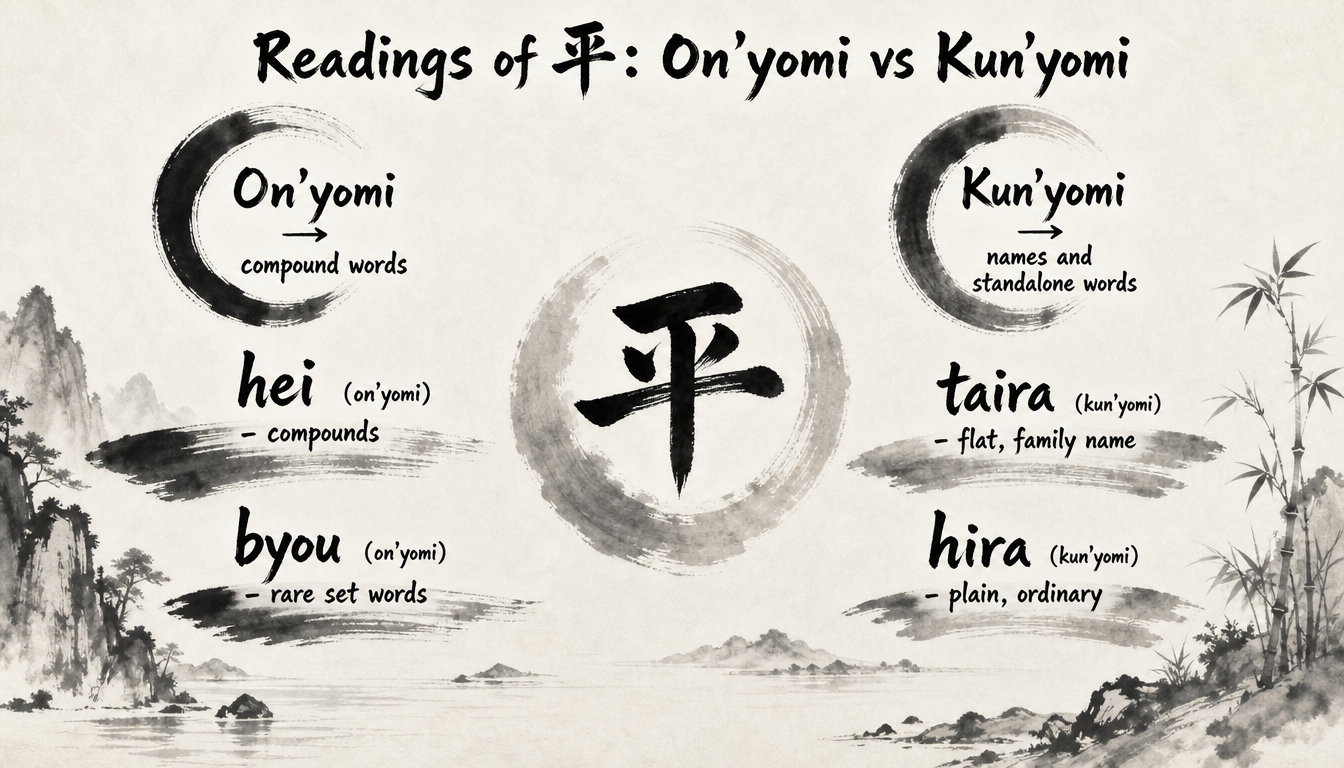
- hei — the workhorse on'yomi, found in most compound words such as those for weekday and calmness.
- byou — a rarer on'yomi, surviving in a handful of set words.
- taira — the kun'yomi meaning flat or level; also a well-known family name.
- hira — a kun'yomi prefix suggesting plain, ordinary, or flat, as in everyday objects.
In classic Japanese literature the reading also lives inside personal names. In Shimada Seijiro's novel Chijo, hosted on Aozora Bunko, the protagonist is named 平一郎 (Heiichiro), a reminder that 平 has long felt at home in a person's identity.
Here on'yomi dominates compounds while kun'yomi carries names and standalone words, a pattern that holds across most kanji.
References: JLPTsensei, Aozora Bunko
Stroke Order and Writing 平
平 is built from five strokes, and its symmetry is part of its charm. Writing it well means honoring the balance the character stands for. Rush it and it leans; take your time and it settles.
The general sequence follows the standard top-to-bottom, left-to-right logic of kanji calligraphy:
- Begin with the short horizontal stroke near the top.
- Add the pair of small strokes beneath it, left then right, like two small wings.
- Draw the long horizontal stroke that spans the width and gives the character its level footing.
- Finish with the central vertical stroke that drops straight down through the middle.
That final vertical is the visual anchor. It bisects the wide horizontal, and the whole character rests on that intersection like a scale finding equilibrium. When you write 平, you are drawing a small diagram of balance itself.
For tattoo or brush-art planning, confirm the stroke order against a reliable reference and never mirror the character. A flipped 平 loses its steady symmetry and reads as an error to Japanese eyes.
平 Versus 和: Two Faces of Japanese Peace
English collapses many ideas into the single word peace, but Japanese draws finer lines. The most important distinction for anyone choosing a kanji for peace is between 平 and 和.
和 (wa) means harmony, the peace of many parts fitting together: people, sounds, flavors, a society. It is relational and warm. 平 (hei) means the peace of evenness, of a surface with no bumps and a mind with no turbulence. It is structural and cool. Both are beautiful, and they often team up in the compound for peace that combines them, but they answer different questions. 和 asks whether things blend. 平 asks whether things are level.
| Aspect | 平 (hei / taira) | 和 (wa) |
|---|---|---|
| Core idea | Evenness, level, calm | Harmony, blending together |
| Feeling | Steady, composed, cool | Warm, cooperative, social |
| Peace it describes | Inner balance, fairness | Relationships in accord |
| Best for someone who values | Composure and impartiality | Connection and togetherness |
Choosing between them is a small act of self-knowledge. If your peace comes from staying centered no matter what surrounds you, 平 is your character. If it comes from bringing people and things into accord, 和 may fit you better. This is where a tool like Oracle Kanji Writer earns its place: rather than guessing, you can discover a personalized Soul Kanji matched to your name, birthdate, and inner qualities, complete with pronunciation, nuanced meanings, and hand-picked compounds so the character resonates authentically in Japan.
Common Compounds and Everyday Uses of 平
Seeing 平 inside real words shows how flexibly it moves between the physical and the emotional. The following jukugo all appear in everyday Japanese, drawn from JLPTsensei.
- 平日 (heijitsu) — weekday, ordinary days. The evenness of a routine, unremarkable day.
- 平気 (heiki) — coolness, composure. Being untroubled, keeping level under pressure.
- 公平 (kouhei) — fairness, impartiality. Treating every side with equal weight.
- 水平 (suihei) — horizontal, level. The literal flatness from which the abstract meanings grow.
Read together, these words map the character's range. From a flat horizon (水平) to a fair judgment (公平) to a calm heart (平気), 平 keeps returning to the same idea: nothing tipped, nothing exaggerated, everything at rest on its level.
References: JLPTsensei
Choosing 平 as a Personal Symbol or Tattoo
As body art or a keepsake, 平 offers a rare gift: visual calm. Its symmetry sits well on skin, and its five strokes stay legible even at small sizes, unlike denser characters that blur into a smudge. A vertical placement along the forearm or spine lets the central stroke run true, echoing the balance it represents.
The meaning suits people who define themselves by composure. Someone who stays level when others panic, who prizes fairness, who finds peace in stillness rather than stimulation. Pairing 平 with 和 makes a quiet statement about harmony and balance together, while pairing it with 心 (heart, mind) leans into inner calm.
Cheap online converters often distort proportions or flip characters. Before committing 平 to skin, verify the stroke order and orientation against a trustworthy source, and check that the font's balance honors the character's natural symmetry.
FAQ
What is the Japanese kanji for peaceful?
平 is a leading choice, carrying the sense of calm, level, and even. It describes a peaceful state of composure and balance. The related character 和 conveys peaceful harmony between people, so the best fit depends on whether you mean inner calm (平) or relational accord (和).
What is the kanji for peace and love?
There is no single kanji that means both at once. A common approach pairs a peace character such as 平 or 和 with 愛 (ai), the kanji for love. Together they express a wish for calm and affection, a pairing often seen in personal mottos and art.
What does 平 mean in Japanese?
平 means even, flat, level, calm, and peace. It read hei or byou in on'yomi and taira or hira in kun'yomi. The through-line across all its uses is balance: a surface, a judgment, or a mind that rests at its natural level.
Bringing 平 Into Your Own Life
The kanji for peace 平 offers more than a pretty shape. It offers a practice: to seek the level in whatever tips you, and to hold it. Here is what to carry away:
- 平 (hei / taira) means even, flat, level, and calm, framing peace as balance rather than the mere absence of conflict.
- Its readings split cleanly: on'yomi (hei, byou) for compounds, kun'yomi (taira, hira) for names and standalone words.
- Five symmetrical strokes make it elegant and legible, ideal for calligraphy or a tattoo, as long as you confirm stroke order and avoid mirroring.
- 平 differs from 和: one is the peace of evenness, the other the peace of harmony.
- To find the character that truly matches your spirit, explore a personalized diagnosis with Oracle Kanji Writer and let an authentic Soul Kanji reflect your own path to peace.
Discover Your Soul Kanji
Experience the depth of Japanese characters: each kanji carries timeless meaning, guiding your life's path.
No credit card required • 2-minute process