Kanji of the Day Vol.50 | "Kanji 花 vs 華 (Hana): The Flower Kanji Variants Revealing Your Soul's Bloom"

花 and 華 both read hana and both mean flower, yet they carry very different souls. This guide breaks down the meaning, nuance, and usage of the two hana kanji variants, showing which suits your name, your tattoo, and your inner bloom, so you never fall for a cheap converter's mistranslation.
Kanji 花 vs 華 (Hana): The Flower Kanji Variants Revealing Your Soul's Bloom
If you want a flower kanji that feels timeless, quietly universal, and instantly readable to any Japanese person, choose 花. If you want something more dressed up, ornate, and dramatic, with the weight of splendor behind it, choose 華. Both read as hana, both mean flower, and both belong to the same emotional family, yet the two hana kanji variants carry very different souls. This guide walks through the nuance, the usage, and the choice that matters most for names and tattoos.
For anyone shopping for a meaningful character, the gap between 花 and 華 is exactly the kind of detail cheap converters miss. Getting it right changes how your kanji lands in Japan.
Discover Your Soul Kanji
Experience the depth of Japanese characters: each kanji carries timeless meaning, guiding your life's path.
No credit card required • 2-minute process
花 vs 華: The Two Hana Kanji Variants at a Glance
Both characters answer to hana, and both point to the same botanical image, a bloom. The difference lives in tone. The everyday word for a flower you buy at a shop, offer at a grave, or arrange in ikebana is written 花. The character 華 pulls toward the abstract: glamour, brilliance, ornament, the flourish of something in full glory.
Here is how they line up on the details that matter.
| 花 | 華 | |
|---|---|---|
| Reading (kun) | は-な (ha-na) | は-な (ha-na) |
| Core meaning | Flower, blossom, to bloom | Splendor, brilliance, ornament, flower |
| Tone | Everyday, universal | Elevated, dressed-up |
| JLPT / grade | Common, taught early (N5–N4 range) | Less common, higher level |
| Feel in a name | Simple, timeless | Ornate, glamorous |
According to the jōyō kanji list, 花 carries the kun-reading は-な and means "flower, flower-like, to bloom" (List of jōyō kanji). It sits among the first characters a Japanese child learns, which is part of why it feels so effortless and clear.
Meaning and Usage Differences Between 花 and 華
The distance between these two hana kanji variants opens up the moment you look past the shared translation.
花: The Everyday Bloom
花 is the flower you can touch. It appears in nearly every common word tied to actual blossoms. Think of it as the grounded, sensory character. It shows up in phrases like 花を供える (hana o sonaeru, to offer flowers at a grave) and 花を咲かせる (hana o sakaseru, to make something lively, literally to make flowers bloom). Jisho lists hundreds of common words built on 花, which tells you how deeply woven it is into daily Japanese (Jisho).
The character combines the grass radical 艹 on top, marking it as a plant, with a phonetic element below. That grass crown is a visual promise: this is something that grows, opens, and fades. 花 holds the full life cycle of a bloom, including its brevity, which is why it resonates so strongly with the Japanese appreciation of impermanence.
華: The Glorious Flourish
華 keeps the flower image but lifts it into the abstract. Where 花 is the blossom itself, 華 is the brilliance of a blossom, the dazzle, the ornament, the moment of peak radiance. It carries meanings like splendor and magnificence. You feel it in words such as 豪華 (gōka, luxurious, gorgeous) and 華麗 (karei, splendid, magnificent). There is even the expression 華を持たせる, letting someone take the credit or shine.
Visually, 華 is denser and more architectural. Its layered strokes read as decoration, as flourish. When Japanese people see 華 in a name, they register elegance and a certain theatrical beauty. It leans dressed-up rather than casual.
Quick rule of thumb: 花 is the flower you hold. 華 is the glow the flower gives off. One is the object, the other is the aura.
How to Write Hana: Kanji Variants in Names
When hana becomes a personal name, the choice of character shapes the whole impression. Japanese naming works this way for every name: the reading stays the same while the chosen kanji rewrites the meaning. Two girls both called Hana can carry entirely different symbolic weight depending on which flower kanji their parents picked.
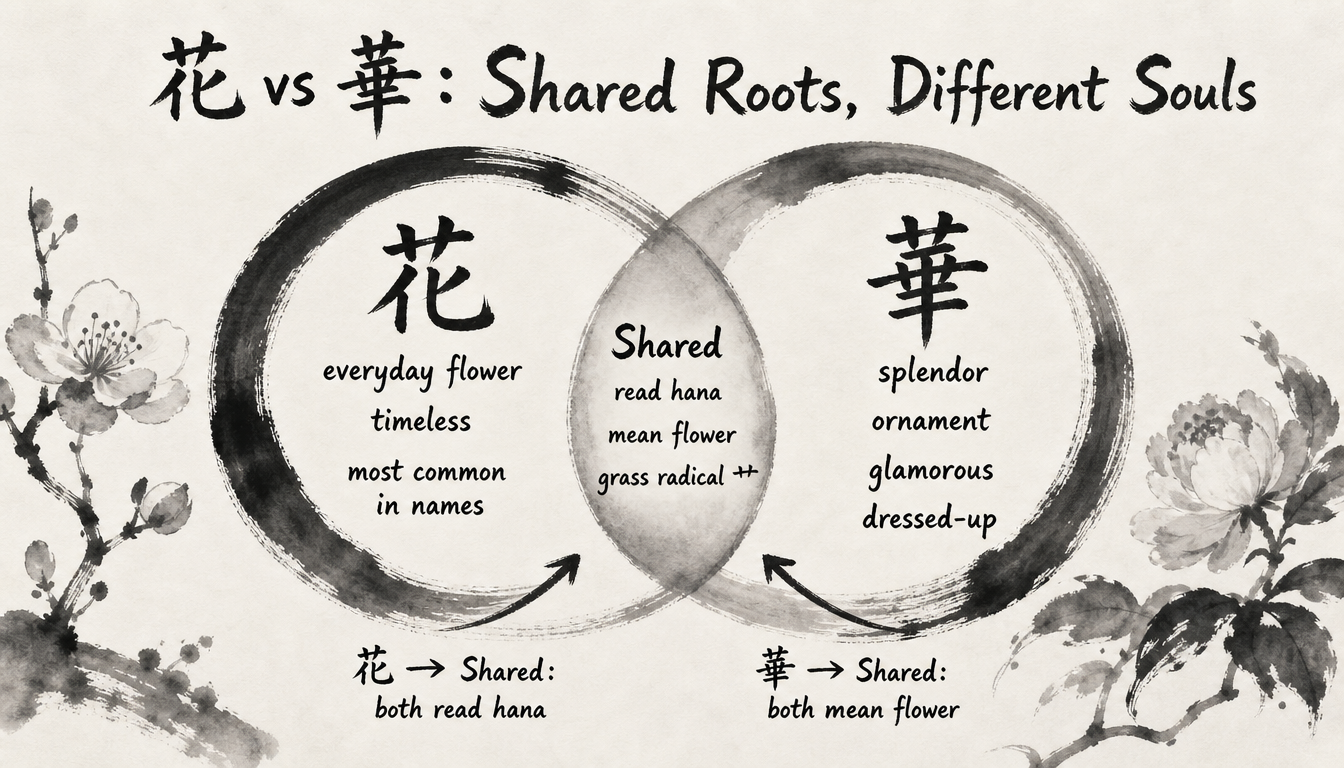
Between the two hana kanji variants, 花 is the far more common choice for names. In a database of Japanese girl names meaning flower, 花 appears in 3,044 names while 華 appears in 2,061 (Japanese Girl Names Meaning 'flower'). The single-kanji spelling 花 has a timeless, universal quality, while 華 leans toward splendor and ornament, a more decorative feel.
The diagram below maps how the two characters overlap and where they diverge.
Hana also frequently opens longer names as a first character. In Hanaka (はなか), for example, 花 pairs with a second character to shade the meaning. Common spellings include 花佳 (flower + excellent), 花賀 (flower + to celebrate), and 花夏 (flower + summer), with 花佳 the dominant form (Hanaka). The 花 opening reads as softly feminine and modern, one of the most popular building blocks in contemporary Japanese girls' naming.
Which Variant Suits You?
The table below sums up the choice by intention.
| You want... | Choose | Why |
|---|---|---|
| Timeless, universal, instantly readable | 花 | The everyday flower; clean and universally understood |
| Elegance, glamour, a dressed-up feel | 華 | Splendor and ornament; theatrical beauty |
| A name that feels soft and modern | 花 | The most popular flower element in girls' names |
| A bold, decorative statement | 華 | Denser strokes, stronger visual flourish |
| A tattoo people won't misread | 花 | Simpler form, lower risk of stroke errors |
Choosing Your Flower Kanji for a Tattoo or Personal Symbol
For body art and personal symbols, the two hana kanji variants ask different questions of you.
花 rewards restraint. Its seven-stroke form is balanced and legible, and it carries the beloved theme of impermanence, the beauty that blooms and fades. That makes it a natural fit for anyone drawn to mindfulness, mono no aware, or the quiet acceptance of change. It also pairs gracefully with other single characters. If you love the cherry-blossom association, 花 sits comfortably near ideas of renewal and gentle strength.
華 is the choice for a statement. The denser architecture reads as glamour and vitality, so it suits people who want their symbol to project brilliance, celebration, and a life lived in full color. The trade-off is complexity: more strokes mean more chances for a tattoo artist to distort the form. Always confirm stroke order with a native reference, and never mirror or rotate the character.
Before any flower kanji goes on skin, verify the exact form with a trusted Japanese source. A misplaced stroke can turn 花 or 華 into something unintended, and cheap converters rarely catch it.
This is where meaning-first curation matters. Oracle Kanji Writer was built by Japanese creators who care about how a character actually lands in Japan, not just how it looks in a font. Its Personalized Soul Kanji Diagnosis takes your name, birthdate, and blood type and recommends a character aligned with your inner qualities, complete with pronunciation, layered meanings, a personal message, and hand-picked compound words for context. If flower is your theme, the tool helps you understand whether the grounded 花 or the radiant 華 truly reflects your bloom, so you avoid the clichés and mistranslations that plague generic converters.
What 花 and 華 Share
Whichever you choose, both hana kanji variants give you the same gifts. Both mean flower at their root. Both read as hana. Both wear the grass radical 艹, marking them as living, growing things. And both connect you to one of the most cherished images in Japanese art and poetry, the blossom as a symbol of beauty, renewal, and the tender fleetingness of life. Pick either, and you are holding a piece of that tradition.
FAQ
What is the kanji for hana?
The most common kanji for hana is 花, meaning flower or blossom, with the kun-reading は-な. A second variant, 華, also reads hana and means splendor or ornament. Both are valid, but 花 is the everyday word and the more frequent choice in names.
What are the 4 types of kanji?
Kanji are traditionally grouped by formation: pictographs (drawn from an object's shape), simple ideographs (abstract ideas like up and down), compound ideographs (two meanings joined), and phono-semantic characters (a meaning part plus a sound part). Both 花 and 華 fall into the phono-semantic and compound families, built around the grass radical.
Is Hana a rare name?
Hana is not rare. It is one of the most recognizable flower names in Japanese, precisely because it can be written so many ways. The more kanji variations a name has, the more common it tends to be, and hana offers several, with 花 leading by a wide margin.
Final Thoughts: Which Hana Kanji Is Yours?
The choice comes down to what you want your flower to say. Reach for 花 if you value the timeless, universal bloom, the flower you can hold, the one that carries impermanence and quiet grace. Reach for 華 if you want splendor, glamour, and a decorative flourish that projects brilliance. Both hana kanji variants share the same root, the same reading, and the same connection to one of Japan's most beloved symbols, so there is no wrong door, only the one that fits your soul's bloom. To find the character that mirrors your inner qualities with cultural accuracy, let a curated tool like Oracle Kanji Writer guide the way.
Discover Your Soul Kanji
Experience the depth of Japanese characters: each kanji carries timeless meaning, guiding your life's path.
No credit card required • 2-minute process