Kanji of the Day Vol.44 | "Kanji 地 (Chi): The Earth Kanji Grounding Your Soul's Stable Foundation"

The kanji 地 (chi) means earth, land, and ground, carrying deep symbolism of stability and foundation. Explore its readings, its place among the five elements, how it differs from 土 (tsuchi), and why it makes such a grounding personal or tattoo symbol for anyone drawn to elemental themes.
Kanji 地 (Chi): The Earth Kanji Grounding Your Soul's Stable Foundation
The kanji chi earth, written 地, is the character for earth, land, and the ground beneath your feet. It carries a sense of stability, vastness, and rootedness that has anchored Japanese thought for centuries. People drawn to grounding energy, elemental symbolism, and a calm sense of belonging often feel a quiet pull toward this character. If you want a personal symbol that speaks of steadiness and connection to the world, 地 is a compelling place to begin.
Below, we break down its meaning, readings, stroke logic, and philosophical weight, so you understand the kanji chi earth deeply enough to wear or share it with confidence.
Discover Your Soul Kanji
Experience the depth of Japanese characters: each kanji carries timeless meaning, guiding your life's path.
No credit card required • 2-minute process
What 地 (Chi) Means as the Kanji Chi Earth
At its core, 地 refers to earth as a whole: land, ground, territory, and the physical surface of our world. It suggests the wide plains and solid terrain that support all life, rather than a small handful of soil. This is the earth you stand on, travel across, and build a home upon.
The character reaches beyond the literal too. In everyday Japanese, 地 appears in words about regions, place, and even a person's true nature or the background texture of a story. That range gives it an emotional resonance of foundation, belonging, and the solid base from which everything grows.
Choosing 地 as a personal kanji signals a desire for stability, grounding, and a strong connection to the land and to your own roots.
Overview of the Kanji 地
| Item | Details |
|---|---|
| Kanji | 地 |
| On'yomi | chi, ji |
| Kun'yomi | (rarely used in native readings) |
| Primary meaning | Earth, ground, land, territory |
| Category | Elemental / natural symbolism |
| Related concepts | Stability, foundation, grounding |
The on'yomi reading chi derives from Middle Chinese, according to the Wiktionary entry for 地. This Chinese-rooted pronunciation is why you hear chi in so many compound words rather than a purely Japanese sound.
Chi (地) vs Tsuchi (土): Two Earth Kanji and Their Distinctions
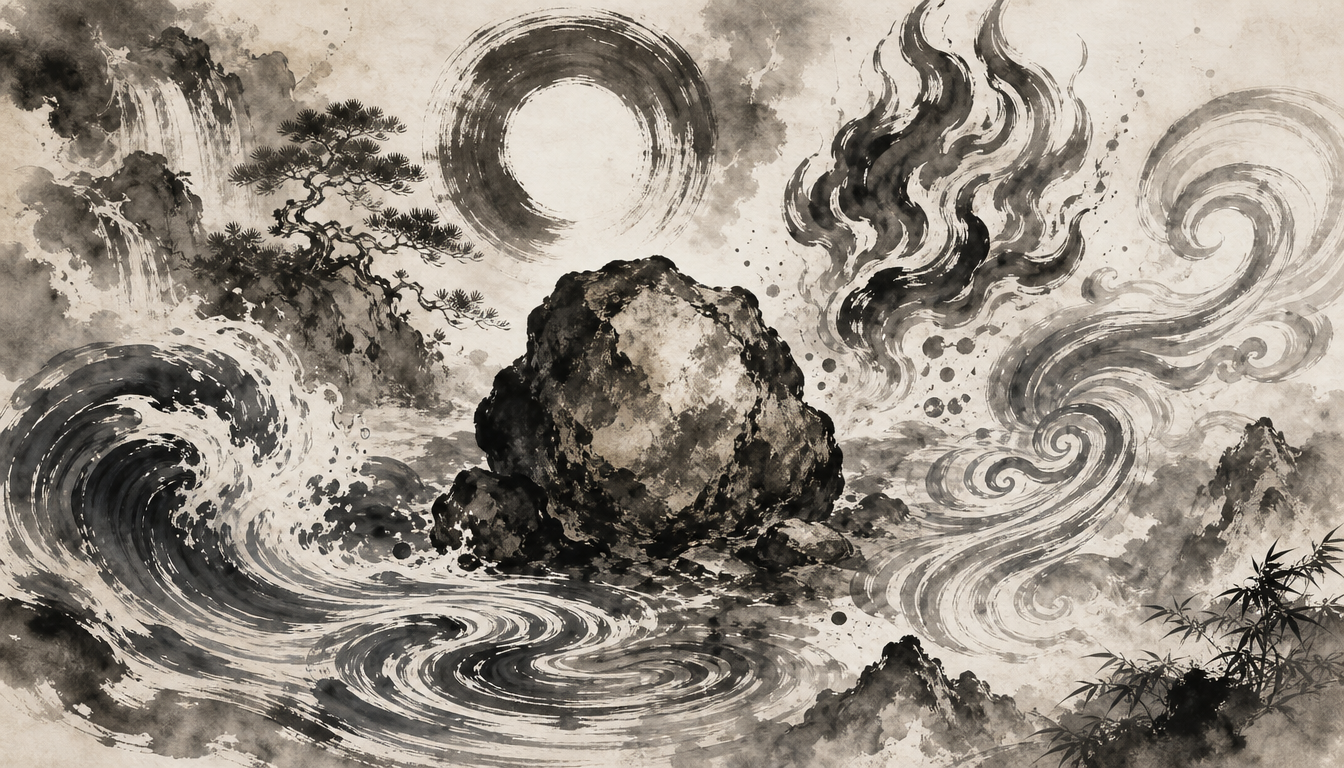
Japanese has two characters that both translate as "earth," and confusing them is one of the most common mistakes among newcomers to kanji. 地 (chi) and 土 (tsuchi) share a family resemblance, yet they point at different scales of the same idea.
地 speaks of the earth as a vast whole: land, ground, and territory. It leans toward balance, grounding energy, and a wide horizon. 土, by contrast, means the soil and dirt directly beneath us, the material that nourishes crops and cycles life through growth and decay. One is the planet you stand on, the other is the handful of earth you can hold.
The comparison below clarifies how each character carries its own texture of meaning.
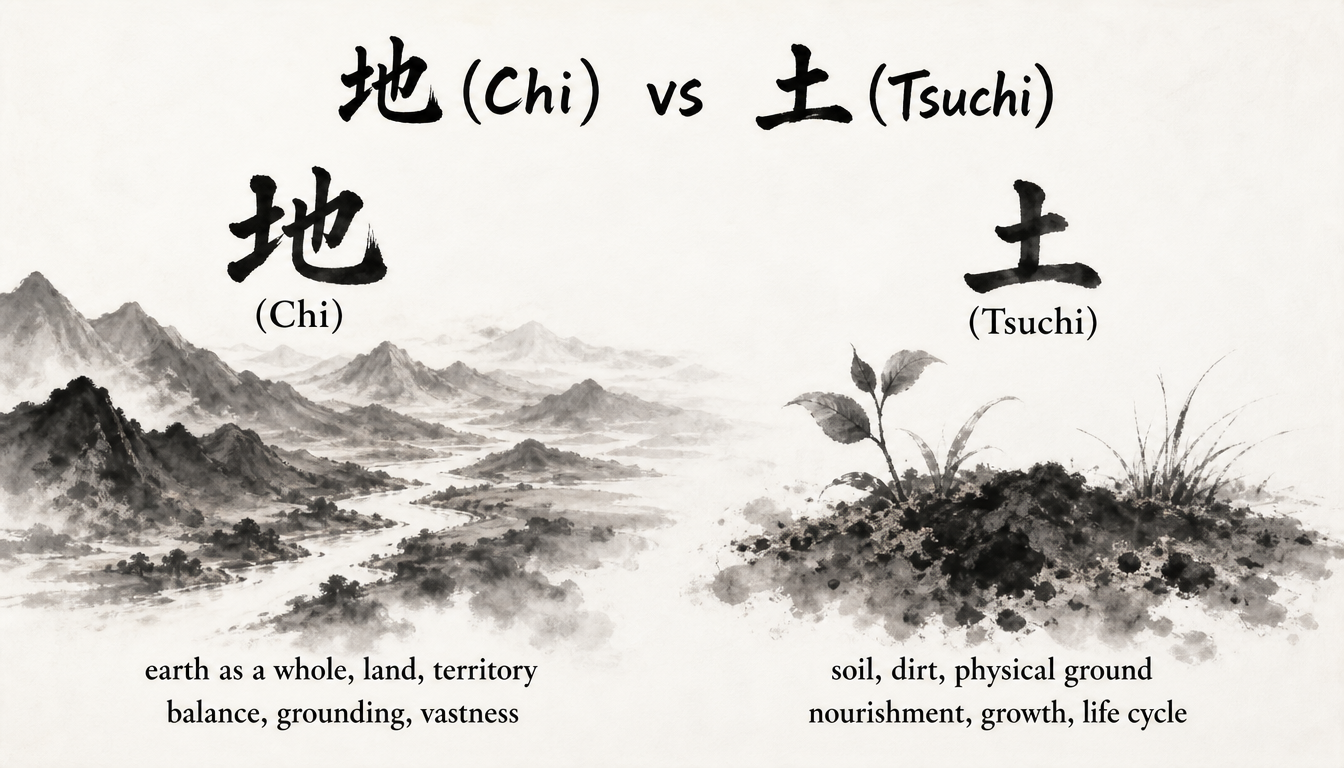
| Aspect | 地 (Chi) | 土 (Tsuchi) |
|---|---|---|
| Core meaning | Earth as a whole, land, territory | Soil, dirt, physical ground |
| Scale | Vast, expansive | Close, tangible |
| Emotional tone | Balance, grounding, vastness | Nourishment, growth, life cycle |
| Typical reading | chi / ji | tsuchi / do / to |
For a personal symbol, the choice matters. If you resonate with belonging, place, and a steady foundation, 地 fits. If you feel closer to growth, cultivation, and the raw material of life, 土 may speak to you instead. Both are beautiful, but they are not interchangeable, which is exactly the kind of nuance a tool like Oracle Kanji Writer exists to protect.
Chi (地) in the Five Elements (Godai) Philosophy
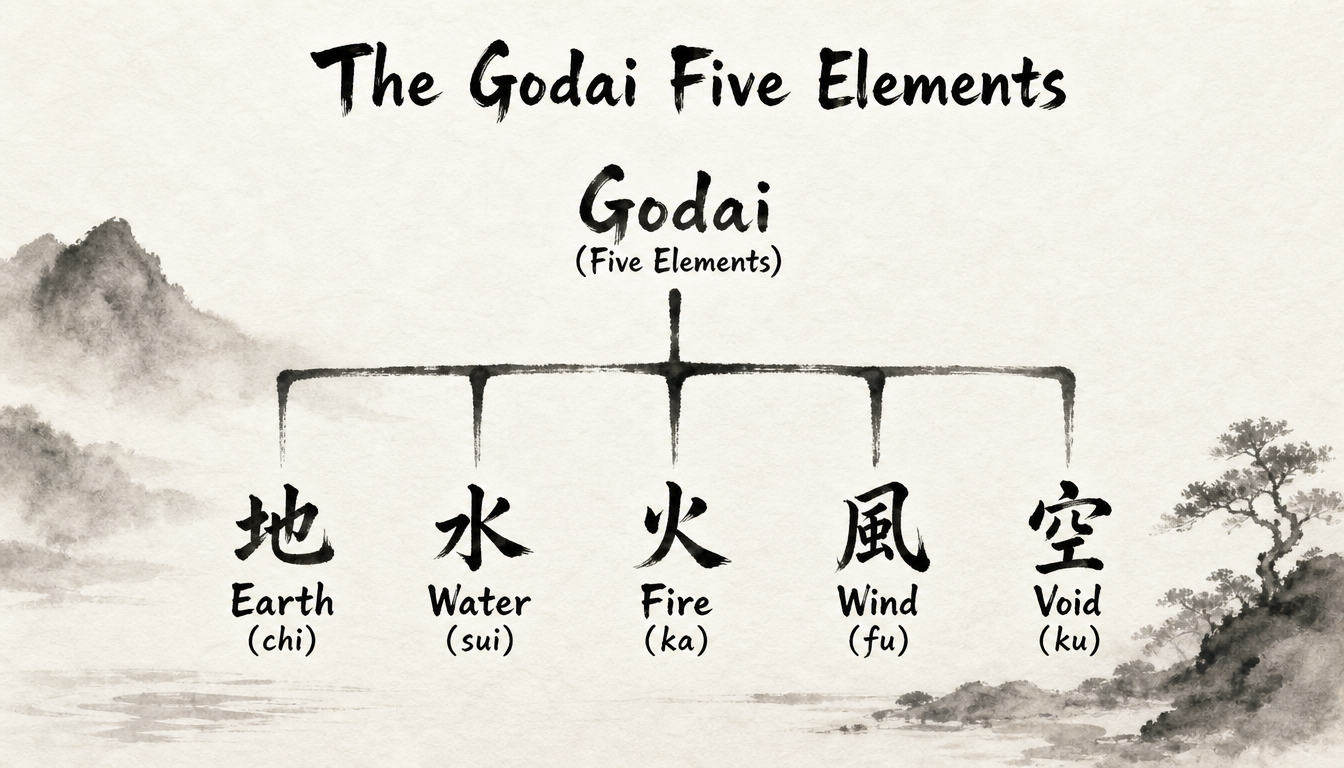
The kanji chi earth holds a formal place in Japanese Buddhist cosmology. According to the Godai (Japanese philosophy) tradition, 地 (chi) represents earth as one of the five great elements, the godai, alongside water (sui), fire (ka), wind (fu), and void (ku).
Within this system, earth is the element of solidity and resistance. It is what gives form its stability, the quality that keeps things from collapsing or drifting away. Where wind moves and fire transforms, earth holds steady. Meditators and practitioners have long associated 地 with the base of the body, a sense of being rooted, and the calm confidence that comes from a firm foundation.
The hierarchy of the godai shows where 地 sits among the elements.
In grounding and mindfulness practice, the earth element is invoked for stability. Choosing 地 can serve as a daily reminder to stay rooted and centered.
This philosophical depth is part of what makes 地 more than a dictionary word. When you wear or display the kanji chi earth, you connect to a lineage of thought that treats earth as the very principle of steadiness.
Readings, Stroke Order, and Real Compound Words
Understanding how 地 is read and written helps you use it accurately, whether in a tattoo, artwork, or a name-inspired symbol.
How the readings work
The dominant reading is the on'yomi chi, heard in most compound words. A second on'yomi, ji, appears in certain words, often carrying senses of "ground," "local area," or "texture" and "true nature." Which reading applies depends entirely on the word, so learning 地 through real compounds is the safest route.
Common compound words with 地
- 地球 (chikyū) — the Earth, the planet. Literally "earth-sphere," the word for our globe.
- 土地 (tochi) — land, plot of ground. Here 地 pairs with 土 to name a piece of real earth.
- 地下 (chika) — underground, below the ground.
- 地元 (jimoto) — one's local area or hometown, using the ji reading to evoke belonging.
- 地図 (chizu) — a map, literally "earth-diagram."
Notice how the readings shift between chi and ji. Getting the reading right is exactly where cheap converters fail. A character that looks correct can still be paired or pronounced wrongly, which is why context matters as much as the glyph itself.
Writing 地 with care
The kanji combines the "earth" radical (土) on the left with a component on the right. As with all kanji, the strokes follow a set order, generally moving from top to bottom and left to right. For any personal or tattoo use, confirm the stroke order from a reliable source and never mirror or rotate the character, since a flipped kanji reads as an obvious error to Japanese eyes.
Before committing 地 to ink, double-check the stroke order and orientation. A mirrored or malformed kanji instantly loses its meaning and beauty.
Symbolism and Choosing 地 as Your Soul Kanji
Selecting 地 as a personal symbol says something about who you are and what you value. It suggests a person who prizes steadiness over spectacle, who wants to feel rooted, and who draws strength from a firm foundation rather than restless motion.
Common misunderstandings are worth clearing up before you commit. Many assume 地 simply means "dirt," but that sense belongs more to 土. Others expect a native kun'yomi reading like "tsuchi" to attach to 地, when in practice the character lives through its on'yomi readings chi and ji. Understanding these distinctions keeps your symbol authentic.
This is where Oracle Kanji Writer, the Personalized Soul Kanji Diagnosis Tool, adds real value. Rather than picking a character at random, you enter your name, birthdate, and blood type, and a tailored algorithm recommends a kanji aligned with your inner qualities. Each result arrives with pronunciation, layered meanings, a personal message, and thoughtfully chosen compound words, all curated by Japanese creators who care about authenticity. For anyone drawn to grounding themes, the kanji chi earth might be the character that reflects your stable core, and the tool helps confirm it resonates correctly in Japan.
Whether 地 becomes wallpaper, a keepsake, or a tattoo design, the cultural explanations that come with it protect you from mistranslations and clichéd choices.
FAQ
What is the kanji for chi earth?
The kanji for chi earth is 地. It represents earth as a whole, including land, ground, and territory, and it is read chi as its main on'yomi, a reading derived from Middle Chinese. It carries connotations of stability, vastness, and grounding.
What is the kanji symbol for earth?
Japanese uses two kanji for earth: 地 (chi) and 土 (tsuchi). 地 means the earth as a whole, land and territory, while 土 means soil and dirt. For grounding, foundation, and belonging, 地 is the natural choice; for growth and cultivation, 土 fits better.
Is 地 part of the five elements?
Yes. In Japanese Buddhist philosophy, the godai or five great elements are earth, water, fire, wind, and void. 地 (chi) is the earth element, representing solidity, resistance, and the stable foundation that gives form its steadiness.
Bringing It All Together
The kanji chi earth is a quietly powerful character worth understanding before you claim it as your own.
- 地 (chi) means earth as a whole: land, ground, and territory, with a tone of stability and vastness.
- It differs from 土 (tsuchi), which means the physical soil and the cycle of growth.
- Its main reading, chi, comes from Middle Chinese, and it also reads ji in words like 地元 (jimoto).
- In the godai five-element philosophy, 地 stands for earth, the principle of solidity and grounding.
- Real compounds like 地球 (chikyū) and 地図 (chizu) show the character in living use.
If the themes of rootedness and foundation speak to you, the kanji chi earth may be the symbol that mirrors your spirit. Tools like Oracle Kanji Writer let you confirm that a character like 地 truly aligns with your inner nature, so your chosen kanji carries authentic, beautiful meaning wherever you display it.
Discover Your Soul Kanji
Experience the depth of Japanese characters: each kanji carries timeless meaning, guiding your life's path.
No credit card required • 2-minute process