Kanji of the Day Vol.54 | "Kanji 美 (Bi): The Beauty Kanji Revealing Your Soul's True Radiance"

美 is the clearest kanji for beauty in Japanese, joining the ancient signs for sheep and person. Explore its etymology, its readings ビ and うつくしい, its everyday compounds, and its deep roots in Japanese aesthetics like wabi-sabi, plus what choosing 美 says about you as a personal symbol or tattoo.
Kanji 美 (Bi): The Beauty Kanji Revealing Your Soul's True Radiance
The kanji for beauty, 美, holds one of the most beloved meanings in the Japanese writing system. It carries the idea of beauty, elegance, and a refined kind of grace that reaches beyond the surface. People who feel drawn to 美 often sense that beauty is a value worth living by, not a fleeting quality but a way of seeing the world. This character sits at the heart of Japanese aesthetics, and understanding it opens a door into how Japan itself thinks about what is beautiful.
In this Vol.54 of our Kanji of the Day series, we look closely at 美: where its form came from, how it is read, the compounds it appears in, and why it resonates so deeply with anyone searching for a meaningful personal symbol.

Discover Your Soul Kanji
Experience the depth of Japanese characters: each kanji carries timeless meaning, guiding your life's path.
No credit card required • 2-minute process
What 美 Means: A One-Line Definition
美 (Bi / utsukushii) means beauty, beautiful, elegance, and aesthetic refinement. It describes something made or seen with care, from a person's appearance to a work of art to the quiet order of nature.
| Item | Detail |
|---|---|
| Character | 美 |
| English meaning | Beauty, beautiful, elegance |
| On'yomi | ビ (bi), ミ (mi) |
| Kun'yomi | うつく.しい (utsuku.shii) |
| Stroke count | 9 |
| Category | Jōyō kanji, aesthetics vocabulary |
According to the Nihongo Master dictionary, 美 is read ビ and ミ in its on'yomi and うつく.しい in its kun'yomi, with 9 strokes and a core meaning of "beauty, beautiful" (Nihongo Master).
美 is the clearest single-character symbol for beauty in Japanese. It appears everywhere from the word for a beautiful person to the name of aesthetic philosophy itself.
References: (Nihongo Master)
Kanji Origins: The Sheep and the Person

The etymology of the kanji for beauty tells a story that surprises most people. 美 is built from two components: 羊, meaning sheep, sitting on top, and 大, meaning big or a person, underneath.
The diagram below breaks down how these two ancient parts combine into the modern character.
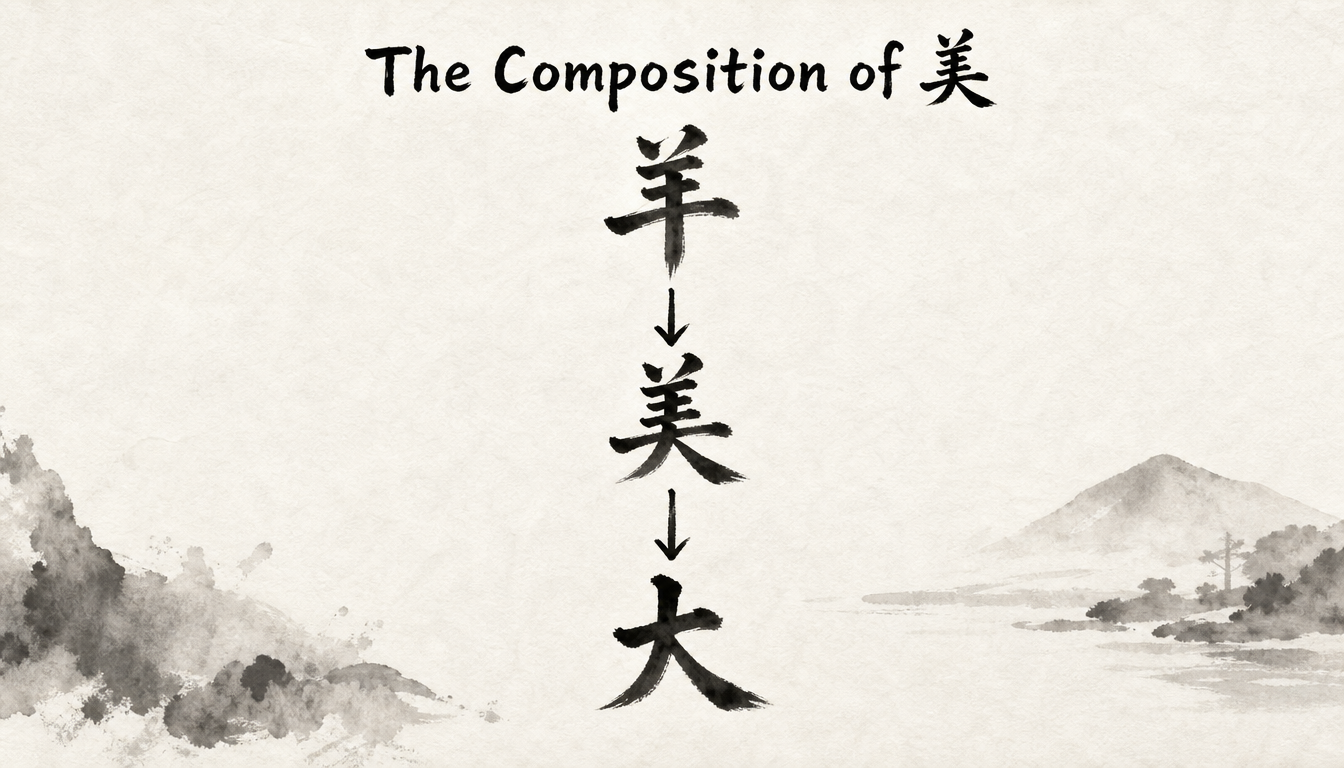
Scholars offer several readings of this pairing. One interpretation holds that a sheep (羊), admired for its pleasing appearance, combined with a person (大) produced the sense of "beautiful." Another sees a mature, large sheep (大) as an impressive, and therefore beautiful, sight. A third reading treats the whole shape as a single image of a sheep, complete with head and legs, that simply looked pretty in its early oracle-bone forms (Kanji Portraits).
Some sources trace the ancient pictograph to a person adorned with an elaborate feathered headdress, which emphasized decoration and display (My Kanji). What the interpretations share is a link between beauty and the living world, whether the animal that fed and clothed early communities or the person dressed for ceremony. The three oldest known forms survive in oracle bone, bronze ware, and seal script styles, showing how the character shifted while keeping its two-part core.
The sheep-plus-person origin is why 美 belongs to a family of characters containing 羊, several of which carry ideas of goodness, righteousness, and worth.
References: (Kanji Portraits), (My Kanji)
Readings and Pronunciations of 美
Like most kanji, 美 carries both Chinese-derived on'yomi and native Japanese kun'yomi readings, and each appears in a distinct context.
On'yomi: ビ and ミ
The on'yomi ビ (bi) and ミ (mi) show up mostly in compound words, the two-character combinations Japanese calls jukugo. When you see 美 joined to another kanji, expect the reading ビ in the vast majority of cases. The reading ミ is rarer and appears in a smaller set of words.
Kun'yomi: うつくしい
The kun'yomi うつく.しい (utsukushii) is the standalone adjective meaning "beautiful." You use it to describe a beautiful landscape, a beautiful piece of music, or a beautiful gesture. うつくしい carries a warmth and emotional weight that the compound readings rarely convey. Where ビ often names beauty as a concept or category, うつくしい lets you feel it directly.
| Reading type | Reading | Where it appears |
|---|---|---|
| On'yomi | ビ (bi) | Most compounds, e.g. 美人 |
| On'yomi | ミ (mi) | A smaller set of words |
| Kun'yomi | うつくしい (utsukushii) | Standalone adjective "beautiful" |
References: (Nihongo Master)
Compound Words and Everyday Use
美 appears in a wide range of common words, which is one reason it feels so alive in daily Japanese. Here are a few worth knowing.
- 美人 (bijin) — beautiful woman. The word once carried a broader meaning but now usually refers to women in modern Japanese (WaniKani).
- 美容院 (biyōin) — beauty salon. Built from 美 (beauty), 容 (appearance), and 院 (institution) (Kanji Damage).
- 美少年 (bishōnen) — a beautiful young man, a term with deep roots in Japanese literature and popular culture (Kanji Damage).
These examples reveal how flexible the kanji for beauty is. It can describe a person, a place, or an entire field of study. When you learn 美 through real vocabulary rather than as an isolated character, its personality comes through more clearly.
Learning a kanji alongside its common compounds and example sentences, complete with readings and audio, helps the meaning stick far better than memorizing the character alone.
References: (WaniKani), (Kanji Damage)
Beauty in Japanese Aesthetics and Philosophy
To choose 美 as a personal symbol is to align yourself with one of the richest traditions in Japanese thought. Japanese aesthetics rests on ancient ideals such as wabi, the transient and stark beauty of simple things, sabi, the beauty of natural aging and patina, and yūgen, a profound and subtle grace (Japanese aesthetics).
What sets this tradition apart is that beauty is treated as part of daily life rather than a distant ideal. In Zen-influenced thinking, beauty can appear in the mundane and the simple, and it takes a quiet mind and a cultivated eye to notice it (Japanese aesthetics). The philosophy of wabi-sabi celebrates the imperfect, the impermanent, and the incomplete, finding grace in a crack in a teacup or the fall of cherry blossoms (TOKI).
Seen this way, 美 is not about flawlessness. It points to a way of perceiving that honors nature, time, and care. Someone who resonates with the kanji for beauty often values attention, presence, and the quiet dignity of things done well.
Common Misunderstandings About 美
| Misconception | The reality |
|---|---|
| 美 only means physical or facial beauty | It covers elegance, refinement, art, and aesthetic feeling far beyond appearance |
| 美 and 綺麗 (kirei) are identical | 綺麗 leans toward "pretty, clean, tidy," while 美 carries a deeper, more formal sense of beauty |
| Beauty in Japan means perfection | Wabi-sabi finds beauty precisely in imperfection and impermanence |
References: (Japanese aesthetics), (TOKI)
Choosing 美 as a Personal Symbol or Tattoo
Because 美 speaks to both inner and outer beauty, it makes a resonant choice for a tattoo, a piece of art, or a personal emblem. Its nine strokes balance neatly, with the crossing lines of the upper element sitting above a grounded base, which gives it a stable, symmetrical look on skin or paper.
A few points worth keeping in mind before you commit to any kanji design:
- Confirm the stroke order and correct form with a reliable dictionary before finalizing artwork.
- Avoid mirrored or rotated versions, which can distort the character into something unrecognizable.
- Consider pairing 美 with a related character whose meaning complements yours, rather than picking a cliché combination.
This is where getting the meaning right matters most. A machine that swaps English letters for kanji can hand you something that looks Japanese but reads as nonsense to a native speaker. Oracle Kanji Writer approaches the problem differently. It offers a personalized Soul Kanji diagnosis, curated by Japanese creators who care about authenticity and aesthetics, so the character you receive resonates in Japan as genuinely beautiful and meaningful. Each result comes with pronunciation, layered meanings, a personal message, and carefully chosen compound words, along with cultural notes that steer you away from mistranslations and tired picks.
FAQ
What is the kanji for pretty?
The most common word for "pretty" in Japanese is 綺麗 (kirei), which suggests clean, tidy, and attractive. If you want a single character that captures beauty in a deeper, more refined sense, 美 (Bi / utsukushii) is the standard choice.
What is the most beautiful kanji?
Beauty is subjective, but 美 is often named the clearest and most fitting kanji to represent beauty itself. Its balanced nine-stroke form and its rich meaning of elegance and aesthetic refinement make it a favorite for personal symbols and art.
What is the kanji for beautiful woman?
The word for a beautiful woman is 美人 (bijin), which combines 美 (beauty) with 人 (person). Although it once had a broader meaning, in modern Japanese it generally refers to a woman (WaniKani).
Conclusion
美 rewards a closer look, revealing a character that carries both surface elegance and profound philosophical weight.
- 美 means beauty, elegance, and aesthetic refinement, read ビ or ミ in compounds and うつくしい as a standalone adjective.
- Its ancient form joins 羊 (sheep) and 大 (person or big), linking beauty to the living, ceremonial world.
- Common compounds include 美人 (beautiful woman), 美容院 (beauty salon), and 美少年 (beautiful young man).
- In Japanese aesthetics, beauty embraces imperfection and impermanence through ideals like wabi-sabi.
If 美 speaks to how you see the world, it may be one of several kanji that reflect your character. Exploring the kanji for beauty and the values it represents is a fitting first step toward discovering a personal Soul Kanji that captures your own inner radiance. To go further, look into related characters such as 雅 (elegance), 愛 (love), 光 (light), and 和 (harmony).
Discover Your Soul Kanji
Experience the depth of Japanese characters: each kanji carries timeless meaning, guiding your life's path.
No credit card required • 2-minute process