Japanese Proverbs (Kotowaza): 16 Sayings and the Kanji That Carry Them

Japanese proverbs, or kotowaza, compress centuries of observation into a handful of characters. This guide ranks 16 sayings by cultural authenticity, portability, kanji strength, and everyday usefulness, from ichi-go ichi-e to nana korobi ya oki. Each entry includes the reading, the core meaning, and the single character that best distills it, along with guidance on matching a proverb to your situation and choosing kanji that read beautifully in Japan rather than as a cliché.
Start Here: Three Japanese Proverbs Worth Carrying With You

If you only take three japanese proverbs away from this article, make them these: 一期一会 (ichi-go ichi-e), 七転び八起き (nana korobi ya oki), and 井の中の蛙大海を知らず (i no naka no kawazu taikai o shirazu). The first teaches presence, the second resilience, the third humility. Together they cover most of what a person needs to stay grounded.
Known in Japanese as ことわざ (kotowaza), these sayings compress centuries of observation into a handful of characters. Wikipedia's overview of Japanese proverbs notes that a kotowaza can take the form of a short saying (言い習わし, iinarawashi), an idiomatic phrase (慣用句, kan'yōku), or a four-character idiom (四字熟語, yojijukugo), and that a phrase only counts as a proverb if it expresses a common truth or wisdom rather than naming a mere thing.
I ranked the sixteen below on how well they travel. A proverb that needs three paragraphs of footnotes to land is a beautiful artifact, but it will not help you on a hard Tuesday.
References: Japanese proverbs - Wikipedia
Discover Your Soul Kanji
Experience the depth of Japanese characters: each kanji carries timeless meaning, guiding your life's path.
No credit card required • 2-minute process
How I Chose and Ranked These Sayings
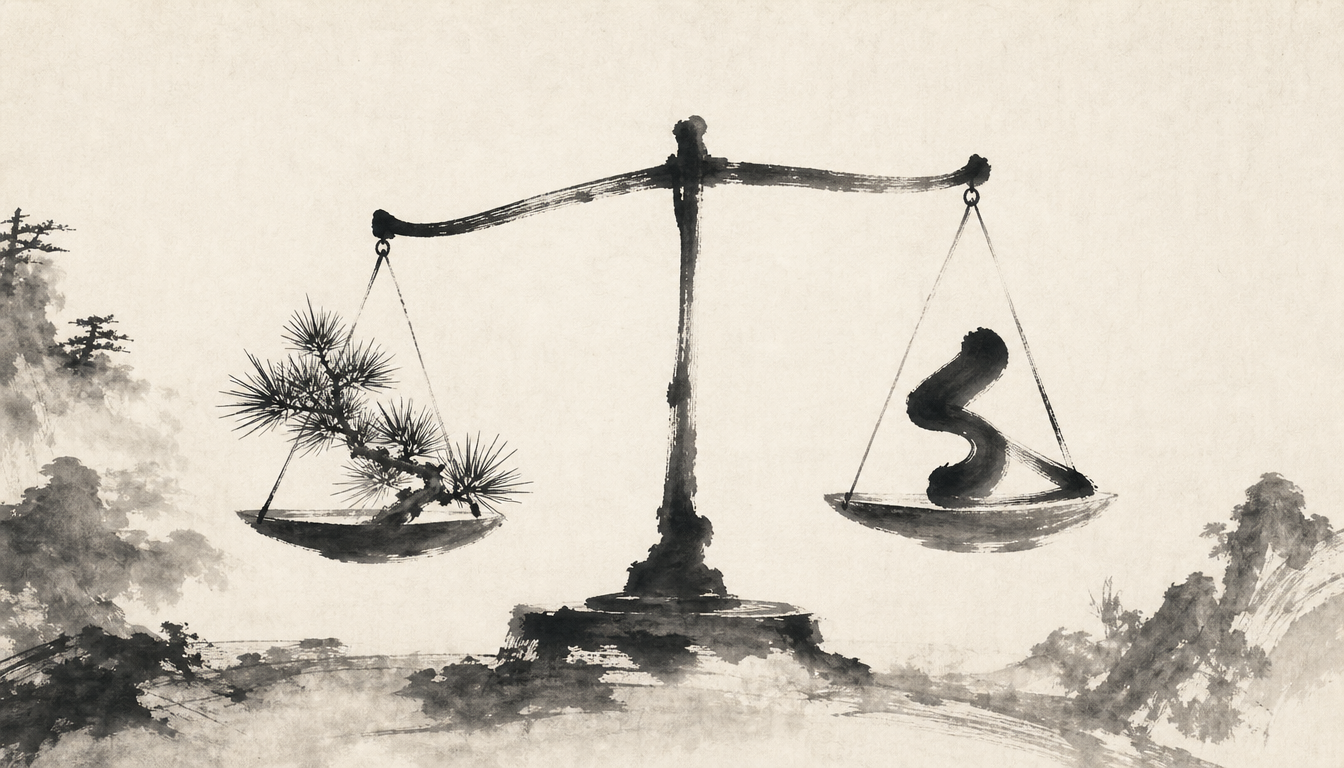
Four criteria did the work, weighted roughly as follows.
- Cultural authenticity (35%) — the saying is genuinely used or recognized in Japan, not invented for Western consumption.
- Portability of meaning (30%) — the wisdom survives translation without collapsing into cliché.
- Kanji strength (20%) — the characters themselves carry visual and semantic weight, which matters if you plan to write, print, or wear them.
- Everyday usefulness (15%) — you can apply it this week, not just admire it.
The kanji criterion deserves a note. A proverb is a sentence, and sentences do not always make good design objects. A single character or a four-character compound often carries the same idea with far more visual economy. The diagram below shows how the three main forms of kotowaza relate to one another.
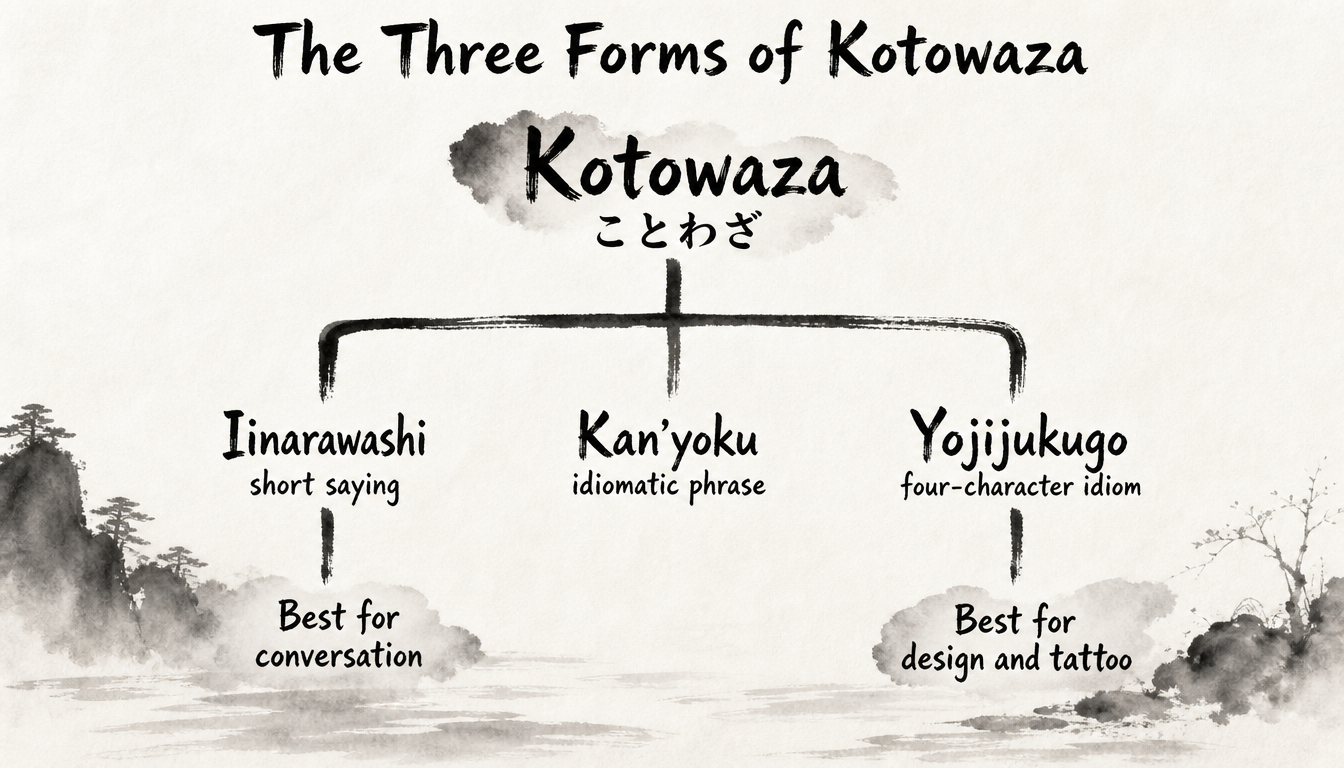
That distinction matters most to anyone planning a tattoo, a piece of calligraphy, or a print. The full proverb belongs in conversation; the condensed kanji belongs on skin or paper.
References: Yojijukugo - Wikipedia
All 16 Japanese Proverbs at a Glance
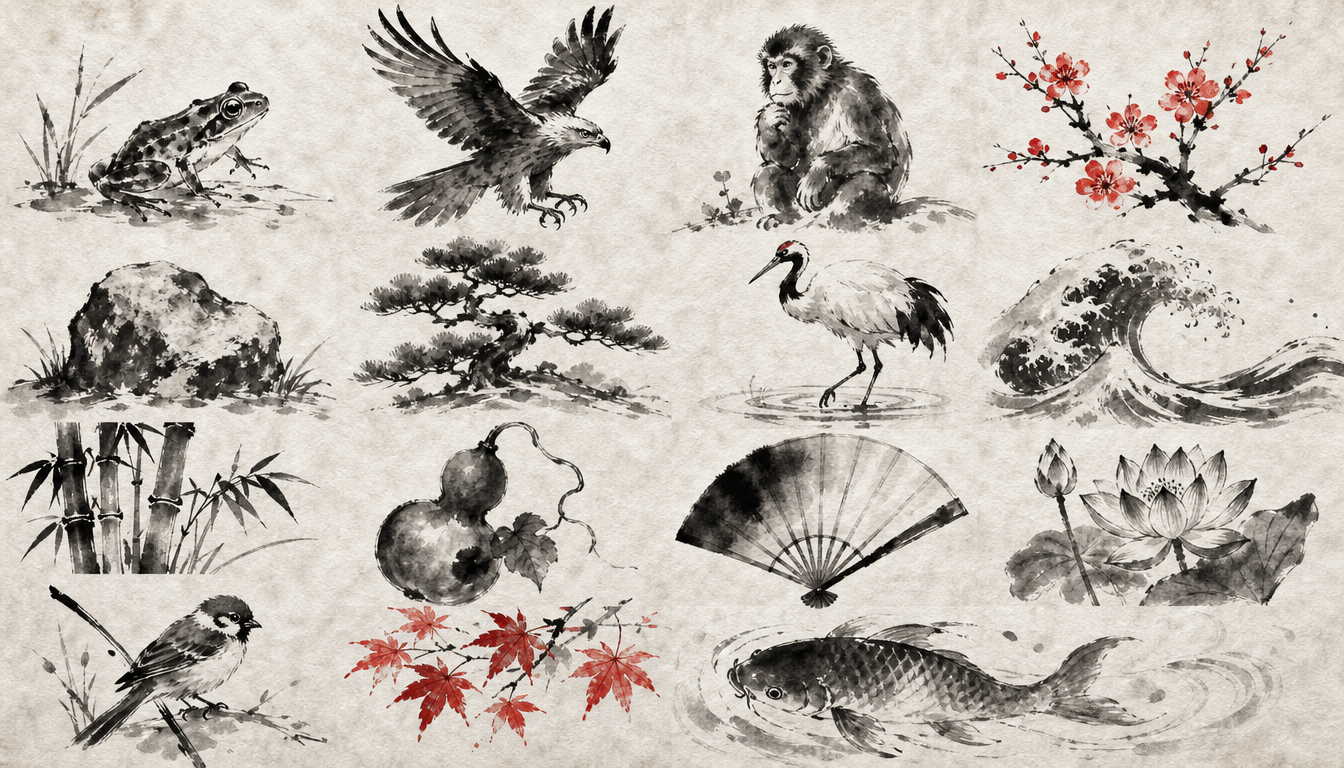
Each entry pairs the proverb with the single character or short compound I would recommend if you wanted to distill it into one visual mark.
| Proverb (Japanese) | Reading | Core meaning | Distilled kanji | Rating |
|---|---|---|---|---|
| 一期一会 | ichi-go ichi-e | One time, one meeting; treasure this moment | 一 / 会 | ★★★★★ |
| 七転び八起き | nana korobi ya oki | Fall seven times, rise eight | 起 | ★★★★★ |
| 井の中の蛙大海を知らず | i no naka no kawazu taikai o shirazu | The frog in the well knows nothing of the ocean | 海 | ★★★★★ |
| 花は桜木人は武士 | hana wa sakuragi hito wa bushi | Among blossoms, the cherry; among men, the warrior | 桜 / 武 | ★★★★☆ |
| 継続は力なり | keizoku wa chikara nari | Persistence becomes strength | 継 / 力 | ★★★★★ |
| 猿も木から落ちる | saru mo ki kara ochiru | Even monkeys fall from trees | 謙 | ★★★★☆ |
| 出る杭は打たれる | deru kui wa utareru | The stake that sticks out gets hammered | 和 | ★★★☆☆ |
| 案ずるより産むが易し | anzuru yori umu ga yasushi | Doing is easier than worrying | 行 | ★★★★☆ |
| 石の上にも三年 | ishi no ue ni mo san nen | Three years on a stone warms it | 忍 | ★★★★★ |
| 一石二鳥 | isseki nichō | One stone, two birds | 効 | ★★★☆☆ |
| 十人十色 | jūnin toiro | Ten people, ten colors | 色 | ★★★★☆ |
| 能ある鷹は爪を隠す | nō aru taka wa tsume o kakusu | The skilled hawk hides its talons | 鷹 / 隠 | ★★★★☆ |
| 知らぬが仏 | shiranu ga hotoke | Not knowing is Buddha; ignorance is bliss | 仏 | ★★★☆☆ |
| 急がば回れ | isogaba maware | If you hurry, go around | 道 | ★★★★☆ |
| 初心忘るべからず | shoshin wasuru bekarazu | Never forget the beginner's mind | 初心 | ★★★★★ |
| 笑う門には福来る | warau kado ni wa fuku kitaru | Fortune comes to the laughing gate | 福 | ★★★★☆ |
The Proverbs in Detail and the Kanji Behind Them
Below, the sayings that reward a closer look, grouped by the kind of pressure they answer.
一期一会 — Ichi-go ichi-e
Four kanji, one idea: every encounter happens once and never repeats. The phrase is rooted in Buddhist thinking and is believed to descend from a longer saying used by the 16th-century tea master Sen no Rikyū, ichi-go ni ichi-do (一期に一度), according to My Modern Met. In practice it asks you to give the train ride, the meal, the conversation your full attention, because this particular version of it will not come back. Downside: it has become popular enough abroad that it risks reading as a slogan. Best for anyone who wants a mindfulness anchor with real lineage behind it.
七転び八起き — Nana korobi ya oki
Fall seven times, get up eight. The asymmetry is the whole point: you rise one more time than you fall, which quietly assumes you started on the ground. The kanji 起 (ki, to rise) works beautifully on its own. Best for people rebuilding after a setback.
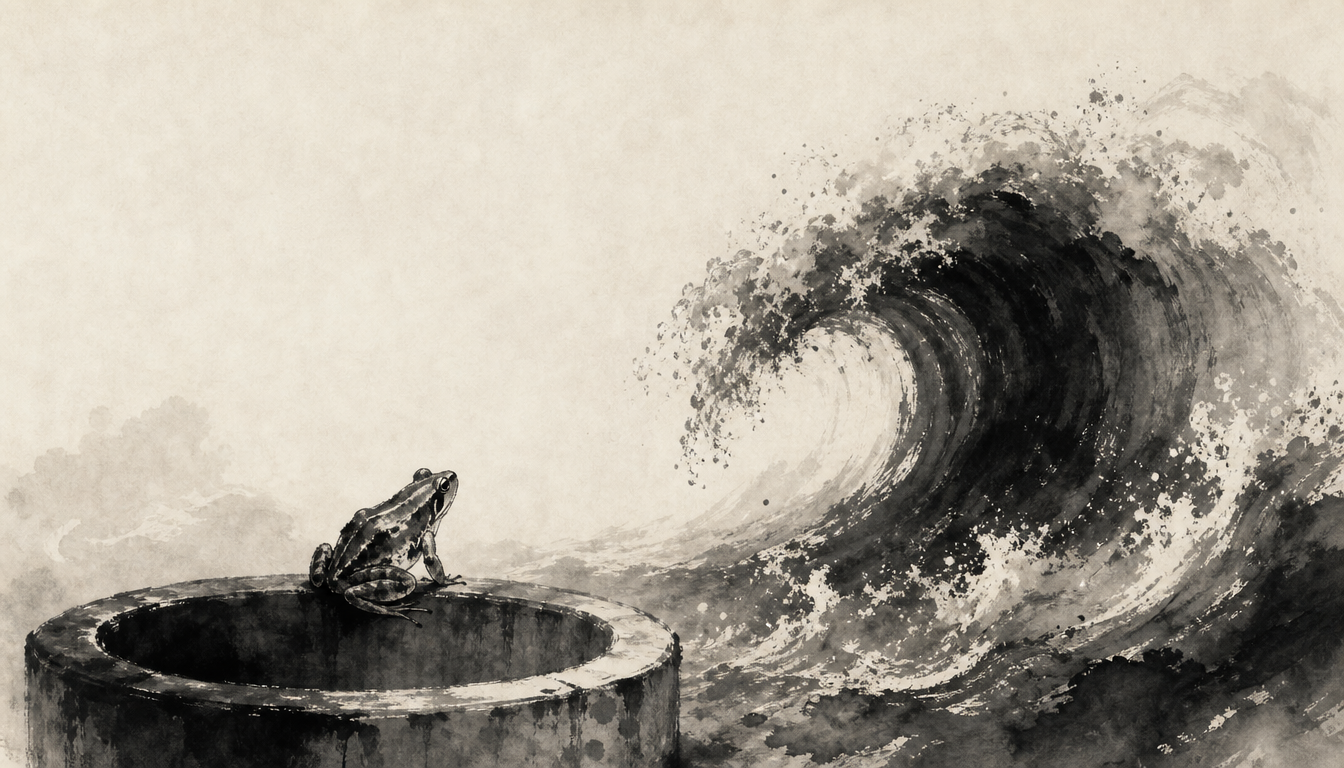
井の中の蛙大海を知らず — I no naka no kawazu
Japanese-Lesson.com renders the meaning plainly: the frog in the well knows nothing about the great ocean, and staying inside a small boundary costs you the chance to know a diverse world. It cuts both ways, as a warning against provincialism and a nudge to travel, read, and listen. The full proverb is long for a design; 海 (sea) or the frog motif carries it. Best for anyone at a crossroads about leaving a comfortable situation.
花は桜木人は武士 — Hana wa sakuragi, hito wa bushi
Literally "the best blossom is the cherry blossom; the best man is the warrior," a proverb that Wikipedia dates to the medieval period. The samurai was likened to the cherry blossom because of how his life was understood. It is the most historically loaded entry here, and that weight is exactly why it needs handling with care rather than casual appropriation. Best for readers drawn to the aesthetics of impermanence and the bushi tradition.
石の上にも三年 — Ishi no ue ni mo san nen
Sit on a cold stone for three years and it warms. Unglamorous, and the most honest proverb about mastery on this list. The character 忍 (endurance, forbearance) distills it. Best for long-haul projects: a degree, a craft, a language.
初心忘るべからず — Shoshin wasuru bekarazu
Never forget your beginner's mind. 初心 (shoshin) is one of the most graceful two-character compounds in the language, and it survives condensation better than most. Best for experts who feel their curiosity flattening.
出る杭は打たれる — Deru kui wa utareru
The stake that sticks out gets hammered down. Often quoted abroad as proof of Japanese conformity, which flattens it. Japanese speakers use it descriptively as often as prescriptively, sometimes with irony. I rated it lower for portability because the cross-cultural reading distorts so easily. Best as a lens for understanding group dynamics, not as a personal motto.
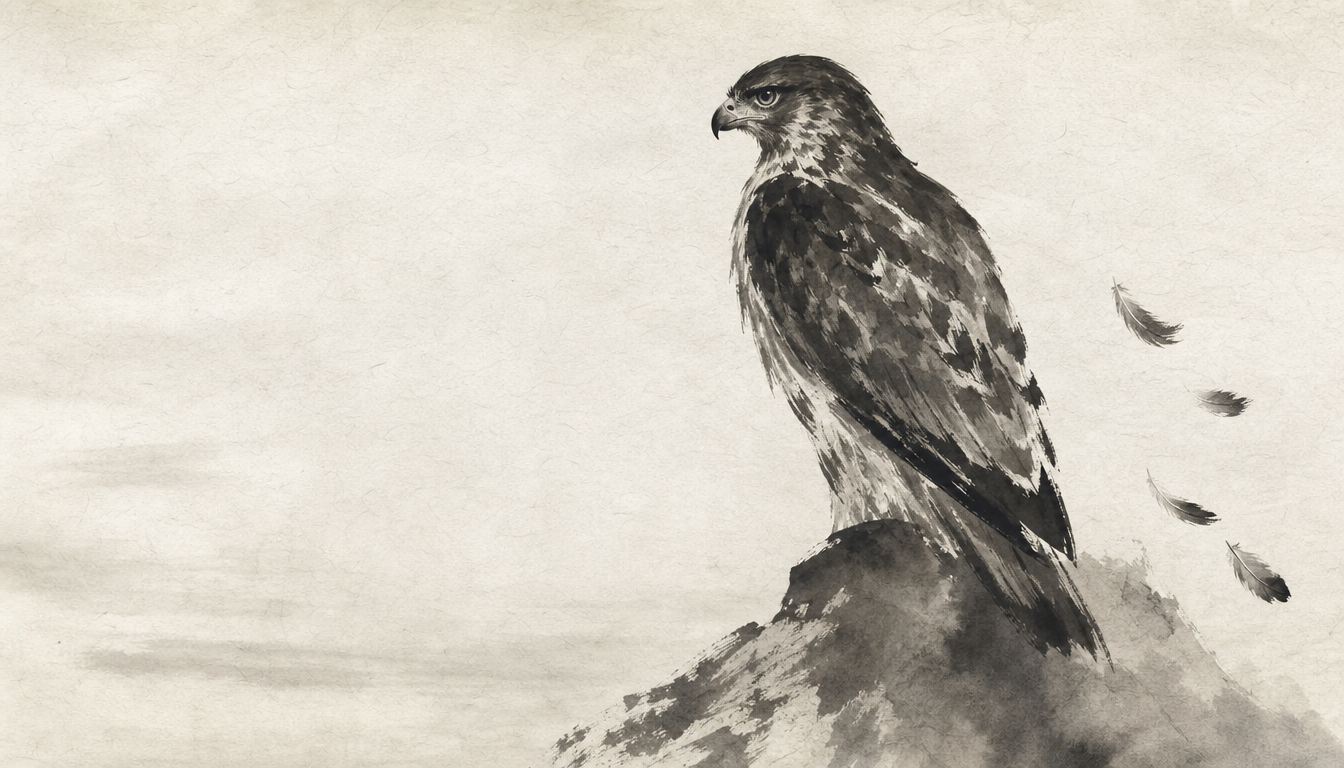
能ある鷹は爪を隠す — Nō aru taka wa tsume o kakusu
The capable hawk hides its talons. Genuine skill does not announce itself. The hawk imagery gives it strong visual potential, and the underlying value, quiet competence, translates cleanly. Best for people who dislike self-promotion but want a principle behind it.
Which Japanese Proverbs Fit Your Situation
Proverbs work best when matched to a moment rather than collected. Use the table to find yours.
| Your situation | Proverb | Why it fits |
|---|---|---|
| Recovering from failure | 七転び八起き | Builds the rising into the count of falls |
| Feeling stuck in a small world | 井の中の蛙 | Names the cost of staying inside the well |
| Overthinking a decision | 案ずるより産むが易し | Doing usually proves lighter than dreading |
| Learning something slowly | 石の上にも三年 | Reframes slowness as the method, not the problem |
| Planning a kanji tattoo | 一期一会 or 初心 | Compact, legible in Japan, meaning intact |
| Building a daily practice | 継続は力なり | Persistence itself is the strength |
For tattoos and printed art specifically, the gap between a proverb and a single character matters more than people expect. Sentence-length Japanese reads as text to a Japanese eye. One well-chosen character reads as an image. The process below is how I would approach choosing between them.
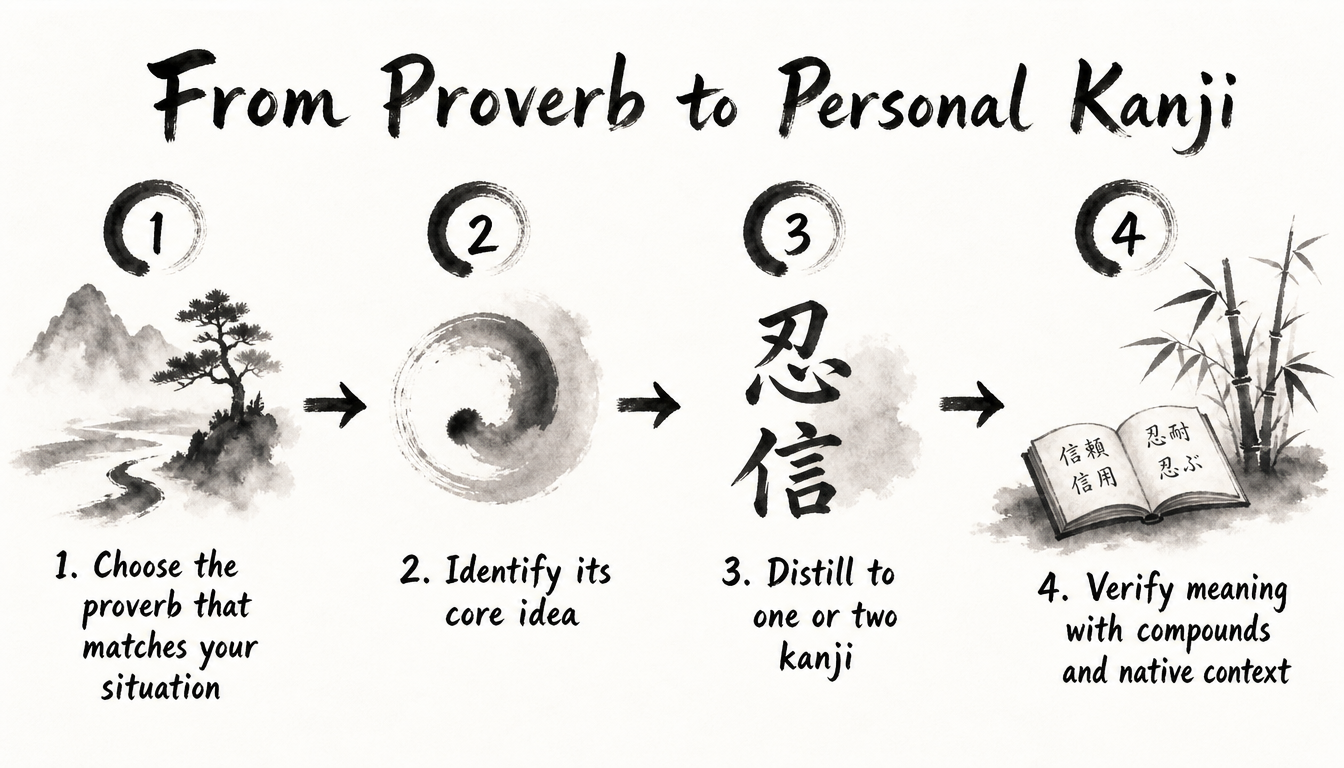
This is where Oracle Kanji Writer – Personalized Soul Kanji Diagnosis Tool earns its place. Rather than picking a character from a list because it looks striking, you enter your name, birthdate, and blood type, and the tool recommends a kanji matched to your inner qualities and life path. Each result arrives with pronunciation, primary and nuanced meanings, a personal message, and compound words that widen the context, all curated by Japanese creators. That last part is the safeguard: the compounds show you how the character actually behaves in Japanese, which is precisely what prevents the mistranslations and clichés that make locals wince. You can download the kanji art for a wallpaper, a keepsake, or a tattoo reference.
Final Recommendations
If you want a single saying to live by, take 一期一会 for presence or 七転び八起き for grit. If you want a saying to think with, 井の中の蛙 will keep asking you uncomfortable questions for years.
Points to keep in mind as you choose among japanese proverbs:
- Check the register. A proverb that sounds profound in translation may sound like a poster in Japanese. Ask a native speaker or use a tool built by Japanese creators.
- Prefer condensation for design. One character or a two- to four-character compound beats a full sentence on skin, paper, or screen.
- Learn the story. Yojijukugo in particular often trace back to a specific tale, and the meaning is hard to derive without it.
- Match the proverb to a real situation. Wisdom you cannot apply this month is decoration.
- Respect the heavy ones. Sayings tied to the samurai tradition carry history that deserves acknowledgment, not just aesthetics.
Kotowaza have lasted because they compress hard-won observation into a form people can hold in memory. Pick the japanese proverbs that answer a question you are actually asking, find the kanji that carries them, and let the characters do the rest.
References: Japanese proverbs - Wikipedia, My Modern Met: Ichi-Go Ichi-E, Japanese-Lesson.com
Discover Your Soul Kanji
Experience the depth of Japanese characters: each kanji carries timeless meaning, guiding your life's path.
No credit card required • 2-minute process