Japanese Personality Tests: Why Blood Type, Kanji, and Birthdate Readings Still Thrive

Western personality frameworks are losing cultural authority just as Japanese symbolic self-reading gains it. Blood type theory, kanji meaning, and birthdate symbolism are being adopted outside Japan as identity tools rather than party tricks. This analysis tracks three signals driving the shift, explains why analysts keep missing it, and offers concrete steps for anyone who wants a personal symbol that holds up culturally, especially before it becomes a tattoo.
The Trend Hiding in Plain Sight

Western personality frameworks are losing cultural authority at the exact moment Japanese symbolic self-reading is gaining it. While English-language media keeps debating whether the Myers-Briggs Type Indicator holds up scientifically, a quieter migration is underway: people outside Japan are adopting japanese personality test formats built on blood type, kanji meaning, and birthdate symbolism, and treating them as identity tools rather than party games.
This matters because these systems play by different rules. They do not claim predictive validity. They offer a character, an image, a word you can carry. That shift in what a self-assessment is for is the thing most commentators are still missing.

Discover Your Soul Kanji
Experience the depth of Japanese characters: each kanji carries timeless meaning, guiding your life's path.
No credit card required • 2-minute process
How the Industry Currently Reads the Situation

The mainstream conversation about personality assessment runs on a single axis: accurate or inaccurate. Researchers at UNSW note that personality tests promise to help us understand who we are and how we compare to others, and that the same tests raise questions about whether they paint an accurate picture and whether taking them too seriously causes harm . Psychometricians add their own criteria, including test-retest reliability, the consistency of scores between two sessions under similar conditions .
Under that lens, Japanese blood type personality theory looks indefensible. Wikipedia describes it as a pseudoscientific belief prevalent in East Asia holding that blood type predicts personality, temperament, and compatibility, and notes the scientific community generally treats it as superstition (Wikipedia). Case closed, most Western writers conclude, then move on.
That conclusion answers a question nobody taking the test is asking. Japanese self-reading traditions compete on resonance, aesthetics, and social lubrication. Savvy Tokyo reports that in Japan, knowing whether you are A, B, AB, or O is more common than knowing your star sign, and that many people believe personality, employability, temperament, and romantic compatibility connect to blood type . A framework with that penetration is doing cultural work that a validity coefficient cannot capture.
References: UNSW Newsroom, ScienceDirect, Wikipedia, Savvy Tokyo
Three Signals Worth Watching

Three developments point the same direction, and they reinforce each other.
Signal 1: Blood type literacy is spreading through soft media
Blood type personality theory did not arrive in Japan as folklore. Masahiko Nomi, a journalist who advocated Takeji Furukawa's idea that blood type influences personality, published Ketsueki-gata de Wakaru Aisho (Understanding Affinity by Blood Type), which became a best seller in 1971, and he went on to write more than ten popular books (Wikipedia). One writer built a national vocabulary.
The export phase is now visible in English media. Gathered frames the belief system, ketsueki-gata, as shaping social interactions, workplace dynamics, and romantic relationships in Japan, and notes that around one-third of Americans and more than half of Britons do not know their blood type . That gap is the tell. When a framework starts prompting people to go find out a fact about themselves they never bothered to learn, it has stopped being trivia.
Signal 2: Meaning-first Japanese concepts already broke through
Ikigai proves the pathway exists. Wikipedia glosses it as a Japanese concept of an individual's definition of the meaning of their life, and cites psychologist Katsuya Inoue's two-part account: sources or objects that bring value or meaning to life, and the feeling that one's life has value because those sources exist (Wikipedia). Harvard Medical School's continuing education arm describes ikigai as a reflective practice for uncovering essential purpose through a metacognitive process of noting and accepting ideas and identifying what brings fulfillment (Harvard Medical School).
Note what happened. An untestable interpretive concept entered institutional wellness discourse because it gave people a usable frame. Blood type reading and kanji symbolism sit in the same category, and the audience has already been trained to accept that category.
Signal 3: Symbolic output beats categorical output
Western type systems return a label. ISFJ stands for Introverted, Sensing, Feeling, Judging within the sixteen types created by Katharine Briggs and Isabel Myers . Useful shorthand, but an acronym is hard to wear, hang on a wall, or explain to a stranger with any warmth.
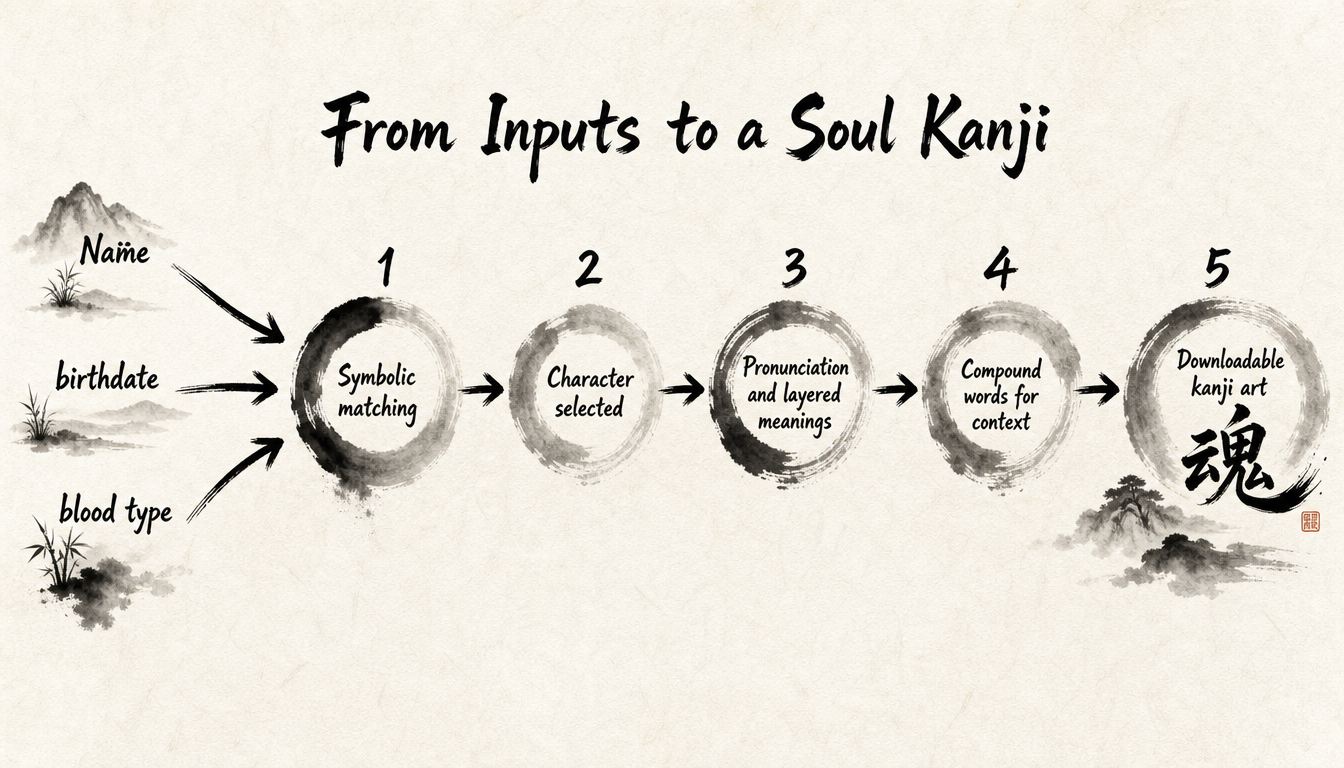
Kanji-based results behave differently. A single character carries a reading, layered meanings, and compound associations that expand context. James W. Heisig built an entire course around how not to forget the meaning and writing of Japanese characters, which tells you something about their density . This is the design logic behind Oracle Kanji Writer – Personalized Soul Kanji Diagnosis Tool, which takes a name, birthdate, and blood type and returns a Soul Kanji with pronunciation, primary and nuanced meanings, a personal message, and curated compound words. The output is an object of meaning, not a bucket.
The comparison below shows how the two approaches differ in design intent.
| Dimension | Western type inventories | Japanese symbolic reading |
|---|---|---|
| Primary output | Category label or score profile | Character, meaning, and image |
| Input required | Long self-report questionnaire | Name, birthdate, blood type |
| Validity claim | Explicit and contested | Not claimed |
| Social use | Hiring, team building | Compatibility talk, gifts, art |
| Shareable artifact | Four-letter acronym | Calligraphic character |
References: Wikipedia, Gathered, Wikipedia, Harvard Medical School, Truity
Why Most People Miss This Shift

Three blind spots keep this trend invisible to the people who analyze self-assessment for a living.
The first is a category error. Analysts evaluate symbolic tools with psychometric instruments, find them wanting, and stop. Nobody asks whether the tool succeeded at what it was built to do.
The second is universalism. OpenStax's Psychology 2e states plainly that Western ideas about personality may not be applicable to other cultures, and that evidence shows the strength of personality traits varies across cultures. It cites findings that people in collectivist Asian cultures tend to be less extroverted, that people in Central and South American cultures tend to score higher on openness to experience, and that Europeans score higher on neuroticism . The same text notes that individualist cultures emphasize independence, competition, and personal achievement, while collectivist cultures value social harmony, respectfulness, and group needs, and it identifies three approaches to studying personality in cultural context: cultural-comparative, indigenous, and combined . An indigenous framework like blood type reading is legible only through an indigenous or combined lens. Most Western coverage applies neither.
The third is aesthetic blindness. Analysts do not count beauty as a feature. A character rendered in ink, suited to a wall or a tattoo, delivers something a questionnaire result never will, and that is precisely the currency this market runs on.
The people who already see this are illustrators, tattoo artists, and wellness practitioners. They noticed that clients want a symbol with a verified meaning, not a score.
References: OpenStax Psychology 2e 11.8, OpenStax Psychology 2e Summary
Where the Japanese Personality Test Category Goes Next
What follows separates documented facts from my projections.
Established: blood type personality theory has decades of penetration in Japan and lacks scientific support. Ikigai has crossed into Western institutional wellness discourse. Cultural variation in personality expression is documented in mainstream psychology texts.
My forecast, clearly labeled as such:
- Near term. Expect a flood of low-effort kanji generators chasing search demand, most producing characters that read as clumsy or unintentionally comic in Japan. Mistranslation stories will follow.
- Medium term. Authenticity becomes the sorting mechanism. Tools curated by Japanese creators, with explicit cultural notes, separate from scrapers. Tattoo artists start asking clients where a character came from.
- Longer term. Symbolic self-reading settles beside Western typologies rather than replacing it, the way ikigai now coexists with goal-setting frameworks. Hybrid results, a type plus a character plus a phrase, become standard.
The diagram below maps how a symbolic reading moves from raw inputs to something a person actually keeps.
Moving Before the Crowd Does
Early positioning here costs little and compounds.
- Learn your blood type. If you are among the large share of Americans and Britons who do not know it, that single fact unlocks an entire interpretive layer .
- Run a symbolic reading now and record it. Take a japanese personality test that returns a character rather than a label, then write down your reaction. Your unfiltered first response is data you cannot recover later.
- Verify meaning before permanence. For tattoos, insist on pronunciation, layered meanings, and compound words. Oracle Kanji Writer supplies those alongside downloadable kanji art and cultural explanations designed to prevent mistranslations and cliché picks.
- Hold both frames. Keep your Big Five or MBTI profile for practical planning. Use the character for meaning and identity.
- Learn the etiquette. Blood type talk functions as social currency in Japan. Knowing how it is used, and where it shades into stereotyping, makes you a better guest in the conversation.
The risk is modest: mistaking a symbolic tool for a diagnostic one. Name that boundary and the downside disappears. The upside is a piece of personal symbolism that holds up culturally, which matters enormously once it is on your skin or your wall.
References: Gathered
What to Watch
The overlooked trend is not that a japanese personality test can outperform Western psychometrics. It is that a large audience has stopped wanting a score and started wanting a symbol, and Japanese traditions have been refining symbolic self-reading for far longer than the acronym industry has existed.
Three things to track: whether English-language wellness media begins covering blood type reading with the same seriousness it gave ikigai, whether authenticity becomes a visible differentiator among kanji tools, and whether tattoo culture starts demanding provenance for characters. Any japanese personality test that gives you a beautiful character, an honest meaning, and no false promise of prediction is playing the game correctly. That is the standard worth holding the whole category to.
Discover Your Soul Kanji
Experience the depth of Japanese characters: each kanji carries timeless meaning, guiding your life's path.
No credit card required • 2-minute process