Japanese Blood Type Personality: The Cultural Habit Behind 'What's Your Type?'

Ketsueki-gata, Japan's blood type personality habit, is drifting overseas and being rebuilt as a symbolic identity input rather than a social verdict. This piece traces the origins from Furukawa's 1927 paper to Nomi's bestsellers, examines three overlooked signals driving global adoption, explains why analysts keep missing the shift, and offers concrete steps for engaging with the tradition thoughtfully, including how blood type now combines with name and birthdate in personalized kanji symbolism.
A Ninety-Year-Old Icebreaker Is Quietly Becoming a Global Identity Tool

The Japanese blood type personality habit is drifting out of Japan and into international self-discovery culture, and almost nobody is tracking it. What used to be a domestic conversational reflex, asking a new acquaintance their type before asking their job, is now showing up in fandom bios, dating app prompts, and personalized cultural products built for non-Japanese audiences. That shift matters because it changes what the system is for.
Inside Japan, ketsueki-gata has always carried social weight, including its ugly side. Outside Japan, it is being adopted as something looser: a low-friction symbolic vocabulary, closer to a birth chart than a background check. The trend worth watching is not whether blood types predict behavior. It is how a discarded pseudoscience is being recycled into a tool for personal meaning-making, and who benefits from that.

Discover Your Soul Kanji
Experience the depth of Japanese characters: each kanji carries timeless meaning, guiding your life's path.
No credit card required • 2-minute process
What Most People Currently Think About Japanese Blood Type Personality
Ask a Western reader what they know and you get one of two answers. Either they have never heard of it, or they have heard it dismissed as Japan's version of astrology.
The dismissal has a fair basis. The theory traces back to a 1916 paper by physician Kimata Hara and gained momentum in 1927 with psychologist Takeji Furukawa's The Study of Temperament Through Blood Type, work later criticized for weak methodology, as Japan Experience documents. Journalist Masahiko Nomi revived it commercially decades later; his 1971 book Ketsueki-gata de Wakaru Aisho became a bestseller, according to Wikipedia. The scientific community treats the whole framework as superstition.
The commentary usually stops there, and it stops at the two most reported angles: the origin story and the harm. The harm is real. Japan has a word for it, bura-hara, blood-type harassment, with reported cases of bullying, broken relationships, and lost job opportunities, as the BBC reported. Type B people in particular absorb the worst of it; one writer at Tofugu describes being mocked for it repeatedly.
What both angles miss is the function. Neither explains why a debunked framework survives ninety years of debunking, or why it is now spreading to people who have no cultural obligation to participate.
Three Signals That the Trend Is Already Moving

The evidence is scattered across places that rarely get read together: entertainment exports, identity-product design, and the mechanics of how people describe themselves online.
Signal 1: Character Profiles Are Doing the Teaching
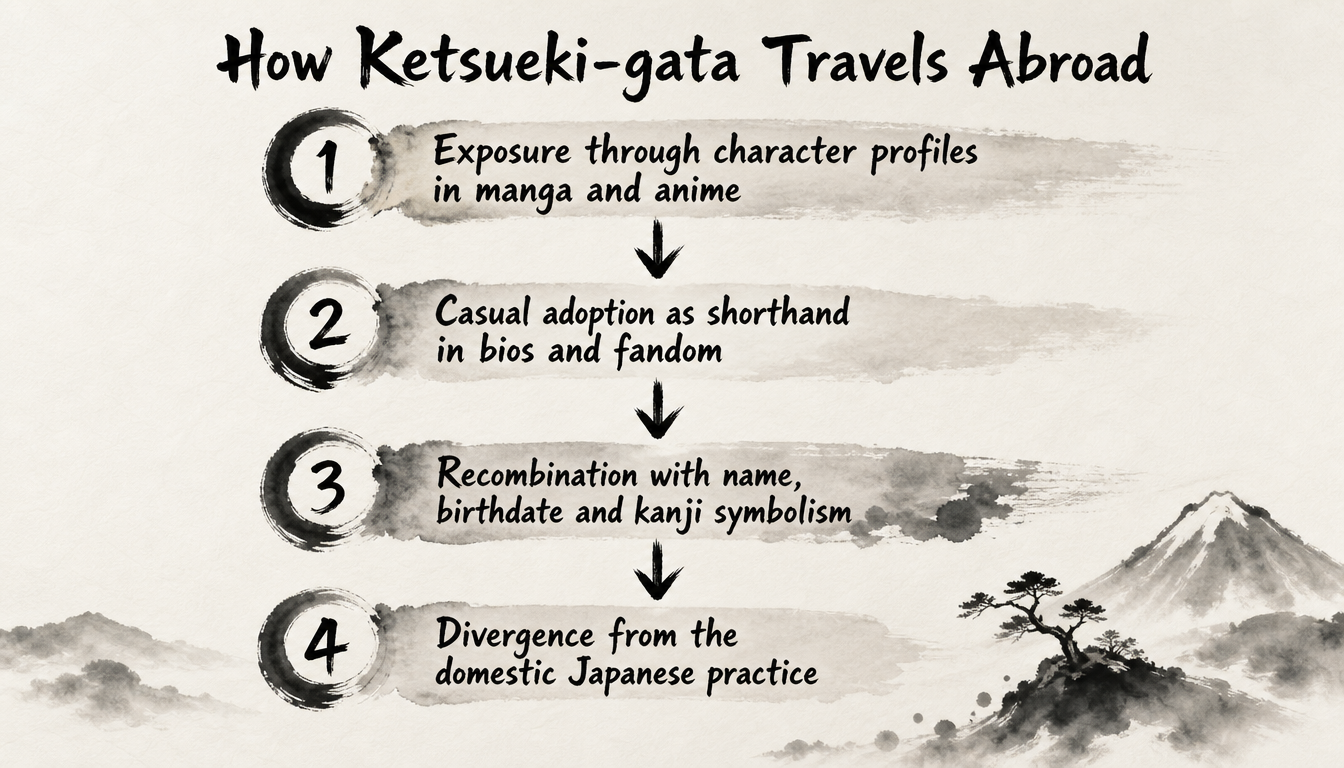
Manga and anime character bios routinely list blood type alongside height and birthday. For decades that detail read as inscrutable trivia to overseas fans. It no longer does. A generation raised on those profiles absorbed the associations by osmosis, learning that A signals conscientiousness and restraint, B signals independence, O signals warmth and drive, AB signals ambiguity. Fan wikis, character analysis videos, and fan fiction now treat blood type as a legible personality cue rather than a footnote. No institution taught this. It spread through repetition in fiction, which is exactly how symbolic systems normally travel.
Signal 2: The Four-Type Structure Fits Modern Identity Formats Better Than Sixteen
Compare the dominant identity frameworks people actually use online, and the structural advantage becomes obvious.
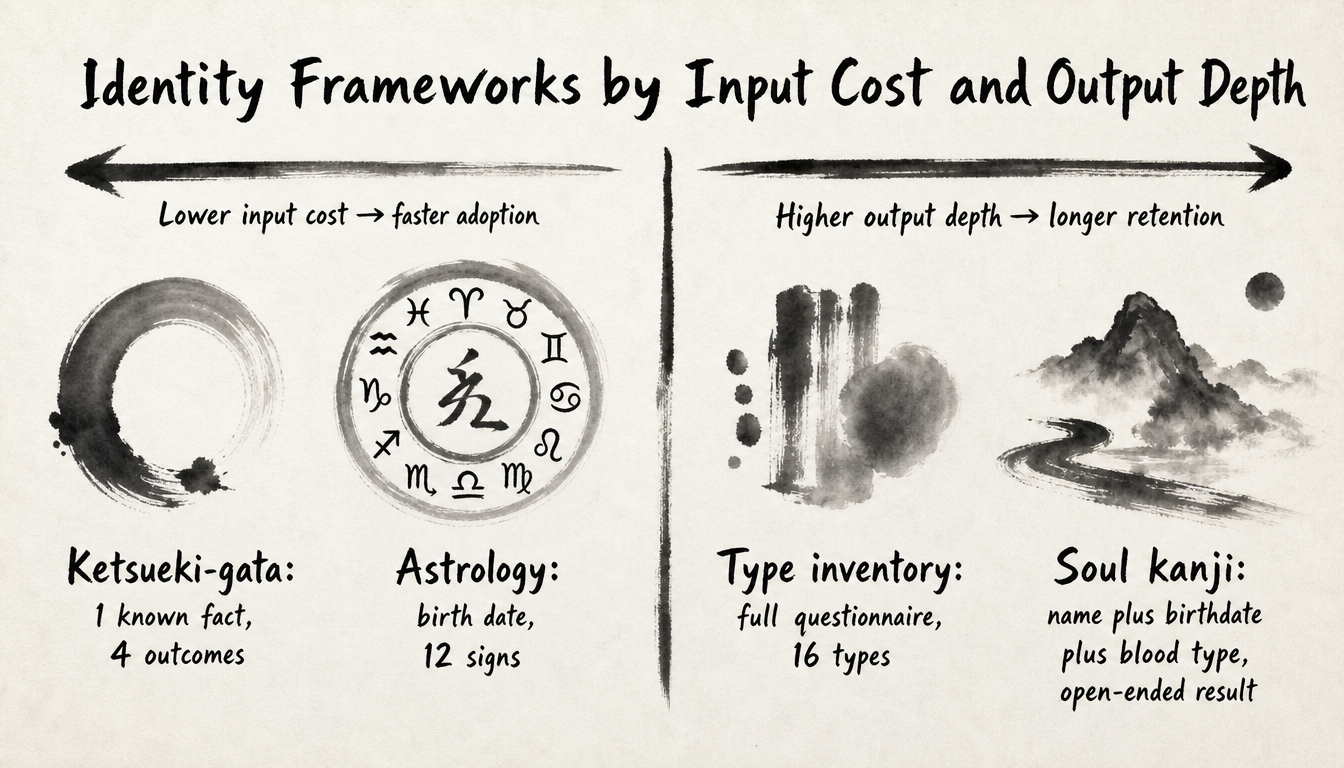
| Framework | Number of categories | Input required | Basis | Social shareability |
|---|---|---|---|---|
| Ketsueki-gata (blood type) | 4 | One fact you already know | Cultural tradition | Very high, instantly stated |
| Western astrology | 12 sun signs | Birth date | Cultural tradition | High |
| MBTI-style type inventories | 16 | Full questionnaire | Psychological typology | Moderate, requires a test first |
| Soul kanji symbolism | Open-ended | Name, birthdate, blood type | Language and cultural imagery | High, visual and personal |
Four categories are memorable, pronounceable, and require zero setup. You do not take a test to learn your type; you already know it. In an attention economy where identity labels function as social shorthand, that frictionlessness is the entire competitive advantage. The comparison below maps how these systems differ in input cost and output richness.
Signal 3: Blood Type Is Being Recombined With Other Symbolic Inputs
The most telling development is that blood type is no longer standing alone. Creators outside the traditional fortune-telling industry are treating it as one variable among several. Tools like Oracle Kanji Writer take a person's name, birthdate, and blood type together and return a single Japanese character chosen to reflect their inner qualities, complete with pronunciation, layered meanings, and related compound words. Blood type here is not a verdict. It is one thread in a composite portrait, weighted alongside other inputs and expressed through language rather than a trait list.
That recombination is the real shift. A rigid four-box taxonomy becomes something generative when it feeds into an open-ended symbolic output. The connection between the three signals is straightforward: fiction built the familiarity, format advantage built the adoption, and recombination is turning adoption into something people want to keep.
Why the Japanese Blood Type Personality Trend Keeps Getting Overlooked

Three blind spots keep this off most people's radar.
The debunking reflex ends the conversation. Once a framework is labeled pseudoscience, Western commentary treats analysis as endorsement. That reflex is understandable but analytically expensive. It means nobody studies what the system does socially, only whether it is true. Nobody applies that test to astrology columns or personality quizzes with the same finality, yet both remain enormous cultural forces.
Cultural exports are measured by the wrong units. Analysts count anime licensing revenue, tourism figures, and food trends. They do not count the transmission of conversational habits, which move invisibly and leave no financial trail until a product monetizes them years later.
Japan's own ambivalence muddies the signal. Domestic discourse increasingly frames ketsueki-gata as a discrimination problem, which it is. Observers reading that discourse conclude the practice is declining. They miss that the overseas version is inheriting the symbolism without the social enforcement, which makes it safer and therefore more portable.
The people who already see this are mostly creators building identity products, not analysts writing about Japan. They noticed that users volunteer their blood type without being asked twice.
Where This Goes Next
The diagram below traces the likely progression from imported curiosity to a stable symbolic vocabulary.
Near term, expect blood type to keep appearing as an optional field in identity-oriented apps and creator tools aimed at global audiences, usually paired with other inputs rather than presented alone. The pairing is deliberate; a four-way split is too coarse to satisfy anyone on its own.
Over a longer horizon, the likely outcome is divergence. The Japanese version stays entangled with real social consequence and continues to face criticism at home. The exported version drifts toward pure symbolism, stripped of the workplace and dating-market enforcement that makes it harmful. Those two things will share a name and mean different things, which will confuse a lot of writing about the topic.
One forecast worth stating plainly as a prediction, not a fact: the framing that survives will be the one that treats blood type as a starting question rather than an answer. Systems that hand people a fixed label invite backlash. Systems that use the label as raw material for something richer, a character, an image, a phrase to sit with, avoid the trap entirely.
How to Move Before the Crowd Does
If you want to engage with this early, whether as a creator, a cultural enthusiast, or someone planning a tattoo, a few moves separate thoughtful participation from the obvious mistakes.
- Learn the origin, not just the trait list. Knowing that Furukawa's 1927 paper lacked rigor and that Nomi popularized the idea commercially gives you the context to use the system playfully without asserting it as fact.
- Never use it to judge someone else. The bura-hara record is the cautionary tale. Applied inward it is symbolism. Applied outward it becomes prejudice with a friendly face.
- Treat blood type as one input among several. Combine it with name, birthdate, and your own reading of yourself. Composite systems produce results specific enough to feel earned.
- Verify meaning before you commit anything permanently. Kanji chosen from a dictionary lookup frequently lands wrong in Japanese, either clichéd or unintentionally odd. A tool curated by Japanese creators, like Oracle Kanji Writer, returns characters with their nuanced meanings and compound usages so you understand how the character actually reads to a Japanese eye.
- Document your reasoning. If you are building content or a product around this, explain the cultural history alongside the fun. That is what earns trust as the topic gets more crowded.
The risk is minimal and the asymmetry favors early movers. Nobody loses by understanding a cultural practice more deeply than the surface commentary allows. The downside is only reputational, and only if you present superstition as science or use it to sort other people.
What to Watch From Here
The overlooked trend is not that blood type predicts personality. It does not. The trend is that a ninety-year-old Japanese conversational habit is being rebuilt overseas as a symbolic identity input, decoupled from the social enforcement that made it harmful at home, and recombined with richer forms of meaning like kanji and personal narrative.
Watch three things: whether identity tools aimed at global users keep adding blood type as an input, whether Japanese commentary continues to separate the domestic practice from the exported one, and whether the market rewards composite systems over single-label verdicts. The japanese blood type personality framework will not survive as science. It is surviving as a doorway, and the people building thoughtfully curated experiences on the other side of that door are the ones worth watching.
Discover Your Soul Kanji
Experience the depth of Japanese characters: each kanji carries timeless meaning, guiding your life's path.
No credit card required • 2-minute process