Ikigai Explained: Finding the Reason You Get Up, in Kanji

Ikigai is usually reduced to a four-circle career diagram, but the Japanese word 生き甲斐 says something quieter and more durable: living is worth the effort. This guide breaks the term down character by character, separates authentic Japanese usage from the Western adaptation, reviews what public health research actually found, and shows how to choose a kanji that carries the idea without falling into tattoo-shop clichés.
What This Guide Gives You
This guide is written for beginners and curious intermediates who want the real ikigai meaning, not the watered-down version that circulates on career blogs. By the end, you will understand the kanji behind the word, where the four-circle diagram actually came from, how Japanese people use the term in daily life, and how to choose a kanji that carries this idea without falling into clichés. Reading time is roughly ten minutes.
You will also get practical guidance if you plan to wear a kanji on your skin, hang it on your wall, or use it as a personal touchstone.
Discover Your Soul Kanji
Experience the depth of Japanese characters: each kanji carries timeless meaning, guiding your life's path.
No credit card required • 2-minute process
Prerequisites
- No Japanese language ability is required.
- It helps to know that Japanese uses three scripts: kanji (characters borrowed from Chinese), hiragana, and katakana.
- Basic willingness to accept that some words do not translate cleanly. Ikigai is one of them.
The Ikigai Meaning, Character by Character
Ikigai is written 生き甲斐. Wikipedia glosses it literally as "a reason for being", and Japanese speakers pronounce it roughly ee-key-guy.
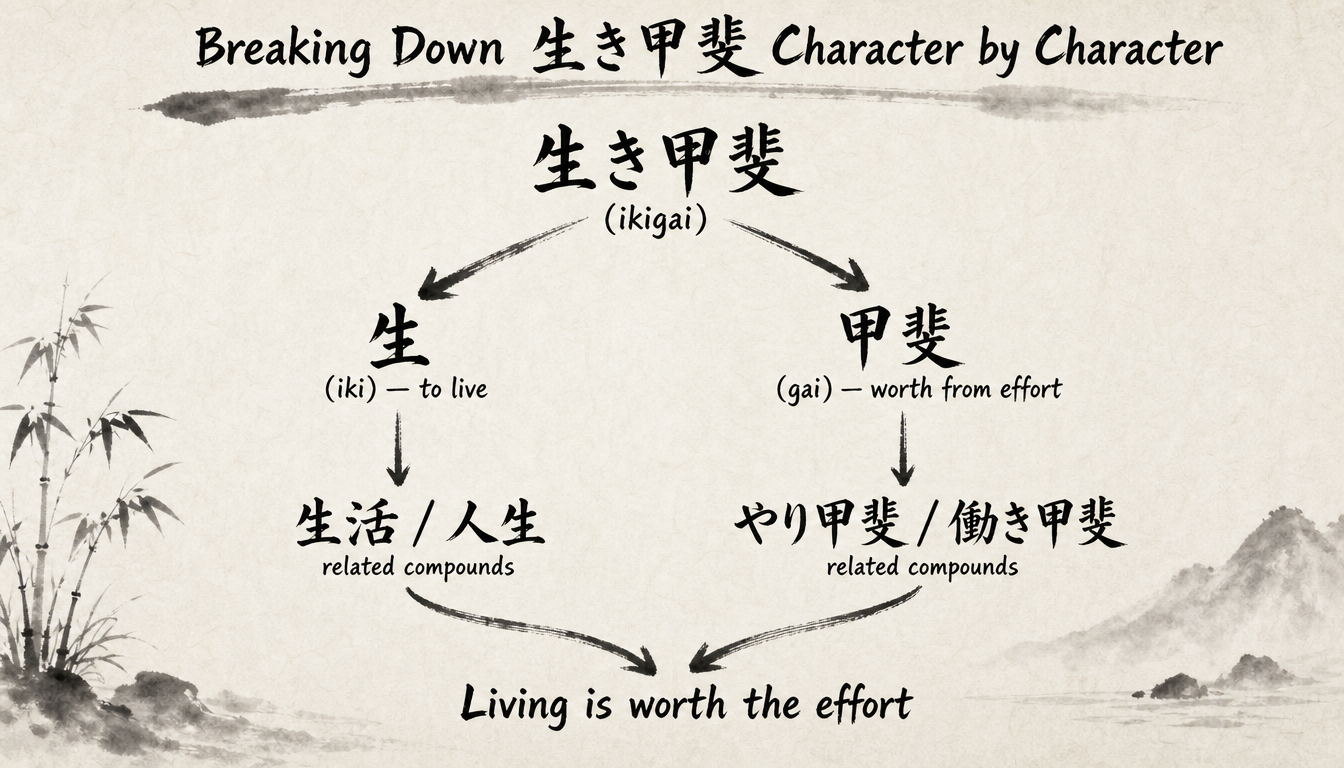
生 (iki) — to live
The character 生 is one of the most fertile in the language. It carries life, birth, growth, rawness, and freshness. You find it in 生活 (seikatsu, daily living) and 人生 (jinsei, a human life). In ikigai, it appears in its verb form 生きる, to live, so the word begins with the act of living rather than the abstract noun of life.
甲斐 (gai) — worth, effect, the payoff of effort
甲斐 is the subtler half. It describes the worth that effort produces, the sense that something was not done in vain. Japanese uses it in constructions like やり甲斐 (yarigai, the satisfaction of doing something worthwhile) and 働き甲斐 (hatarakigai, work worth doing). So ikigai is closer to "living is worth the effort" than to "my grand life purpose."
That distinction matters. The BBC's Yukari Mitsuhashi put it plainly: ikigai is essentially the reason you get up in the morning. A grandchild's face. A garden. A craft you have practiced for thirty years. None of these need to be monetized or world-changing.
The diagram below breaks the word into its component characters and their contributions to meaning.
The Four-Circle Diagram: Useful, but Not Japanese
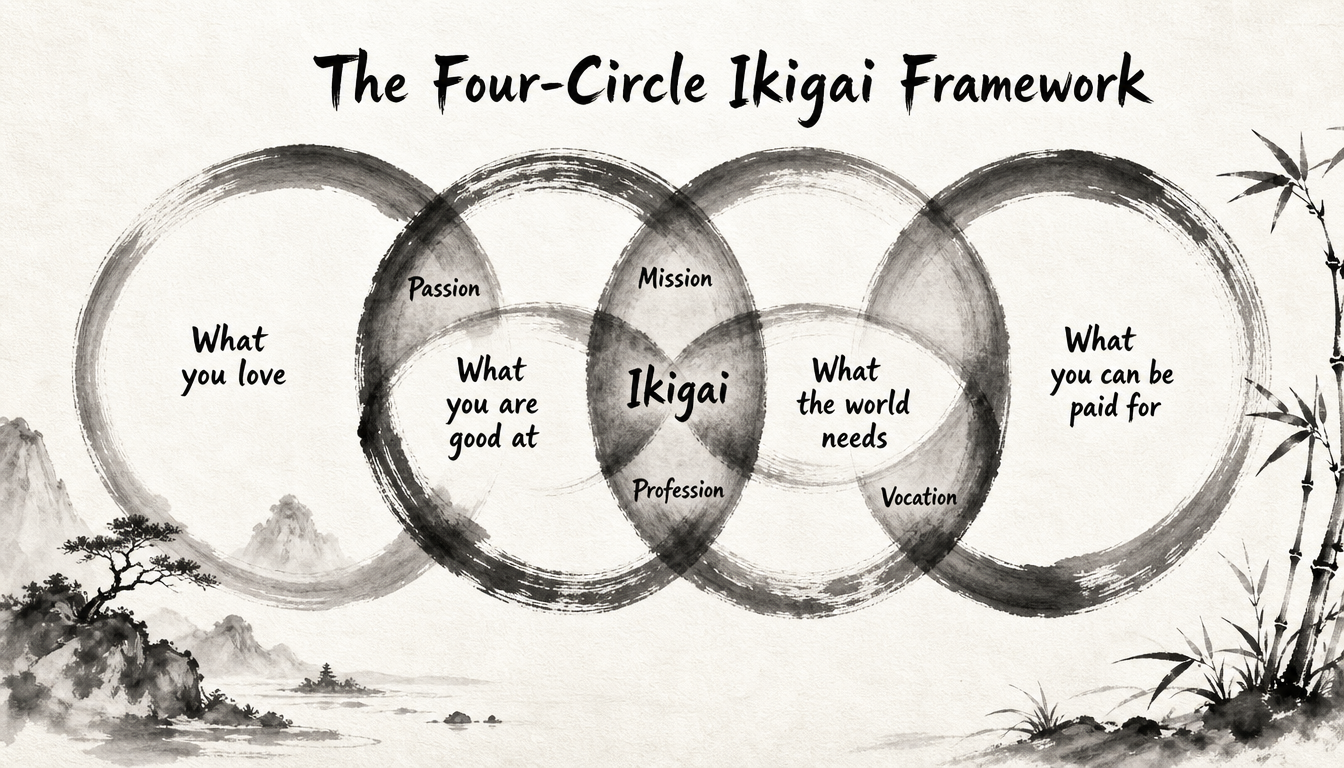
Most English-language articles present ikigai as the overlap of four circles: what you love, what you are good at, what the world needs, and what you can be paid for. Harvard Medical School's continuing education blog describes the framework as four parts: passion, mission, profession, and vocation, and Johns Hopkins offers it as a career-planning exercise.
The framework is genuinely useful for career reflection. It is also a Western adaptation. The Japanese usage described by researchers is broader and less tied to income. Psychologist Katsuya Inoue, as summarized by wikiHow, distinguished sources that bring value to life from the feeling that one's life has value because those sources exist, and identified social, non-social, and anti-social varieties of ikigai.
Here is how the two readings compare.
| Aspect | Japanese everyday usage | Western four-circle model |
|---|---|---|
| Scope | Any source of daily worth | Career and vocation focused |
| Money | Irrelevant to the concept | One of four required circles |
| Scale | Often small and private | Often framed as life mission |
| Who has it | Assumed available to anyone | Presented as something to find |
| Typical context | Retirement, hobbies, family, craft | Job searching, burnout recovery |
Use the diagram if it helps you think. Just do not tell a Japanese friend that their ikigai must pay rent.
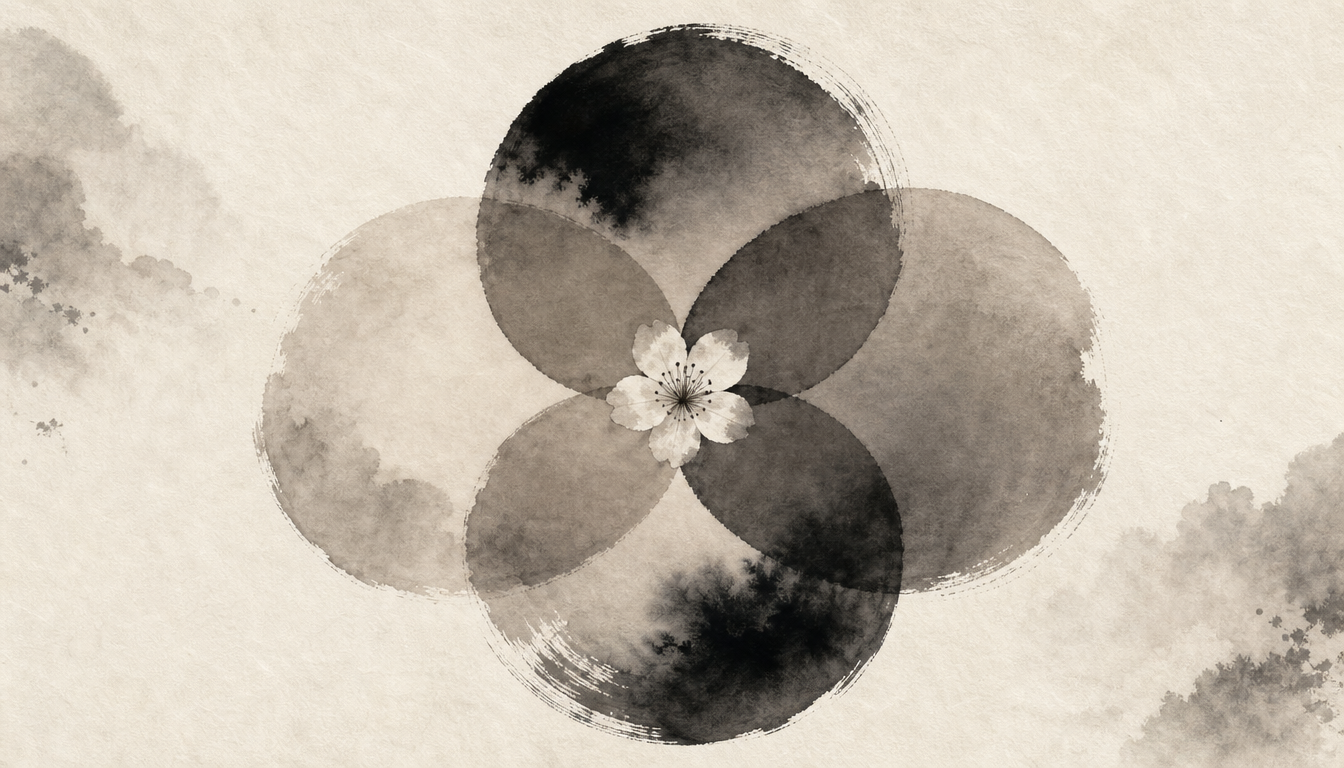
The Venn diagram below shows the four-circle model as it is commonly taught.
Why the Ikigai Meaning Holds Up Under Research
The concept is not only poetic. Japanese public health researchers have studied ikigai for decades as a measurable variable.
A nationwide longitudinal study of Japanese adults aged 65 and over examined whether having ikigai in 2013 predicted outcomes measured in 2016 across physical health, health behavior, psychological distress, social wellbeing, and pro-social behavior. A separate cross-sectional study in a mountainous region of Tokushima found that among physical activity, cognitive function, social isolation, and depression scores, only the depression measure showed a significant path to ikigai, suggesting the concept sits closer to emotional state than to physical capacity.
Research summarized in OBM Geriatrics also reports an inverse relationship between ikigai and depressive symptoms, including findings outside Japan. The concept travels.
What this means for you
Do not treat ikigai as a puzzle to solve once and then file away. Treat it as something you notice and protect. The research points toward emotional wellbeing rather than achievement, which suggests the useful question is not "what is my purpose" but "what made getting up worth it this week."
Choosing a Kanji That Carries This Idea
Many people who fall in love with the ikigai meaning want a physical form of it: a tattoo, a framed piece of calligraphy, a phone wallpaper. This is where mistakes happen.
Common pitfalls
- Tattooing 生き甲斐 in full. It is four characters including hiragana き, which looks visually unbalanced to Japanese eyes and reads as a vocabulary word rather than a statement.
- Picking the most famous character. 愛 (love), 力 (power), and 夢 (dream) are beautiful but so common in Western tattoo culture that they read as generic in Japan.
- Trusting a machine translation. Kanji carry registers and connotations that dictionaries flatten. A character can be technically correct and tonally wrong.
- Ignoring compounds. A single kanji lives inside dozens of compound words. Those compounds shape how a native reader interprets it.
A better approach
Start from the quality you want to carry, not from the English word you want translated. If your ikigai is patient craftsmanship, the surrounding concept might be 拘り (kodawari), described as an intense dedication to the best possible outcome regardless of time, effort, or profit. If it is quiet endurance, the territory is different again.
This is exactly the gap that Oracle Kanji Writer was built to close. You enter your name, birthdate, and blood type, and the tool suggests a Soul Kanji matched to your inner qualities. Each result comes with pronunciation, primary and nuanced meanings, a personal message, and curated compound words so you can see how the character behaves in real Japanese. Because the selections are curated by Japanese creators, the characters you receive read as beautiful and meaningful in Japan, not as a translation accident.
The process below outlines how to move from a feeling to a finished character.
Frequently Asked Questions
Is ikigai an ancient philosophy?
The word is old, but the four-circle diagram is a modern Western framing. Japanese sources treat ikigai as ordinary vocabulary rather than a formal doctrine, closer to a common noun than to a school of thought.
Does my ikigai have to be my job?
No. Japanese usage frequently attaches ikigai to hobbies, relationships, caregiving, and craft. The income circle belongs to the Western career adaptation.
Can I have more than one ikigai?
Yes. Inoue's categories suggest multiple sources of worth can coexist, some social and some entirely private.
Should I tattoo 生き甲斐 or a single kanji?
A single well-chosen kanji usually reads better visually and carries more personal weight. Multi-character phrases invite grammatical scrutiny and are harder to compose attractively.
How do I know a kanji means what I think it means?
Check its compound words and its register. A character used mainly in bureaucratic vocabulary will not feel poetic, no matter how the dictionary glosses it.
Next Steps
Start with observation rather than research. For one week, note what actually made you want to get out of bed. Small entries count. Then look for the common quality underneath them: patience, curiosity, service, precision, play.
- Read the primary sources on ikigai rather than summaries. The BBC feature and the Wikipedia entry both give the Japanese framing directly.
- Learn how kanji compounds work. Understanding that 生 appears in both 生活 and 人生 will change how you read every character.
- Generate your Soul Kanji with Oracle Kanji Writer and study the compound words it returns. Sit with the character for a few weeks before committing it to skin or wall.
- If you plan a tattoo, show the character to a Japanese reader and ask what it makes them feel, not what it means.
The ikigai meaning is not a destination you arrive at. It is the accumulated worth of days you chose to live fully, and a well-chosen kanji is a way of keeping that intention visible.
Discover Your Soul Kanji
Experience the depth of Japanese characters: each kanji carries timeless meaning, guiding your life's path.
No credit card required • 2-minute process