Hiragana, Katakana, Kanji: The Three Japanese Writing Systems Explained Simply

Japanese uses three scripts at once, and each one does a different job. This guide breaks down hiragana, katakana, and kanji in plain language: how to tell them apart on sight, why a foreign name is written in katakana instead of kanji, and what multiple readings mean for anyone choosing a character for art or a tattoo. Includes a comparison table, historical context, and practical advice for picking a kanji that actually resonates in Japan.
What This Guide Gives You
This guide is written for absolute beginners and curious intermediates who want to understand the three japanese writing systems without enrolling in a language course. By the end, you will recognize hiragana, katakana, and kanji on sight, understand why Japanese uses all three at once, and know what that means if you are choosing a character for a tattoo, a piece of art, or a personal symbol. Give it about ten minutes.
You will not become fluent. You will, however, stop confusing kanji with Chinese, stop assuming a character means whatever a translation app says it means, and gain enough context to make culturally sound choices.
Discover Your Soul Kanji
Experience the depth of Japanese characters: each kanji carries timeless meaning, guiding your life's path.
No credit card required • 2-minute process
Prerequisites
- No prior Japanese knowledge required.
- Helpful: knowing that Japanese is written without spaces between words.
- Helpful: accepting that romaji (Japanese written in Roman letters) is a transcription tool, not one of the writing systems themselves, as Busuu points out.
The Three Japanese Writing Systems at a Glance
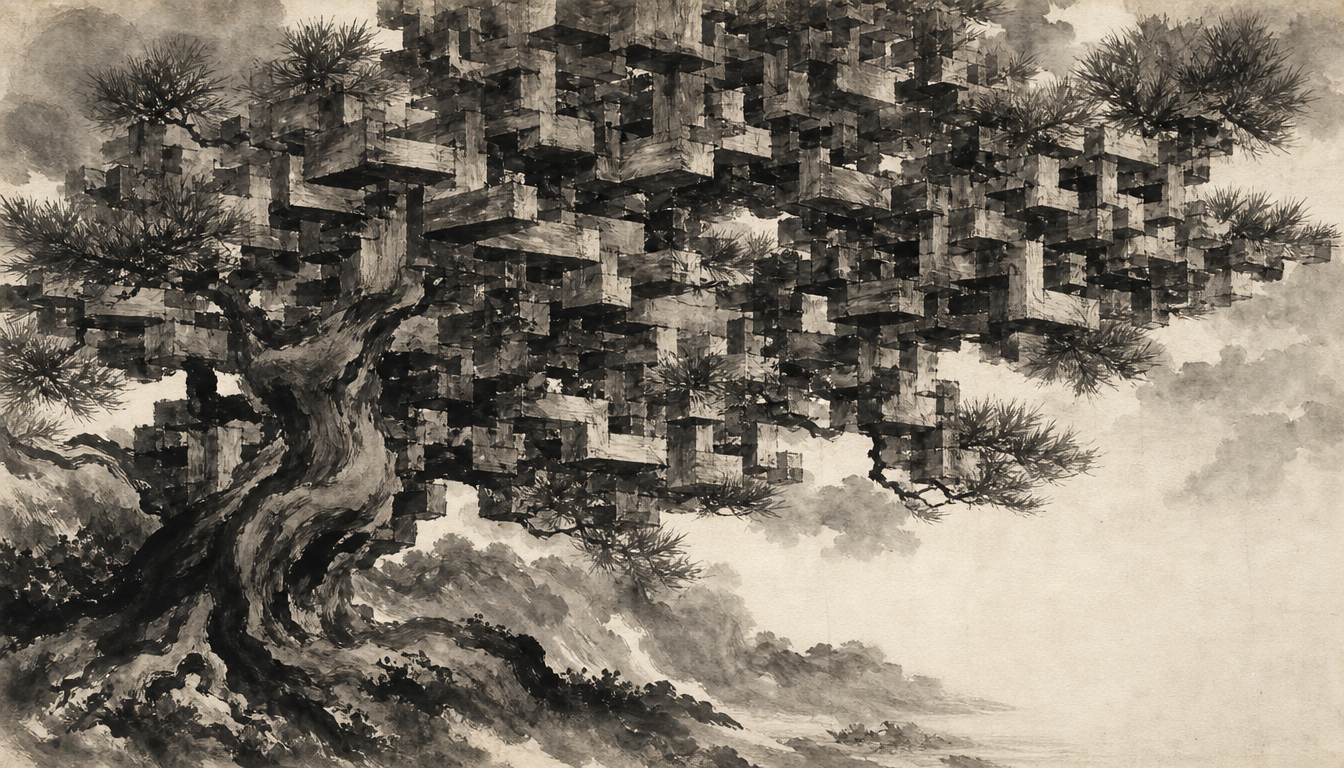
Japanese is not written with an alphabet. It uses three scripts side by side in the same sentence, each doing a different job. Hiragana carries grammar and native words. Katakana handles foreign borrowings and emphasis. Kanji carries meaning in compact, visual blocks.
The visual difference is the fastest way in. Hiragana looks curly and flowing. Katakana looks angular and sharp. Kanji looks dense and architectural, built from strokes stacked into squares.
| Feature | Hiragana | Katakana | Kanji |
|---|---|---|---|
| Type | Syllabary | Syllabary | Logographic characters |
| Look | Rounded, cursive | Angular, sharp | Blocky, complex |
| Main use | Grammar, native words, verb endings | Loanwords, foreign names, emphasis | Nouns and core meaning of words |
| Basic character count | 46 | 46 (one no longer in use) | Thousands |
| Origin | Simplified from Chinese characters | Simplified from Chinese characters | Adapted from Chinese characters |
The diagram below shows how the three japanese writing systems overlap and where each one stands apart.
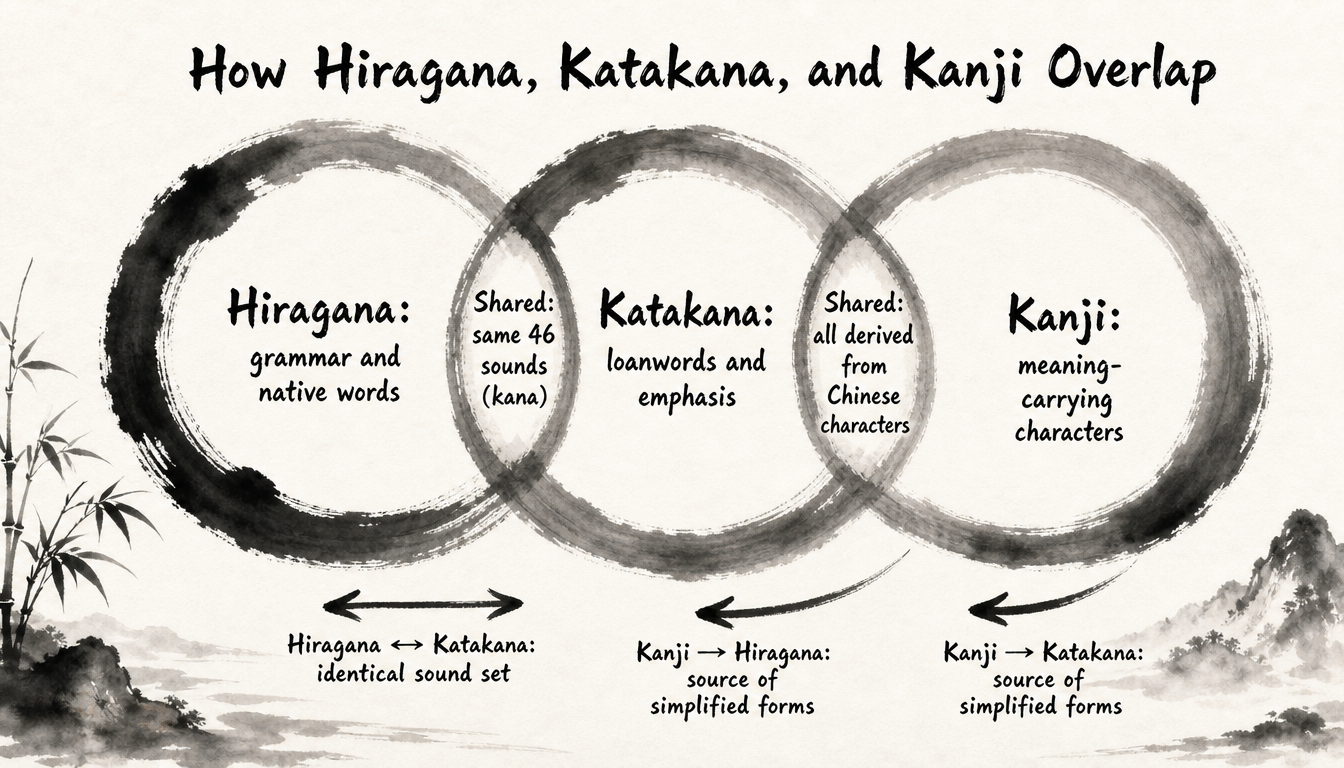
Hiragana and katakana are collectively called kana. Both represent the same set of sounds, per Migaku, which is why learners often study them as a pair.
Hiragana and Katakana: The Sound Scripts
How a syllabary differs from an alphabet
In English, letters map to individual sounds, and you combine them. In a syllabary, one character equals one full syllable. The hiragana character か is not "k" plus "a" waiting to be assembled. It is ka, complete. Busuu notes that both kana sets contain 46 characters covering the same sounds, with one katakana character no longer in active use.
Why two scripts for the same sounds
Usage separates them. Hiragana handles particles, verb conjugations, and words of native Japanese origin. Katakana marks words that arrived from outside Japan, along with onomatopoeia, scientific names, and text meant to stand out visually.
This matters for anyone designing something personal. A non-Japanese name written in Japanese almost always uses katakana, not kanji. Katakana signals "this came from elsewhere." Kanji signals "this carries meaning." Confusing the two produces designs that read as awkward to Japanese eyes.
How long they take to learn
Kana are genuinely learnable in a short stretch of focused study. Each character maps to exactly one pronunciation, which removes the spelling guesswork English speakers are used to. Learning hiragana first also teaches you the full sound inventory of the language.
Kanji: Where Meaning Lives
Characters that carry ideas
Kanji are Chinese characters adapted for Japanese use. Each one represents a word or concept rather than a sound. Since Japanese text contains no spaces, kanji do structural work too: they visually break sentences into units and separate homophones, which are abundant given the limited number of distinct Japanese sounds.
Multiple readings, one character
A single kanji usually has more than one pronunciation. Characters borrowed from Chinese brought an approximation of the Chinese reading with them, while Japanese also assigned native words to the same shapes. Context determines which reading applies. This is why a character pulled from a dictionary without context can be pronounced several different ways, and why "what does this kanji say" rarely has a single clean answer.
Stroke order is not optional
Tae Kim's Guide to Japanese stresses learning correct stroke order from the beginning. Handwritten and brushed characters rarely look like printed type, and stroke order is what keeps a character recognizable when written fluidly. If you plan to have kanji rendered as calligraphy or ink, the stroke logic underneath is what makes the result look correct rather than traced.
How many you need
Reading basic Japanese requires roughly a thousand kanji, according to Busuu. For choosing a single meaningful character, you need zero, but you do need reliable cultural context for the one you pick.
How the Three Scripts Work Together in One Sentence
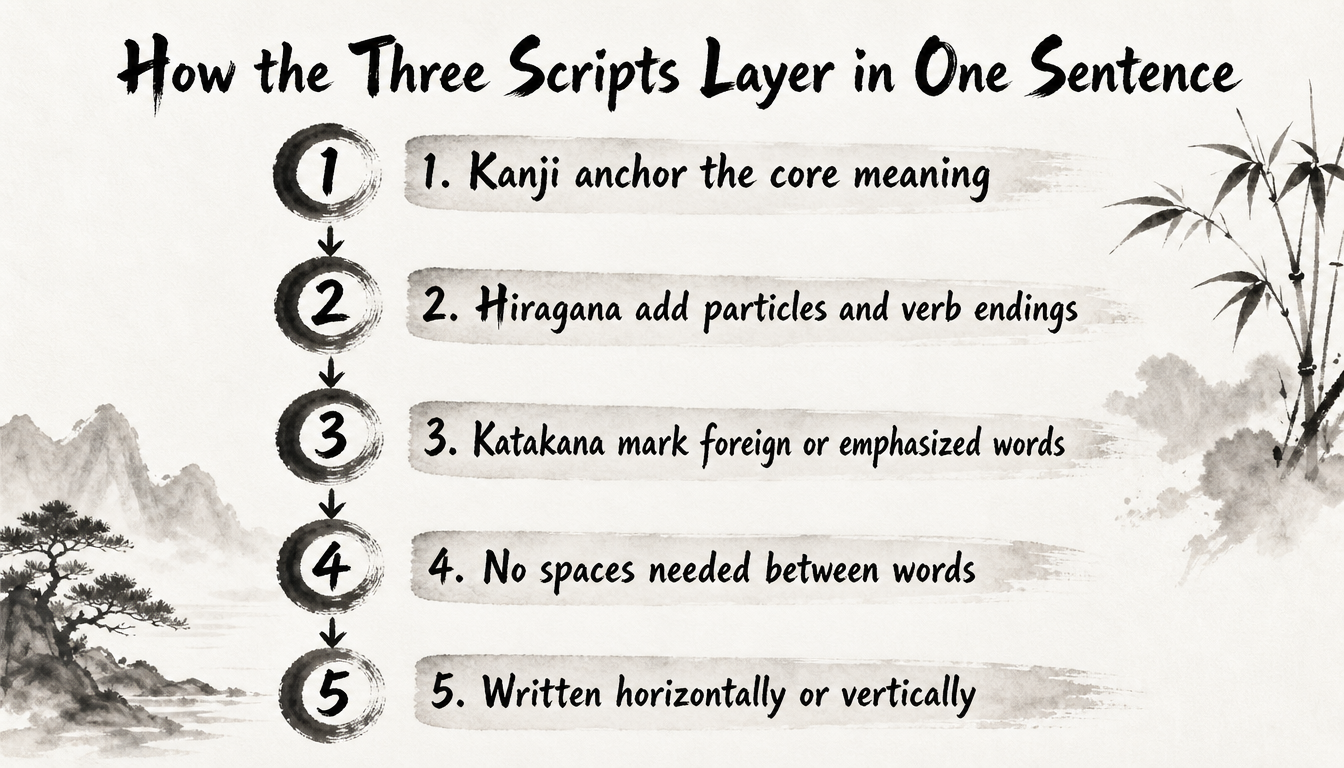
A typical Japanese sentence mixes all three. The kanji carry the content words, hiragana attaches grammar around them, and katakana appears wherever a borrowed word shows up. This mixed style is the standard orthography for modern Japanese, described on Wikipedia as kanji kana majiri bun.
Direction adds another layer. Japanese can be written horizontally, left to right, or vertically in columns read from right to left. Vertical writing, called tategaki, remains common in novels, newspapers, and manga. For art and tattoos, vertical arrangement often looks more traditional, while horizontal reads as modern.
The process below shows how the scripts layer into a single line of text.
The history explains the arrangement. Chinese characters entered Japan and were first used phonetically in a system called man'yōgana, where characters stood for Old Japanese sounds rather than their original meanings. Kana later emerged as simplified forms of those characters, as Wikipedia records. Three scripts coexist today because each solved a problem the others could not.
Choosing a Kanji for Personal Meaning
Where people go wrong
Most mistakes come from treating kanji like a decorative font. A dictionary gloss gives you one English word for a character that may carry several layers of nuance, some of them unflattering. Characters also behave differently alone than they do inside compound words, and a character that looks powerful in isolation can read as blunt, archaic, or slightly comic to a native reader.
What a good choice accounts for
- Pronunciation in context, not just a romanized guess.
- Primary meaning alongside its secondary and emotional shades.
- Compound words the character appears in, which reveal how Japanese speakers actually associate it.
- Aesthetic balance, since stroke density affects how a character sits as art or on skin.
- Cliché avoidance, because a handful of characters are so overused abroad that they carry no personal weight.
A structured alternative to guessing
Oracle Kanji Writer was built around exactly this gap. You enter your name, birthdate, and blood type, and its algorithm recommends a Soul Kanji matched to your inner qualities. The result includes pronunciation, primary and nuanced meanings, a personal message, and selected compound words that show the character in real use. Because Japanese creators curate the selection, the characters read as beautiful and meaningful in Japan rather than as an accidental mistranslation. You can download the kanji as art for a wallpaper, a keepsake, or tattoo planning, with the cultural explanation attached.
Frequently Asked Questions
| Question | Answer |
|---|---|
| Is kanji the same as Chinese? | Kanji are Chinese characters adapted for Japanese. Many shapes overlap, but readings, usage, and some meanings differ. |
| Which script should I learn first? | Hiragana. It teaches every sound in the language and unlocks beginner materials. |
| Is romaji a Japanese writing system? | No. Romaji is the Roman-letter transcription of Japanese, useful for typing and beginners but not one of the three scripts. |
| How is my foreign name written in Japanese? | Usually in katakana, which marks words of foreign origin. |
| Can one kanji be pronounced several ways? | Yes. Most kanji have multiple readings, and context decides which one applies. |
Next Steps
Start with hiragana using a chart and spaced-repetition practice, then move to katakana, which covers the same sounds in a different shape. Once kana feel automatic, kanji stops looking like a wall and starts looking like vocabulary. Practicing on gridded genkō yōshi paper trains proportion, which carries over into any calligraphy you commission or design.
If your interest leans toward symbolism rather than fluency, shift your energy toward depth over breadth. Pick one character, learn its readings, trace its stroke order, and study the compounds it lives in. Understanding the three japanese writing systems is what separates a kanji that means something to you from one that merely looks Japanese, and a guided tool like Oracle Kanji Writer can give that single character the cultural grounding it deserves.
Discover Your Soul Kanji
Experience the depth of Japanese characters: each kanji carries timeless meaning, guiding your life's path.
No credit card required • 2-minute process