Hikari Name Meaning: A Guide to Light, Kanji, and Culture
Hikari (光) is a Japanese name meaning "light" — a word that doubles as an everyday noun and carries deep spiritual, aesthetic, and cultural significance. This guide explores its kanji variations, its evolution into a unisex name, its symbolism in Japanese tradition, and how it compares to related light terms like Akari and Hikaru.
What Does Hikari Mean? A Name Rooted in Light
Hikari (ひかり) is one of the most evocative names in the Japanese language because it doubles as an everyday word. While most names hint at their meanings through poetic kanji combinations, Hikari simply is the word for light. The name derives from the verb hikaru (光る), meaning "to shine," and carries the literal sense of light, illumination, or radiance. According to Jisho.org, the kanji 光 means light, illumination, or happiness in Japanese.
That linguistic transparency gives Hikari a rare emotional clarity. When a Japanese speaker hears the name, they don't need to decode it; they immediately feel the warmth, brightness, and openness it suggests. This is part of why Hikari has become a cherished given name, a popular character name in anime and manga, and even the name of one of Japan's flagship Shinkansen bullet train services on the Tōkaidō line.
For people outside Japan exploring the name, Hikari offers something special: a word that is at once ordinary and luminous, modern and ancient, gentle and powerful. It's a name that fits a newborn, a fictional hero, a wellness brand, or a tattoo as easily as it fits a poem.
Pronunciation and Rhythm
Hikari is pronounced in three even syllables: hi-ka-ri (/çi.kä.ɾi/). The stress is gentle and flat, with no syllable dominating. The soft "hi," the crisp "ka," and the rolling "ri" create a balanced rhythm that feels both delicate and confident — a quality that contributes to its enduring appeal.
Discover Your Soul Kanji
Experience the depth of Japanese characters: each kanji carries timeless meaning, guiding your life's path.
No credit card required • 2-minute process
Kanji Variations and Writing Systems
One of the most fascinating aspects of Japanese names is how a single sound can be written in multiple ways, each carrying its own visual and symbolic weight. Hikari is no exception. Parents, artists, and writers can choose from several scripts and kanji combinations, and each choice subtly shifts the meaning and feel of the name.
The Most Common Forms
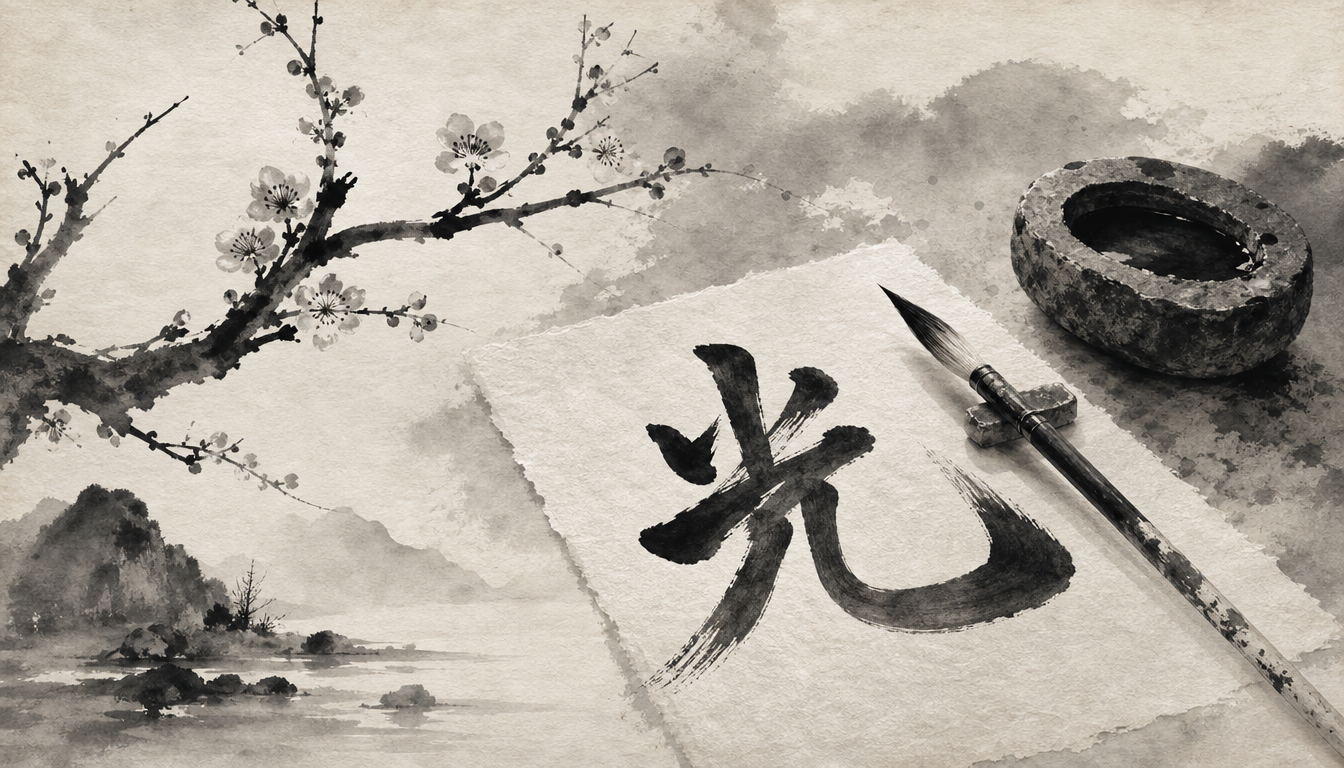
The dominant kanji for Hikari is 光, the everyday word for "light." It's a stroke-efficient, visually balanced character that, according to Kanji alive, has six strokes, belongs to the "human legs" (ひとあし) radical family, and is taught at grade 2 in Japanese schools. Its on'yomi reading is コウ (kō) and its kun'yomi readings include ひか and ひかり.
Beyond 光, the name can also be written purely in hiragana (ひかり) or katakana (ヒカリ). Each script carries a distinct aesthetic:
WritingScriptFeel and Nuance光KanjiClassic, grounded, directly evokes "light"ひかりHiraganaSoft, gentle, decorative — popular for girlsヒカリKatakanaModern, stylized, often used in pop culture and branding輝Kanji (rare for Hikari)Radiance, brilliance — more often read as Hikaru
Compound and Creative Kanji Choices
Some parents combine multiple kanji to spell Hikari, layering meanings such as "sun" (日), "flower" (花), "summer" (夏), or "hope" (希) with characters that suggest brightness or beauty. These creative spellings are part of a broader Japanese naming tradition where the chosen kanji functions almost like a hidden blessing — a private wish encoded into a child's identity.
For someone considering a Hikari tattoo or a personal kanji keepsake, the choice between 光 and a creative spelling matters. The single character 光 is what a Japanese speaker will most naturally read as "hikari," while more elaborate combinations can risk being misread or misunderstood. This is exactly the kind of nuance where culturally informed guidance — like the curation offered by Oracle Kanji Writer — helps non-native admirers avoid awkward or unintentional choices.
Unisex Usage and Gender Evolution
Hikari was historically read as a feminine-leaning name, especially when written in soft hiragana. But over the past few decades, it has become one of Japan's well-recognized unisex names, embraced by parents who want a name that transcends traditional gender expectations.
The shift mirrors broader trends in Japanese naming culture, where parents increasingly favor names with universal, nature-based, or virtue-based meanings over names with explicitly gendered endings. "Light," after all, belongs to everyone.
Hikari for Girls
When given to girls, Hikari is most often written as 光 or in flowing hiragana (ひかり). The hiragana form, in particular, has surged in popularity for daughters in recent decades because of its gentle, almost lyrical appearance on the page. Famous bearers include actress Hikari Mitsushima, who according to Wikipedia was born on 30 November 1985 in Kagoshima, Japan, and actress Hikari Ishida, born in 1972.
Hikari for Boys
For boys, Hikari is rarer than its close cousin Hikaru (ひかる), but it is gaining ground. The kanji 光 reads naturally as either name, and modern parents sometimes choose Hikari specifically because of its softer, more melodic ending. The closely related unisex name Hikaru shares the same meaning — "light" or "radiance" — and the two names are often considered siblings within the same family of light-themed names.
Hikari Outside Japan
Internationally, Hikari remains uncommon but is steadily appearing more often. According to data·yze, in 2021 there were only 19 baby girls named Hikari in the United States, making it a distinctively rare choice. For globally minded parents or adults adopting a personal Japanese name for creative or spiritual reasons, that rarity is part of the appeal — Hikari is recognizable enough to be understood, yet uncommon enough to feel personal.
Cultural Significance and Symbolism
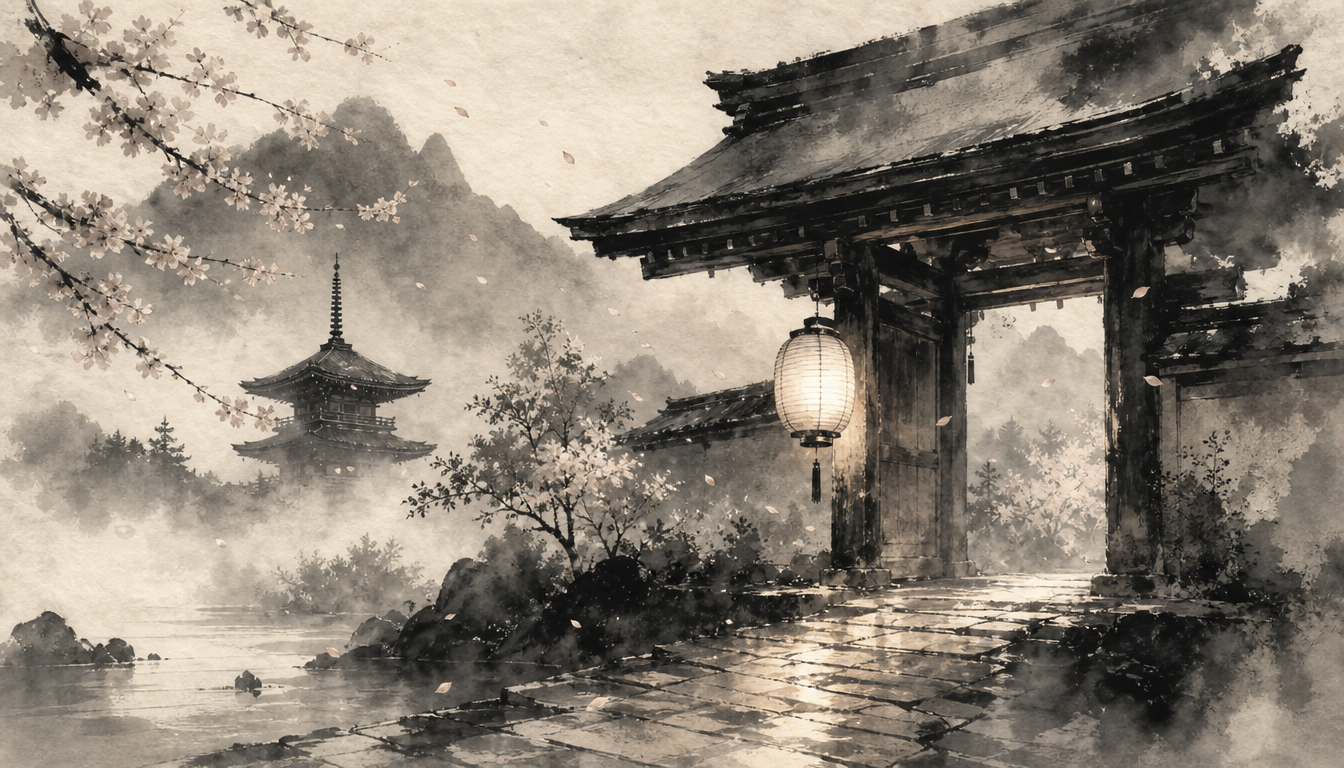
To understand why Hikari resonates so deeply, you have to look at how the Japanese imagination treats light. Light in Japanese culture is rarely just an optical phenomenon. It's a metaphor for hope, clarity, spiritual awakening, beauty in transience, and the quiet brilliance of an ordinary moment.
Light as a Spiritual and Philosophical Symbol
In Shinto and Buddhist traditions, light is closely tied to the divine. The sun goddess Amaterasu, ancestral deity of the Japanese imperial line, embodies sunlight as life-giving and sovereign. Buddhist iconography uses radiant halos and golden light to signify enlightenment, with Amida Buddha often depicted emanating boundless light. In this context, Hikari isn't merely "bright" — it gestures toward awakening, compassion, and grace.
For people drawn to mindfulness and Eastern philosophy, naming a child Hikari — or claiming the character 光 as a personal symbol — connects them to a long lineage of meaning. It says: may you see clearly, may you bring warmth, may you illuminate what is hidden.
Light in Japanese Aesthetics
Japanese aesthetic traditions like wabi-sabi and komorebi (the dappled light filtering through leaves) treat light as a relational, fleeting presence. A shaft of afternoon sun across a tatami floor, the gleam on a tea bowl, the silver edge of a cloud — these are the moments Japanese poetry and design cherish. Hikari as a name borrows that sensibility. It doesn't suggest blinding brilliance; it suggests grace, awareness, and the soft glow that reveals beauty.
Hikari in Popular Culture
The name's cultural footprint is enormous. Hikari appears as a beloved character name across anime, manga, video games, and music. The 1985 sports romance manga Hikari no Densetsu (光の伝説, "Legend of Light") helped cement the name's association with grace and aspiration. More recently, Mondo Grosso's music video for "Labyrinth" featuring Hikari Mitsushima garnered over 42 million views on YouTube as of December 2025, according to Wikipedia — a testament to how the name continues to carry contemporary cultural weight.
Even Japan's transportation infrastructure honors the word: the JR Tōkaidō Shinkansen's Hikari service has carried the name since the line's earliest days, evoking the speed and brightness of a streak of light cutting across the country.
Related Light Terms in Japanese: Akari vs Hikari vs Hikaru
Japanese has a remarkably rich vocabulary for light, with each word carrying its own emotional temperature. If you're choosing a light-themed name or kanji, understanding the differences helps you pick the one that truly fits.
Hikari (光) vs Akari (明かり)
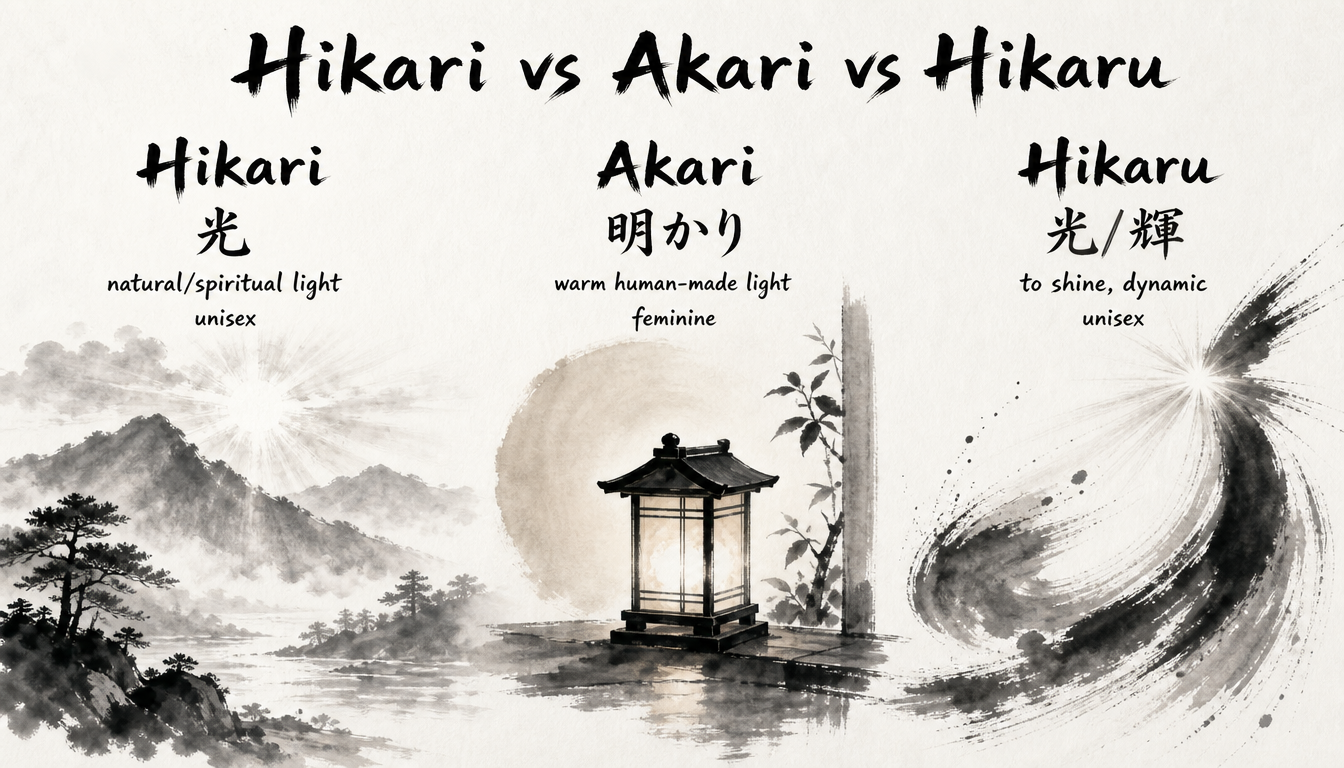
Hikari refers most often to natural, spiritual, or symbolic light — sunlight, starlight, the light of hope. Akari (明かり), by contrast, typically describes warm, human-made illumination — a lantern, a lamp, the soft glow of a room at dusk. Both are beautiful, but they evoke different scenes. Hikari is the sun on a mountainside; Akari is the candle by the window.
As a girl's name, Akari has become extremely fashionable in recent years, often written 明里, 灯, or 朱里. It feels intimate and homely. Hikari feels more expansive and elemental.
Hikari vs Hikaru
Hikari (ひかり) is the noun "light." Hikaru (ひかる) is the verb "to shine." As names, both use the same primary kanji (光) and both are unisex, but they differ in feel:
AspectHikari (ひかり)Hikaru (ひかる)Grammatical originNoun: "light"Verb: "to shine"Common kanji光光, 輝Gender leanSlightly feminine, strongly unisexHistorically masculine, now unisexFeelSoft, lyrical, contemplativeActive, dynamic, energetic
Other Light-Related Japanese Words
- Hi (日) — sun or day; the most elemental light word.
- Kō (光) — the on'yomi reading of 光, used in compounds like 光線 (kōsen, "light ray"), 日光 (nikkō, "sunlight"), and 栄光 (eikō, "glory").
- Kagayaki (輝き) — radiance, brilliance, sparkle.
- Tomoshibi (灯) — a small flame or guiding light, often metaphorical.
Each of these words could appear as part of a kanji name or compound, and each conveys a different shade of luminosity. This is one of the great pleasures of working with Japanese: light isn't one word but a whole palette.
Choosing Hikari as Your Personal Kanji or Tattoo
For many people discovering Japanese culture from abroad, the appeal of a name like Hikari goes beyond naming a child. It becomes a personal symbol — a wallpaper, a journal cover, a meaningful tattoo, or a quiet anchor during meditation. If you're drawn to 光, here are a few things worth knowing before you commit.
What 光 Really Communicates in Japan
To a Japanese reader, 光 is immediately legible and emotionally clean. It doesn't feel mystical or exotic; it feels universal, almost elemental. That clarity is precisely its strength as a tattoo or art piece. Unlike kanji combinations that can read as forced or grammatically odd, 光 stands alone gracefully. It's a single brushstroke composition that calligraphers love because of its balanced, six-stroke architecture.
Common Compounds That Deepen the Meaning
If you want to expand the concept of light beyond a single character, these compounds offer rich, culturally grounded options:
- 日光 (nikkō) — sunlight; also the name of a famous shrine town.
- 月光 (gekkō) — moonlight.
- 栄光 (eikō) — glory.
- 光景 (kōkei) — a scene or spectacle.
- 光年 (kōnen) — light year.
These compounds, listed on Kanji alive, show how 光 anchors a whole vocabulary of brightness, scope, and wonder.
Avoiding Cliché and Mistranslation
The biggest risk for non-Japanese speakers choosing a kanji is selecting characters based on dictionary translations alone. A character can be technically correct yet feel awkward, dated, or even comical to a native eye. This is where guided, culturally informed tools become valuable. Oracle Kanji Writer, for example, offers a personalized "Soul Kanji" diagnosis that takes your name, birthdate, and blood type and recommends a character aligned with your inner qualities. Each result includes the pronunciation, primary and nuanced meanings, a motivational personal message, and curated compound words — all reviewed by Japanese creators who understand what reads as beautiful versus what reads as off.
If Hikari resonates with you but you're not sure whether 光 is genuinely your character, that kind of curated discovery process can save you from a tattoo or art piece that doesn't quite land — and may surface a kanji you'd never have found on your own.
Notable People Named Hikari
Part of what gives a name its texture is the people who have carried it. Hikari has been worn by writers, athletes, actors, and artists across modern Japan, each adding to its public meaning.
- Hikari Agata (1943–1992) — Japanese novelist and translator.
- Hikari Ishida (born 1972) — actress known across film and television.
- Hikari Mitsushima (born 1985) — acclaimed actress and singer; per Wikipedia, she was born in Kagoshima.
- Hikari Mori (born 1992) — model, actress, and television host.
- Hikari Yamada (née Sasaki, born 4 October 1967) — retired judoka who competed in the women's middleweight category, per Grokipedia.
From literary fiction to elite sport to fashion, Hikari has shown itself to be a name that adapts to many kinds of brilliance — quiet, athletic, artistic, glamorous. That versatility is part of its quiet power.
Why Hikari Endures
Names rise and fall on trends, but a few have a staying power that comes from their connection to something essential. Hikari is one of them. It names a thing every human has felt: the relief of morning, the warmth of a lamp, the spark of understanding. It carries the weight of Japanese spiritual tradition without feeling heavy. It's modern without being trendy. It's gendered softly enough that anyone can wear it.
For globally minded readers exploring Japanese culture — whether you're considering the name for a child, designing a meaningful tattoo, or searching for a personal symbol to anchor your inner work — Hikari offers a rare combination: linguistic simplicity, cultural depth, and aesthetic beauty all in a single luminous character.
And if Hikari intrigues you but you want to be sure your chosen kanji truly reflects who you are, consider exploring a guided process like Oracle Kanji Writer's Soul Kanji diagnosis. The right character, chosen with care and cultural insight, doesn't just decorate your life — it illuminates it.
Discover Your Soul Kanji
Experience the depth of Japanese characters: each kanji carries timeless meaning, guiding your life's path.
No credit card required • 2-minute process