Hikari Name Meaning: A Guide to Light, Kanji, and Culture
The Japanese name Hikari means 'light' — but its deeper meaning depends on the kanji you choose. This guide explores the kanji 光, its cultural and spiritual symbolism in Shintō and Buddhism, how Hikari functions as a unisex name, its place in Japanese pop culture, and why understanding kanji meaning is essential — especially for tattoos. A complete cultural primer for anyone drawn to the beauty of Japanese names.
Hikari Name Meaning: A Guide to Light, Kanji, and Culture
The Japanese name Hikari (ひかり) carries one of the most luminous meanings in the entire Japanese naming tradition: light. It's a name that has captured the imagination of people far beyond Japan — appearing in anime, manga, video games, and tattoo studios around the world. But behind those three soft syllables lies a rich tapestry of kanji choices, cultural symbolism, and spiritual nuance that most quick translation tools never reveal.
This guide is written for the culturally curious — for tattoo enthusiasts seeking accuracy, mindfulness seekers drawn to Japanese aesthetics, and anyone considering Hikari as a name for themselves, a child, or a creative project. By the end, you'll understand not just what Hikari means, but why it means what it does, and how the kanji you choose changes everything.
What You'll Learn in This Guide
This is a deep dive intended for readers who want to go beyond the surface-level "Hikari means light" answer. It's suitable for beginners with no prior Japanese knowledge, but contains enough nuance to satisfy intermediate learners and culture enthusiasts.
- The literal and cultural meaning of Hikari (光)
- The most common kanji used to write the name, and how each shifts the meaning
- Hikari as a unisex name, and how usage has evolved
- The symbolism of light in Japanese spirituality, Shintō, and Buddhism
- How Hikari appears in pop culture, history, and modern Japan
- Why kanji meaning matters more than phonetic spelling — especially for tattoos
Estimated reading time: about 12 minutes.
Before We Begin: A Quick Primer on Japanese Names
Japanese names work very differently from names in most Western languages. To appreciate Hikari fully, it helps to understand a few foundational ideas:
- Kanji are meaning-carrying characters. Adopted from Chinese script, each kanji has its own meaning(s) and possible readings.
- One sound can be written many ways. The name "Hikari" can be written in hiragana (ひかり), katakana (ヒカリ), or with one or more kanji — and each choice carries different connotations.
- Names often combine concept-kanji. Parents in Japan frequently mix and match kanji to create a personal blessing — wishing for brightness, kindness, fortune, or strength in their child's life.
- The meaning shifts with the kanji. Two people both named "Hikari" can have entirely different written names with subtly different meanings.
Keep this in mind as we move forward. The name Hikari isn't just a sound — it's a canvas.
The Core Meaning of Hikari: Light, Radiance, and More
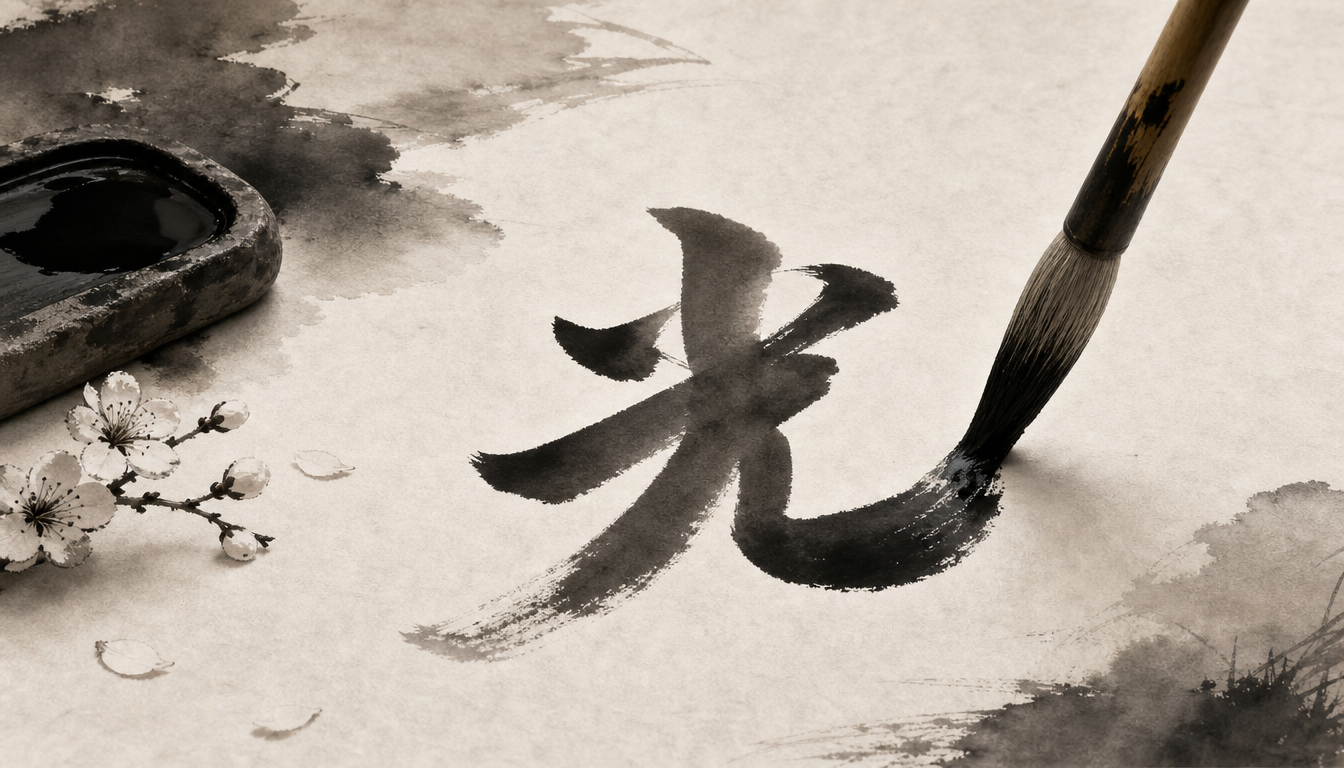
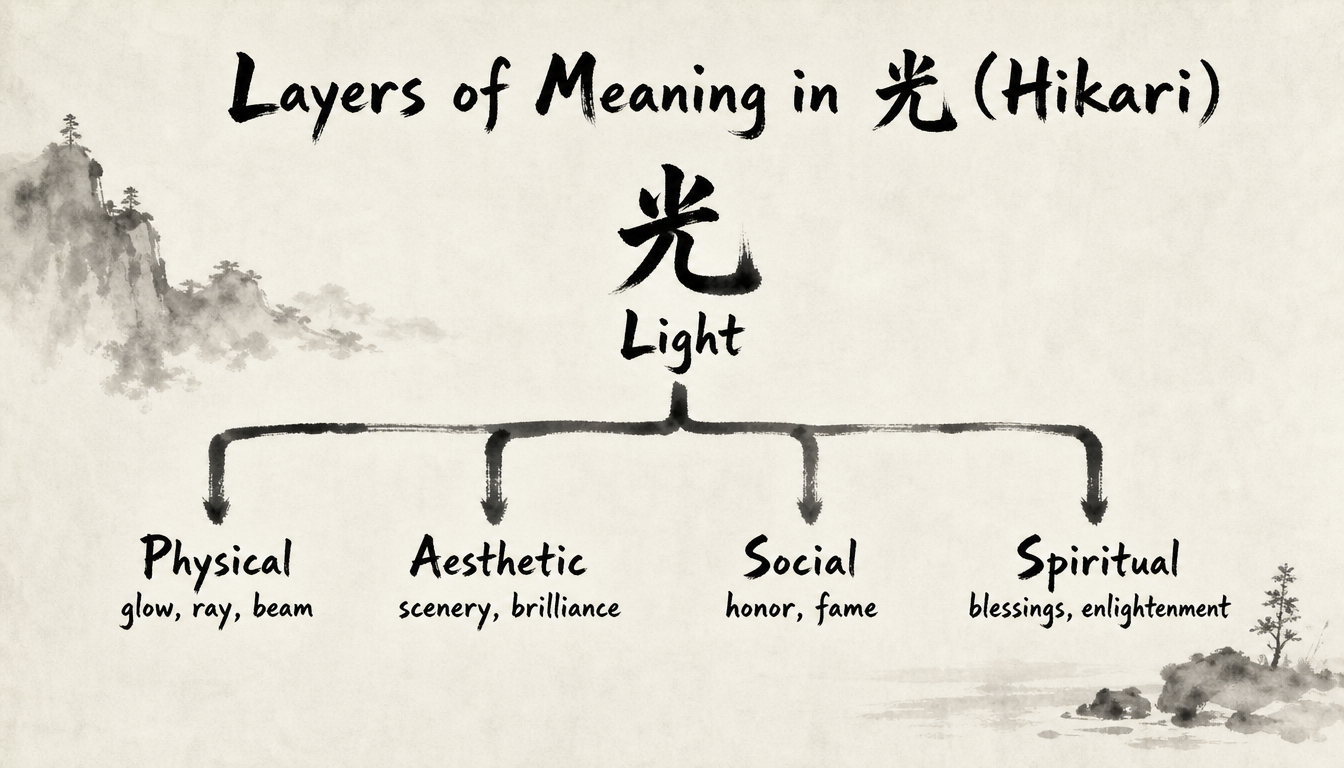
At its heart, Hikari comes from the Japanese noun 光 (hikari), meaning light, ray, beam, or glow. The noun is derived from the verb 光る (hikaru), meaning "to shine." Unlike many Japanese names, Hikari is unusual in that it doubles as an everyday word — the same word you would use to describe sunlight streaming through a window or the gleam of a polished stone.
Beyond "Light": The Layered Meanings of 光
The single kanji 光 carries far more than just physical brightness. In traditional Japanese usage, it can also evoke:
- Glow and glitter — the visible shimmer of light on a surface
- Honor and fame — to be seen, to be celebrated, to shine in society
- Brilliance — both intellectual and visual
- Scenery — as in 風光 (fūkō), "natural beauty"
- Blessings — divine or auspicious favor
- Honorific resonance — words used to praise the actions of others, such as 光栄 (kōei, "honor")
This is why naming a child Hikari isn't just "I hope you'll be bright." It's closer to: May you shine — outwardly, inwardly, and in the eyes of those around you.
Hikari as a Concept in Japanese Culture
Light in Japan is more than a visual phenomenon. In Shintō, the sun goddess Amaterasu Ōmikami is the primary deity of the Japanese pantheon — light itself is sacred. In Buddhism, light symbolizes enlightenment, wisdom, and the dispelling of ignorance. The name Hikari carries echoes of these traditions, even when used in entirely secular settings.
The Kanji of Hikari: Choices and Their Meanings
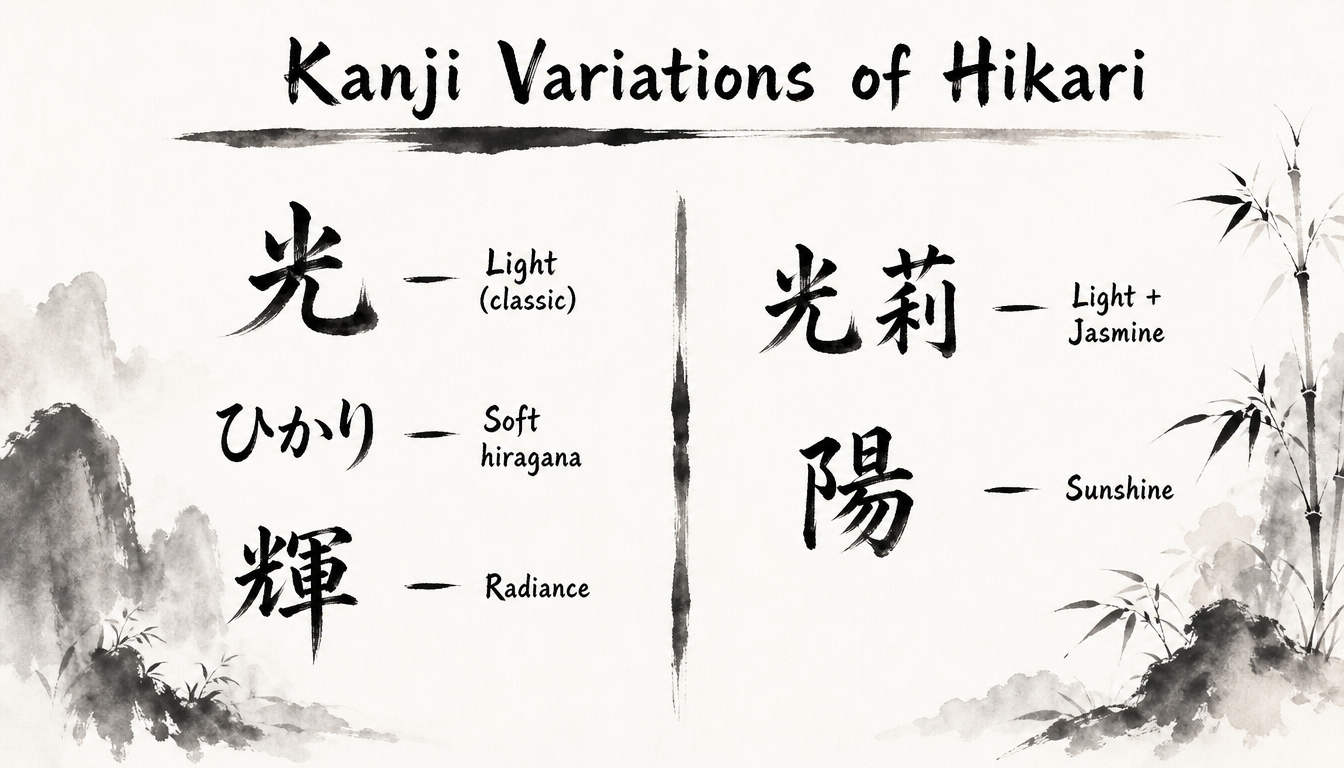
While 光 is by far the most common kanji for Hikari, it isn't the only option. Japanese parents often choose alternative kanji combinations to layer in additional wishes for their child. Here are the most popular and meaningful variations:
| Writing | Reading | Meaning & Nuance |
|---|---|---|
| 光 | Hikari | The standard. Light, glow, brilliance, honor. Simple and powerful. |
| ひかり | Hikari | All hiragana. Soft, gentle, decorative — popular for modern girls' names. |
| ヒカリ | Hikari | Katakana. Modern, stylish, often used in pop culture and branding. |
| 光莉 | Hikari | Light + jasmine flower. Adds femininity and floral grace. |
| 光凛 | Hikari | Light + dignified. Suggests a graceful, composed brilliance. |
| 輝 | Hikari | Radiance, brilliance. A more intense, dazzling brightness. |
| 陽 | Hikari | Sun, sunshine, the yang principle. Warm and life-giving. |
Three-Kanji Combinations
Some parents go further, splitting the name into three syllables — hi-ka-ri — and choosing a kanji for each. This allows for incredibly personalized meanings. For example:
- 陽 (hi) sun + 花 (ka) flower + 里 (ri) village → "a sunlit village of flowers"
- 妃 (hi) princess + 香 (ka) fragrance + 梨 (ri) pear → poetic, regal, sensory
These multi-kanji constructions show how Japanese names function almost like miniature poems — a sequence of images that together form a blessing.
Hiragana ひかり: The Modern Soft Choice
In recent decades, writing Hikari purely in hiragana (ひかり) has become especially popular for girls. The flowing, rounded strokes feel gentle, modern, and unpretentious. Hiragana also removes any single locked-in meaning, allowing the name to feel open and luminous in a more abstract way. This is why many contemporary Japanese celebrities — actresses, idols, voice actresses — write their name as ひかり.
Is Hikari a Boy's Name or a Girl's Name?
Hikari is officially unisex, though usage has shifted over time. Historically, it leaned more feminine, particularly when written in hiragana. Today, it's well-recognized as a name for boys as well, especially when written with the bold single kanji 光 or 輝.
Hikari vs. Hikaru
You may have noticed a closely related name: Hikaru (ひかる). The two names share the same root verb (光る, "to shine") but differ in form:
- Hikari is a noun — "light" itself
- Hikaru is the verb form — "to shine" or "shining"
Hikaru is also unisex and is sometimes considered more traditionally masculine in tone, though both names are flexible. Famous bearers of Hikaru include the musician Hikaru Utada and the chess prodigy Hikaru Nakamura. Famous bearers of Hikari include actresses Hikari Mitsushima and Hikari Ishida.
Hikari in Japanese Culture and Pop Culture
Few names have crossed cultural borders as smoothly as Hikari. Its softness, clarity, and beautiful meaning make it instantly appealing — even to those unfamiliar with Japanese.
The Hikari Shinkansen
One of Japan's iconic high-speed train services on the Tōkaidō Line is called the Hikari. Naming a flagship bullet train after "light" reflects how culturally resonant the word is — speed, brilliance, and forward motion all bundled into a single concept.
Manga, Anime, and Games
Hikari appears as a beloved character name across countless titles. From the 1980s shōjo manga Hikari no Densetsu ("Legend of Light") to characters in modern anime and video games, the name signals purity, hope, or a character who brings illumination to others. For many global fans, Hikari was their first introduction to Japanese names through media.
Spiritual and Wellness Contexts
In mindfulness, meditation, and wellness circles outside Japan, Hikari has become a symbolic word — appearing in studio names, retreat brands, and personal mantras. The association with inner light, clarity, and enlightenment makes it a natural fit for those drawn to Eastern-influenced spiritual practice.
Why Kanji Meaning Matters — Especially for Tattoos
If you're considering Hikari as a tattoo, name choice for a child, or personal symbol, here's the most important section of this guide.
The Mistranslation Problem
Most free "name in Japanese" tools convert your name based on sound, not meaning. They produce ateji — phonetic substitutions using kanji that happen to match the syllables. The result often looks beautiful but means something absurd or nonsensical. Imagine a tattoo that you proudly believe says "light" but actually reads like "comparison-add-village" because the tool just grabbed phonetically convenient kanji.
This is the source of countless tattoo regret stories. The fix is simple: choose kanji for what they mean, not just how they sound.
Choosing Hikari Authentically
If Hikari resonates with you, the single kanji 光 is the cleanest, most authentic choice. It's:
- Universally understood in Japan as "light"
- Visually balanced — six strokes, elegant in calligraphy
- Culturally weighty, carrying spiritual and honorific layers
- Minimalist — aligned with the leading 2026 tattoo trend toward single-character designs
For something more ornamental, 輝 (radiance) is a stunning alternative, though it has more strokes and is visually denser.
Discovering Your Own Soul Kanji
What if your name isn't Hikari, but the concept of light, brilliance, or shining resonates deeply with who you are? This is exactly where tools like the Oracle Kanji Writer — Personalized Soul Kanji Diagnosis Tool step in. Rather than converting your name phonetically, it uses your name, birthdate, and blood type to identify a single kanji that reflects your spiritual essence — your Soul Kanji. You receive calligraphy art, layered meanings, related compound words, and a personal fortune message, all curated by Japanese creators to bridge authentic culture with personal meaning. It's a way to find a character that's truly yours, rather than one borrowed from a name that may or may not fit your inner world.
The Symbolism of Light in Japanese Spirituality
To fully appreciate why Hikari is such a beloved name, it helps to understand how light is woven into Japanese spiritual life.
Shintō and the Sun
The supreme deity of Shintō is Amaterasu Ōmikami, the goddess of the sun. The imperial family of Japan is mythologically descended from her. The rising sun on the Japanese flag isn't just a national symbol — it's a reference to this divine light. Naming a child with kanji meaning light is, in a quiet way, invoking this sacred lineage.
Buddhism and Enlightenment
In Japanese Buddhism — particularly Pure Land traditions — light represents satori (awakening) and the boundless compassion of the Amida Buddha, whose name itself means "infinite light." To shine, in this tradition, is to awaken; to bring light to others is the highest spiritual act.
Wabi-Sabi and the Quiet Light
The Japanese aesthetic of wabi-sabi cherishes the soft, transient quality of light — moonlight on a paper screen, candlelight in a tea room, the gentle glow of dusk. Hikari evokes not just brightness but this quality of light: subtle, fleeting, beautiful precisely because it doesn't last.
Frequently Asked Questions
Is Hikari a popular name in Japan today?
Yes. Hikari has remained a steadily popular name, especially for girls, for decades. The hiragana writing (ひかり) and the single-kanji writing (光) are both common. It's familiar enough to be recognized instantly but unique enough not to feel overused.
Can a non-Japanese person use the name Hikari?
Absolutely. Many parents around the world choose Hikari for its beauty and meaning. As long as the name is used with respect and genuine appreciation for its cultural roots, it's widely considered a positive choice. The same applies to using 光 as a personal symbol or tattoo — authenticity and understanding matter more than ancestry.
What's the difference between writing Hikari in hiragana vs. kanji?
Hiragana (ひかり) is softer, more decorative, and leaves the meaning open. Kanji (光) is more concrete and locks in the specific meaning of "light." Katakana (ヒカリ) feels modern and stylized. Each carries a different mood.
Is 光 a good kanji for a tattoo?
Yes — it's one of the safest, most meaningful single-kanji choices. It's universally understood in Japan, carries deep cultural weight, and works beautifully in calligraphy. Just be sure the calligrapher or designer renders it correctly. Mirrored, broken, or stylistically wrong kanji is a common tattoo pitfall.
What kanji should I choose if I want "light" but not the name Hikari?
Several beautiful options exist depending on the nuance you want: 光 (everyday light), 輝 (radiance, dazzle), 陽 (sunshine, yang), 晃 (bright, dazzling), 燈 (lamplight). Each has a distinct visual and emotional flavor.
Next Steps: Going Deeper
If this guide has sparked something — a curiosity, a connection, a sense that a single kanji might capture something about who you are — here are a few ways to take it further:
- Explore single-kanji concepts beyond Hikari. Try learning the meanings of 愛 (love), 夢 (dream), 希望 (hope), or 無限 (infinity). Each opens a doorway into Japanese thought.
- Study basic Japanese calligraphy. Even tracing the strokes of 光 by hand connects you to centuries of brush tradition and deepens your appreciation for the character.
- Try a Soul Kanji diagnosis. The Oracle Kanji Writer can reveal a kanji uniquely matched to your personality and spirit — going beyond names to offer a character that captures something essential about you, complete with calligraphy art and cultural commentary curated by Japanese creators.
- Visit Japanese cultural sites if you can. Shrines like Ise Jingū (dedicated to Amaterasu) or quiet Buddhist temples bring the concept of sacred light vividly to life.
- Read traditional Japanese poetry. Haiku and waka are full of light imagery — moonlight, dawn light, fireflies — that resonate with the meaning of Hikari.
Whether you're choosing a name, a tattoo, or simply a personal symbol to carry through life, the lesson of Hikari is the same: meaning matters more than appearance. A single character, chosen with care and understanding, can illuminate a lifetime.
Discover Your Soul Kanji
Experience the depth of Japanese characters: each kanji carries timeless meaning, guiding your life's path.
No credit card required • 2-minute process